No Fluff Advisory · Research · Holding companies Plain language

Research paper · October 2026

The Evolution of Holding Companies

Control, client value and three paths for marketing work

By Evgeny Popov · No Fluff Advisory · Research edition, 7 October 2026 update · research cutoff 5 October 2026 · published 6 October 2026, updated 7 October 2026

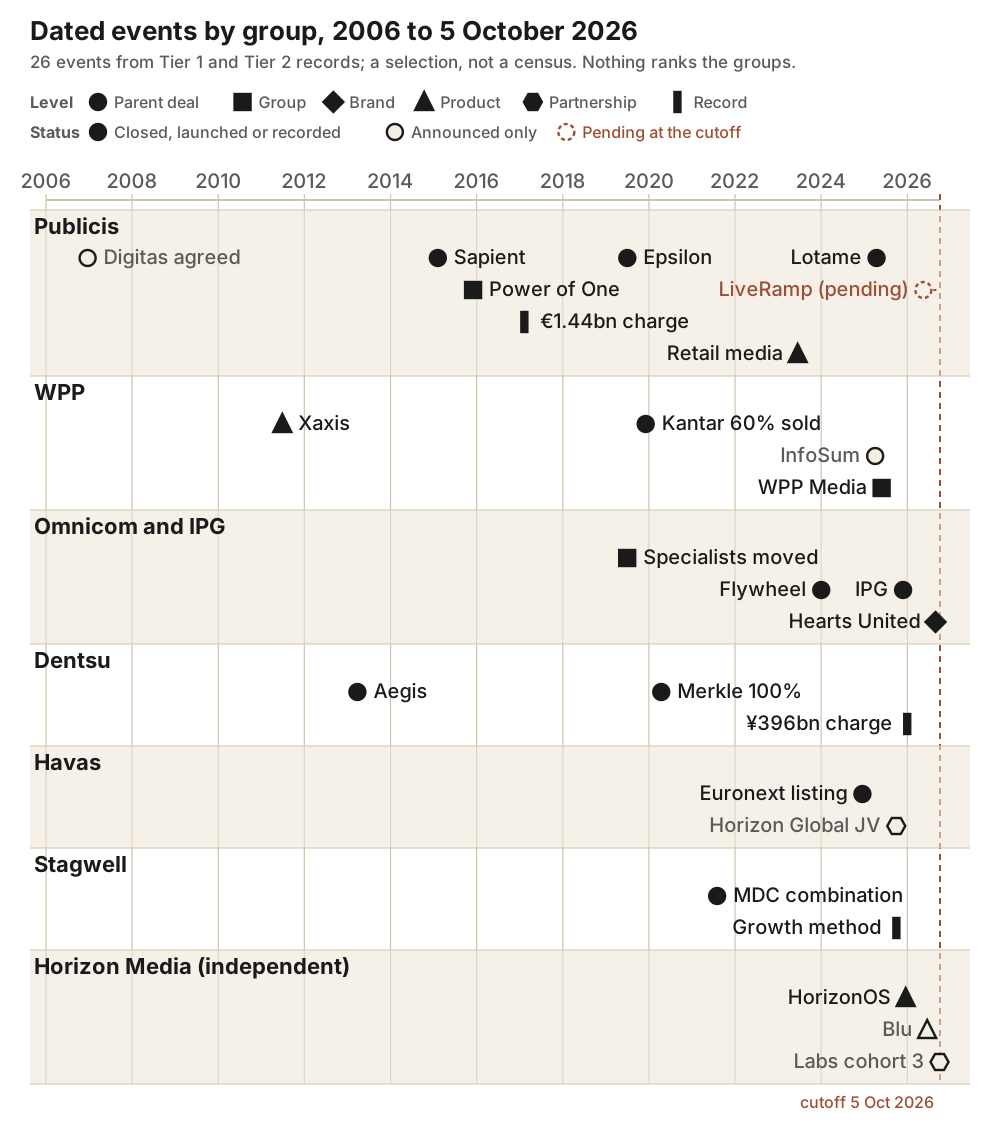
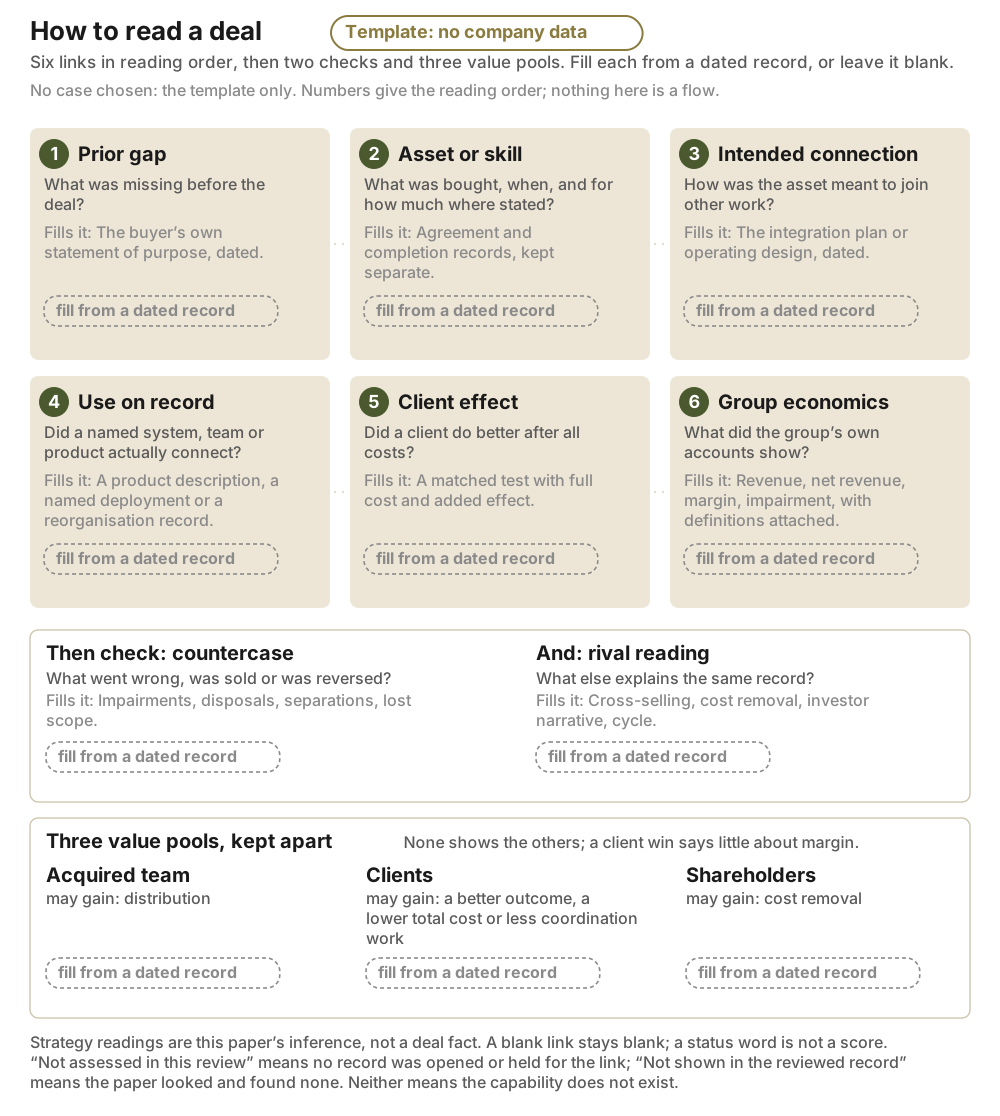
  1. The groups have bought the parts of the loop between a brand's goal and its next decision. The dated record runs from the Digitas agreement of December 2006 to the IPG closing of November 2025. The audited record holds no matched client result for any of these deals.
  2. Buying scale has not gone away. In the only comparable pair of readings held here, the ANA reported principal-media use at 58% of 114 client-side members in 2026, up from 47% in its prior wave. That is a member incidence, not a share of spend.
  3. The record carries real countercases: a €1.44 billion Publicis charge in 2016 citing integration delays, a ¥396.1 billion Dentsu goodwill impairment for 2025, a staged WPP sale of Kantar control, and a digital-first challenger whose 2025 net revenue fell 10.8%.
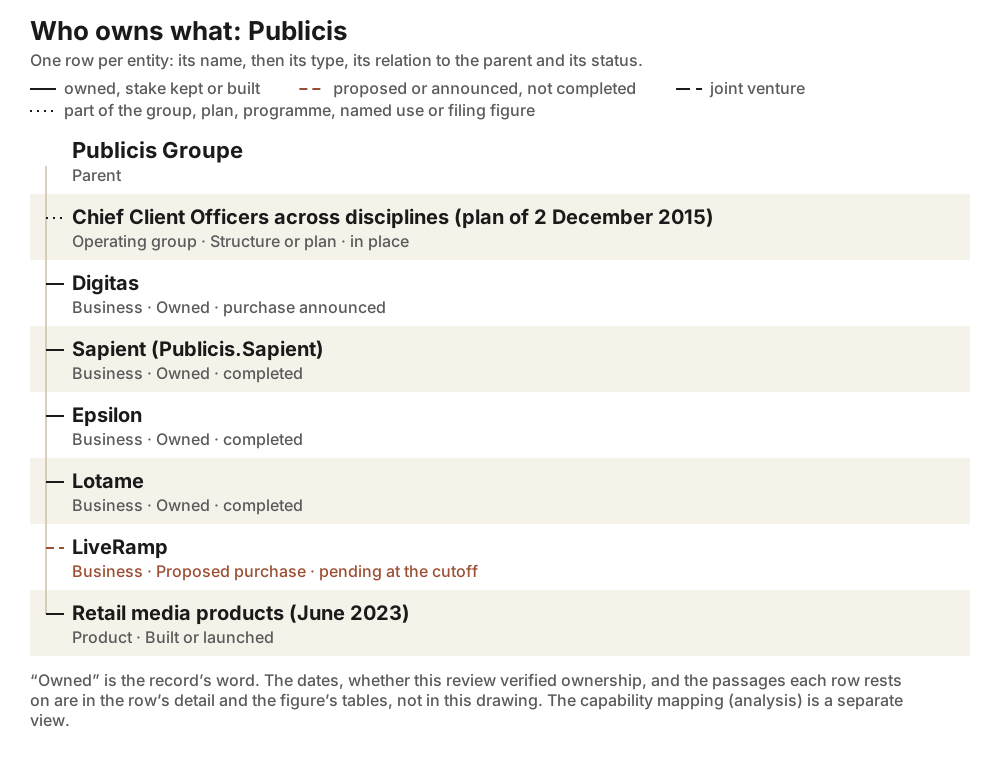
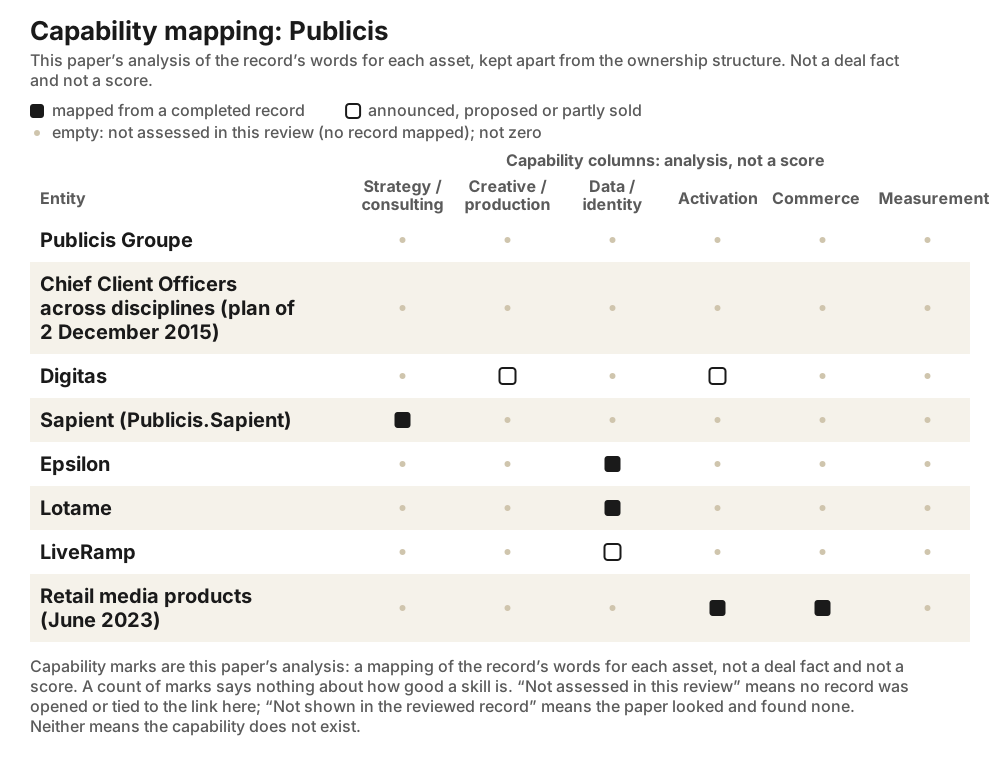
  4. The last large link is still pending. Publicis announced its LiveRamp agreement on 17 May 2026. The latest dated issuer status, a 16 September 2026 bond release, still said approvals were pending. No completion was found by the 5 October 2026 cutoff. This paper never calls the asset owned.
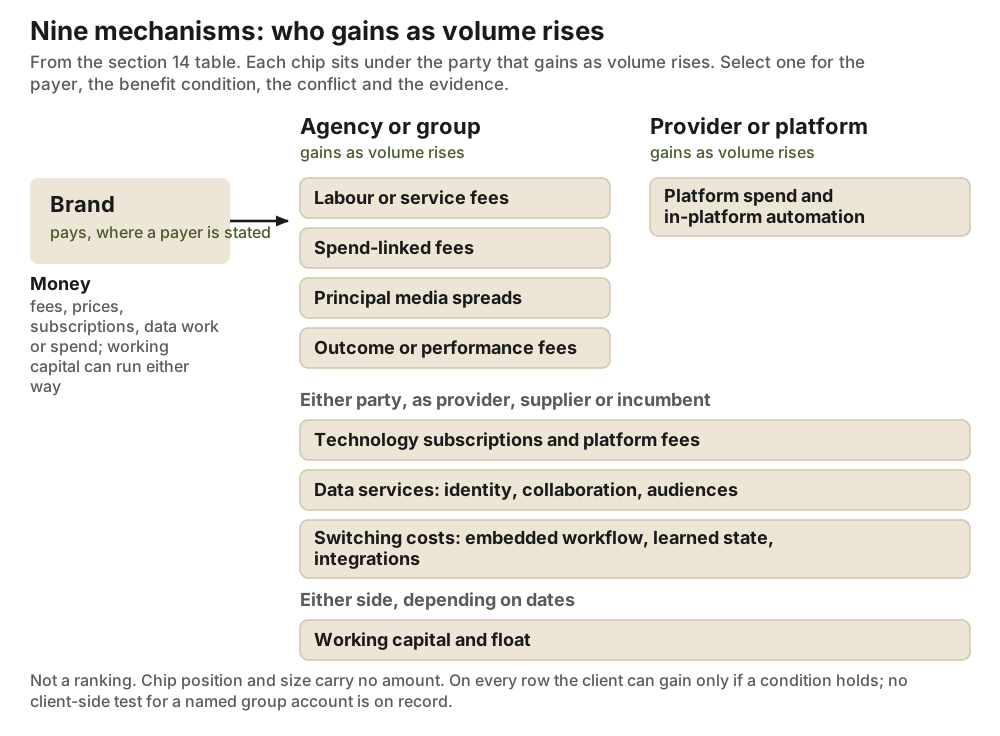
  5. Value captured and value created are different quantities. Spreads, subscriptions, data services and switching costs may let a seller's revenue grow faster than its delivery labour; in this review's register they are also the mechanisms with no client-side test on record. The layers the groups are adding can improve client outcomes, reinforce principal-media economics or raise switching costs. Their value depends on the task, after full cost.
210atomic claims in the public ledger: 160 active, 10 withdrawn, 40 editorial; 148 supported as stated
51sources in the public register, each with a stored audit passage: 49 passages inspected in the prior audit, 2 repositories pinned by commit, 49 rechecked by search only, none re-opened in this edition
104numerical and comparability checks
255rows in the corrections ledger
21figures, each with a text equivalent and an editable SVG

Current status ·

The findings and sources are unchanged since the update of 6 October 2026. Since then the 20 figures were rebuilt and checked twice against the live page, a 21st figure in section 20 sets the present-day loop beside a possible future, and the retailer example in section 26 now pauses new spending after a failed evidence gate. No source was re-opened; the research cutoff is still 5 October 2026. Every dated change is listed in the update history after the method section. Update history (6 dated notes)

Abstract

What this paper covers

Over twenty years the large marketing groups bought the parts of the loop between a brand's goal and its next decision: digital skill, enterprise systems, identity and customer data and commerce operations. The original edition's records, not re-opened here, add creators, production and AI tools. This edition reads that record through dated deal, impairment and results documents. The groups are adding data, software and coordination to buying scale and specialist services. Those layers can improve client outcomes, reinforce principal-media economics or raise switching costs, and the record proves the bid, not the client's gain. Their value depends on the task: whether they improve creative quality, decisions, delivery or incremental results after the full cost of the arrangement. Buying scale persists beside the new tools. Brands keep accountability for goals and evidence while choosing the degree of operational control and portability they can justify. What a brand keeps is decided by the rights it can test, stop and take away: set the goal, act, stop the spend, challenge the proof, keep the learning. Part I gives the audited record for six groups and the alternatives. Parts II and III set the tests and three conditional paths.

How to read this

31 sections. The Skim control collapses the paper to its summaries, figures and instruments. Press / to search the text, the claim ledger and the sources. Every paragraph carries its classification (fact, attributed, inference, assumption, scenario, analysis or illustrative) and every figure its status (observed, illustrative or conditional).

Section 1

The argument after review

The groups bought the parts of the loop. The record proves the bid, not the client's gain.

In short

What a brand keeps turns on the rights it can test, stop and take away. It does not turn on who owns the most tools. The layers the groups add can improve outcomes, reinforce principal economics or raise switching costs; their value depends on the task after full cost.

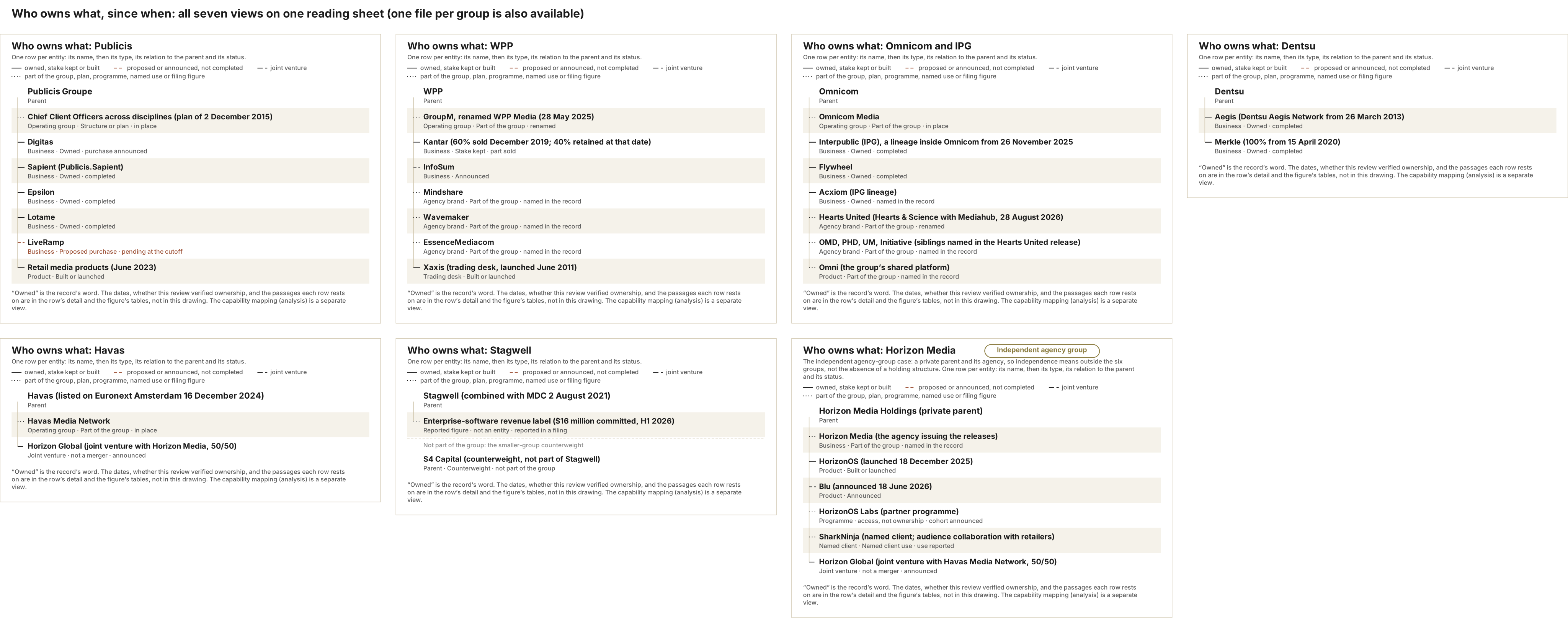
A holding company is a parent firm that owns or controls several marketing businesses. This paper calls it a group. For twenty years the large groups have bought new kinds of work. They bought digital skill, enterprise systems, identity and customer data and commerce operations; the original edition's records, not re-opened here, add creators, production and AI tools. The deal records are real and dated. Publicis agreed to buy Digitas in December 2006. It closed Sapient in February 2015 and Epsilon in July 2019 [1][2][3]. Omnicom closed Flywheel on 2 January 2024 and IPG on 26 November 2025 [4][5]. Stagwell and MDC combined on 2 August 2021 [6].[1][2][3][4][5][6]fact A008 A009 A025 A036

Figure 1 illustrative

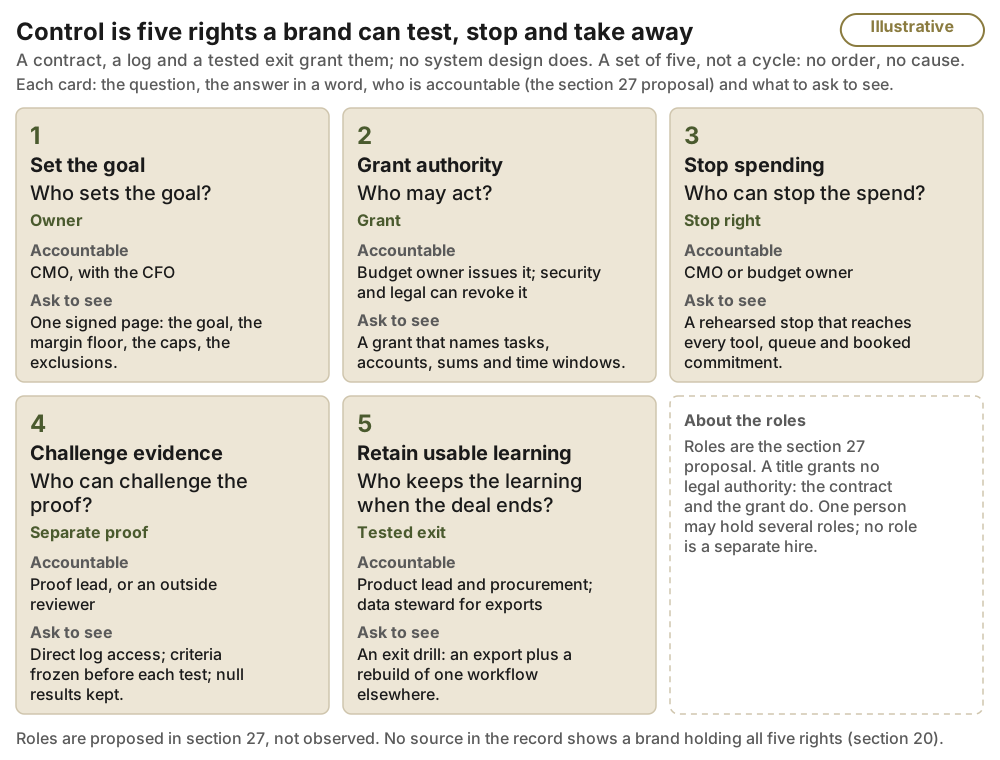
Five control questions

Control is five rights a brand can test, stop and take away. A contract, a log and a tested exit grant them. No system design does.

Five control questions: five rights a brand can test, stop and take away, drawn as a set of cards (three, then two), not a cycleFive rights drawn as five cards in two rows (three, then two, with a note on the roles in the sixth place), a set with no arrows between them: the paper lists them in one sentence and draws no order or cause. Each card shows the question, the answer in a word, the accountable role (a proposal from section 27) and the evidence to request. 1 Set the goal. Who sets the goal? Owner. Accountable: the CMO, with the CFO. Ask to see one signed page with the goal, the margin floor, the caps and the exclusions. 2 Grant authority. Who may act? Grant. Accountable: the budget owner issues the grant; security and legal can revoke it. Ask to see a grant that names tasks, accounts, sums and time windows, and nothing else. 3 Stop spending. Who can stop the spend? Stop right. Accountable: the CMO or the budget owner; the proof lead on a data-use breach. Ask to see a rehearsed stop that reaches every connected tool, queue and booked commitment. Its detail names the technical revocation authority (security and legal can revoke any grant; the brand can revoke authority and every active agent stops or falls back safely) and the contractual cancellation limits (a cap is not a liability ceiling, because booked commitments and a failed stop can exceed it; spend stops within the agreed window and partial actions are listed for repair). 4 Challenge evidence. Who can challenge the proof? Separate proof. Accountable: the proof lead, or an outside reviewer with access and freedom to disagree. Ask to see direct log access, success criteria frozen before each test, null results kept, and attribution and causal estimates as separate documents. 5 Retain usable learning. Who keeps the learning when the deal ends? Tested exit. Accountable: the product lead and procurement run the exit drill; the data steward owns export formats. Ask to see an exit drill: an export plus a rebuild of one workflow elsewhere, with lost state, cost, downtime and licences documented. Selecting a card reveals its contract clause, a log example, its failure mode and the chapters to read; the table below holds the same. Roles are the section 27 proposal: a title grants no legal authority, the contract and the grant do; one person may hold several roles and no role is a separate hire. No source in the record shows a brand holding all five rights. Illustrative framework, not an observation of any product.Control is five rights a brand can test, stop and take awayIllustrativeA contract, a log and a tested exit grant them; no system design does. A set of five, not a cycle: no order, no cause.Each card: the question, the answer in a word, who is accountable (the section 27 proposal) and what to ask to see.1SelectedSet the goalWho sets the goal?OwnerAccountableCMO, with the CFOAsk to seeOne signed page: the goal, themargin floor, the caps, theexclusions.2SelectedGrant authorityWho may act?GrantAccountableBudget owner issues it; securityand legal can revoke itAsk to seeA grant that names tasks,accounts, sums and time windows.3SelectedStop spendingWho can stop the spend?Stop rightAccountableCMO or budget ownerAsk to seeA rehearsed stop that reachesevery tool, queue and bookedcommitment.4SelectedChallenge evidenceWho can challenge theproof?Separate proofAccountableProof lead, or an outsidereviewerAsk to seeDirect log access; criteriafrozen before each test; nullresults kept.5SelectedRetain usable learningWho keeps the learningwhen the deal ends?Tested exitAccountableProduct lead and procurement;data steward for exportsAsk to seeAn exit drill: an export plus arebuild of one workflowelsewhere.About the rolesRoles are the section 27proposal. A title grants nolegal authority: the contractand the grant do. One personmay hold several roles; no roleis a separate hire.Roles are proposed in section 27, not observed. No source in the record shows a brand holding all five rights (section 20).

Five rights, a set: no order and no cause between them. Open a right for its clause, log example, failure mode and chapters.

1 Set the goal Who sets the goal? Owner

Accountable (a proposed role, section 27)

CMO, with the CFO

Roles are the section 27 proposal. A title grants no legal authority: the contract and the grant do. One person may hold several roles; no role is a separate hire.

Evidence to request

One signed page with the goal, the margin floor, the caps and the exclusions.

Contract clause

Reserved to the brand: goal, margin floor, caps, exclusions, consent rules, measurement mandate, final supplier approval, stop right.

Log example

The mandate text, with the reason for each limit, kept by the brand.

Failure mode

No single decision can be named with a measurable goal. A wrong goal scales the wrong action.

Read more

section 24, Choose by task: make, buy or partner; section 25, A commercial design; section 26, One retailer, three agents

Basis: question: s01/P1-0005; accountable role: s27/P2-0211, s26/P2-0198; role short: s27/P2-0211, s26/P2-0198; evidence to request: s28/P2-0220; evidence short: s28/P2-0220; clause: s25/P2-0177; log example: s21/P2-0056; failure mode: s28/P2-0220, s24/P2-0167.

2 Grant authority Who may act? Grant

Accountable (a proposed role, section 27)

The budget owner issues the grant; security and legal can revoke it

Roles are the section 27 proposal. A title grants no legal authority: the contract and the grant do. One person may hold several roles; no role is a separate hire.

Evidence to request

A grant that names tasks, accounts, sums and time windows, and nothing else.

Contract clause

Delegated within a recorded grant: planning, creative production, platform setup, bounded optimisation, reporting.

Log example

Each action record holds the approver, human or grant id, and the time.

Failure mode

A request outside the grant is not refused. An action is found with no grant behind it.

Read more

section 16, What “agentic” can mean: the authority ladder; section 17, Protocols: a promise needs a working test; section 27, The retained team

Basis: question: s01/P1-0005; accountable role: s27/P2-0211, s27/P2-0212; role short: s27/P2-0211, s27/P2-0212; evidence to request: s17/P2-0021; evidence short: s17/P2-0021; clause: s25/P2-0177; log example: s26/P2-0205; failure mode: s17/P2-0021, s22/P2-0112.

3 Stop spending Who can stop the spend? Stop right

Accountable (a proposed role, section 27)

CMO or budget owner; the proof lead on a data-use breach

Roles are the section 27 proposal. A title grants no legal authority: the contract and the grant do. One person may hold several roles; no role is a separate hire.

Technical revocation authority

Technical revocation: security and legal can revoke any grant (the retained-team table); the brand can revoke authority, and every active agent stops or falls back safely; the stop must reach every connected tool, queue and booked commitment, each confirming the withdrawal.

Contractual cancellation limits

Contractual limits: a cap is not a liability ceiling, because booked commitments and a failed stop can exceed it; spend stops within the agreed window and partial actions are listed for repair; a cancellation does not reverse a booking already made, so the deal names who repairs and who pays.

Evidence to request

A rehearsed stop that reaches every connected tool, queue and booked commitment.

Contract clause

The stop right is reserved to the brand. A cap is not a liability ceiling: booked commitments and a failed stop can exceed it.

Log example

Partial actions listed for repair after the stop, with the named repairer.

Failure mode

The stop misses a tool or a booked commitment. A retry duplicates a booking.

Read more

section 17, Protocols: a promise needs a working test; section 26, One retailer, three agents; section 28, The next 90 days

Basis: question: s01/P1-0005; accountable role: s26/P2-0202, s27/P2-0211; role short: s26/P2-0202, s27/P2-0211; evidence to request: s17/P2-0021, s28/P2-0220; evidence short: s17/P2-0021, s28/P2-0220; clause: s25/P2-0177, s25/P2-0183; log example: s17/P2-0021; failure mode: s28/P2-0220; revocation authority: s27/P2-0211, s25/P2-0189, s17/P2-0021; cancellation limits: s25/P2-0183, s17/P2-0021, s16/P4-0003.

4 Challenge evidence Who can challenge the proof? Separate proof

Accountable (a proposed role, section 27)

Proof lead, or an outside reviewer with access and freedom to disagree

Roles are the section 27 proposal. A title grants no legal authority: the contract and the grant do. One person may hold several roles; no role is a separate hire.

Evidence to request

Direct log access. Success criteria frozen before each test. Null results kept. Attribution and causal estimates as separate documents.

Contract clause

The proof function may test media the agency sells and may publish adverse results to the brand’s leadership.

Log example

A log that shows an action taken on a provisional signal keeps that fact, so later proof can reverse the plan.

Failure mode

Criteria changed after results. Logs read only through the operator’s dashboard.

Read more

section 17, Protocols: a promise needs a working test; section 19, The CMO must manage two time horizons; section 25, A commercial design; section 27, The retained team

Basis: question: s01/P1-0005; accountable role: s27/P2-0211, s28/P2-0220; role short: s27/P2-0211, s28/P2-0220; evidence to request: s25/P2-0185; evidence short: s25/P2-0185; clause: s25/P2-0185; log example: s26/P2-0205; failure mode: s28/P2-0220, s17/P2-0021.

5 Retain usable learning Who keeps the learning when the deal ends? Tested exit

Accountable (a proposed role, section 27)

Product lead and procurement run the exit drill; the data steward owns export formats

Roles are the section 27 proposal. A title grants no legal authority: the contract and the grant do. One person may hold several roles; no role is a separate hire.

Evidence to request

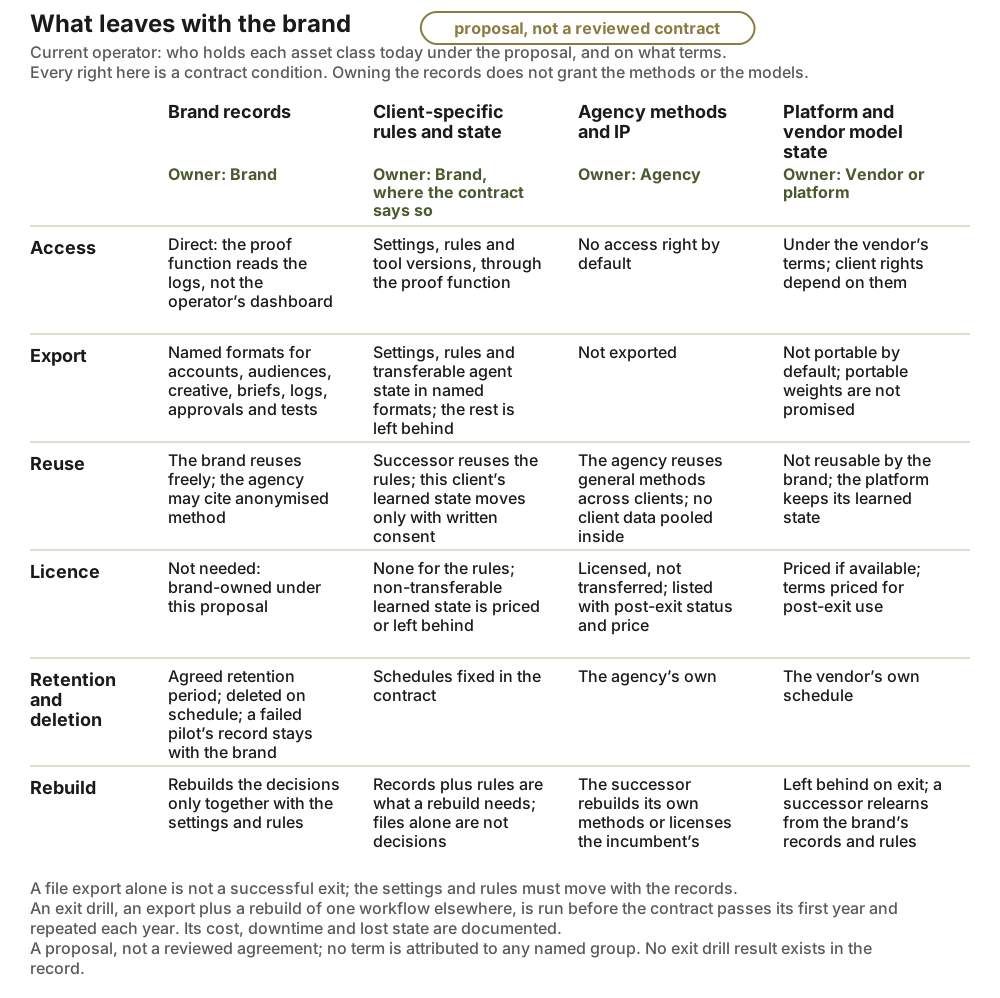
An exit drill: an export plus a rebuild of one workflow elsewhere, with lost state, cost, downtime and licences documented.

Contract clause

Export rights cover accounts, audience definitions, creative source files and usage rights, briefs, decision logs, approval history, test designs and results, settings and rules, and any transferable agent state, each in a named format.

Log example

What the brand keeps on exit: decision history, approval history, test designs and results, exclusion and consent rules, creative source files with rights, account access and the exit drill record.

Failure mode

Usable state cannot be rebuilt on the promised terms. The brand holds files, not decisions.

Read more

section 25, A commercial design; section 27, The retained team; section 28, The next 90 days

Basis: question: s01/P1-0005; accountable role: s27/P2-0211, s28/P2-0220; role short: s27/P2-0211, s28/P2-0220; evidence to request: s25/P2-0187, s28/P2-0220; evidence short: s25/P2-0187, s28/P2-0220; clause: s25/P2-0187; log example: s27/P2-0218; failure mode: s28/P2-0220, s25/P2-0192.

Select a right to see its contract clause, a log example, the failure mode and the chapters to read. The stop right is card 3; the exit test is card 5.

Five control questions illustrative Control has five parts, a set of rights, not a cycle: who sets the goal (owner); who may act (grant); who can stop the spend (stop right); who can challenge the proof (separate proof); who keeps the learning when the deal ends (tested exit). A contract, a log and a tested exit grant them, not a system design. Roles shown are proposed; a title grants no legal authority, and no role is a separate hire. Illustrative. Units: none; a set of rights, not stages or timing. Scope: the paper's own design. Text equivalent: appendix “Figure text equivalents”.
Text equivalent

Five rights drawn as five cards in two rows (three, then two, with a note on the roles in the sixth place), a set with no arrows between them: the paper lists them in one sentence and draws no order or cause. Each card shows the question, the answer in a word, the accountable role (a proposal from section 27) and the evidence to request. 1 Set the goal. Who sets the goal? Owner. Accountable: the CMO, with the CFO. Ask to see one signed page with the goal, the margin floor, the caps and the exclusions. 2 Grant authority. Who may act? Grant. Accountable: the budget owner issues the grant; security and legal can revoke it. Ask to see a grant that names tasks, accounts, sums and time windows, and nothing else. 3 Stop spending. Who can stop the spend? Stop right. Accountable: the CMO or the budget owner; the proof lead on a data-use breach. Ask to see a rehearsed stop that reaches every connected tool, queue and booked commitment. Its detail names the technical revocation authority (security and legal can revoke any grant; the brand can revoke authority and every active agent stops or falls back safely) and the contractual cancellation limits (a cap is not a liability ceiling, because booked commitments and a failed stop can exceed it; spend stops within the agreed window and partial actions are listed for repair). 4 Challenge evidence. Who can challenge the proof? Separate proof. Accountable: the proof lead, or an outside reviewer with access and freedom to disagree. Ask to see direct log access, success criteria frozen before each test, null results kept, and attribution and causal estimates as separate documents. 5 Retain usable learning. Who keeps the learning when the deal ends? Tested exit. Accountable: the product lead and procurement run the exit drill; the data steward owns export formats. Ask to see an exit drill: an export plus a rebuild of one workflow elsewhere, with lost state, cost, downtime and licences documented. Selecting a card reveals its contract clause, a log example, its failure mode and the chapters to read; the table below holds the same. Roles are the section 27 proposal: a title grants no legal authority, the contract and the grant do; one person may hold several roles and no role is a separate hire. No source in the record shows a brand holding all five rights. Illustrative framework, not an observation of any product.

The five rights: question, accountable role, evidence to request, failure mode, chapters
RightQuestionAccountable roleAuthority and limitsEvidence to requestFailure modeChapters
Set the goalWho sets the goal?CMO, with the CFOSee the role; a title grants no legal authority (section 27)One signed page with the goal, the margin floor, the caps and the exclusions.No single decision can be named with a measurable goal. A wrong goal scales the wrong action.s24, s25, s26
Grant authorityWho may act?The budget owner issues the grant; security and legal can revoke itSee the role; a title grants no legal authority (section 27)A grant that names tasks, accounts, sums and time windows, and nothing else.A request outside the grant is not refused. An action is found with no grant behind it.s16, s17, s27
Stop spendingWho can stop the spend?CMO or budget owner; the proof lead on a data-use breachTechnical revocation: security and legal can revoke any grant (the retained-team table); the brand can revoke authority, and every active agent stops or falls back safely; the stop must reach every connected tool, queue and booked commitment, each confirming the withdrawal. Contractual limits: a cap is not a liability ceiling, because booked commitments and a failed stop can exceed it; spend stops within the agreed window and partial actions are listed for repair; a cancellation does not reverse a booking already made, so the deal names who repairs and who pays.A rehearsed stop that reaches every connected tool, queue and booked commitment.The stop misses a tool or a booked commitment. A retry duplicates a booking.s17, s26, s28
Challenge evidenceWho can challenge the proof?Proof lead, or an outside reviewer with access and freedom to disagreeSee the role; a title grants no legal authority (section 27)Direct log access. Success criteria frozen before each test. Null results kept. Attribution and causal estimates as separate documents.Criteria changed after results. Logs read only through the operator’s dashboard.s17, s19, s25, s27
Retain usable learningWho keeps the learning when the deal ends?Product lead and procurement run the exit drill; the data steward owns export formatsSee the role; a title grants no legal authority (section 27)An exit drill: an export plus a rebuild of one workflow elsewhere, with lost state, cost, downtime and licences documented.Usable state cannot be rebuilt on the promised terms. The brand holds files, not decisions.s25, s27, s28
Contract clause and log example per right
RightAnswer in a wordContract clauseLog example
Set the goalOwnerReserved to the brand: goal, margin floor, caps, exclusions, consent rules, measurement mandate, final supplier approval, stop right.The mandate text, with the reason for each limit, kept by the brand.
Grant authorityGrantDelegated within a recorded grant: planning, creative production, platform setup, bounded optimisation, reporting.Each action record holds the approver, human or grant id, and the time.
Stop spendingStop rightThe stop right is reserved to the brand. A cap is not a liability ceiling: booked commitments and a failed stop can exceed it.Partial actions listed for repair after the stop, with the named repairer.
Challenge evidenceSeparate proofThe proof function may test media the agency sells and may publish adverse results to the brand’s leadership.A log that shows an action taken on a provisional signal keeps that fact, so later proof can reverse the plan.
Retain usable learningTested exitExport rights cover accounts, audience definitions, creative source files and usage rights, briefs, decision logs, approval history, test designs and results, settings and rules, and any transferable agent state, each in a named format.What the brand keeps on exit: decision history, approval history, test designs and results, exclusion and consent rules, creative source files with rights, account access and the exit drill record.

Reader question: What are the five rights that decide what a brand keeps, and what grants each one?

Sources and assumptions

Status: illustrative — analysis (illustrative): A framework from section 1. It names rights; it does not observe any product or contract.

Claim ids: none; the figure draws the paper’s own design

Sources: none cited by the figure itself

Assumptions:

  • The five rights are a set. The paper lists them in one sentence and draws no order or cause between them.
  • Every right is a contract condition to prove, not a current entitlement of any brand.

Scope: the paper's own design.

Units: none; a set of rights, not stages or timing.

Open the SVG fileDownload the editable SVGEditable text, viewBox 1000 wide, colours and fonts resolved; the default view with its assumptions

This paper reads those purchases as parts of one loop: the loop that runs from a brand's goal to its next decision. The record proves the bid. It does not prove the client's gain. Filings show assets bought, charges taken and group margins earned. They almost never show a matched client result: profit after fees, internal cost and long-term brand effects. The one client-reported result in this review is a recognition rate, not a sales figure. It comes from a vendor release with no control group [7]. That is the gap this paper keeps open on purpose.[7]inference A028 A029 A048

Buying scale has not gone away. Principal media is media an agency buys on its own account and resells to the client. In March 2026 the ANA reported that 58% of 114 qualified client-side members had used principal media in the past year, up from 47% in its prior wave. Fieldwork ran from October 2025 to January 2026 [8]. That is a member sample, not a share of spend. It is still the only comparable pair of readings this review holds. It points up, not down.[8]attributed A061 A062 A063

The thesis is therefore narrow and testable. The groups are adding data, software and coordination to buying scale and specialist services. Those layers can do three different things: improve client outcomes, reinforce principal-media economics, or raise switching costs. The record proves the bid, not the client's gain. The value of each layer depends on the task: whether it improves creative quality, decisions, delivery or incremental business results after the full cost of the arrangement. Two effects sit behind that. Shared tools can make a group more useful to a client. The same tools can make the group's own media and data products easier to sell. The new way of doing the work can prop up the old way of earning money. Neither effect proves the other. A client must test both. What a brand keeps is decided by the rights it can test, stop and take away. Those rights explain who captures value; on their own they do not explain what creates it. A brand keeps accountability for its goals and its evidence while choosing the degree of operational control and portability it can justify.analysis A001

Control is the useful word. It has five parts. Who sets the goal? Who may act? Who can stop the spend? Who can challenge the proof? Who keeps the learning when the deal ends? No system design grants those rights by name. A contract, a log and a tested exit do. Everything that follows is built around that claim.analysis

Three paths can coexist. A brand may run the core itself. An agency may run it for the brand. A platform may run much of the work inside its own system. The right route can differ by market and by task. No route wins by name. An agency can earn a premium, a closed platform can create value, and a brand can delegate operation without giving up accountability; each is a case to test, not a rule. Part III sets out the three paths as conditions, not forecasts. It names the one decision a CMO can take in each.analysis

One more thing stays in view throughout. Cheaper production does not automate judgment: what to say, what to stop, what is distinct and what the brand should mean. Cheaper versions are not a stronger idea. That judgment is the part of the loop a brand must keep, or knowingly buy with a right to overrule.analysis A047

Section 2

What this edition covers

Cutoff 5 October 2026. History from January 2006. Every count says what it is counted against.

In short

A public-source study of six groups and selected alternatives. No source was re-opened in this edition's own review, and that limit is part of the result. An external review of 6 October 2026 is named where this update relies on one of its checks; those checks are attributed, not adopted.

This is a public-source research edition. It is written for CMOs and senior leaders in media, advertising and technology. The research window runs from 1 January 2006 to 5 October 2026. It covers Publicis, WPP and WPP Media, Omnicom and the IPG lineage, Dentsu, Havas and Stagwell. It also looks at selected smaller firms, independent agencies and media platforms. It is a set of cases that matter. It is not a census of every subsidiary, affiliate or local brand.fact A004 A005

The evidence is strongest for large global groups and for US and European brand buyers. The surveys quoted are member samples: 114 ANA client-side members in 2026, 162 ANA respondents in 2023, 45 companies in the WFA and Observatory study, and 69 multinationals in the WFA 2026 study [8][9][10][11]. None is a market share or a global rate. This paper gives no full legal and financial comparison for China, India, Africa, Latin America or most Middle East markets. Conclusions about rights, proof and exit travel across markets. Prices, fee forms and legal buying roles do not.[8][9][10][11]analysis A063 A065 A068 A069

Coverage, with denominators

The audit behind this edition is dated 5 October 2026. It read named passages in 49 sources. It judged 72 selected atomic claims from the original paper and 20 more about Horizon, 92 in all. It recomputed the 32 inherited calculations; 31 reproduce, and one, a statutory-margin check, cannot be recomputed from the stored records and is not printed. The calculation ledger of this edition holds 104 numerical and comparability checks: those 32 recomputations, 48 numbers checked from the revised edition against their stored inputs, 15 task-model edge cases, 7 peer-growth observations and 2 precision rules. Only the 32 are recomputations in the strict sense. It listed all 362 paragraphs of the original edition. The original register of 232 claim records and 329 financial observations was not all audited again. Those records stay in a marked private archive. The counts the build computes for this page are 210 claim records, 51 source records and 255 correction entries.fact

In this edition's own review no source was re-opened. Network policy blocked every source host. So each of the 49 sources was rechecked only at search level: did its URL, title and date still appear in results dated on or before the cutoff? A search result is a discovery aid, not support. The stored audit passages were carried forward unread, and the source register labels them as such. Two protocol repositories were cloned through git and pinned to a commit. An external critical review dated 6 October 2026 reports that it opened 13 of these sources and reproduced all 47 arithmetic rows. Where this update relies on one of its checks, the text names the review. Those checks are attributed to it; they are not this paper’s own verification, and the re-opening of the 49 sources remains open.fact

The review used three passes: evidence, challenge and editing. One assistant made all three. They were not three separate reviews. There were no client interviews, no private fee audits, no contract reads and no live buying tests.fact

The evidence rule

Facts in this edition rest on one of two tiers. Tier 1 is a claim the audit found supported or partly supported, within its stated limits; the block names the claim id and the source. Tier 2 is a dated statement from one of the 49 register sources, written as what the source said on its date. Anything found only by search, or only in the original edition's archive, is not used as fact here. Where such a record would have mattered, the text says what this review did not show. It names the check that would settle it.fact

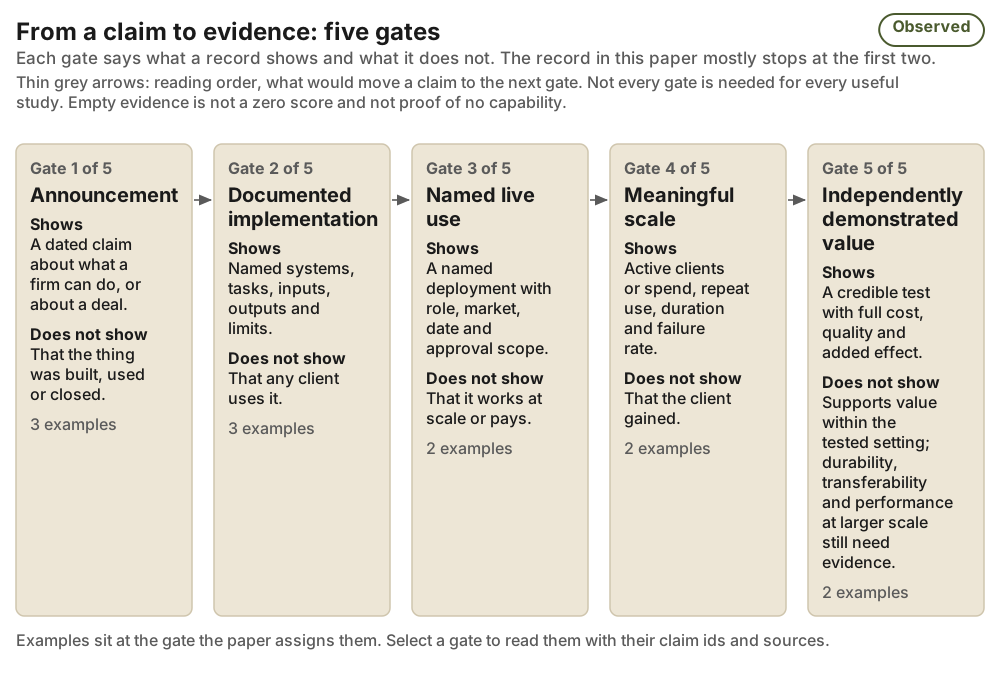
The five evidence gates used throughoutColumn classifications: analysis

GateanalysisWhat it showsanalysisWhat it does not showanalysis
AnnouncementA dated claim about what a firm can do, or about a deal.That the thing was built, used or closed.
Documented implementationNamed systems, tasks, inputs, outputs and limits.That any client uses it.
Named live useA named deployment with role, market, date and approval scope.That it works at scale or pays.
Meaningful scaleActive clients or spend, repeat use, duration and failure rate.That the client gained.
Independently demonstrated valueA credible test with full cost, quality and added effect.Supports value within the tested setting; durability, transferability and performance at larger scale still need evidence.

Figure 2 observed

From a claim to evidence

Five gates separate what a claim shows from what it does not. Most of the record stops at the first two. Empty evidence is not a zero score and not proof of no capability.

View
From a claim to evidence: the five gates, what each shows and does not show; a reading aid, not a universal prerequisite chainDefault view: five cards in one row, joined by thin reading-order arrows. Gate 1, announcement, shows a dated claim about what a firm can do, or about a deal; it does not show that the thing was built, used or closed. Gate 2, documented implementation, shows named systems, tasks, inputs, outputs and limits; not that any client uses it. Gate 3, named live use, shows a named deployment with role, market, date and approval scope; not that it works at scale or pays. Gate 4, meaningful scale, shows active clients or spend, repeat use, duration and failure rate; not that the client gained. Gate 5, independently demonstrated value, shows a credible test with full cost, quality and added effect; it supports value within the tested setting, and durability, transferability and performance at larger scale still need evidence. Selecting a gate lists the paper’s examples at that gate with their claim ids and sources; no example reaches gate four or five for a named group account, a gap in the record, not a score. Not every gate is needed for every useful study; empty evidence is not a zero score and not proof of no capability. Second view, protocol stages: a grid of six items (IAB Tech Lab AAMP 3.0 with OpenProposal; AAMP 2.0; AdCP; platform agent products; Google automated bidding and Amazon automated buying products; Horizon Blu APIs and MCP connections) against the paper’s six stages (proposal, specification, reference implementation, compatibility test, deployment, measured adoption), each cell in a few words with the full section 17 wording in the table, and a column for the record and version verified (two repositories cloned by git and pinned by commit; stored passages for the rest; none opened for the platform agent products). The AdCP row carries one version record: the version analysed is 3.2.1, generally available from 30 September 2026, at commit 6adfebe2; a later patch tag, v3.2.2 of 4 October 2026, inside the cutoff, is recorded beside it with what its changelog entry changes (documentation), and is not substituted for the version analysed. Not established is a gap in inspection, not a zero. Shared transport is not shared meaning, rights or state. Tests run by this review: none.From a claim to evidence: five gatesObservedEach gate says what a record shows and what it does not. The record in this paper mostly stops at the first two.Thin grey arrows: reading order, what would move a claim to the next gate. Not every gate is needed for every usefulstudy. Empty evidence is not a zero score and not proof of no capability.SelectedGate 1 of 5AnnouncementShowsA dated claimabout what afirm can do, orabout a deal.Does not showThat the thingwas built, usedor closed.3 examplesSelectedGate 2 of 5DocumentedimplementationShowsNamed systems,tasks, inputs,outputs andlimits.Does not showThat any clientuses it.3 examplesSelectedGate 3 of 5Named liveuseShowsA nameddeployment withrole, market,date andapproval scope.Does not showThat it works atscale or pays.2 examplesSelectedGate 4 of 5MeaningfulscaleShowsActive clientsor spend, repeatuse, durationand failurerate.Does not showThat the clientgained.2 examplesSelectedGate 5 of 5IndependentlydemonstratedvalueShowsA credible testwith full cost,quality andadded effect.Does not showSupports valuewithin thetested setting;durability,transferabilityand performanceat larger scalestill needevidence.2 examplesExamples sit at the gate the paper assigns them. Select a gate to read them with their claim ids and sources.

Five gates, read in order. Not every gate is needed for every useful study; empty evidence is not a zero score.

1 Announcement A dated claim about what a firm can do, or about a deal.

Shows

A dated claim about what a firm can do, or about a deal.

Does not show

That the thing was built, used or closed.

What would move a claim past this gate

Named systems, tasks, inputs, outputs and limits (the next gate).

Examples in this paper

  • LiveRamp agreement, 17 May 2026; still pending on 16 September 2026 A013 V3-009 [17][18]
  • Horizon Blu announced 18 June 2026 V3-050 [13]
  • InfoSum purchase announced 3 April 2025 [26]

Basis: s02/P1-0016. Empty evidence is not a zero score.

2 Documented implementation Named systems, tasks, inputs, outputs and limits.

Shows

Named systems, tasks, inputs, outputs and limits.

Does not show

That any client uses it.

What would move a claim past this gate

A named deployment with role, market, date and approval scope.

Examples in this paper

  • Publicis retail media products, June 2023: bids triggered by stock and price signals; a seller’s description V3-043 [19]
  • Google documents goal-led bidding across its inventory (Performance Max) V3-089 [15]
  • Amazon’s page dated 21 March 2025; its title and body give different stages, so it cannot date the stage on its own A057 [16]

Basis: s02/P1-0016. Empty evidence is not a zero score.

3 Named live use A named deployment with role, market, date and approval scope.

Shows

A named deployment with role, market, date and approval scope.

Does not show

That it works at scale or pays.

What would move a claim past this gate

Active clients or spend, repeat use, duration and failure rate.

Examples in this paper

  • Acxiom at Guitar Center: recognised visitors 23% to 35%; vendor before-and-after, no control group A028 A029 [7]
  • SharkNinja: audience collaboration with retailers, issuer-reported; not autonomous buying (that reading was withdrawn) H006 H007 [13]

Basis: s02/P1-0016. Empty evidence is not a zero score.

4 Meaningful scale Active clients or spend, repeat use, duration and failure rate.

Shows

Active clients or spend, repeat use, duration and failure rate.

Does not show

That the client gained.

What would move a claim past this gate

A credible test with full cost, quality and added effect.

Examples in this paper

  • None in the record. Participation counts (11 partners; more than 600 submissions; more than 50 participants) measure programme activity, not adoption H008 H009 H010 [14]
  • Principal media use rose to 58% from 47% in the ANA member sample: incidence, not scale of any one system A061 A062 A063 [8]

Basis: s02/P1-0016. Empty evidence is not a zero score.

5 Independently demonstrated value A credible test with full cost, quality and added effect.

Shows

A credible test with full cost, quality and added effect.

Does not show

Supports value within the tested setting; durability, transferability and performance at larger scale still need evidence.

What would move a claim past this gate

Repeated tests across settings and scales; this is the top gate, so nothing above it.

Examples in this paper

  • A 2025 study of 5,172 support agents found a 15% average productivity gain: task-level evidence outside advertising; the gain varied with skill A060 [12]
  • No client-side test has been published for a named group account A048

Basis: s02/P1-0016. Empty evidence is not a zero score.

The paper names six stages (the brief lists five; the paper’s proposal stage is kept). Each stage is a separate fact with its own evidence. A cell says not established where this review found no primary record; that is a gap in inspection, not a claim that the thing does not exist.

IAB Tech Lab AAMP 3.0 with OpenProposal Cloned by git; pinned commit
Proposal
Released 22 September 2026 for public comment to 22 October 2026
Specification
Draft. Repository cloned 5 October 2026 at commit 66ce40a8, tag v3.0-draft-1 present; governance file leaves working-group roles and decision rule blank; schema folder marked as coming
Reference implementation
Not established
Compatibility test
Not established
Deployment
Not established
Measured adoption
Not established

Record verified

IABTechLab/OpenProposal repository, cloned by git on 5 October 2026

Version verified

commit 66ce40a8; tag v3.0-draft-1

This review’s own test

None run; none proposed for a draft

[20][24]

Basis: s17/P2-0015.

IAB Tech Lab AAMP 2.0 Stored passage
Proposal
Published
Specification
The release describes buyer and seller reference SDKs with approval before booking, deal state and logs
Reference implementation
Described by the publisher
Compatibility test
Not established in this review
Deployment
No live client approval log inspected
Measured adoption
Not established

Record verified

Publisher release (stored passage; not re-opened)

Version verified

AAMP 2.0

This review’s own test

None run; a buyer test is proposed

A055 [21]

Basis: s17/P2-0015.

AdCP (Ad Context Protocol) Cloned by git; pinned commit
Proposal
Published
Specification
Schemas, FAQ and governance documents, pinned to commit 6adfebe2 on 5 October 2026
Reference implementation
The pinned release notes state version 3.2.1 as generally available, published 30 September 2026; the FAQ marks campaign governance surfaces as experimental
Compatibility test
Not established by this review; no cross-vendor result was opened
Deployment
Not established in a primary record opened here
Measured adoption
Not established

Record verified

AdCP repository, cloned by git on 5 October 2026

Version verified

commit 6adfebe2; release 3.2.1 (GA 30 September 2026); a later patch tag v3.2.2 (4 October 2026, documentation changes) is recorded beside it, not substituted

Version record

Version analysed: 3.2.1 at commit 6adfebe2 (2026-10-05); generally available from 2026-09-30. Tags: v3.2.1 (c32bd78c, 2026-10-01); v3.2.2 (e3b3aaa9, 2026-10-04). Later patch tag inside the cutoff: 3.2.2 of 2026-10-04: The CHANGELOG.md entry at the pinned commit lists two patch changes, both documentation: how a buyer-declared account reference behaves before provisioning, with one recovery for ACCOUNT_NOT_FOUND; and consistency fixes between the trust and verification docs and the spec (signed responses limited to the brand-claim verification tasks; the relationship_trust values and house_domain field from the schema). No schema or wire-protocol change is named; the wire pin stays 3.2. docs/reference/release-notes.mdx, versions.mdx and whats-new-in-3-2.mdx at the pinned commit carry no 3.2.2 entry; the two changesets are still present under .changeset/ at that commit. Rule: The version analysed stays 3.2.1 at commit 6adfebe2. The 3.2.2 patch tag of 4 October 2026 is inside the 5 October 2026 cutoff and is reported beside it; it is never substituted for the version analysed.

Tag commits and dates as the source register recorded them on 5 October 2026 (ROOT-S005, ROOT-S302). The local pinned clone is a depth-1 clone that holds no tag objects, so the editorial repair of 6 October 2026 could not re-verify them from the tags themselves. Inspected: Editorial repair, 6 October 2026, on the local pinned clone only (no network, nothing re-fetched): git rev-parse HEAD and git log -1 (6adfebe2, 2026-10-05 09:11:57 -0400); git tag (none present; shallow clone); package.json; CHANGELOG.md top entry; .changeset/; docs/reference/release-notes.mdx, versions.mdx and whats-new-in-3-2.mdx. [22][25]

This review’s own test

None run

A056 [22][23][25]

Basis: s17/P2-0015.

Platform agent products (several named platforms) None opened
Proposal
Announced
Specification
Vendor-specific; not either protocol
Reference implementation
Vendor-owned
Compatibility test
Not applicable across vendors
Deployment
Search-level results describe beta, pilot or closed-beta stages; no primary page was opened, so no stage is recorded
Measured adoption
Not established

Record verified

None opened

Version verified

none

This review’s own test

None run

Basis: s17/P2-0015.

Google automated bidding; Amazon automated buying products Vendor pages, stored
Proposal
Published
Specification
Google documents goal-led bidding across its inventory; Amazon’s page dated 21 March 2025 describes its products, with a title and body that now give different stages
Reference implementation
Vendor-owned
Compatibility test
Not applicable
Deployment
Documented by the vendor within its own surfaces
Measured adoption
Not established

Record verified

Vendor pages (stored passages; not re-opened)

Version verified

Google page undated and living; Amazon page dated 21 March 2025

This review’s own test

None run

V3-089 A057 [15][16]

Basis: s17/P2-0015.

Horizon Blu APIs and MCP connections Issuer releases, stored
Proposal
Announced 18 June 2026
Specification
Stated availability
Reference implementation
Not inspected
Compatibility test
Not tested; versions and revocation untested
Deployment
One named audience-collaboration deployment, issuer-reported
Measured adoption
Participation counts are not adoption

Record verified

Issuer releases (stored passages; not re-opened)

Version verified

none stated

This review’s own test

None run

H005 H006 H010 [13][14]

Basis: s17/P2-0015.

Shared transport is not shared meaning, rights or state. A buyer needs three separate proofs: that messages arrive, that both sides mean the same thing by them, and that the rights and state behind them move too. Tests run by this review: None. The thirteen controls and the pair test are proposed for a buyer.

Select a gate to see what it shows, what it does not, what would move a claim past it, and the paper’s examples with their claim ids and sources.

From a claim to evidence observed The five evidence gates (section 2): announcement; documented implementation; named live use; meaningful scale; independently demonstrated value. Each card states what a record shows and what it does not; the arrows are reading order, not a prerequisite chain. A second view places the section 17 items on the paper’s six protocol stages, linked only to the record and version verified. Empty evidence is not a zero score. Observed. Units: none; gates and stages, not scores. Scope: the paper's own evidence rule (section 2) and the section 17 table: documentation-level claims; no source re-opened; no test run.[8][12][13][14][7][15][16][17][18][19][20][21][22][23][24][25][26] A013 A028 A029 A045 A048 A055 A056 A057 A060 A061 A062 A063 H005 H006 H007 H008 H009 H010 V3-009 V3-043 V3-050 V3-089 Text equivalent: appendix “Figure text equivalents”.
Text equivalent

Default view: five cards in one row, joined by thin reading-order arrows. Gate 1, announcement, shows a dated claim about what a firm can do, or about a deal; it does not show that the thing was built, used or closed. Gate 2, documented implementation, shows named systems, tasks, inputs, outputs and limits; not that any client uses it. Gate 3, named live use, shows a named deployment with role, market, date and approval scope; not that it works at scale or pays. Gate 4, meaningful scale, shows active clients or spend, repeat use, duration and failure rate; not that the client gained. Gate 5, independently demonstrated value, shows a credible test with full cost, quality and added effect; it supports value within the tested setting, and durability, transferability and performance at larger scale still need evidence. Selecting a gate lists the paper’s examples at that gate with their claim ids and sources; no example reaches gate four or five for a named group account, a gap in the record, not a score. Not every gate is needed for every useful study; empty evidence is not a zero score and not proof of no capability. Second view, protocol stages: a grid of six items (IAB Tech Lab AAMP 3.0 with OpenProposal; AAMP 2.0; AdCP; platform agent products; Google automated bidding and Amazon automated buying products; Horizon Blu APIs and MCP connections) against the paper’s six stages (proposal, specification, reference implementation, compatibility test, deployment, measured adoption), each cell in a few words with the full section 17 wording in the table, and a column for the record and version verified (two repositories cloned by git and pinned by commit; stored passages for the rest; none opened for the platform agent products). The AdCP row carries one version record: the version analysed is 3.2.1, generally available from 30 September 2026, at commit 6adfebe2; a later patch tag, v3.2.2 of 4 October 2026, inside the cutoff, is recorded beside it with what its changelog entry changes (documentation), and is not substituted for the version analysed. Not established is a gap in inspection, not a zero. Shared transport is not shared meaning, rights or state. Tests run by this review: none.

The five evidence gates: what each shows, does not show, what would move a claim, examples
GateWhat it showsWhat it does not showWhat would move the claimExamples in this paper
AnnouncementA dated claim about what a firm can do, or about a deal.That the thing was built, used or closed.Named systems, tasks, inputs, outputs and limits (the next gate).LiveRamp agreement, 17 May 2026; still pending on 16 September 2026; Horizon Blu announced 18 June 2026; InfoSum purchase announced 3 April 2025
Documented implementationNamed systems, tasks, inputs, outputs and limits.That any client uses it.A named deployment with role, market, date and approval scope.Publicis retail media products, June 2023: bids triggered by stock and price signals; a seller’s description; Google documents goal-led bidding across its inventory (Performance Max); Amazon’s page dated 21 March 2025; its title and body give different stages, so it cannot date the stage on its own
Named live useA named deployment with role, market, date and approval scope.That it works at scale or pays.Active clients or spend, repeat use, duration and failure rate.Acxiom at Guitar Center: recognised visitors 23% to 35%; vendor before-and-after, no control group; SharkNinja: audience collaboration with retailers, issuer-reported; not autonomous buying (that reading was withdrawn)
Meaningful scaleActive clients or spend, repeat use, duration and failure rate.That the client gained.A credible test with full cost, quality and added effect.None in the record. Participation counts (11 partners; more than 600 submissions; more than 50 participants) measure programme activity, not adoption; Principal media use rose to 58% from 47% in the ANA member sample: incidence, not scale of any one system
Independently demonstrated valueA credible test with full cost, quality and added effect.Supports value within the tested setting; durability, transferability and performance at larger scale still need evidence.Repeated tests across settings and scales; this is the top gate, so nothing above it.A 2025 study of 5,172 support agents found a 15% average productivity gain: task-level evidence outside advertising; the gain varied with skill; No client-side test has been published for a named group account
Protocol and product stages at the cutoff (section 17 table), with the record and version verified
ItemProposalSpecificationReference implementationCompatibility testDeploymentMeasured adoptionRecord and version verifiedThis review’s own test
IAB Tech Lab AAMP 3.0 with OpenProposalReleased 22 September 2026 for public comment to 22 October 2026Draft. Repository cloned 5 October 2026 at commit 66ce40a8, tag v3.0-draft-1 present; governance file leaves working-group roles and decision rule blank; schema folder marked as comingNot establishedNot establishedNot establishedNot establishedIABTechLab/OpenProposal repository, cloned by git on 5 October 2026; commit 66ce40a8; tag v3.0-draft-1None run; none proposed for a draft
IAB Tech Lab AAMP 2.0PublishedThe release describes buyer and seller reference SDKs with approval before booking, deal state and logsDescribed by the publisherNot established in this reviewNo live client approval log inspectedNot establishedPublisher release (stored passage; not re-opened); AAMP 2.0None run; a buyer test is proposed
AdCP (Ad Context Protocol)PublishedSchemas, FAQ and governance documents, pinned to commit 6adfebe2 on 5 October 2026The pinned release notes state version 3.2.1 as generally available, published 30 September 2026; the FAQ marks campaign governance surfaces as experimentalNot established by this review; no cross-vendor result was openedNot established in a primary record opened hereNot establishedAdCP repository, cloned by git on 5 October 2026; commit 6adfebe2; version analysed 3.2.1 (GA 30 September 2026); later patch tag v3.2.2 of 4 October 2026 recorded, not substitutedNone run
Platform agent products (several named platforms)AnnouncedVendor-specific; not either protocolVendor-ownedNot applicable across vendorsSearch-level results describe beta, pilot or closed-beta stages; no primary page was opened, so no stage is recordedNot establishedNone opened; noneNone run
Google automated bidding; Amazon automated buying productsPublishedGoogle documents goal-led bidding across its inventory; Amazon’s page dated 21 March 2025 describes its products, with a title and body that now give different stagesVendor-ownedNot applicableDocumented by the vendor within its own surfacesNot establishedVendor pages (stored passages; not re-opened); Google page undated and living; Amazon page dated 21 March 2025None run
Horizon Blu APIs and MCP connectionsAnnounced 18 June 2026Stated availabilityNot inspectedNot tested; versions and revocation untestedOne named audience-collaboration deployment, issuer-reportedParticipation counts are not adoptionIssuer releases (stored passages; not re-opened); none statedNone run

The paper names six stages (the brief lists five; the paper’s proposal stage is kept). Each stage is a separate fact with its own evidence. A cell says not established where this review found no primary record; that is a gap in inspection, not a claim that the thing does not exist. Shared transport is not shared meaning, rights or state. A buyer needs three separate proofs: that messages arrive, that both sides mean the same thing by them, and that the rights and state behind them move too. Tests run by this review: None. The thirteen controls and the pair test are proposed for a buyer.

Reader question: For any claim in this paper, which gate has the record reached, what is its boundary, and what would move it?

Sources and assumptions

Status: observed — method (observed): The five gates as the paper defines them, with the record’s own examples placed at the gate the paper assigns. protocol record (observed): Two repositories cloned by git and pinned by commit and file hash; every other protocol cell rests on a stored passage or says not established.

Claim ids: A013 A028 A029 A045 A048 A055 A056 A057 A060 A061 A062 A063 H005 H006 H007 H008 H009 H010 V3-009 V3-043 V3-050 V3-089

Sources: [8][12][13][14][7][15][16][17][18][19][20][21][22][23][24][25][26]

Assumptions:

  • Not every gate is a universal prerequisite for every useful study. The gates are a reading aid for this paper’s claims.
  • Missing public proof means not shown here. It does not mean the skill is absent.
  • A supported reported claim means the speaker made the claim, not that the promised result followed.

Scope: the paper's own evidence rule (section 2) and the section 17 table: documentation-level claims; no source re-opened; no test run.

Units: none; gates and stages, not scores.

Open the SVG fileDownload the editable SVGEditable text, viewBox 1000 wide, colours and fonts resolved; the default view with its assumptions

How to read the labels. A fact cites a source. A reported statement is what a company or body said on a date. A supported reported claim means the speaker made the claim, not that the promised result followed. Analysis is this paper's reasoning. An assumption or scenario states a condition, not a forecast. An illustrative number exists for arithmetic only. Missing public proof means not shown here. It does not mean the skill is absent. Where this paper says a brand must, should or never does something, that is a design choice of the paper, carried in a block labelled analysis, scenario, assumption or illustrative; it is not a finding about prevailing practice.analysis A045

Section 3

Use the right unit

A parent, an operating group, an agency brand, a product, a non-equity partnership, an equity partnership and a joint venture are seven different things. Keep them apart.

In short

Most errors in this field come from mixing units. A rename is not an acquisition. A joint venture is not a merger.

Most confusion about groups comes from the unit of analysis. A parent owns businesses. An operating group sits inside a parent. An agency brand is a route to clients and talent; it need not be a legal company. A product is software or a service with an owner and a licence. A non-equity partnership is a contract. An equity partnership is a shared stake. A joint venture is a jointly owned business whose parents keep their own. Each has its own dates, rights and economics. The table fixes the working terms used here.analysis

Figure 3 observed

Who owns what, since when

Six groups and one independent, on the dated record only. Owned, accessed, shared and proposed are kept apart. A count of deals says nothing about how good a skill is.

Group
View

Publicis: 8 entities and 9 dated events on the record held. Not a census; a count is not a score.

Who owns what, since when: one group at a time on the dated recordObserved record, selected not exhaustive: six groups and the independent agency-group case (Horizon Media), from Tier 1 and Tier 2 records to the 5 October 2026 cutoff, each shown in two views drawn from one data file. The ownership view lists the parent and its entities; each row gives the entity’s name and one line with its type, its relation to the parent and its transaction status. A selected row’s detail, the group tables and this text keep five separate fields, plus the passages in this paper each row rests on: the entity type (parent, operating group, agency brand, business, product, trading desk, joint venture, programme, named client, reported figure), the relation to the parent (owned, stake kept, joint venture, programme, named client use, proposed purchase, announced, structure or plan, part of the group, built or launched, reported figure, counterweight), the transaction status with its effective date and the date of the record it rests on, and a verification line that keeps “owned on the record” apart from “ownership verified by this review” (a completion record held). The capability-mapping view, kept apart from the ownership structure, shows six capability columns (strategy or consulting, creative or production, data or identity, activation, commerce, measurement) are analysis: a filled mark means the paper’s words for the asset fall in that column on a completed record; an outlined mark means the record is announced, proposed or partly sold; an empty cell means not assessed in this review, not that the capability is absent. A count of marks is not a score. Two labels stand for empty evidence throughout: “Not assessed in this review” and “Not shown in the reviewed record”; neither means the capability does not exist. Publicis: Publicis Groupe (Parent; Parent, the owner of the rows below; dated events: no dated event drawn; capability columns: none mapped). Chief Client Officers across disciplines (plan of 2 December 2015) (Operating group · Structure or plan; In place Jan 2016 · record 2 Dec 2015; A plan record; not today’s roster; dated events: reorganised 2 Dec 2015; capability columns: none mapped). Digitas (Business · Owned; Purchase announced 20 Dec 2006; Owned on the record; not verified by this review: closing not checked; dated events: agreement announced 20 Dec 2006; capability columns: Creative / production (announced or proposed), Activation (announced or proposed)). Sapient (Publicis.Sapient) (Business · Owned; Completed 6 Feb 2015; Ownership verified by this review: completion record held; dated events: completed 6 Feb 2015, impairment booked 9 Feb 2017; capability columns: Strategy / consulting). Epsilon (Business · Owned; Completed 1 Jul 2019 · record 2 Jul 2019; Ownership verified by this review: completion record held; dated events: completed 2 Jul 2019; capability columns: Data / identity). Lotame (Business · Owned; Completed Apr 2025 · record H1 2026 report, note 3.2; Owned on the company’s own note; to be re-read; dated events: completed Apr 2025; capability columns: Data / identity). LiveRamp (Business · Proposed purchase; Agreed 17 May 2026 · pending, status 16 Sep 2026; Not owned: pending at the cutoff; never shown as owned; dated events: agreement announced 17 May 2026, still pending, status checked 16 Sep 2026; capability columns: Data / identity (announced or proposed)). Retail media products (June 2023) (Product · Built or launched; Launched 16 Jun 2023; Issuer’s own description; no deal record; dated events: launched 16 Jun 2023; capability columns: Activation, Commerce). WPP: WPP (Parent; Parent, the owner of the rows below; dated events: no dated event drawn; capability columns: none mapped). GroupM, renamed WPP Media (28 May 2025) (Operating group · Part of the group; Renamed 28 May 2025; Issuer’s own description; no deal record; dated events: renamed 28 May 2025; capability columns: Activation). Kantar (60% sold December 2019; 40% retained at that date) (Business · Stake kept; Part sold 5 Dec 2019; The stake at that date; not checked since; dated events: sold in part 5 Dec 2019; capability columns: Measurement (announced or proposed)). InfoSum (Business · Announced; Purchase announced 3 Apr 2025; Not drawn as owned: completion not in the record held; dated events: agreement announced 3 Apr 2025; capability columns: Data / identity (announced or proposed)). Mindshare (Agency brand · Part of the group; Named in the record 28 May 2025; Issuer’s own description; no deal record; dated events: no dated event drawn; capability columns: none mapped). Wavemaker (Agency brand · Part of the group; Named in the record 28 May 2025; Issuer’s own description; no deal record; dated events: no dated event drawn; capability columns: none mapped). EssenceMediacom (Agency brand · Part of the group; Named in the record 28 May 2025; Issuer’s own description; no deal record; dated events: no dated event drawn; capability columns: none mapped). Xaxis (trading desk, launched June 2011) (Trading desk · Built or launched; Launched Jun 2011; Issuer’s own description; no deal record; dated events: launched Jun 2011; capability columns: Data / identity, Activation). Omnicom and IPG: Omnicom (Parent; Parent, the owner of the rows below; dated events: no dated event drawn; capability columns: none mapped). Omnicom Media (Operating group · Part of the group; In place on the record 28 Aug 2026; Issuer’s own description; no deal record; dated events: reorganised 2019; capability columns: Activation). Interpublic (IPG), a lineage inside Omnicom from 26 November 2025 (Business · Owned; Completed 26 Nov 2025; Ownership verified by this review: completion record held; dated events: completed 26 Nov 2025; capability columns: Data / identity, Activation). Flywheel (Business · Owned; Completed 2 Jan 2024; Ownership verified by this review: completion record held; dated events: completed 2 Jan 2024; capability columns: Commerce). Acxiom (IPG lineage) (Business · Owned; Named in the record Jul 2026; Owned on the record; not verified by this review: the record is unread; dated events: named use reported Jul 2026; capability columns: none mapped). Hearts United (Hearts & Science with Mediahub, 28 August 2026) (Agency brand · Part of the group; Renamed 28 Aug 2026; Issuer’s own description; no deal record; dated events: renamed 28 Aug 2026; capability columns: none mapped). OMD, PHD, UM, Initiative (siblings named in the Hearts United release) (Agency brand · Part of the group; Named in the record 28 Aug 2026; Issuer’s own description; no deal record; dated events: no dated event drawn; capability columns: none mapped). Omni (the group’s shared platform) (Product · Part of the group; Named in the record 2 Jan 2024; Owned on the record; not verified by this review: the record is unread; dated events: no dated event drawn; capability columns: none mapped). Dentsu: Dentsu (Parent; Parent · Impairment booked FY2025; dated events: impairment booked FY2025; capability columns: none mapped). Aegis (Dentsu Aegis Network from 26 March 2013) (Business · Owned; Completed 26 Mar 2013; Ownership verified by this review: completion record held; dated events: agreement announced Jul 2012, completed 26 Mar 2013; capability columns: Activation). Merkle (100% from 15 April 2020) (Business · Owned; Completed 15 Apr 2020; Ownership verified by this review: completion record held; dated events: completed 15 Apr 2020; capability columns: Data / identity). Havas: Havas (listed on Euronext Amsterdam 16 December 2024) (Parent; Parent · Listed 16 Dec 2024; dated events: listed 16 Dec 2024; capability columns: none mapped). Havas Media Network (Operating group · Part of the group; In place on the record 29 Sep 2025; Issuer’s own description; no deal record; dated events: no dated event drawn; capability columns: none mapped). Horizon Global (joint venture with Horizon Media, 50/50) (Joint venture · not a merger; Announced 29 Sep 2025; Issuer’s own description; no deal record; dated events: announced 29 Sep 2025; capability columns: Activation (announced or proposed)). Stagwell: Stagwell (combined with MDC 2 August 2021) (Parent; Parent · Recorded Q3 2025; dated events: completed 2 Aug 2021, recorded Q3 2025; capability columns: Creative / production, Activation, Measurement). Enterprise-software revenue label ($16 million committed, H1 2026) (Reported figure · not an entity; Reported in a filing of 30 Jul 2026; Not an entity: no product entity in the record held; dated events: recorded 30 Jul 2026; capability columns: none mapped). S4 Capital (counterweight, not part of Stagwell) (Parent · Counterweight; Not part of the group · results Mar 2026; dated events: no dated event drawn; capability columns: none mapped). Horizon Media (the independent agency-group case: a private parent and its agency; independence means outside the six groups, not the absence of a holding structure): Horizon Media Holdings (private parent) (Parent; Parent, the owner of the rows below; dated events: no dated event drawn; capability columns: none mapped). Horizon Media (the agency issuing the releases) (Business · Part of the group; Named in the record 18 Dec 2025; Issuer’s own description; no deal record; dated events: no dated event drawn; capability columns: none mapped). HorizonOS (launched 18 December 2025) (Product · Built or launched; Launched 18 Dec 2025; Issuer’s own description; no deal record; dated events: launched 18 Dec 2025; capability columns: Strategy / consulting, Activation). Blu (announced 18 June 2026) (Product · Announced; Announced 18 Jun 2026; Issuer’s own description; no deal record; dated events: announced 18 Jun 2026; capability columns: Data / identity (announced or proposed), Activation (announced or proposed)). HorizonOS Labs (partner programme) (Programme · access, not ownership; Cohort announced 1 Oct 2026; Issuer’s own description; no deal record; dated events: cohort announced 1 Oct 2026; capability columns: none mapped). SharkNinja (named client; audience collaboration with retailers) (Named client · Named client use; Use reported 18 Jun 2026; Issuer’s own description; no deal record; dated events: named use reported 18 Jun 2026; capability columns: none mapped). Horizon Global (joint venture with Havas Media Network, 50/50) (Joint venture · not a merger; Announced 29 Sep 2025; Issuer’s own description; no deal record; dated events: Announced 29 Sep 2025 (drawn on the Havas tab); capability columns: none mapped). Twenty deal cards give what was acquired, the intended connection (an inference), the evidence of implementation and of client benefit, and the gate the record reaches (announcement for most; documented implementation for the Publicis retail media products; named live use for IPG’s Acxiom result and Horizon’s Blu with SharkNinja). Client benefit is not shown in the reviewed record for any group deal; the one figure held is a vendor-reported recognition rate with no control group. LiveRamp is proposed (17 May 2026) and still pending at the 16 September 2026 check; it is never shown as owned. The Stagwell $16 million row is a revenue label in a filing, not a product entity. Gaps are shown as gaps: the Digitas closing, the Omni releases, IPG’s 2018 Acxiom purchase, IPG’s disposals and impairment, AKQA and Grey, the Stagwell 2026 products, the Havas purchases, the trading-desk lineages and two abandoned deals were carried forward unread. Downloads: per group, the ownership view and, as a second file, its capability mapping; and one reading sheet of the seven ownership views.Who owns what: PublicisOne row per entity: its name, then its type, its relation to the parent and its status.owned, stake kept or builtproposed or announced, not completedjoint venturepart of the group, plan, programme, named use or filing figurePublicis GroupeParentChief Client Officers across disciplines (plan of 2 December 2015)Operating group · Structure or plan · in placeDigitasBusiness · Owned · purchase announcedSapient (Publicis.Sapient)Business · Owned · completedEpsilonBusiness · Owned · completedLotameBusiness · Owned · completedLiveRampBusiness · Proposed purchase · pending at the cutoffRetail media products (June 2023)Product · Built or launched“Owned” is the record’s word. The dates, whether this review verified ownership, and the passages each row restson are in the row’s detail and the figure’s tables, not in this drawing. The capability mapping (analysis) is a separateview.Who owns what: WPPOne row per entity: its name, then its type, its relation to the parent and its status.owned, stake kept or builtproposed or announced, not completedjoint venturepart of the group, plan, programme, named use or filing figureWPPParentGroupM, renamed WPP Media (28 May 2025)Operating group · Part of the group · renamedKantar (60% sold December 2019; 40% retained at that date)Business · Stake kept · part soldInfoSumBusiness · AnnouncedMindshareAgency brand · Part of the group · named in the recordWavemakerAgency brand · Part of the group · named in the recordEssenceMediacomAgency brand · Part of the group · named in the recordXaxis (trading desk, launched June 2011)Trading desk · Built or launched“Owned” is the record’s word. The dates, whether this review verified ownership, and the passages each row restson are in the row’s detail and the figure’s tables, not in this drawing. The capability mapping (analysis) is a separateview.Who owns what: Omnicom and IPGOne row per entity: its name, then its type, its relation to the parent and its status.owned, stake kept or builtproposed or announced, not completedjoint venturepart of the group, plan, programme, named use or filing figureOmnicomParentOmnicom MediaOperating group · Part of the group · in placeInterpublic (IPG), a lineage inside Omnicom from 26 November 2025Business · Owned · completedFlywheelBusiness · Owned · completedAcxiom (IPG lineage)Business · Owned · named in the recordHearts United (Hearts & Science with Mediahub, 28 August 2026)Agency brand · Part of the group · renamedOMD, PHD, UM, Initiative (siblings named in the Hearts United release)Agency brand · Part of the group · named in the recordOmni (the group’s shared platform)Product · Part of the group · named in the record“Owned” is the record’s word. The dates, whether this review verified ownership, and the passages each row restson are in the row’s detail and the figure’s tables, not in this drawing. The capability mapping (analysis) is a separateview.Who owns what: DentsuOne row per entity: its name, then its type, its relation to the parent and its status.owned, stake kept or builtproposed or announced, not completedjoint venturepart of the group, plan, programme, named use or filing figureDentsuParentAegis (Dentsu Aegis Network from 26 March 2013)Business · Owned · completedMerkle (100% from 15 April 2020)Business · Owned · completed“Owned” is the record’s word. The dates, whether this review verified ownership, and the passages each row restson are in the row’s detail and the figure’s tables, not in this drawing. The capability mapping (analysis) is a separateview.Who owns what: HavasOne row per entity: its name, then its type, its relation to the parent and its status.owned, stake kept or builtproposed or announced, not completedjoint venturepart of the group, plan, programme, named use or filing figureHavas (listed on Euronext Amsterdam 16 December 2024)ParentHavas Media NetworkOperating group · Part of the group · in placeHorizon Global (joint venture with Horizon Media, 50/50)Joint venture · not a merger · announced“Owned” is the record’s word. The dates, whether this review verified ownership, and the passages each row restson are in the row’s detail and the figure’s tables, not in this drawing. The capability mapping (analysis) is a separateview.Who owns what: StagwellOne row per entity: its name, then its type, its relation to the parent and its status.owned, stake kept or builtproposed or announced, not completedjoint venturepart of the group, plan, programme, named use or filing figureStagwell (combined with MDC 2 August 2021)ParentEnterprise-software revenue label ($16 million committed, H1 2026)Reported figure · not an entity · reported in a filingNot part of the group: the smaller-group counterweightS4 Capital (counterweight, not part of Stagwell)Parent · Counterweight · not part of the group“Owned” is the record’s word. The dates, whether this review verified ownership, and the passages each row restson are in the row’s detail and the figure’s tables, not in this drawing. The capability mapping (analysis) is a separateview.Who owns what: Horizon MediaIndependent agency groupThe independent agency-group case: a private parent and its agency, so independence means outside the sixgroups, not the absence of a holding structure. One row per entity: its name, then its type, its relation to the parentand its status.owned, stake kept or builtproposed or announced, not completedjoint venturepart of the group, plan, programme, named use or filing figureHorizon Media Holdings (private parent)ParentHorizon Media (the agency issuing the releases)Business · Part of the group · named in the recordHorizonOS (launched 18 December 2025)Product · Built or launchedBlu (announced 18 June 2026)Product · AnnouncedHorizonOS Labs (partner programme)Programme · access, not ownership · cohort announcedSharkNinja (named client; audience collaboration with retailers)Named client · Named client use · use reportedHorizon Global (joint venture with Havas Media Network, 50/50)Joint venture · not a merger · announced“Owned” is the record’s word. The dates, whether this review verified ownership, and the passages each row restson are in the row’s detail and the figure’s tables, not in this drawing. The capability mapping (analysis) is a separateview.Capability mapping: PublicisThis paper’s analysis of the record’s words for each asset, kept apart from the ownership structure. Not a deal factand not a score.mapped from a completed recordannounced, proposed or partly soldempty: not assessed in this review (no record mapped); not zeroEntityCapability columns: analysis, not a scoreStrategy /consultingCreative /productionData /identityActivationCommerceMeasurementPublicis GroupeChief Client Officersacross disciplines (plan of2 December 2015)DigitasSapient (Publicis.Sapient)EpsilonLotameLiveRampRetail media products(June 2023)Capability marks are this paper’s analysis: a mapping of the record’s words for each asset, not a deal fact and not ascore. A count of marks says nothing about how good a skill is. “Not assessed in this review” means no record wasopened or tied to the link here; “Not shown in the reviewed record” means the paper looked and found none.Neither means the capability does not exist.Capability mapping: WPPThis paper’s analysis of the record’s words for each asset, kept apart from the ownership structure. Not a deal factand not a score.mapped from a completed recordannounced, proposed or partly soldempty: not assessed in this review (no record mapped); not zeroEntityCapability columns: analysis, not a scoreStrategy /consultingCreative /productionData /identityActivationCommerceMeasurementWPPGroupM, renamed WPPMedia (28 May 2025)Kantar (60% soldDecember 2019; 40%retained at that date)InfoSumMindshareWavemakerEssenceMediacomXaxis (trading desk,launched June 2011)Capability marks are this paper’s analysis: a mapping of the record’s words for each asset, not a deal fact and not ascore. A count of marks says nothing about how good a skill is. “Not assessed in this review” means no record wasopened or tied to the link here; “Not shown in the reviewed record” means the paper looked and found none.Neither means the capability does not exist.Capability mapping: Omnicom and IPGThis paper’s analysis of the record’s words for each asset, kept apart from the ownership structure. Not a deal factand not a score.mapped from a completed recordannounced, proposed or partly soldempty: not assessed in this review (no record mapped); not zeroEntityCapability columns: analysis, not a scoreStrategy /consultingCreative /productionData /identityActivationCommerceMeasurementOmnicomOmnicom MediaInterpublic (IPG), alineage inside Omnicomfrom 26 November 2025FlywheelAcxiom (IPG lineage)Hearts United (Hearts &Science with Mediahub,28 August 2026)OMD, PHD, UM, Initiative(siblings named in theHearts United release)Omni (the group’s sharedplatform)Capability marks are this paper’s analysis: a mapping of the record’s words for each asset, not a deal fact and not ascore. A count of marks says nothing about how good a skill is. “Not assessed in this review” means no record wasopened or tied to the link here; “Not shown in the reviewed record” means the paper looked and found none.Neither means the capability does not exist.Capability mapping: DentsuThis paper’s analysis of the record’s words for each asset, kept apart from the ownership structure. Not a deal factand not a score.mapped from a completed recordannounced, proposed or partly soldempty: not assessed in this review (no record mapped); not zeroEntityCapability columns: analysis, not a scoreStrategy /consultingCreative /productionData /identityActivationCommerceMeasurementDentsuAegis (Dentsu AegisNetwork from 26 March2013)Merkle (100% from 15April 2020)Capability marks are this paper’s analysis: a mapping of the record’s words for each asset, not a deal fact and not ascore. A count of marks says nothing about how good a skill is. “Not assessed in this review” means no record wasopened or tied to the link here; “Not shown in the reviewed record” means the paper looked and found none.Neither means the capability does not exist.Capability mapping: HavasThis paper’s analysis of the record’s words for each asset, kept apart from the ownership structure. Not a deal factand not a score.mapped from a completed recordannounced, proposed or partly soldempty: not assessed in this review (no record mapped); not zeroEntityCapability columns: analysis, not a scoreStrategy /consultingCreative /productionData /identityActivationCommerceMeasurementHavas (listed on EuronextAmsterdam 16 December2024)Havas Media NetworkHorizon Global (jointventure with HorizonMedia, 50/50)Capability marks are this paper’s analysis: a mapping of the record’s words for each asset, not a deal fact and not ascore. A count of marks says nothing about how good a skill is. “Not assessed in this review” means no record wasopened or tied to the link here; “Not shown in the reviewed record” means the paper looked and found none.Neither means the capability does not exist.Capability mapping: StagwellThis paper’s analysis of the record’s words for each asset, kept apart from the ownership structure. Not a deal factand not a score.mapped from a completed recordannounced, proposed or partly soldempty: not assessed in this review (no record mapped); not zeroEntityCapability columns: analysis, not a scoreStrategy /consultingCreative /productionData /identityActivationCommerceMeasurementStagwell (combined withMDC 2 August 2021)Enterprise-softwarerevenue label ($16 millioncommitted, H1 2026)Not part of the group: the smaller-group counterweightS4 Capital(counterweight, not partof Stagwell)Capability marks are this paper’s analysis: a mapping of the record’s words for each asset, not a deal fact and not ascore. A count of marks says nothing about how good a skill is. “Not assessed in this review” means no record wasopened or tied to the link here; “Not shown in the reviewed record” means the paper looked and found none.Neither means the capability does not exist.Capability mapping: Horizon MediaIndependent agency groupThis paper’s analysis of the record’s words for each asset, kept apart from the ownership structure. Not a deal factand not a score.mapped from a completed recordannounced, proposed or partly soldempty: not assessed in this review (no record mapped); not zeroEntityCapability columns: analysis, not a scoreStrategy /consultingCreative /productionData /identityActivationCommerceMeasurementHorizon Media Holdings(private parent)Horizon Media (theagency issuing thereleases)HorizonOS (launched 18December 2025)Blu (announced 18 June2026)HorizonOS Labs (partnerprogramme)SharkNinja (named client;audience collaborationwith retailers)Horizon Global (jointventure with Havas MediaNetwork, 50/50)Capability marks are this paper’s analysis: a mapping of the record’s words for each asset, not a deal fact and not ascore. A count of marks says nothing about how good a skill is. “Not assessed in this review” means no record wasopened or tied to the link here; “Not shown in the reviewed record” means the paper looked and found none.Neither means the capability does not exist.
Who owns what, since when (print sheet 1 of 5): PublicisObserved record, selected not exhaustive: six groups and the independent agency-group case (Horizon Media), from Tier 1 and Tier 2 records to the 5 October 2026 cutoff, each shown in two views drawn from one data file. The ownership view lists the parent and its entities; each row gives the entity’s name and one line with its type, its relation to the parent and its transaction status. A selected row’s detail, the group tables and this text keep five separate fields, plus the passages in this paper each row rests on: the entity type (parent, operating group, agency brand, business, product, trading desk, joint venture, programme, named client, reported figure), the relation to the parent (owned, stake kept, joint venture, programme, named client use, proposed purchase, announced, structure or plan, part of the group, built or launched, reported figure, counterweight), the transaction status with its effective date and the date of the record it rests on, and a verification line that keeps “owned on the record” apart from “ownership verified by this review” (a completion record held). The capability-mapping view, kept apart from the ownership structure, shows six capability columns (strategy or consulting, creative or production, data or identity, activation, commerce, measurement) are analysis: a filled mark means the paper’s words for the asset fall in that column on a completed record; an outlined mark means the record is announced, proposed or partly sold; an empty cell means not assessed in this review, not that the capability is absent. A count of marks is not a score. Two labels stand for empty evidence throughout: “Not assessed in this review” and “Not shown in the reviewed record”; neither means the capability does not exist. Publicis: Publicis Groupe (Parent; Parent, the owner of the rows below; dated events: no dated event drawn; capability columns: none mapped). Chief Client Officers across disciplines (plan of 2 December 2015) (Operating group · Structure or plan; In place Jan 2016 · record 2 Dec 2015; A plan record; not today’s roster; dated events: reorganised 2 Dec 2015; capability columns: none mapped). Digitas (Business · Owned; Purchase announced 20 Dec 2006; Owned on the record; not verified by this review: closing not checked; dated events: agreement announced 20 Dec 2006; capability columns: Creative / production (announced or proposed), Activation (announced or proposed)). Sapient (Publicis.Sapient) (Business · Owned; Completed 6 Feb 2015; Ownership verified by this review: completion record held; dated events: completed 6 Feb 2015, impairment booked 9 Feb 2017; capability columns: Strategy / consulting). Epsilon (Business · Owned; Completed 1 Jul 2019 · record 2 Jul 2019; Ownership verified by this review: completion record held; dated events: completed 2 Jul 2019; capability columns: Data / identity). Lotame (Business · Owned; Completed Apr 2025 · record H1 2026 report, note 3.2; Owned on the company’s own note; to be re-read; dated events: completed Apr 2025; capability columns: Data / identity). LiveRamp (Business · Proposed purchase; Agreed 17 May 2026 · pending, status 16 Sep 2026; Not owned: pending at the cutoff; never shown as owned; dated events: agreement announced 17 May 2026, still pending, status checked 16 Sep 2026; capability columns: Data / identity (announced or proposed)). Retail media products (June 2023) (Product · Built or launched; Launched 16 Jun 2023; Issuer’s own description; no deal record; dated events: launched 16 Jun 2023; capability columns: Activation, Commerce). WPP: WPP (Parent; Parent, the owner of the rows below; dated events: no dated event drawn; capability columns: none mapped). GroupM, renamed WPP Media (28 May 2025) (Operating group · Part of the group; Renamed 28 May 2025; Issuer’s own description; no deal record; dated events: renamed 28 May 2025; capability columns: Activation). Kantar (60% sold December 2019; 40% retained at that date) (Business · Stake kept; Part sold 5 Dec 2019; The stake at that date; not checked since; dated events: sold in part 5 Dec 2019; capability columns: Measurement (announced or proposed)). InfoSum (Business · Announced; Purchase announced 3 Apr 2025; Not drawn as owned: completion not in the record held; dated events: agreement announced 3 Apr 2025; capability columns: Data / identity (announced or proposed)). Mindshare (Agency brand · Part of the group; Named in the record 28 May 2025; Issuer’s own description; no deal record; dated events: no dated event drawn; capability columns: none mapped). Wavemaker (Agency brand · Part of the group; Named in the record 28 May 2025; Issuer’s own description; no deal record; dated events: no dated event drawn; capability columns: none mapped). EssenceMediacom (Agency brand · Part of the group; Named in the record 28 May 2025; Issuer’s own description; no deal record; dated events: no dated event drawn; capability columns: none mapped). Xaxis (trading desk, launched June 2011) (Trading desk · Built or launched; Launched Jun 2011; Issuer’s own description; no deal record; dated events: launched Jun 2011; capability columns: Data / identity, Activation). Omnicom and IPG: Omnicom (Parent; Parent, the owner of the rows below; dated events: no dated event drawn; capability columns: none mapped). Omnicom Media (Operating group · Part of the group; In place on the record 28 Aug 2026; Issuer’s own description; no deal record; dated events: reorganised 2019; capability columns: Activation). Interpublic (IPG), a lineage inside Omnicom from 26 November 2025 (Business · Owned; Completed 26 Nov 2025; Ownership verified by this review: completion record held; dated events: completed 26 Nov 2025; capability columns: Data / identity, Activation). Flywheel (Business · Owned; Completed 2 Jan 2024; Ownership verified by this review: completion record held; dated events: completed 2 Jan 2024; capability columns: Commerce). Acxiom (IPG lineage) (Business · Owned; Named in the record Jul 2026; Owned on the record; not verified by this review: the record is unread; dated events: named use reported Jul 2026; capability columns: none mapped). Hearts United (Hearts & Science with Mediahub, 28 August 2026) (Agency brand · Part of the group; Renamed 28 Aug 2026; Issuer’s own description; no deal record; dated events: renamed 28 Aug 2026; capability columns: none mapped). OMD, PHD, UM, Initiative (siblings named in the Hearts United release) (Agency brand · Part of the group; Named in the record 28 Aug 2026; Issuer’s own description; no deal record; dated events: no dated event drawn; capability columns: none mapped). Omni (the group’s shared platform) (Product · Part of the group; Named in the record 2 Jan 2024; Owned on the record; not verified by this review: the record is unread; dated events: no dated event drawn; capability columns: none mapped). Dentsu: Dentsu (Parent; Parent · Impairment booked FY2025; dated events: impairment booked FY2025; capability columns: none mapped). Aegis (Dentsu Aegis Network from 26 March 2013) (Business · Owned; Completed 26 Mar 2013; Ownership verified by this review: completion record held; dated events: agreement announced Jul 2012, completed 26 Mar 2013; capability columns: Activation). Merkle (100% from 15 April 2020) (Business · Owned; Completed 15 Apr 2020; Ownership verified by this review: completion record held; dated events: completed 15 Apr 2020; capability columns: Data / identity). Havas: Havas (listed on Euronext Amsterdam 16 December 2024) (Parent; Parent · Listed 16 Dec 2024; dated events: listed 16 Dec 2024; capability columns: none mapped). Havas Media Network (Operating group · Part of the group; In place on the record 29 Sep 2025; Issuer’s own description; no deal record; dated events: no dated event drawn; capability columns: none mapped). Horizon Global (joint venture with Horizon Media, 50/50) (Joint venture · not a merger; Announced 29 Sep 2025; Issuer’s own description; no deal record; dated events: announced 29 Sep 2025; capability columns: Activation (announced or proposed)). Stagwell: Stagwell (combined with MDC 2 August 2021) (Parent; Parent · Recorded Q3 2025; dated events: completed 2 Aug 2021, recorded Q3 2025; capability columns: Creative / production, Activation, Measurement). Enterprise-software revenue label ($16 million committed, H1 2026) (Reported figure · not an entity; Reported in a filing of 30 Jul 2026; Not an entity: no product entity in the record held; dated events: recorded 30 Jul 2026; capability columns: none mapped). S4 Capital (counterweight, not part of Stagwell) (Parent · Counterweight; Not part of the group · results Mar 2026; dated events: no dated event drawn; capability columns: none mapped). Horizon Media (the independent agency-group case: a private parent and its agency; independence means outside the six groups, not the absence of a holding structure): Horizon Media Holdings (private parent) (Parent; Parent, the owner of the rows below; dated events: no dated event drawn; capability columns: none mapped). Horizon Media (the agency issuing the releases) (Business · Part of the group; Named in the record 18 Dec 2025; Issuer’s own description; no deal record; dated events: no dated event drawn; capability columns: none mapped). HorizonOS (launched 18 December 2025) (Product · Built or launched; Launched 18 Dec 2025; Issuer’s own description; no deal record; dated events: launched 18 Dec 2025; capability columns: Strategy / consulting, Activation). Blu (announced 18 June 2026) (Product · Announced; Announced 18 Jun 2026; Issuer’s own description; no deal record; dated events: announced 18 Jun 2026; capability columns: Data / identity (announced or proposed), Activation (announced or proposed)). HorizonOS Labs (partner programme) (Programme · access, not ownership; Cohort announced 1 Oct 2026; Issuer’s own description; no deal record; dated events: cohort announced 1 Oct 2026; capability columns: none mapped). SharkNinja (named client; audience collaboration with retailers) (Named client · Named client use; Use reported 18 Jun 2026; Issuer’s own description; no deal record; dated events: named use reported 18 Jun 2026; capability columns: none mapped). Horizon Global (joint venture with Havas Media Network, 50/50) (Joint venture · not a merger; Announced 29 Sep 2025; Issuer’s own description; no deal record; dated events: Announced 29 Sep 2025 (drawn on the Havas tab); capability columns: none mapped). Twenty deal cards give what was acquired, the intended connection (an inference), the evidence of implementation and of client benefit, and the gate the record reaches (announcement for most; documented implementation for the Publicis retail media products; named live use for IPG’s Acxiom result and Horizon’s Blu with SharkNinja). Client benefit is not shown in the reviewed record for any group deal; the one figure held is a vendor-reported recognition rate with no control group. LiveRamp is proposed (17 May 2026) and still pending at the 16 September 2026 check; it is never shown as owned. The Stagwell $16 million row is a revenue label in a filing, not a product entity. Gaps are shown as gaps: the Digitas closing, the Omni releases, IPG’s 2018 Acxiom purchase, IPG’s disposals and impairment, AKQA and Grey, the Stagwell 2026 products, the Havas purchases, the trading-desk lineages and two abandoned deals were carried forward unread. Downloads: per group, the ownership view and, as a second file, its capability mapping; and one reading sheet of the seven ownership views.Who owns what: PublicisType · relation · status and dates · verification · capability columns (analysis, not a score; none mapped is not zero).Publicis GroupeParent · Parent, the owner of the rows below · columns: none mappedChief Client Officers across disciplines (plan of 2 December 2015)Operating group · Structure or plan · In place Jan 2016 · record 2 Dec 2015 · A plan record; not today’s roster ·columns: none mappedDigitasBusiness · Owned · Purchase announced 20 Dec 2006 · Owned on the record; not verified by this review:closing not checked · columns: Creative / production (announced or proposed), Activation (announced orproposed)Sapient (Publicis.Sapient)Business · Owned · Completed 6 Feb 2015 · Ownership verified by this review: completion record held ·columns: Strategy / consultingEpsilonBusiness · Owned · Completed 1 Jul 2019 · record 2 Jul 2019 · Ownership verified by this review: completionrecord held · columns: Data / identityLotameBusiness · Owned · Completed Apr 2025 · record H1 2026 report, note 3.2 · Owned on the company’s own note;to be re-read · columns: Data / identityLiveRampBusiness · Proposed purchase · Agreed 17 May 2026 · pending, status 16 Sep 2026 · Not owned: pending at thecutoff; never shown as owned · columns: Data / identity (announced or proposed)Retail media products (June 2023)Product · Built or launched · Launched 16 Jun 2023 · Issuer’s own description; no deal record · columns:Activation, CommerceWho owns what, since when (print sheet 2 of 5): WPPObserved record, selected not exhaustive: six groups and the independent agency-group case (Horizon Media), from Tier 1 and Tier 2 records to the 5 October 2026 cutoff, each shown in two views drawn from one data file. The ownership view lists the parent and its entities; each row gives the entity’s name and one line with its type, its relation to the parent and its transaction status. A selected row’s detail, the group tables and this text keep five separate fields, plus the passages in this paper each row rests on: the entity type (parent, operating group, agency brand, business, product, trading desk, joint venture, programme, named client, reported figure), the relation to the parent (owned, stake kept, joint venture, programme, named client use, proposed purchase, announced, structure or plan, part of the group, built or launched, reported figure, counterweight), the transaction status with its effective date and the date of the record it rests on, and a verification line that keeps “owned on the record” apart from “ownership verified by this review” (a completion record held). The capability-mapping view, kept apart from the ownership structure, shows six capability columns (strategy or consulting, creative or production, data or identity, activation, commerce, measurement) are analysis: a filled mark means the paper’s words for the asset fall in that column on a completed record; an outlined mark means the record is announced, proposed or partly sold; an empty cell means not assessed in this review, not that the capability is absent. A count of marks is not a score. Two labels stand for empty evidence throughout: “Not assessed in this review” and “Not shown in the reviewed record”; neither means the capability does not exist. Publicis: Publicis Groupe (Parent; Parent, the owner of the rows below; dated events: no dated event drawn; capability columns: none mapped). Chief Client Officers across disciplines (plan of 2 December 2015) (Operating group · Structure or plan; In place Jan 2016 · record 2 Dec 2015; A plan record; not today’s roster; dated events: reorganised 2 Dec 2015; capability columns: none mapped). Digitas (Business · Owned; Purchase announced 20 Dec 2006; Owned on the record; not verified by this review: closing not checked; dated events: agreement announced 20 Dec 2006; capability columns: Creative / production (announced or proposed), Activation (announced or proposed)). Sapient (Publicis.Sapient) (Business · Owned; Completed 6 Feb 2015; Ownership verified by this review: completion record held; dated events: completed 6 Feb 2015, impairment booked 9 Feb 2017; capability columns: Strategy / consulting). Epsilon (Business · Owned; Completed 1 Jul 2019 · record 2 Jul 2019; Ownership verified by this review: completion record held; dated events: completed 2 Jul 2019; capability columns: Data / identity). Lotame (Business · Owned; Completed Apr 2025 · record H1 2026 report, note 3.2; Owned on the company’s own note; to be re-read; dated events: completed Apr 2025; capability columns: Data / identity). LiveRamp (Business · Proposed purchase; Agreed 17 May 2026 · pending, status 16 Sep 2026; Not owned: pending at the cutoff; never shown as owned; dated events: agreement announced 17 May 2026, still pending, status checked 16 Sep 2026; capability columns: Data / identity (announced or proposed)). Retail media products (June 2023) (Product · Built or launched; Launched 16 Jun 2023; Issuer’s own description; no deal record; dated events: launched 16 Jun 2023; capability columns: Activation, Commerce). WPP: WPP (Parent; Parent, the owner of the rows below; dated events: no dated event drawn; capability columns: none mapped). GroupM, renamed WPP Media (28 May 2025) (Operating group · Part of the group; Renamed 28 May 2025; Issuer’s own description; no deal record; dated events: renamed 28 May 2025; capability columns: Activation). Kantar (60% sold December 2019; 40% retained at that date) (Business · Stake kept; Part sold 5 Dec 2019; The stake at that date; not checked since; dated events: sold in part 5 Dec 2019; capability columns: Measurement (announced or proposed)). InfoSum (Business · Announced; Purchase announced 3 Apr 2025; Not drawn as owned: completion not in the record held; dated events: agreement announced 3 Apr 2025; capability columns: Data / identity (announced or proposed)). Mindshare (Agency brand · Part of the group; Named in the record 28 May 2025; Issuer’s own description; no deal record; dated events: no dated event drawn; capability columns: none mapped). Wavemaker (Agency brand · Part of the group; Named in the record 28 May 2025; Issuer’s own description; no deal record; dated events: no dated event drawn; capability columns: none mapped). EssenceMediacom (Agency brand · Part of the group; Named in the record 28 May 2025; Issuer’s own description; no deal record; dated events: no dated event drawn; capability columns: none mapped). Xaxis (trading desk, launched June 2011) (Trading desk · Built or launched; Launched Jun 2011; Issuer’s own description; no deal record; dated events: launched Jun 2011; capability columns: Data / identity, Activation). Omnicom and IPG: Omnicom (Parent; Parent, the owner of the rows below; dated events: no dated event drawn; capability columns: none mapped). Omnicom Media (Operating group · Part of the group; In place on the record 28 Aug 2026; Issuer’s own description; no deal record; dated events: reorganised 2019; capability columns: Activation). Interpublic (IPG), a lineage inside Omnicom from 26 November 2025 (Business · Owned; Completed 26 Nov 2025; Ownership verified by this review: completion record held; dated events: completed 26 Nov 2025; capability columns: Data / identity, Activation). Flywheel (Business · Owned; Completed 2 Jan 2024; Ownership verified by this review: completion record held; dated events: completed 2 Jan 2024; capability columns: Commerce). Acxiom (IPG lineage) (Business · Owned; Named in the record Jul 2026; Owned on the record; not verified by this review: the record is unread; dated events: named use reported Jul 2026; capability columns: none mapped). Hearts United (Hearts & Science with Mediahub, 28 August 2026) (Agency brand · Part of the group; Renamed 28 Aug 2026; Issuer’s own description; no deal record; dated events: renamed 28 Aug 2026; capability columns: none mapped). OMD, PHD, UM, Initiative (siblings named in the Hearts United release) (Agency brand · Part of the group; Named in the record 28 Aug 2026; Issuer’s own description; no deal record; dated events: no dated event drawn; capability columns: none mapped). Omni (the group’s shared platform) (Product · Part of the group; Named in the record 2 Jan 2024; Owned on the record; not verified by this review: the record is unread; dated events: no dated event drawn; capability columns: none mapped). Dentsu: Dentsu (Parent; Parent · Impairment booked FY2025; dated events: impairment booked FY2025; capability columns: none mapped). Aegis (Dentsu Aegis Network from 26 March 2013) (Business · Owned; Completed 26 Mar 2013; Ownership verified by this review: completion record held; dated events: agreement announced Jul 2012, completed 26 Mar 2013; capability columns: Activation). Merkle (100% from 15 April 2020) (Business · Owned; Completed 15 Apr 2020; Ownership verified by this review: completion record held; dated events: completed 15 Apr 2020; capability columns: Data / identity). Havas: Havas (listed on Euronext Amsterdam 16 December 2024) (Parent; Parent · Listed 16 Dec 2024; dated events: listed 16 Dec 2024; capability columns: none mapped). Havas Media Network (Operating group · Part of the group; In place on the record 29 Sep 2025; Issuer’s own description; no deal record; dated events: no dated event drawn; capability columns: none mapped). Horizon Global (joint venture with Horizon Media, 50/50) (Joint venture · not a merger; Announced 29 Sep 2025; Issuer’s own description; no deal record; dated events: announced 29 Sep 2025; capability columns: Activation (announced or proposed)). Stagwell: Stagwell (combined with MDC 2 August 2021) (Parent; Parent · Recorded Q3 2025; dated events: completed 2 Aug 2021, recorded Q3 2025; capability columns: Creative / production, Activation, Measurement). Enterprise-software revenue label ($16 million committed, H1 2026) (Reported figure · not an entity; Reported in a filing of 30 Jul 2026; Not an entity: no product entity in the record held; dated events: recorded 30 Jul 2026; capability columns: none mapped). S4 Capital (counterweight, not part of Stagwell) (Parent · Counterweight; Not part of the group · results Mar 2026; dated events: no dated event drawn; capability columns: none mapped). Horizon Media (the independent agency-group case: a private parent and its agency; independence means outside the six groups, not the absence of a holding structure): Horizon Media Holdings (private parent) (Parent; Parent, the owner of the rows below; dated events: no dated event drawn; capability columns: none mapped). Horizon Media (the agency issuing the releases) (Business · Part of the group; Named in the record 18 Dec 2025; Issuer’s own description; no deal record; dated events: no dated event drawn; capability columns: none mapped). HorizonOS (launched 18 December 2025) (Product · Built or launched; Launched 18 Dec 2025; Issuer’s own description; no deal record; dated events: launched 18 Dec 2025; capability columns: Strategy / consulting, Activation). Blu (announced 18 June 2026) (Product · Announced; Announced 18 Jun 2026; Issuer’s own description; no deal record; dated events: announced 18 Jun 2026; capability columns: Data / identity (announced or proposed), Activation (announced or proposed)). HorizonOS Labs (partner programme) (Programme · access, not ownership; Cohort announced 1 Oct 2026; Issuer’s own description; no deal record; dated events: cohort announced 1 Oct 2026; capability columns: none mapped). SharkNinja (named client; audience collaboration with retailers) (Named client · Named client use; Use reported 18 Jun 2026; Issuer’s own description; no deal record; dated events: named use reported 18 Jun 2026; capability columns: none mapped). Horizon Global (joint venture with Havas Media Network, 50/50) (Joint venture · not a merger; Announced 29 Sep 2025; Issuer’s own description; no deal record; dated events: Announced 29 Sep 2025 (drawn on the Havas tab); capability columns: none mapped). Twenty deal cards give what was acquired, the intended connection (an inference), the evidence of implementation and of client benefit, and the gate the record reaches (announcement for most; documented implementation for the Publicis retail media products; named live use for IPG’s Acxiom result and Horizon’s Blu with SharkNinja). Client benefit is not shown in the reviewed record for any group deal; the one figure held is a vendor-reported recognition rate with no control group. LiveRamp is proposed (17 May 2026) and still pending at the 16 September 2026 check; it is never shown as owned. The Stagwell $16 million row is a revenue label in a filing, not a product entity. Gaps are shown as gaps: the Digitas closing, the Omni releases, IPG’s 2018 Acxiom purchase, IPG’s disposals and impairment, AKQA and Grey, the Stagwell 2026 products, the Havas purchases, the trading-desk lineages and two abandoned deals were carried forward unread. Downloads: per group, the ownership view and, as a second file, its capability mapping; and one reading sheet of the seven ownership views.Who owns what: WPPType · relation · status and dates · verification · capability columns (analysis, not a score; none mapped is not zero).WPPParent · Parent, the owner of the rows below · columns: none mappedGroupM, renamed WPP Media (28 May 2025)Operating group · Part of the group · Renamed 28 May 2025 · Issuer’s own description; no deal record ·columns: ActivationKantar (60% sold December 2019; 40% retained at that date)Business · Stake kept · Part sold 5 Dec 2019 · The stake at that date; not checked since · columns:Measurement (announced or proposed)InfoSumBusiness · Announced · Purchase announced 3 Apr 2025 · Not drawn as owned: completion not in the recordheld · columns: Data / identity (announced or proposed)MindshareAgency brand · Part of the group · Named in the record 28 May 2025 · Issuer’s own description; no deal record ·columns: none mappedWavemakerAgency brand · Part of the group · Named in the record 28 May 2025 · Issuer’s own description; no deal record ·columns: none mappedEssenceMediacomAgency brand · Part of the group · Named in the record 28 May 2025 · Issuer’s own description; no deal record ·columns: none mappedXaxis (trading desk, launched June 2011)Trading desk · Built or launched · Launched Jun 2011 · Issuer’s own description; no deal record · columns: Data/ identity, ActivationWho owns what, since when (print sheet 3 of 5): Omnicom and IPG, DentsuObserved record, selected not exhaustive: six groups and the independent agency-group case (Horizon Media), from Tier 1 and Tier 2 records to the 5 October 2026 cutoff, each shown in two views drawn from one data file. The ownership view lists the parent and its entities; each row gives the entity’s name and one line with its type, its relation to the parent and its transaction status. A selected row’s detail, the group tables and this text keep five separate fields, plus the passages in this paper each row rests on: the entity type (parent, operating group, agency brand, business, product, trading desk, joint venture, programme, named client, reported figure), the relation to the parent (owned, stake kept, joint venture, programme, named client use, proposed purchase, announced, structure or plan, part of the group, built or launched, reported figure, counterweight), the transaction status with its effective date and the date of the record it rests on, and a verification line that keeps “owned on the record” apart from “ownership verified by this review” (a completion record held). The capability-mapping view, kept apart from the ownership structure, shows six capability columns (strategy or consulting, creative or production, data or identity, activation, commerce, measurement) are analysis: a filled mark means the paper’s words for the asset fall in that column on a completed record; an outlined mark means the record is announced, proposed or partly sold; an empty cell means not assessed in this review, not that the capability is absent. A count of marks is not a score. Two labels stand for empty evidence throughout: “Not assessed in this review” and “Not shown in the reviewed record”; neither means the capability does not exist. Publicis: Publicis Groupe (Parent; Parent, the owner of the rows below; dated events: no dated event drawn; capability columns: none mapped). Chief Client Officers across disciplines (plan of 2 December 2015) (Operating group · Structure or plan; In place Jan 2016 · record 2 Dec 2015; A plan record; not today’s roster; dated events: reorganised 2 Dec 2015; capability columns: none mapped). Digitas (Business · Owned; Purchase announced 20 Dec 2006; Owned on the record; not verified by this review: closing not checked; dated events: agreement announced 20 Dec 2006; capability columns: Creative / production (announced or proposed), Activation (announced or proposed)). Sapient (Publicis.Sapient) (Business · Owned; Completed 6 Feb 2015; Ownership verified by this review: completion record held; dated events: completed 6 Feb 2015, impairment booked 9 Feb 2017; capability columns: Strategy / consulting). Epsilon (Business · Owned; Completed 1 Jul 2019 · record 2 Jul 2019; Ownership verified by this review: completion record held; dated events: completed 2 Jul 2019; capability columns: Data / identity). Lotame (Business · Owned; Completed Apr 2025 · record H1 2026 report, note 3.2; Owned on the company’s own note; to be re-read; dated events: completed Apr 2025; capability columns: Data / identity). LiveRamp (Business · Proposed purchase; Agreed 17 May 2026 · pending, status 16 Sep 2026; Not owned: pending at the cutoff; never shown as owned; dated events: agreement announced 17 May 2026, still pending, status checked 16 Sep 2026; capability columns: Data / identity (announced or proposed)). Retail media products (June 2023) (Product · Built or launched; Launched 16 Jun 2023; Issuer’s own description; no deal record; dated events: launched 16 Jun 2023; capability columns: Activation, Commerce). WPP: WPP (Parent; Parent, the owner of the rows below; dated events: no dated event drawn; capability columns: none mapped). GroupM, renamed WPP Media (28 May 2025) (Operating group · Part of the group; Renamed 28 May 2025; Issuer’s own description; no deal record; dated events: renamed 28 May 2025; capability columns: Activation). Kantar (60% sold December 2019; 40% retained at that date) (Business · Stake kept; Part sold 5 Dec 2019; The stake at that date; not checked since; dated events: sold in part 5 Dec 2019; capability columns: Measurement (announced or proposed)). InfoSum (Business · Announced; Purchase announced 3 Apr 2025; Not drawn as owned: completion not in the record held; dated events: agreement announced 3 Apr 2025; capability columns: Data / identity (announced or proposed)). Mindshare (Agency brand · Part of the group; Named in the record 28 May 2025; Issuer’s own description; no deal record; dated events: no dated event drawn; capability columns: none mapped). Wavemaker (Agency brand · Part of the group; Named in the record 28 May 2025; Issuer’s own description; no deal record; dated events: no dated event drawn; capability columns: none mapped). EssenceMediacom (Agency brand · Part of the group; Named in the record 28 May 2025; Issuer’s own description; no deal record; dated events: no dated event drawn; capability columns: none mapped). Xaxis (trading desk, launched June 2011) (Trading desk · Built or launched; Launched Jun 2011; Issuer’s own description; no deal record; dated events: launched Jun 2011; capability columns: Data / identity, Activation). Omnicom and IPG: Omnicom (Parent; Parent, the owner of the rows below; dated events: no dated event drawn; capability columns: none mapped). Omnicom Media (Operating group · Part of the group; In place on the record 28 Aug 2026; Issuer’s own description; no deal record; dated events: reorganised 2019; capability columns: Activation). Interpublic (IPG), a lineage inside Omnicom from 26 November 2025 (Business · Owned; Completed 26 Nov 2025; Ownership verified by this review: completion record held; dated events: completed 26 Nov 2025; capability columns: Data / identity, Activation). Flywheel (Business · Owned; Completed 2 Jan 2024; Ownership verified by this review: completion record held; dated events: completed 2 Jan 2024; capability columns: Commerce). Acxiom (IPG lineage) (Business · Owned; Named in the record Jul 2026; Owned on the record; not verified by this review: the record is unread; dated events: named use reported Jul 2026; capability columns: none mapped). Hearts United (Hearts & Science with Mediahub, 28 August 2026) (Agency brand · Part of the group; Renamed 28 Aug 2026; Issuer’s own description; no deal record; dated events: renamed 28 Aug 2026; capability columns: none mapped). OMD, PHD, UM, Initiative (siblings named in the Hearts United release) (Agency brand · Part of the group; Named in the record 28 Aug 2026; Issuer’s own description; no deal record; dated events: no dated event drawn; capability columns: none mapped). Omni (the group’s shared platform) (Product · Part of the group; Named in the record 2 Jan 2024; Owned on the record; not verified by this review: the record is unread; dated events: no dated event drawn; capability columns: none mapped). Dentsu: Dentsu (Parent; Parent · Impairment booked FY2025; dated events: impairment booked FY2025; capability columns: none mapped). Aegis (Dentsu Aegis Network from 26 March 2013) (Business · Owned; Completed 26 Mar 2013; Ownership verified by this review: completion record held; dated events: agreement announced Jul 2012, completed 26 Mar 2013; capability columns: Activation). Merkle (100% from 15 April 2020) (Business · Owned; Completed 15 Apr 2020; Ownership verified by this review: completion record held; dated events: completed 15 Apr 2020; capability columns: Data / identity). Havas: Havas (listed on Euronext Amsterdam 16 December 2024) (Parent; Parent · Listed 16 Dec 2024; dated events: listed 16 Dec 2024; capability columns: none mapped). Havas Media Network (Operating group · Part of the group; In place on the record 29 Sep 2025; Issuer’s own description; no deal record; dated events: no dated event drawn; capability columns: none mapped). Horizon Global (joint venture with Horizon Media, 50/50) (Joint venture · not a merger; Announced 29 Sep 2025; Issuer’s own description; no deal record; dated events: announced 29 Sep 2025; capability columns: Activation (announced or proposed)). Stagwell: Stagwell (combined with MDC 2 August 2021) (Parent; Parent · Recorded Q3 2025; dated events: completed 2 Aug 2021, recorded Q3 2025; capability columns: Creative / production, Activation, Measurement). Enterprise-software revenue label ($16 million committed, H1 2026) (Reported figure · not an entity; Reported in a filing of 30 Jul 2026; Not an entity: no product entity in the record held; dated events: recorded 30 Jul 2026; capability columns: none mapped). S4 Capital (counterweight, not part of Stagwell) (Parent · Counterweight; Not part of the group · results Mar 2026; dated events: no dated event drawn; capability columns: none mapped). Horizon Media (the independent agency-group case: a private parent and its agency; independence means outside the six groups, not the absence of a holding structure): Horizon Media Holdings (private parent) (Parent; Parent, the owner of the rows below; dated events: no dated event drawn; capability columns: none mapped). Horizon Media (the agency issuing the releases) (Business · Part of the group; Named in the record 18 Dec 2025; Issuer’s own description; no deal record; dated events: no dated event drawn; capability columns: none mapped). HorizonOS (launched 18 December 2025) (Product · Built or launched; Launched 18 Dec 2025; Issuer’s own description; no deal record; dated events: launched 18 Dec 2025; capability columns: Strategy / consulting, Activation). Blu (announced 18 June 2026) (Product · Announced; Announced 18 Jun 2026; Issuer’s own description; no deal record; dated events: announced 18 Jun 2026; capability columns: Data / identity (announced or proposed), Activation (announced or proposed)). HorizonOS Labs (partner programme) (Programme · access, not ownership; Cohort announced 1 Oct 2026; Issuer’s own description; no deal record; dated events: cohort announced 1 Oct 2026; capability columns: none mapped). SharkNinja (named client; audience collaboration with retailers) (Named client · Named client use; Use reported 18 Jun 2026; Issuer’s own description; no deal record; dated events: named use reported 18 Jun 2026; capability columns: none mapped). Horizon Global (joint venture with Havas Media Network, 50/50) (Joint venture · not a merger; Announced 29 Sep 2025; Issuer’s own description; no deal record; dated events: Announced 29 Sep 2025 (drawn on the Havas tab); capability columns: none mapped). Twenty deal cards give what was acquired, the intended connection (an inference), the evidence of implementation and of client benefit, and the gate the record reaches (announcement for most; documented implementation for the Publicis retail media products; named live use for IPG’s Acxiom result and Horizon’s Blu with SharkNinja). Client benefit is not shown in the reviewed record for any group deal; the one figure held is a vendor-reported recognition rate with no control group. LiveRamp is proposed (17 May 2026) and still pending at the 16 September 2026 check; it is never shown as owned. The Stagwell $16 million row is a revenue label in a filing, not a product entity. Gaps are shown as gaps: the Digitas closing, the Omni releases, IPG’s 2018 Acxiom purchase, IPG’s disposals and impairment, AKQA and Grey, the Stagwell 2026 products, the Havas purchases, the trading-desk lineages and two abandoned deals were carried forward unread. Downloads: per group, the ownership view and, as a second file, its capability mapping; and one reading sheet of the seven ownership views.Who owns what: Omnicom and IPGType · relation · status and dates · verification · capability columns (analysis, not a score; none mapped is not zero).OmnicomParent · Parent, the owner of the rows below · columns: none mappedOmnicom MediaOperating group · Part of the group · In place on the record 28 Aug 2026 · Issuer’s own description; no dealrecord · columns: ActivationInterpublic (IPG), a lineage inside Omnicom from 26 November 2025Business · Owned · Completed 26 Nov 2025 · Ownership verified by this review: completion record held ·columns: Data / identity, ActivationFlywheelBusiness · Owned · Completed 2 Jan 2024 · Ownership verified by this review: completion record held ·columns: CommerceAcxiom (IPG lineage)Business · Owned · Named in the record Jul 2026 · Owned on the record; not verified by this review: the recordis unread · columns: none mappedHearts United (Hearts & Science with Mediahub, 28 August 2026)Agency brand · Part of the group · Renamed 28 Aug 2026 · Issuer’s own description; no deal record · columns:none mappedOMD, PHD, UM, Initiative (siblings named in the Hearts United release)Agency brand · Part of the group · Named in the record 28 Aug 2026 · Issuer’s own description; no deal record ·columns: none mappedOmni (the group’s shared platform)Product · Part of the group · Named in the record 2 Jan 2024 · Owned on the record; not verified by this review:the record is unread · columns: none mappedWho owns what: DentsuType · relation · status and dates · verification · capability columns (analysis, not a score; none mapped is not zero).DentsuParent · Parent · Impairment booked FY2025 · columns: none mappedAegis (Dentsu Aegis Network from 26 March 2013)Business · Owned · Completed 26 Mar 2013 · Ownership verified by this review: completion record held ·columns: ActivationMerkle (100% from 15 April 2020)Business · Owned · Completed 15 Apr 2020 · Ownership verified by this review: completion record held ·columns: Data / identityWho owns what, since when (print sheet 4 of 5): Havas, StagwellObserved record, selected not exhaustive: six groups and the independent agency-group case (Horizon Media), from Tier 1 and Tier 2 records to the 5 October 2026 cutoff, each shown in two views drawn from one data file. The ownership view lists the parent and its entities; each row gives the entity’s name and one line with its type, its relation to the parent and its transaction status. A selected row’s detail, the group tables and this text keep five separate fields, plus the passages in this paper each row rests on: the entity type (parent, operating group, agency brand, business, product, trading desk, joint venture, programme, named client, reported figure), the relation to the parent (owned, stake kept, joint venture, programme, named client use, proposed purchase, announced, structure or plan, part of the group, built or launched, reported figure, counterweight), the transaction status with its effective date and the date of the record it rests on, and a verification line that keeps “owned on the record” apart from “ownership verified by this review” (a completion record held). The capability-mapping view, kept apart from the ownership structure, shows six capability columns (strategy or consulting, creative or production, data or identity, activation, commerce, measurement) are analysis: a filled mark means the paper’s words for the asset fall in that column on a completed record; an outlined mark means the record is announced, proposed or partly sold; an empty cell means not assessed in this review, not that the capability is absent. A count of marks is not a score. Two labels stand for empty evidence throughout: “Not assessed in this review” and “Not shown in the reviewed record”; neither means the capability does not exist. Publicis: Publicis Groupe (Parent; Parent, the owner of the rows below; dated events: no dated event drawn; capability columns: none mapped). Chief Client Officers across disciplines (plan of 2 December 2015) (Operating group · Structure or plan; In place Jan 2016 · record 2 Dec 2015; A plan record; not today’s roster; dated events: reorganised 2 Dec 2015; capability columns: none mapped). Digitas (Business · Owned; Purchase announced 20 Dec 2006; Owned on the record; not verified by this review: closing not checked; dated events: agreement announced 20 Dec 2006; capability columns: Creative / production (announced or proposed), Activation (announced or proposed)). Sapient (Publicis.Sapient) (Business · Owned; Completed 6 Feb 2015; Ownership verified by this review: completion record held; dated events: completed 6 Feb 2015, impairment booked 9 Feb 2017; capability columns: Strategy / consulting). Epsilon (Business · Owned; Completed 1 Jul 2019 · record 2 Jul 2019; Ownership verified by this review: completion record held; dated events: completed 2 Jul 2019; capability columns: Data / identity). Lotame (Business · Owned; Completed Apr 2025 · record H1 2026 report, note 3.2; Owned on the company’s own note; to be re-read; dated events: completed Apr 2025; capability columns: Data / identity). LiveRamp (Business · Proposed purchase; Agreed 17 May 2026 · pending, status 16 Sep 2026; Not owned: pending at the cutoff; never shown as owned; dated events: agreement announced 17 May 2026, still pending, status checked 16 Sep 2026; capability columns: Data / identity (announced or proposed)). Retail media products (June 2023) (Product · Built or launched; Launched 16 Jun 2023; Issuer’s own description; no deal record; dated events: launched 16 Jun 2023; capability columns: Activation, Commerce). WPP: WPP (Parent; Parent, the owner of the rows below; dated events: no dated event drawn; capability columns: none mapped). GroupM, renamed WPP Media (28 May 2025) (Operating group · Part of the group; Renamed 28 May 2025; Issuer’s own description; no deal record; dated events: renamed 28 May 2025; capability columns: Activation). Kantar (60% sold December 2019; 40% retained at that date) (Business · Stake kept; Part sold 5 Dec 2019; The stake at that date; not checked since; dated events: sold in part 5 Dec 2019; capability columns: Measurement (announced or proposed)). InfoSum (Business · Announced; Purchase announced 3 Apr 2025; Not drawn as owned: completion not in the record held; dated events: agreement announced 3 Apr 2025; capability columns: Data / identity (announced or proposed)). Mindshare (Agency brand · Part of the group; Named in the record 28 May 2025; Issuer’s own description; no deal record; dated events: no dated event drawn; capability columns: none mapped). Wavemaker (Agency brand · Part of the group; Named in the record 28 May 2025; Issuer’s own description; no deal record; dated events: no dated event drawn; capability columns: none mapped). EssenceMediacom (Agency brand · Part of the group; Named in the record 28 May 2025; Issuer’s own description; no deal record; dated events: no dated event drawn; capability columns: none mapped). Xaxis (trading desk, launched June 2011) (Trading desk · Built or launched; Launched Jun 2011; Issuer’s own description; no deal record; dated events: launched Jun 2011; capability columns: Data / identity, Activation). Omnicom and IPG: Omnicom (Parent; Parent, the owner of the rows below; dated events: no dated event drawn; capability columns: none mapped). Omnicom Media (Operating group · Part of the group; In place on the record 28 Aug 2026; Issuer’s own description; no deal record; dated events: reorganised 2019; capability columns: Activation). Interpublic (IPG), a lineage inside Omnicom from 26 November 2025 (Business · Owned; Completed 26 Nov 2025; Ownership verified by this review: completion record held; dated events: completed 26 Nov 2025; capability columns: Data / identity, Activation). Flywheel (Business · Owned; Completed 2 Jan 2024; Ownership verified by this review: completion record held; dated events: completed 2 Jan 2024; capability columns: Commerce). Acxiom (IPG lineage) (Business · Owned; Named in the record Jul 2026; Owned on the record; not verified by this review: the record is unread; dated events: named use reported Jul 2026; capability columns: none mapped). Hearts United (Hearts & Science with Mediahub, 28 August 2026) (Agency brand · Part of the group; Renamed 28 Aug 2026; Issuer’s own description; no deal record; dated events: renamed 28 Aug 2026; capability columns: none mapped). OMD, PHD, UM, Initiative (siblings named in the Hearts United release) (Agency brand · Part of the group; Named in the record 28 Aug 2026; Issuer’s own description; no deal record; dated events: no dated event drawn; capability columns: none mapped). Omni (the group’s shared platform) (Product · Part of the group; Named in the record 2 Jan 2024; Owned on the record; not verified by this review: the record is unread; dated events: no dated event drawn; capability columns: none mapped). Dentsu: Dentsu (Parent; Parent · Impairment booked FY2025; dated events: impairment booked FY2025; capability columns: none mapped). Aegis (Dentsu Aegis Network from 26 March 2013) (Business · Owned; Completed 26 Mar 2013; Ownership verified by this review: completion record held; dated events: agreement announced Jul 2012, completed 26 Mar 2013; capability columns: Activation). Merkle (100% from 15 April 2020) (Business · Owned; Completed 15 Apr 2020; Ownership verified by this review: completion record held; dated events: completed 15 Apr 2020; capability columns: Data / identity). Havas: Havas (listed on Euronext Amsterdam 16 December 2024) (Parent; Parent · Listed 16 Dec 2024; dated events: listed 16 Dec 2024; capability columns: none mapped). Havas Media Network (Operating group · Part of the group; In place on the record 29 Sep 2025; Issuer’s own description; no deal record; dated events: no dated event drawn; capability columns: none mapped). Horizon Global (joint venture with Horizon Media, 50/50) (Joint venture · not a merger; Announced 29 Sep 2025; Issuer’s own description; no deal record; dated events: announced 29 Sep 2025; capability columns: Activation (announced or proposed)). Stagwell: Stagwell (combined with MDC 2 August 2021) (Parent; Parent · Recorded Q3 2025; dated events: completed 2 Aug 2021, recorded Q3 2025; capability columns: Creative / production, Activation, Measurement). Enterprise-software revenue label ($16 million committed, H1 2026) (Reported figure · not an entity; Reported in a filing of 30 Jul 2026; Not an entity: no product entity in the record held; dated events: recorded 30 Jul 2026; capability columns: none mapped). S4 Capital (counterweight, not part of Stagwell) (Parent · Counterweight; Not part of the group · results Mar 2026; dated events: no dated event drawn; capability columns: none mapped). Horizon Media (the independent agency-group case: a private parent and its agency; independence means outside the six groups, not the absence of a holding structure): Horizon Media Holdings (private parent) (Parent; Parent, the owner of the rows below; dated events: no dated event drawn; capability columns: none mapped). Horizon Media (the agency issuing the releases) (Business · Part of the group; Named in the record 18 Dec 2025; Issuer’s own description; no deal record; dated events: no dated event drawn; capability columns: none mapped). HorizonOS (launched 18 December 2025) (Product · Built or launched; Launched 18 Dec 2025; Issuer’s own description; no deal record; dated events: launched 18 Dec 2025; capability columns: Strategy / consulting, Activation). Blu (announced 18 June 2026) (Product · Announced; Announced 18 Jun 2026; Issuer’s own description; no deal record; dated events: announced 18 Jun 2026; capability columns: Data / identity (announced or proposed), Activation (announced or proposed)). HorizonOS Labs (partner programme) (Programme · access, not ownership; Cohort announced 1 Oct 2026; Issuer’s own description; no deal record; dated events: cohort announced 1 Oct 2026; capability columns: none mapped). SharkNinja (named client; audience collaboration with retailers) (Named client · Named client use; Use reported 18 Jun 2026; Issuer’s own description; no deal record; dated events: named use reported 18 Jun 2026; capability columns: none mapped). Horizon Global (joint venture with Havas Media Network, 50/50) (Joint venture · not a merger; Announced 29 Sep 2025; Issuer’s own description; no deal record; dated events: Announced 29 Sep 2025 (drawn on the Havas tab); capability columns: none mapped). Twenty deal cards give what was acquired, the intended connection (an inference), the evidence of implementation and of client benefit, and the gate the record reaches (announcement for most; documented implementation for the Publicis retail media products; named live use for IPG’s Acxiom result and Horizon’s Blu with SharkNinja). Client benefit is not shown in the reviewed record for any group deal; the one figure held is a vendor-reported recognition rate with no control group. LiveRamp is proposed (17 May 2026) and still pending at the 16 September 2026 check; it is never shown as owned. The Stagwell $16 million row is a revenue label in a filing, not a product entity. Gaps are shown as gaps: the Digitas closing, the Omni releases, IPG’s 2018 Acxiom purchase, IPG’s disposals and impairment, AKQA and Grey, the Stagwell 2026 products, the Havas purchases, the trading-desk lineages and two abandoned deals were carried forward unread. Downloads: per group, the ownership view and, as a second file, its capability mapping; and one reading sheet of the seven ownership views.Who owns what: HavasType · relation · status and dates · verification · capability columns (analysis, not a score; none mapped is not zero).Havas (listed on Euronext Amsterdam 16 December 2024)Parent · Parent · Listed 16 Dec 2024 · columns: none mappedHavas Media NetworkOperating group · Part of the group · In place on the record 29 Sep 2025 · Issuer’s own description; no dealrecord · columns: none mappedHorizon Global (joint venture with Horizon Media, 50/50)Joint venture · not a merger · Announced 29 Sep 2025 · Issuer’s own description; no deal record · columns:Activation (announced or proposed)Who owns what: StagwellType · relation · status and dates · verification · capability columns (analysis, not a score; none mapped is not zero).Stagwell (combined with MDC 2 August 2021)Parent · Parent · Recorded Q3 2025 · columns: Creative / production, Activation, MeasurementEnterprise-software revenue label ($16 million committed, H1 2026)Reported figure · not an entity · Reported in a filing of 30 Jul 2026 · Not an entity: no product entity in therecord held · columns: none mappedS4 Capital (counterweight, not part of Stagwell)Parent · Counterweight · Not part of the group · results Mar 2026 · not part of the group · columns: nonemappedWho owns what, since when (print sheet 5 of 5): Horizon MediaObserved record, selected not exhaustive: six groups and the independent agency-group case (Horizon Media), from Tier 1 and Tier 2 records to the 5 October 2026 cutoff, each shown in two views drawn from one data file. The ownership view lists the parent and its entities; each row gives the entity’s name and one line with its type, its relation to the parent and its transaction status. A selected row’s detail, the group tables and this text keep five separate fields, plus the passages in this paper each row rests on: the entity type (parent, operating group, agency brand, business, product, trading desk, joint venture, programme, named client, reported figure), the relation to the parent (owned, stake kept, joint venture, programme, named client use, proposed purchase, announced, structure or plan, part of the group, built or launched, reported figure, counterweight), the transaction status with its effective date and the date of the record it rests on, and a verification line that keeps “owned on the record” apart from “ownership verified by this review” (a completion record held). The capability-mapping view, kept apart from the ownership structure, shows six capability columns (strategy or consulting, creative or production, data or identity, activation, commerce, measurement) are analysis: a filled mark means the paper’s words for the asset fall in that column on a completed record; an outlined mark means the record is announced, proposed or partly sold; an empty cell means not assessed in this review, not that the capability is absent. A count of marks is not a score. Two labels stand for empty evidence throughout: “Not assessed in this review” and “Not shown in the reviewed record”; neither means the capability does not exist. Publicis: Publicis Groupe (Parent; Parent, the owner of the rows below; dated events: no dated event drawn; capability columns: none mapped). Chief Client Officers across disciplines (plan of 2 December 2015) (Operating group · Structure or plan; In place Jan 2016 · record 2 Dec 2015; A plan record; not today’s roster; dated events: reorganised 2 Dec 2015; capability columns: none mapped). Digitas (Business · Owned; Purchase announced 20 Dec 2006; Owned on the record; not verified by this review: closing not checked; dated events: agreement announced 20 Dec 2006; capability columns: Creative / production (announced or proposed), Activation (announced or proposed)). Sapient (Publicis.Sapient) (Business · Owned; Completed 6 Feb 2015; Ownership verified by this review: completion record held; dated events: completed 6 Feb 2015, impairment booked 9 Feb 2017; capability columns: Strategy / consulting). Epsilon (Business · Owned; Completed 1 Jul 2019 · record 2 Jul 2019; Ownership verified by this review: completion record held; dated events: completed 2 Jul 2019; capability columns: Data / identity). Lotame (Business · Owned; Completed Apr 2025 · record H1 2026 report, note 3.2; Owned on the company’s own note; to be re-read; dated events: completed Apr 2025; capability columns: Data / identity). LiveRamp (Business · Proposed purchase; Agreed 17 May 2026 · pending, status 16 Sep 2026; Not owned: pending at the cutoff; never shown as owned; dated events: agreement announced 17 May 2026, still pending, status checked 16 Sep 2026; capability columns: Data / identity (announced or proposed)). Retail media products (June 2023) (Product · Built or launched; Launched 16 Jun 2023; Issuer’s own description; no deal record; dated events: launched 16 Jun 2023; capability columns: Activation, Commerce). WPP: WPP (Parent; Parent, the owner of the rows below; dated events: no dated event drawn; capability columns: none mapped). GroupM, renamed WPP Media (28 May 2025) (Operating group · Part of the group; Renamed 28 May 2025; Issuer’s own description; no deal record; dated events: renamed 28 May 2025; capability columns: Activation). Kantar (60% sold December 2019; 40% retained at that date) (Business · Stake kept; Part sold 5 Dec 2019; The stake at that date; not checked since; dated events: sold in part 5 Dec 2019; capability columns: Measurement (announced or proposed)). InfoSum (Business · Announced; Purchase announced 3 Apr 2025; Not drawn as owned: completion not in the record held; dated events: agreement announced 3 Apr 2025; capability columns: Data / identity (announced or proposed)). Mindshare (Agency brand · Part of the group; Named in the record 28 May 2025; Issuer’s own description; no deal record; dated events: no dated event drawn; capability columns: none mapped). Wavemaker (Agency brand · Part of the group; Named in the record 28 May 2025; Issuer’s own description; no deal record; dated events: no dated event drawn; capability columns: none mapped). EssenceMediacom (Agency brand · Part of the group; Named in the record 28 May 2025; Issuer’s own description; no deal record; dated events: no dated event drawn; capability columns: none mapped). Xaxis (trading desk, launched June 2011) (Trading desk · Built or launched; Launched Jun 2011; Issuer’s own description; no deal record; dated events: launched Jun 2011; capability columns: Data / identity, Activation). Omnicom and IPG: Omnicom (Parent; Parent, the owner of the rows below; dated events: no dated event drawn; capability columns: none mapped). Omnicom Media (Operating group · Part of the group; In place on the record 28 Aug 2026; Issuer’s own description; no deal record; dated events: reorganised 2019; capability columns: Activation). Interpublic (IPG), a lineage inside Omnicom from 26 November 2025 (Business · Owned; Completed 26 Nov 2025; Ownership verified by this review: completion record held; dated events: completed 26 Nov 2025; capability columns: Data / identity, Activation). Flywheel (Business · Owned; Completed 2 Jan 2024; Ownership verified by this review: completion record held; dated events: completed 2 Jan 2024; capability columns: Commerce). Acxiom (IPG lineage) (Business · Owned; Named in the record Jul 2026; Owned on the record; not verified by this review: the record is unread; dated events: named use reported Jul 2026; capability columns: none mapped). Hearts United (Hearts & Science with Mediahub, 28 August 2026) (Agency brand · Part of the group; Renamed 28 Aug 2026; Issuer’s own description; no deal record; dated events: renamed 28 Aug 2026; capability columns: none mapped). OMD, PHD, UM, Initiative (siblings named in the Hearts United release) (Agency brand · Part of the group; Named in the record 28 Aug 2026; Issuer’s own description; no deal record; dated events: no dated event drawn; capability columns: none mapped). Omni (the group’s shared platform) (Product · Part of the group; Named in the record 2 Jan 2024; Owned on the record; not verified by this review: the record is unread; dated events: no dated event drawn; capability columns: none mapped). Dentsu: Dentsu (Parent; Parent · Impairment booked FY2025; dated events: impairment booked FY2025; capability columns: none mapped). Aegis (Dentsu Aegis Network from 26 March 2013) (Business · Owned; Completed 26 Mar 2013; Ownership verified by this review: completion record held; dated events: agreement announced Jul 2012, completed 26 Mar 2013; capability columns: Activation). Merkle (100% from 15 April 2020) (Business · Owned; Completed 15 Apr 2020; Ownership verified by this review: completion record held; dated events: completed 15 Apr 2020; capability columns: Data / identity). Havas: Havas (listed on Euronext Amsterdam 16 December 2024) (Parent; Parent · Listed 16 Dec 2024; dated events: listed 16 Dec 2024; capability columns: none mapped). Havas Media Network (Operating group · Part of the group; In place on the record 29 Sep 2025; Issuer’s own description; no deal record; dated events: no dated event drawn; capability columns: none mapped). Horizon Global (joint venture with Horizon Media, 50/50) (Joint venture · not a merger; Announced 29 Sep 2025; Issuer’s own description; no deal record; dated events: announced 29 Sep 2025; capability columns: Activation (announced or proposed)). Stagwell: Stagwell (combined with MDC 2 August 2021) (Parent; Parent · Recorded Q3 2025; dated events: completed 2 Aug 2021, recorded Q3 2025; capability columns: Creative / production, Activation, Measurement). Enterprise-software revenue label ($16 million committed, H1 2026) (Reported figure · not an entity; Reported in a filing of 30 Jul 2026; Not an entity: no product entity in the record held; dated events: recorded 30 Jul 2026; capability columns: none mapped). S4 Capital (counterweight, not part of Stagwell) (Parent · Counterweight; Not part of the group · results Mar 2026; dated events: no dated event drawn; capability columns: none mapped). Horizon Media (the independent agency-group case: a private parent and its agency; independence means outside the six groups, not the absence of a holding structure): Horizon Media Holdings (private parent) (Parent; Parent, the owner of the rows below; dated events: no dated event drawn; capability columns: none mapped). Horizon Media (the agency issuing the releases) (Business · Part of the group; Named in the record 18 Dec 2025; Issuer’s own description; no deal record; dated events: no dated event drawn; capability columns: none mapped). HorizonOS (launched 18 December 2025) (Product · Built or launched; Launched 18 Dec 2025; Issuer’s own description; no deal record; dated events: launched 18 Dec 2025; capability columns: Strategy / consulting, Activation). Blu (announced 18 June 2026) (Product · Announced; Announced 18 Jun 2026; Issuer’s own description; no deal record; dated events: announced 18 Jun 2026; capability columns: Data / identity (announced or proposed), Activation (announced or proposed)). HorizonOS Labs (partner programme) (Programme · access, not ownership; Cohort announced 1 Oct 2026; Issuer’s own description; no deal record; dated events: cohort announced 1 Oct 2026; capability columns: none mapped). SharkNinja (named client; audience collaboration with retailers) (Named client · Named client use; Use reported 18 Jun 2026; Issuer’s own description; no deal record; dated events: named use reported 18 Jun 2026; capability columns: none mapped). Horizon Global (joint venture with Havas Media Network, 50/50) (Joint venture · not a merger; Announced 29 Sep 2025; Issuer’s own description; no deal record; dated events: Announced 29 Sep 2025 (drawn on the Havas tab); capability columns: none mapped). Twenty deal cards give what was acquired, the intended connection (an inference), the evidence of implementation and of client benefit, and the gate the record reaches (announcement for most; documented implementation for the Publicis retail media products; named live use for IPG’s Acxiom result and Horizon’s Blu with SharkNinja). Client benefit is not shown in the reviewed record for any group deal; the one figure held is a vendor-reported recognition rate with no control group. LiveRamp is proposed (17 May 2026) and still pending at the 16 September 2026 check; it is never shown as owned. The Stagwell $16 million row is a revenue label in a filing, not a product entity. Gaps are shown as gaps: the Digitas closing, the Omni releases, IPG’s 2018 Acxiom purchase, IPG’s disposals and impairment, AKQA and Grey, the Stagwell 2026 products, the Havas purchases, the trading-desk lineages and two abandoned deals were carried forward unread. Downloads: per group, the ownership view and, as a second file, its capability mapping; and one reading sheet of the seven ownership views.Who owns what: Horizon Media (the independent agency-group case)Type · relation · status and dates · verification · capability columns (analysis, not a score; none mapped is not zero).Horizon Media Holdings (private parent)Parent · Parent, the owner of the rows below · columns: none mappedHorizon Media (the agency issuing the releases)Business · Part of the group · Named in the record 18 Dec 2025 · Issuer’s own description; no deal record ·columns: none mappedHorizonOS (launched 18 December 2025)Product · Built or launched · Launched 18 Dec 2025 · Issuer’s own description; no deal record · columns:Strategy / consulting, ActivationBlu (announced 18 June 2026)Product · Announced · Announced 18 Jun 2026 · Issuer’s own description; no deal record · columns: Data /identity (announced or proposed), Activation (announced or proposed)HorizonOS Labs (partner programme)Programme · access, not ownership · Cohort announced 1 Oct 2026 · Issuer’s own description; no deal record ·columns: none mappedSharkNinja (named client; audience collaboration with retailers)Named client · Named client use · Use reported 18 Jun 2026 · Issuer’s own description; no deal record ·columns: none mappedHorizon Global (joint venture with Havas Media Network, 50/50)Joint venture · not a merger · Announced 29 Sep 2025 · Issuer’s own description; no deal record · columns:none mapped

Publicis

  • Publicis Groupe Parent · Parent, the owner of the rows belowEffective date: none in the record held; evidence date: none drawn. Basis passages: s03/P1-0022.Capability columns (analysis): not assessed in this review; none mapped, not zero
  • Chief Client Officers across disciplines (plan of 2 December 2015) Operating group · Structure or plan · In place Jan 2016 · record 2 Dec 2015 · A plan record; not today’s rosterEffective date: Jan 2016; evidence date: 2 Dec 2015. Basis passages: s03/P1-0022.Capability columns (analysis): not assessed in this review; none mapped, not zero
  • Digitas Business · Owned · Purchase announced 20 Dec 2006 · Owned on the record; not verified by this review: closing not checked Agreement 20 December 2006 (an announcement, not a closing); the closing was not checked here. The paper’s deal order treats Digitas as bought; this review holds only the agreement record.Effective date: none in the record held; evidence date: 20 Dec 2006. Basis passages: s06/P1-0043, s06/P1-0042, s04/P1-0025, s31/P4-0015.Capability columns (analysis): Creative / production (announced or proposed), Activation (announced or proposed); a mapping, not a score
  • Sapient (Publicis.Sapient) Business · Owned · Completed 6 Feb 2015 · Ownership verified by this review: completion record heldEffective date: 6 Feb 2015; evidence date: 6 Feb 2015. Basis passages: s06/P1-0043, s04/P1-0025.Capability columns (analysis): Strategy / consulting; a mapping, not a score
  • Epsilon Business · Owned · Completed 1 Jul 2019 · record 2 Jul 2019 · Ownership verified by this review: completion record heldEffective date: 1 Jul 2019 (consolidated from 1 July 2019; completion announced 2 July 2019); evidence date: 2 Jul 2019. Basis passages: s06/P1-0043, s04/P1-0025.Capability columns (analysis): Data / identity; a mapping, not a score
  • Lotame Business · Owned · Completed Apr 2025 · record H1 2026 report, note 3.2 · Owned on the company’s own note; to be re-read Full purchase dated April 2025 by note 3.2 of the half-year 2026 financial report; closed on the company’s note, to be re-read. Lotame and LiveRamp are different deals.Effective date: Apr 2025; evidence date: H1 2026 report, note 3.2. Basis passages: s06/P1-0043, s04/P1-0025.Capability columns (analysis): Data / identity; a mapping, not a score
  • LiveRamp Business · Proposed purchase · Agreed 17 May 2026 · pending, status 16 Sep 2026 · Not owned: pending at the cutoff; never shown as owned Agreed 17 May 2026; subject to approvals on 16 September 2026, the latest dated issuer status; pending at the cutoff; never drawn as ownedEffective date: none in the record held; evidence date: 16 Sep 2026. Basis passages: s06/P1-0051, s03/P1-0022.Capability columns (analysis): Data / identity (announced or proposed); a mapping, not a score
  • Retail media products (June 2023) Product · Built or launched · Launched 16 Jun 2023 · Issuer’s own description; no deal recordEffective date: 16 Jun 2023; evidence date: 16 Jun 2023. Basis passages: s06/P1-0045.Capability columns (analysis): Activation, Commerce; a mapping, not a score

Dated events of the chosen group, oldest first. Select one for its dates (announcement and closing kept apart), what was acquired, the intended connection, the evidence and the sources. “Not assessed in this review” means no record was opened or tied to the link here; “Not shown in the reviewed record” means the paper looked and found none. Neither means the capability does not exist.

Publicis

Nothing selected. Choose a row in the drawing (click it, or Tab to it and press Enter) or a dated event from the list. The detail gives the dates, whether this review verified ownership, the passages the row rests on and, for a deal, what was acquired, the intended connection (an inference), the evidence of use and of client benefit, and the gate the record reaches.

Who owns what, since when observed Six groups and the independent agency-group case (Horizon Media), each in two short views. Ownership shows each entity’s name, type, relation to the parent and status; the dates, whether this review verified ownership, and the passages behind each row are in its detail and the tables. Capability mapping is analysis, not a score. LiveRamp stays pending. Status: observed. Units: none. Scope: six groups and the independent agency-group case on the Tier 1 and Tier 2 record held; a set of cases, not a census.[6][27][28][29][30][31][32][33][34][13][14][35][4][5][7][36][1][2][37][3][17][18][38][19][39][40][26][41][42] A006 A007 A008 A009 A010 A011 A012 A013 A014 A015 A016 A022 A023 A024 A025 A026 A027 A028 A029 A030 A031 A032 A036 A037 A038 A039 A040 A048 H001 H002 H003 H004 H005 H006 H008 H009 H010 H011 H012 H017 H018 H019 H020 V3-009 V3-043 V3-048 V3-050 V3-051 Text equivalent: appendix “Figure text equivalents”.
Text equivalent

Observed record, selected not exhaustive: six groups and the independent agency-group case (Horizon Media), from Tier 1 and Tier 2 records to the 5 October 2026 cutoff, each shown in two views drawn from one data file. The ownership view lists the parent and its entities; each row gives the entity’s name and one line with its type, its relation to the parent and its transaction status. A selected row’s detail, the group tables and this text keep five separate fields, plus the passages in this paper each row rests on: the entity type (parent, operating group, agency brand, business, product, trading desk, joint venture, programme, named client, reported figure), the relation to the parent (owned, stake kept, joint venture, programme, named client use, proposed purchase, announced, structure or plan, part of the group, built or launched, reported figure, counterweight), the transaction status with its effective date and the date of the record it rests on, and a verification line that keeps “owned on the record” apart from “ownership verified by this review” (a completion record held). The capability-mapping view, kept apart from the ownership structure, shows six capability columns (strategy or consulting, creative or production, data or identity, activation, commerce, measurement) are analysis: a filled mark means the paper’s words for the asset fall in that column on a completed record; an outlined mark means the record is announced, proposed or partly sold; an empty cell means not assessed in this review, not that the capability is absent. A count of marks is not a score. Two labels stand for empty evidence throughout: “Not assessed in this review” and “Not shown in the reviewed record”; neither means the capability does not exist. Publicis: Publicis Groupe (Parent; Parent, the owner of the rows below; dated events: no dated event drawn; capability columns: none mapped). Chief Client Officers across disciplines (plan of 2 December 2015) (Operating group · Structure or plan; In place Jan 2016 · record 2 Dec 2015; A plan record; not today’s roster; dated events: reorganised 2 Dec 2015; capability columns: none mapped). Digitas (Business · Owned; Purchase announced 20 Dec 2006; Owned on the record; not verified by this review: closing not checked; dated events: agreement announced 20 Dec 2006; capability columns: Creative / production (announced or proposed), Activation (announced or proposed)). Sapient (Publicis.Sapient) (Business · Owned; Completed 6 Feb 2015; Ownership verified by this review: completion record held; dated events: completed 6 Feb 2015, impairment booked 9 Feb 2017; capability columns: Strategy / consulting). Epsilon (Business · Owned; Completed 1 Jul 2019 · record 2 Jul 2019; Ownership verified by this review: completion record held; dated events: completed 2 Jul 2019; capability columns: Data / identity). Lotame (Business · Owned; Completed Apr 2025 · record H1 2026 report, note 3.2; Owned on the company’s own note; to be re-read; dated events: completed Apr 2025; capability columns: Data / identity). LiveRamp (Business · Proposed purchase; Agreed 17 May 2026 · pending, status 16 Sep 2026; Not owned: pending at the cutoff; never shown as owned; dated events: agreement announced 17 May 2026, still pending, status checked 16 Sep 2026; capability columns: Data / identity (announced or proposed)). Retail media products (June 2023) (Product · Built or launched; Launched 16 Jun 2023; Issuer’s own description; no deal record; dated events: launched 16 Jun 2023; capability columns: Activation, Commerce). WPP: WPP (Parent; Parent, the owner of the rows below; dated events: no dated event drawn; capability columns: none mapped). GroupM, renamed WPP Media (28 May 2025) (Operating group · Part of the group; Renamed 28 May 2025; Issuer’s own description; no deal record; dated events: renamed 28 May 2025; capability columns: Activation). Kantar (60% sold December 2019; 40% retained at that date) (Business · Stake kept; Part sold 5 Dec 2019; The stake at that date; not checked since; dated events: sold in part 5 Dec 2019; capability columns: Measurement (announced or proposed)). InfoSum (Business · Announced; Purchase announced 3 Apr 2025; Not drawn as owned: completion not in the record held; dated events: agreement announced 3 Apr 2025; capability columns: Data / identity (announced or proposed)). Mindshare (Agency brand · Part of the group; Named in the record 28 May 2025; Issuer’s own description; no deal record; dated events: no dated event drawn; capability columns: none mapped). Wavemaker (Agency brand · Part of the group; Named in the record 28 May 2025; Issuer’s own description; no deal record; dated events: no dated event drawn; capability columns: none mapped). EssenceMediacom (Agency brand · Part of the group; Named in the record 28 May 2025; Issuer’s own description; no deal record; dated events: no dated event drawn; capability columns: none mapped). Xaxis (trading desk, launched June 2011) (Trading desk · Built or launched; Launched Jun 2011; Issuer’s own description; no deal record; dated events: launched Jun 2011; capability columns: Data / identity, Activation). Omnicom and IPG: Omnicom (Parent; Parent, the owner of the rows below; dated events: no dated event drawn; capability columns: none mapped). Omnicom Media (Operating group · Part of the group; In place on the record 28 Aug 2026; Issuer’s own description; no deal record; dated events: reorganised 2019; capability columns: Activation). Interpublic (IPG), a lineage inside Omnicom from 26 November 2025 (Business · Owned; Completed 26 Nov 2025; Ownership verified by this review: completion record held; dated events: completed 26 Nov 2025; capability columns: Data / identity, Activation). Flywheel (Business · Owned; Completed 2 Jan 2024; Ownership verified by this review: completion record held; dated events: completed 2 Jan 2024; capability columns: Commerce). Acxiom (IPG lineage) (Business · Owned; Named in the record Jul 2026; Owned on the record; not verified by this review: the record is unread; dated events: named use reported Jul 2026; capability columns: none mapped). Hearts United (Hearts & Science with Mediahub, 28 August 2026) (Agency brand · Part of the group; Renamed 28 Aug 2026; Issuer’s own description; no deal record; dated events: renamed 28 Aug 2026; capability columns: none mapped). OMD, PHD, UM, Initiative (siblings named in the Hearts United release) (Agency brand · Part of the group; Named in the record 28 Aug 2026; Issuer’s own description; no deal record; dated events: no dated event drawn; capability columns: none mapped). Omni (the group’s shared platform) (Product · Part of the group; Named in the record 2 Jan 2024; Owned on the record; not verified by this review: the record is unread; dated events: no dated event drawn; capability columns: none mapped). Dentsu: Dentsu (Parent; Parent · Impairment booked FY2025; dated events: impairment booked FY2025; capability columns: none mapped). Aegis (Dentsu Aegis Network from 26 March 2013) (Business · Owned; Completed 26 Mar 2013; Ownership verified by this review: completion record held; dated events: agreement announced Jul 2012, completed 26 Mar 2013; capability columns: Activation). Merkle (100% from 15 April 2020) (Business · Owned; Completed 15 Apr 2020; Ownership verified by this review: completion record held; dated events: completed 15 Apr 2020; capability columns: Data / identity). Havas: Havas (listed on Euronext Amsterdam 16 December 2024) (Parent; Parent · Listed 16 Dec 2024; dated events: listed 16 Dec 2024; capability columns: none mapped). Havas Media Network (Operating group · Part of the group; In place on the record 29 Sep 2025; Issuer’s own description; no deal record; dated events: no dated event drawn; capability columns: none mapped). Horizon Global (joint venture with Horizon Media, 50/50) (Joint venture · not a merger; Announced 29 Sep 2025; Issuer’s own description; no deal record; dated events: announced 29 Sep 2025; capability columns: Activation (announced or proposed)). Stagwell: Stagwell (combined with MDC 2 August 2021) (Parent; Parent · Recorded Q3 2025; dated events: completed 2 Aug 2021, recorded Q3 2025; capability columns: Creative / production, Activation, Measurement). Enterprise-software revenue label ($16 million committed, H1 2026) (Reported figure · not an entity; Reported in a filing of 30 Jul 2026; Not an entity: no product entity in the record held; dated events: recorded 30 Jul 2026; capability columns: none mapped). S4 Capital (counterweight, not part of Stagwell) (Parent · Counterweight; Not part of the group · results Mar 2026; dated events: no dated event drawn; capability columns: none mapped). Horizon Media (the independent agency-group case: a private parent and its agency; independence means outside the six groups, not the absence of a holding structure): Horizon Media Holdings (private parent) (Parent; Parent, the owner of the rows below; dated events: no dated event drawn; capability columns: none mapped). Horizon Media (the agency issuing the releases) (Business · Part of the group; Named in the record 18 Dec 2025; Issuer’s own description; no deal record; dated events: no dated event drawn; capability columns: none mapped). HorizonOS (launched 18 December 2025) (Product · Built or launched; Launched 18 Dec 2025; Issuer’s own description; no deal record; dated events: launched 18 Dec 2025; capability columns: Strategy / consulting, Activation). Blu (announced 18 June 2026) (Product · Announced; Announced 18 Jun 2026; Issuer’s own description; no deal record; dated events: announced 18 Jun 2026; capability columns: Data / identity (announced or proposed), Activation (announced or proposed)). HorizonOS Labs (partner programme) (Programme · access, not ownership; Cohort announced 1 Oct 2026; Issuer’s own description; no deal record; dated events: cohort announced 1 Oct 2026; capability columns: none mapped). SharkNinja (named client; audience collaboration with retailers) (Named client · Named client use; Use reported 18 Jun 2026; Issuer’s own description; no deal record; dated events: named use reported 18 Jun 2026; capability columns: none mapped). Horizon Global (joint venture with Havas Media Network, 50/50) (Joint venture · not a merger; Announced 29 Sep 2025; Issuer’s own description; no deal record; dated events: Announced 29 Sep 2025 (drawn on the Havas tab); capability columns: none mapped). Twenty deal cards give what was acquired, the intended connection (an inference), the evidence of implementation and of client benefit, and the gate the record reaches (announcement for most; documented implementation for the Publicis retail media products; named live use for IPG’s Acxiom result and Horizon’s Blu with SharkNinja). Client benefit is not shown in the reviewed record for any group deal; the one figure held is a vendor-reported recognition rate with no control group. LiveRamp is proposed (17 May 2026) and still pending at the 16 September 2026 check; it is never shown as owned. The Stagwell $16 million row is a revenue label in a filing, not a product entity. Gaps are shown as gaps: the Digitas closing, the Omni releases, IPG’s 2018 Acxiom purchase, IPG’s disposals and impairment, AKQA and Grey, the Stagwell 2026 products, the Havas purchases, the trading-desk lineages and two abandoned deals were carried forward unread. Downloads: per group, the ownership view and, as a second file, its capability mapping; and one reading sheet of the seven ownership views.

Publicis: every entity on the dated record with its type, relation to the parent, transaction status, effective date, evidence date, verification, dated events, capability columns (analysis), deal card and the passages it rests on
EntityTypeRelation to the parentTransaction statusEffective dateEvidence dateOwnership verified by this review?Dated eventsCapability columns (analysis)Deal card; basis passages (paragraph ids in this paper)
Publicis GroupeParentParentParent, the owner of the rows belownone in the record heldnone drawnthe parent itselfno dated event drawnnone mapped (not assessed in this review; not zero)No deal card: no deal event for this entity in the record held. Basis passages: s03/P1-0022.
Chief Client Officers across disciplines (plan of 2 December 2015)Operating groupStructure or planIn place Jan 2016 · record 2 Dec 2015Jan 20162 Dec 2015A plan record; not today’s rosterReorganised 2 Dec 2015none mapped (not assessed in this review; not zero)No deal card: no deal event for this entity in the record held. Basis passages: s03/P1-0022.
DigitasBusinessOwned — Agreement 20 December 2006 (an announcement, not a closing); the closing was not checked here. The paper’s deal order treats Digitas as bought; this review holds only the agreement record.Purchase announced 20 Dec 2006none in the record held20 Dec 2006Owned on the record; not verified by this review: closing not checkedAgreement announced 20 Dec 2006Creative / production (announced or proposed), Activation (announced or proposed)Digital expertise and distribution, in the buyer’s words; the paper reads it as digital and direct-marketing skill at scale → gate reached: announcement Basis passages: s06/P1-0043, s06/P1-0042, s04/P1-0025, s31/P4-0015.
Sapient (Publicis.Sapient)BusinessOwnedCompleted 6 Feb 20156 Feb 20156 Feb 2015Ownership verified by this review: completion record heldCompleted 6 Feb 2015; Impairment booked 9 Feb 2017Strategy / consultingConsulting and engineering → gate reached: announcement Basis passages: s06/P1-0043, s04/P1-0025.
EpsilonBusinessOwnedCompleted 1 Jul 2019 · record 2 Jul 20191 Jul 2019 (consolidated from 1 July 2019; completion announced 2 July 2019)2 Jul 2019Ownership verified by this review: completion record heldCompleted 2 Jul 2019Data / identityIdentity and customer data (a data and CRM business) → gate reached: announcement Basis passages: s06/P1-0043, s04/P1-0025.
LotameBusinessOwned — Full purchase dated April 2025 by note 3.2 of the half-year 2026 financial report; closed on the company’s note, to be re-read. Lotame and LiveRamp are different deals.Completed Apr 2025 · record H1 2026 report, note 3.2Apr 2025H1 2026 report, note 3.2Owned on the company’s own note; to be re-readCompleted Apr 2025Data / identityA data business → gate reached: announcement Basis passages: s06/P1-0043, s04/P1-0025.
LiveRampBusinessProposed purchase — Agreed 17 May 2026; subject to approvals on 16 September 2026, the latest dated issuer status; pending at the cutoff; never drawn as ownedAgreed 17 May 2026 · pending, status 16 Sep 2026none in the record held16 Sep 2026Not owned: pending at the cutoff; never shown as ownedAgreement announced 17 May 2026; Still pending, status checked 16 Sep 2026Data / identity (announced or proposed)A data-collaboration platform; proposed, not completed → gate reached: announcement Basis passages: s06/P1-0051, s03/P1-0022.
Retail media products (June 2023)ProductBuilt or launchedLaunched 16 Jun 202316 Jun 202316 Jun 2023Issuer’s own description; no deal recordLaunched 16 Jun 2023Activation, CommerceNot a deal: a product launch → gate reached: documented implementation Basis passages: s06/P1-0045.
WPP: every entity on the dated record with its type, relation to the parent, transaction status, effective date, evidence date, verification, dated events, capability columns (analysis), deal card and the passages it rests on
EntityTypeRelation to the parentTransaction statusEffective dateEvidence dateOwnership verified by this review?Dated eventsCapability columns (analysis)Deal card; basis passages (paragraph ids in this paper)
WPPParentParentParent, the owner of the rows belownone in the record heldnone drawnthe parent itselfno dated event drawnnone mapped (not assessed in this review; not zero)No deal card: no deal event for this entity in the record held. Basis passages: s03/P1-0022.
GroupM, renamed WPP Media (28 May 2025)Operating groupPart of the groupRenamed 28 May 202528 May 202528 May 2025Issuer’s own description; no deal recordRenamed 28 May 2025ActivationNot a deal: a rename. No business changed hands → gate reached: announcement Basis passages: s03/P1-0020, s03/P1-0022.
Kantar (60% sold December 2019; 40% retained at that date)BusinessStake kept — 60% sold on 5 December 2019 for about 90% of the business; 40% kept at that date, not a checked current stakePart sold 5 Dec 20195 Dec 20195 Dec 2019The stake at that date; not checked sinceSold in part 5 Dec 2019Measurement (announced or proposed)A disposal, not a purchase: 60% of Kantar sold → gate reached: announcement Basis passages: s07/P1-0060.
InfoSumBusinessAnnounced — Purchase announced 3 April 2025; terms not disclosed; completion not in the record heldPurchase announced 3 Apr 2025none in the record held3 Apr 2025Not drawn as owned: completion not in the record heldAgreement announced 3 Apr 2025Data / identity (announced or proposed)Data-collaboration technology; terms not disclosed → gate reached: announcement Basis passages: s07/P1-0055, s31/P4-0015.
MindshareAgency brandPart of the group — A client brand named as kept when WPP Media replaced the GroupM name; no deal record appliesNamed in the record 28 May 2025none in the record held28 May 2025Issuer’s own description; no deal recordno dated event drawnnone mapped (not assessed in this review; not zero)No deal card: no deal event for this entity in the record held. Basis passages: s03/P1-0022, s03/P1-0020.
WavemakerAgency brandPart of the group — A client brand named as kept when WPP Media replaced the GroupM name; no deal record appliesNamed in the record 28 May 2025none in the record held28 May 2025Issuer’s own description; no deal recordno dated event drawnnone mapped (not assessed in this review; not zero)No deal card: no deal event for this entity in the record held. Basis passages: s03/P1-0022, s03/P1-0020.
EssenceMediacomAgency brandPart of the group — A client brand named as kept when WPP Media replaced the GroupM name; no deal record appliesNamed in the record 28 May 2025none in the record held28 May 2025Issuer’s own description; no deal recordno dated event drawnnone mapped (not assessed in this review; not zero)No deal card: no deal event for this entity in the record held. Basis passages: s03/P1-0022, s03/P1-0020.
Xaxis (trading desk, launched June 2011)Trading deskBuilt or launched — Built from existing teams, not boughtLaunched Jun 2011Jun 2011Jun 2011Issuer’s own description; no deal recordLaunched Jun 2011Data / identity, ActivationNot a deal: a trading desk built from existing teams → gate reached: announcement Basis passages: s07/P1-0055, s03/P1-0019.
Omnicom and IPG: every entity on the dated record with its type, relation to the parent, transaction status, effective date, evidence date, verification, dated events, capability columns (analysis), deal card and the passages it rests on
EntityTypeRelation to the parentTransaction statusEffective dateEvidence dateOwnership verified by this review?Dated eventsCapability columns (analysis)Deal card; basis passages (paragraph ids in this paper)
OmnicomParentParentParent, the owner of the rows belownone in the record heldnone drawnthe parent itselfno dated event drawnnone mapped (not assessed in this review; not zero)No deal card: no deal event for this entity in the record held. Basis passages: s03/P1-0022.
Omnicom MediaOperating groupPart of the groupIn place on the record 28 Aug 2026none in the record held28 Aug 2026Issuer’s own description; no deal recordReorganised 2019ActivationNot a deal: a reorganisation → gate reached: announcement Basis passages: s03/P1-0022, s04/P1-0029.
Interpublic (IPG), a lineage inside Omnicom from 26 November 2025BusinessOwnedCompleted 26 Nov 202526 Nov 202526 Nov 2025Ownership verified by this review: completion record heldCompleted 26 Nov 2025Data / identity, ActivationA parent-level combination: scale; IPG’s lineage ran from first-party data work to applications and activation → gate reached: named live use Basis passages: s08/P1-0064, s08/P1-0065.
FlywheelBusinessOwnedCompleted 2 Jan 20242 Jan 20242 Jan 2024Ownership verified by this review: completion record heldCompleted 2 Jan 2024CommerceA commerce business → gate reached: announcement Basis passages: s08/P1-0065.
Acxiom (IPG lineage)BusinessOwned — Owned on the record (an Acxiom release in Omnicom’s newsroom, July 2026, in the IPG lineage); IPG’s 2018 Acxiom purchase was carried forward unread, so ownership is not verified by this review. Acxiom and LiveRamp are different companies on different pathsNamed in the record Jul 2026none in the record heldJul 2026Owned on the record; not verified by this review: the record is unreadNamed use reported Jul 2026none mapped (not assessed in this review; not zero)No deal card: no deal event for this entity in the record held. Basis passages: s08/P1-0065, s08/P1-0067, s31/P4-0015.
Hearts United (Hearts & Science with Mediahub, 28 August 2026)Agency brandPart of the group — A joining of two brands, not a purchase; UM was not the merger partnerRenamed 28 Aug 202628 Aug 202628 Aug 2026Issuer’s own description; no deal recordRenamed 28 Aug 2026none mapped (not assessed in this review; not zero)No deal card: no deal event for this entity in the record held. Basis passages: s08/P1-0067, s03/P1-0022.
OMD, PHD, UM, Initiative (siblings named in the Hearts United release)Agency brandPart of the group — Siblings named in the Hearts United release; no deal record appliesNamed in the record 28 Aug 2026none in the record held28 Aug 2026Issuer’s own description; no deal recordno dated event drawnnone mapped (not assessed in this review; not zero)No deal card: no deal event for this entity in the record held. Basis passages: s03/P1-0022, s08/P1-0067.
Omni (the group’s shared platform)ProductPart of the group — Named as the group’s shared platform in the Flywheel closing release; its 2018 launch and the January 2026 release were carried forward unreadNamed in the record 2 Jan 2024none in the record held2 Jan 2024Owned on the record; not verified by this review: the record is unreadno dated event drawnnone mapped (not assessed in this review; not zero)No deal card: no deal event for this entity in the record held. Basis passages: s08/P1-0065, s08/P1-0066, s31/P4-0015.
Dentsu: every entity on the dated record with its type, relation to the parent, transaction status, effective date, evidence date, verification, dated events, capability columns (analysis), deal card and the passages it rests on
EntityTypeRelation to the parentTransaction statusEffective dateEvidence dateOwnership verified by this review?Dated eventsCapability columns (analysis)Deal card; basis passages (paragraph ids in this paper)
DentsuParentParentParent · Impairment booked FY2025none in the record heldnone drawnthe parent itselfImpairment booked FY2025none mapped (not assessed in this review; not zero)No deal card: no deal event for this entity in the record held. Basis passages: s09/P1-0075.
Aegis (Dentsu Aegis Network from 26 March 2013)BusinessOwned — Agreement announced July 2012; completed 26 March 2013, when Dentsu Aegis Network was establishedCompleted 26 Mar 201326 Mar 201326 Mar 2013Ownership verified by this review: completion record heldAgreement announced Jul 2012; Completed 26 Mar 2013ActivationReach outside Japan and digital skill in those markets → gate reached: announcement Basis passages: s09/P1-0075, s04/P1-0025.
Merkle (100% from 15 April 2020)BusinessOwned — 100% ownership confirmed 15 April 2020; payment for the remaining stake due in the third quarter of 2021; ownership, payment and reporting dates differCompleted 15 Apr 202015 Apr 202015 Apr 2020Ownership verified by this review: completion record heldCompleted 15 Apr 2020Data / identityCustomer data and CRM: customer systems and services → gate reached: announcement Basis passages: s09/P1-0075.
Havas: every entity on the dated record with its type, relation to the parent, transaction status, effective date, evidence date, verification, dated events, capability columns (analysis), deal card and the passages it rests on
EntityTypeRelation to the parentTransaction statusEffective dateEvidence dateOwnership verified by this review?Dated eventsCapability columns (analysis)Deal card; basis passages (paragraph ids in this paper)
Havas (listed on Euronext Amsterdam 16 December 2024)ParentParent — Control structure at the cutoff not in the audited recordParent · Listed 16 Dec 2024none in the record held16 Dec 2024the parent itselfListed 16 Dec 2024none mapped (not assessed in this review; not zero)No deal card: no deal event for this entity in the record held. Basis passages: s10/P1-0085.
Havas Media NetworkOperating groupPart of the groupIn place on the record 29 Sep 2025none in the record held29 Sep 2025Issuer’s own description; no deal recordno dated event drawnnone mapped (not assessed in this review; not zero)No deal card: no deal event for this entity in the record held. Basis passages: s10/P1-0086.
Horizon Global (joint venture with Horizon Media, 50/50)Joint ventureJoint venture — Announced by both parents on 29 September 2025; described by Horizon as 50/50; the parents did not merge; no formation record beyond the announcements is held. Shared with the Horizon tabAnnounced 29 Sep 2025none in the record held29 Sep 2025Issuer’s own description; no deal recordAnnounced 29 Sep 2025Activation (announced or proposed)Not a purchase: a commercial joint venture, 50/50; the parents did not merge → gate reached: announcement Basis passages: s03/P1-0019, s03/P1-0020, s10/P1-0086.
Stagwell: every entity on the dated record with its type, relation to the parent, transaction status, effective date, evidence date, verification, dated events, capability columns (analysis), deal card and the passages it rests on
EntityTypeRelation to the parentTransaction statusEffective dateEvidence dateOwnership verified by this review?Dated eventsCapability columns (analysis)Deal card; basis passages (paragraph ids in this paper)
Stagwell (combined with MDC 2 August 2021)ParentParentParent · Recorded Q3 20252 Aug 20212 Aug 2021the parent itselfCompleted 2 Aug 2021; Recorded Q3 2025Creative / production, Activation, MeasurementCreative, research and digital firms in the roster → gate reached: announcement Basis passages: s11/P1-0095.
Enterprise-software revenue label ($16 million committed, H1 2026)Reported figureReported figure — A revenue-category label in the Q2 2026 earnings presentation (filed 30 July 2026): a commercial signal, not recognition and not a product entity. No product entity is identified in the record held; the three 2026 product releases were carried forward unreadReported in a filing of 30 Jul 2026none in the record held30 Jul 2026Not an entity: no product entity in the record heldRecorded 30 Jul 2026none mapped (not assessed in this review; not zero)No deal card: no deal event for this entity in the record held. Basis passages: s11/P1-0097, s11/P1-0096, s31/P4-0015.
S4 Capital (counterweight, not part of Stagwell)ParentCounterweight — A separate listed digital network used as the smaller-group testNot part of the group · results Mar 2026none in the record heldMar 2026no ownership claimno dated event drawnnone mapped (not assessed in this review; not zero)No deal card: no deal event for this entity in the record held. Basis passages: s11/P1-0101, s11/P1-0102.
Horizon Media (the independent agency-group case): every entity on the dated record with its type, relation to the parent, transaction status, effective date, evidence date, verification, dated events, capability columns (analysis), deal card and the passages it rests on
EntityTypeRelation to the parentTransaction statusEffective dateEvidence dateOwnership verified by this review?Dated eventsCapability columns (analysis)Deal card; basis passages (paragraph ids in this paper)
Horizon Media Holdings (private parent)ParentParent — A private parent on the issuer’s own description; the record does not establish an operating-model classification or a capitalisation tableParent, the owner of the rows belownone in the record held18 Dec 2025the parent itselfno dated event drawnnone mapped (not assessed in this review; not zero)No deal card: no deal event for this entity in the record held. Basis passages: s22/P2-0121, s12/P1-0112.
Horizon Media (the agency issuing the releases)BusinessPart of the groupNamed in the record 18 Dec 2025none in the record held18 Dec 2025Issuer’s own description; no deal recordno dated event drawnnone mapped (not assessed in this review; not zero)No deal card: no deal event for this entity in the record held. Basis passages: s22/P2-0121, s12/P1-0112.
HorizonOS (launched 18 December 2025)ProductBuilt or launchedLaunched 18 Dec 202518 Dec 202518 Dec 2025Issuer’s own description; no deal recordLaunched 18 Dec 2025Strategy / consulting, ActivationNot a deal: a product launch with specialist staff, client pilots and a partner marketplace → gate reached: announcement Basis passages: s22/P2-0121, s12/P1-0112.
Blu (announced 18 June 2026)ProductAnnounced — A layer announced 18 June 2026; not a deal; tested compatibility, revocation and an authority log are not establishedAnnounced 18 Jun 2026none in the record held18 Jun 2026Issuer’s own description; no deal recordAnnounced 18 Jun 2026Data / identity (announced or proposed), Activation (announced or proposed)Not a deal: a layer with APIs, MCP connections and agentic buying capabilities → gate reached: named live use Basis passages: s22/P2-0121, s12/P1-0112.
HorizonOS Labs (partner programme)ProgrammeProgramme — A partner programme; participation counts are not adoptionCohort announced 1 Oct 2026none in the record held1 Oct 2026Issuer’s own description; no deal recordCohort announced 1 Oct 2026none mapped (not assessed in this review; not zero)Not a deal: a partner programme; 11 partners from more than 600 submissions → gate reached: announcement Basis passages: s22/P2-0121, s12/P1-0112.
SharkNinja (named client; audience collaboration with retailers)Named clientNamed client use — A named client use reported by the issuer: audience collaboration, not autonomous buying; a deployed integration, not a partnership levelUse reported 18 Jun 2026none in the record held18 Jun 2026Issuer’s own description; no deal recordNamed use reported 18 Jun 2026none mapped (not assessed in this review; not zero)No deal card: no deal event for this entity in the record held. Basis passages: s12/P1-0112, s12/P1-0113, s22/P2-0122, s22/P2-0124.
Horizon Global (joint venture with Havas Media Network, 50/50)Joint ventureJoint venture — The same joint venture as on the Havas tab; its dated event is drawn thereAnnounced 29 Sep 2025none in the record held29 Sep 2025Issuer’s own description; no deal recordAnnounced 29 Sep 2025 (drawn on the Havas tab)none mapped (not assessed in this review; not zero)No deal card: no deal event for this entity in the record held. Basis passages: s22/P2-0121, s22/P2-0122.
Every deal card: what was acquired, the intended connection (an inference), the evidence of implementation, the evidence of client benefit, the gate reached and the capability columns mapped (analysis). “Not assessed in this review” means no record was opened or tied to the link here; “Not shown in the reviewed record” means the paper looked and found none. Neither means the capability does not exist.
EventGroupWhat was acquiredIntended connection (inference)Evidence of implementationEvidence of client benefitGate reachedCapability columns (analysis)
20 Dec 2006: Agreement to buy Digitas; proposed value $1.3 billionPublicisDigital expertise and distribution, in the buyer’s words; the paper reads it as digital and direct-marketing skill at scaleDigital expertise and distributionNot assessed in this review: Not established in this reviewNot shown in the reviewed record.announcementCreative / production, Activation
6 Feb 2015: Sapient purchase completed; about $3.7 billion per the completion releasePublicisConsulting and engineeringNot stated in the record held; the FY2016 impairment release cited delays in joining legacy digital assetsNot assessed in this review: Not established; the countercase is the €1.392 billion impairmentNot shown in the reviewed record.announcementStrategy / consulting
2 Jul 2019: Epsilon completion announced; consolidated from 1 July 2019PublicisIdentity and customer data (a data and CRM business)One customer identity reused across teams; the paper’s reading of the completion releaseNot assessed in this review: Not tied to Epsilon in the record; the June 2023 retail media products sit at gate two for the groupNot shown in the reviewed record.announcementData / identity
Apr 2025: Full purchase of Lotame, per note 3.2 of the half-year 2026 financial reportPublicisA data businessNot stated in the record heldNot assessed in this review: Not establishedNot shown in the reviewed record.announcementData / identity
17 May 2026: Agreement to buy LiveRamp announced; equity value $2.546 billion; closing subject to conditionsPublicisA data-collaboration platform; proposed, not completedNeutral, open access promised by the buyer: a promise to testNot assessed in this review: Not applicable: pending at the cutoffNot assessed in this review: Not applicable: pending at the cutoffannouncementData / identity
16 Jun 2023: Retail media products launched; bidding described as triggered by stock and price signalsPublicisNot a deal: a product launchBids triggered by stock and price signals; a content product recommending page changesA seller’s description of an available skill: gate two, documented implementationNot shown in the reviewed record.documented implementationActivation, Commerce
Jun 2011: Xaxis launched, joining data and technology with GroupM trading scaleWPPNot a deal: a trading desk built from existing teamsJoin the group’s own data tools with GroupM’s trading scaleLaunch record only; nothing in the record says a fee, a risk position or a principal margin ended with the later name changeNot shown in the reviewed record.announcementActivation, Data / identity
5 Dec 2019: Sale of 60% of Kantar closed for about 90% of the business; 40% retainedWPPA disposal, not a purchase: 60% of Kantar soldNot applicableNot assessed in this review: Not applicableNot shown in the reviewed record.announcementMeasurement
3 Apr 2025: InfoSum purchase announced for the data offer; terms not disclosedWPPData-collaboration technology; terms not disclosedAn investment in the data offer, per the releaseNot assessed in this review: Not established; platform usage counts were carried forward unreadNot shown in the reviewed record.announcementData / identity
28 May 2025: WPP Media replaces the GroupM name; Mindshare, Wavemaker and EssenceMediacom remainWPPNot a deal: a rename. No business changed handsOne data and workflow layer shared across the agencies (the paper’s reading of the gap)An operating change; not one contract, team or data right for every clientNot shown in the reviewed record.announcementActivation
2 Jan 2024: Flywheel purchase closed; planned link between commerce data and Omni statedOmnicom and IPGA commerce businessLink commerce data with Omni, stated in the closing releaseNot assessed in this review: Not established; the January 2026 Omni release was carried forward unreadNot shown in the reviewed record.announcementCommerce
26 Nov 2025: Purchase of Interpublic (IPG) completedOmnicom and IPGA parent-level combination: scale; IPG’s lineage ran from first-party data work to applications and activationNot stated in the record heldHearts United (a joining of two brands) and one vendor-reported recognition resultOne reported recognition rate; nothing on added sales or profitnamed live useData / identity, Activation
2019: Specialist programmatic, search and social staff moved into OMD, PHD and Hearts & Science; central skills retainedOmnicom and IPGNot a deal: a reorganisationSpecialist skills placed near the client teams; central product, engineering and data duties keptIntegration running the other wayNot shown in the reviewed record.announcementActivation
26 Mar 2013: Aegis purchase completed; Dentsu Aegis Network establishedDentsuReach outside Japan and digital skill in those marketsMedia reach, to link demand with customer experienceNot assessed in this review: Not establishedNot shown in the reviewed record.announcementActivation
15 Apr 2020: 100% ownership of Merkle confirmed; payment for the remaining stake due in the third quarter of 2021DentsuCustomer data and CRM: customer systems and servicesLink demand with customer experienceNot assessed in this review: No Tier 1 or Tier 2 record documents a named link between Merkle’s work and the group’s media work: a gap in the reviewNot shown in the reviewed record.announcementData / identity
29 Sep 2025: Horizon Global commercial joint venture announced; Horizon describes it as 50/50HavasNot a purchase: a commercial joint venture, 50/50; the parents did not mergeScale without ownershipNot assessed in this review: No Tier 1 or Tier 2 record documents a named client use of the joint ventureNot shown in the reviewed record.announcementActivation
2 Aug 2021: Stagwell and MDC combination completedStagwellCreative, research and digital firms in the rosterThe three 2026 product releases were carried forward unread$16 million labelled as committed enterprise-software revenue for H1 2026: a commercial signal, not recognitionThe audited record holds no client resultannouncementCreative / production, Measurement, Activation
18 Dec 2025: HorizonOS launch: specialist staff, client pilots and a partner marketplace describedHorizon MediaNot a deal: a product launch with specialist staff, client pilots and a partner marketplaceA proposed operating model: find, test, connect and operate capabilities around a client problem (hypothesis, unverified)Client pilots described; no working substitution between partners or matched profit studyNot shown in the reviewed record.announcementStrategy / consulting, Activation
18 Jun 2026: Blu agentic orchestration layer announced; APIs, MCP connections and agentic buying capabilities describedHorizon MediaNot a deal: a layer with APIs, MCP connections and agentic buying capabilitiesAgentic media decisionsOne named audience-collaboration deployment (SharkNinja), issuer-reported; no tested compatibility, revocation or authority logNot shown in the reviewed record.named live useActivation, Data / identity
1 Oct 2026: HorizonOS Labs third cohort: 11 partners chosen from more than 600 submissions; more than 50 participants to dateHorizon MediaNot a deal: a partner programme; 11 partners from more than 600 submissionsPartners meet clients and scope pilotsParticipation counts measure programme activity, not live adoptionNot shown in the reviewed record.announcementnone: not an asset

Capability rule (analysis): A capability mark means the paper’s category words for that asset fall in this column. It is not a measure of capability quality, and a deal count is not a capability score.

Gaps (shown as gaps, not filled):

  • LiveRamp: no completion was verified by 5 October 2026. The latest dated status from the issuer is 16 September 2026. The 17 August 2026 shareholder vote appears only in the search record and is not used as fact.
  • Digitas closing (January 2007 in the original edition) not checked here.
  • Havas: control structure at the cutoff, FullSIX, Havas CX, Uncommon, Channel Bakers and the 2026 deals: carried forward unread; no Havas purchase is listed.
  • Omnicom and IPG: Annalect, Credera, IPG’s 2018 Acxiom purchase, Omni’s 2018 launch, the January 2026 Omni release, Huge and R/GA, the 2024 impairment: carried forward unread.
  • WPP: 24/7 Real Media, TNS, AKQA, Satalia, Goat, the AKQA and Grey separation, the three-layer stack and usage counts: carried forward unread.
  • Stagwell: 72andSunny, Anomaly, the Harris assets, Brand New Galaxy, ADK GLOBAL and the three 2026 product releases: carried forward unread.
  • Dentsu: the 2016 Merkle rationale, the 2023 structure, the 2026 audience product and the 2026 decisions: carried forward unread.
  • Seven trading-desk lineages and two abandoned deals: carried forward unread; not drawn.
  • No deal price is held for most deals; the audited records state none.
  • Horizon: the record does not hold client contracts, the fee mix, principal and partner economics, authority logs, compatibility results, failure rates, or any client outcome measured by a party with no sales interest. These are unavailable, not absent.

Reader question: Who owns what, since when, through which kind of relationship, and what does the record show the deal did?

Sources and assumptions

Status: observed — announcement (observed): Dated agreement, completion, rename, disposal, impairment and proposal records for the listed events. Would change it: Opening the unread records listed in section 31. documented implementation (attributed): Two seller descriptions at gate two: Publicis retail media products (June 2023); HorizonOS and Blu as described by the issuer. Would change it: A named deployment with role, market, date and approval scope. named live use (attributed): Two named uses, each reported by the seller. Acxiom at Guitar Center: a recognition rate with no control group. SharkNinja: audience collaboration, one task, not autonomous buying. Would change it: Scale, duration, failure rate, and a test by a party without a sales interest. independently demonstrated value (not_shown): No matched client result for any group deal. Would change it: A matched test with full cost and added effect for a named account.

Claim ids: A006 A007 A008 A009 A010 A011 A012 A013 A014 A015 A016 A022 A023 A024 A025 A026 A027 A028 A029 A030 A031 A032 A036 A037 A038 A039 A040 A048 H001 H002 H003 H004 H005 H006 H008 H009 H010 H011 H012 H017 H018 H019 H020 V3-009 V3-043 V3-048 V3-050 V3-051

Sources: [6][27][28][29][30][31][32][33][34][13][14][35][4][5][7][36][1][2][37][3][17][18][38][19][39][40][26][41][42]

Assumptions:

  • Only events a Tier 1 or Tier 2 record supports appear. The original edition’s wider timeline stays in the private archive.
  • Not a census. The paper covers a set of cases that matter, not every subsidiary, affiliate or local brand.
  • Announcement and closing are separate facts. A rename is not an acquisition; a joint venture is not a merger; a retired brand is not proof a function ended.

Scope: six groups and the independent agency-group case on the Tier 1 and Tier 2 record held; a set of cases, not a census.

Units: none.

Open the SVG fileDownload this group: PublicisDownload this group’s capability mapping (analysis): PublicisDownload all groups (one reading sheet, 4 × 2)“Download this group” is the ownership drawing of the group shown, one file per group, with its capability mapping (analysis) as a second file; the all-groups file is a reading sheet of the seven ownership drawings side by side, 4 120 units wide. Editable text, colours and fonts resolved.

Working termsColumn classifications: analysis

TermanalysisMeaning in this paperanalysis
Holding company (group)A parent that owns or controls several marketing businesses.
Operating group or media networkA structure inside the parent that runs several agencies or teams.
Agency brandA client-facing name. It may not be a separate legal entity.
Trading deskA team or system that does specialist media buying and optimisation. It may select technology without owning it.
Product or platformSoftware or a service with named functions. Owning the interface does not mean owning the data, inventory or models below it.
Commercial partnership (non-equity)A contract for access or supply. No ownership changes hands; the rights are the contract’s terms.
Equity partnershipOne party takes a stake in the other, or both take stakes in a shared vehicle. Ownership changes; control depends on the terms and the size of the stake.
Joint ventureA jointly owned business with its own scope, set up by its parents, who continue outside it. Horizon Global is described by its parents as a commercial joint venture and as a 50/50 partnership; this paper treats it as a jointly owned venture.
Principal buyingA supplier buys media on its own account and resells it. The contract sets price, risk and rights.
Agency buyingA supplier acts for the client under a mandate.
In-housingThe brand does a defined task inside. The label says nothing about share of spend or of work.
OrchestrationJoining tasks, people, data, tools, rights and feedback across a process. The word says nothing about fees or neutrality.
Software agentA system that performs a bounded sequence of tasks. It is not the client's legal agent because of its name.
AttributionA rule that assigns credit. It need not prove added sales.
IncrementalityThe change caused by an action, against a credible view of what would have happened without it.

Three rules follow. First, a rename is not an acquisition. When WPP Media replaced the GroupM name in May 2025, Mindshare, Wavemaker and EssenceMediacom stayed as client brands. No business changed hands [40]. Second, a retired brand is not proof that a function, a fee or a margin has ended. Omnicom's 2019 move of specialist staff into OMD, PHD and Hearts & Science kept central skills in place [35]. Third, a joint venture is not a merger. Horizon Global, announced on 29 September 2025, is a commercial joint venture of Havas and Horizon Media. The parents did not combine [33].[40][35][33]analysis A006 A022 A023 A032

Accounting labels need the same care. Gross or net revenue follows an accounting judgment about who controls the service before it reaches the client. It is not a clean proxy for the media bought for resale. The gap between the two is not a disclosed principal margin. Publicis reports €17.399 billion of revenue and €14.547 billion of net revenue for 2025. The €2.852 billion difference is pass-through cost, money billed on to clients for media and other third-party costs. It is not a profit line [43].[43]analysis A017 A018

Dated entity checks: the structure on the date of the source, not a current map[40][39][36][33][18]Column classifications: fact attributed

Date of sourcefactParent / unitfactNamed brands or assetfactWhat the source supports [source]attributed
28 May 2025WPP / WPP MediaMindshare; Wavemaker; EssenceMediacomClient brands kept at launch; GroupM name replaced. Not a full current legal entity map. [40]
2 December 2015 (plan)Publicis / Chief Client OfficersClient officers across disciplines and countries; effective January 2016A historical design, not today's roster. The original edition also cited a 10 March 2016 Publicis Media structure; that source was not among the 49 audited and is not used here. [39]
28 August 2026Omnicom / Omnicom MediaHearts United (Hearts & Science with Mediahub); UM, PHD, OMD and Initiative named as siblingsA joining of two brands, not a new acquisition. UM was not the merger partner. [36]
29 September 2025Havas and Horizon MediaHorizon GlobalA commercial joint venture. Parents did not merge. Combined billings are not Havas revenue. [33]
16 September 2026Publicis → LiveRampProposed purchaseLatest dated issuer status: approvals pending, close expected before the end of 2026. No completion verified by the cutoff. Never draw an owned link. [18]

Section 4

Twenty years without a false straight line

The scope of work grew around the buying engine. So did the number of reversals.

In short

A dated event table replaces the smooth story. Every row is a closed, pending, renamed or impaired event with its own source.

The history reads as layers. From 2006 the groups bought digital breadth and built specialist buying teams. From the middle of the 2010s they bid for customer and enterprise work: consulting, engineering, CRM (customer relationship management systems) and identity data. From the late 2010s they merged brands and put a client officer across disciplines. The 2020s added commerce on the audited record; creators, production tools and AI rest on records not re-opened here. Each layer sat on the last. None replaced it. The dates below are anchors, not stages that every group passed on the same day.analysis

Two rules govern the table. Only events that a Tier 1 or Tier 2 record supports appear. And the status column keeps announced, closed, pending, renamed and impaired events apart. A plan, a purchase and a write-down are different facts. The original edition's timeline held about sixty events. The rows not checked again here stay in the private archive and are listed in section 31. They are not smoothed into a series.analysis

Dated events, 2006–2026, from Tier 1 and Tier 2 records only[1][42][29][2][39][37][3][35][41][30][6][19][4][32][26][38][40][33][5][34][31][17][13][36][18][14]Column classifications: fact attributed analysis

DatefactGroupfactEventattributedEntity typeanalysisStatusfactSourcefact
20 December 2006PublicisAgreement to buy Digitas; proposed value $1.3 billion; stated motives digital expertise and distributionAgency (digital)Announced (closing date not checked again here)[1]
27–28 June 2011WPP / GroupMXaxis launched, joining data and technology with GroupM trading scaleTrading deskLaunch[42]
July 2012DentsuAgreement to buy Aegis announcedParent-level dealAnnounced[29]
26 March 2013DentsuAegis purchase completed; Dentsu Aegis Network establishedParent-level dealClosed[29]
6 February 2015PublicisSapient purchase completed; approximate consideration $3.7 billion as stated in the completion releaseConsulting and engineering firmClosed[2]
2 December 2015PublicisTransformation plan: Chief Client Officers across disciplines and countries, effective January 2016Operating structureReorganisation[39]
9 February 2017 (FY2016 results)Publicis€1,440 million impairment, including €1,392 million for Publicis.Sapient; legacy digital assets and integration delays citedAccounting chargeImpairment[37]
2 July 2019PublicisEpsilon completion announced; consolidated from 1 July 2019Data and CRM businessClosed[3]
2019 (publication date not re-shown)OmnicomSpecialist programmatic, search and social staff moved into OMD, PHD and Hearts & Science; central skills retainedOperating structureReorganisation[35]
5 December 2019WPPSale of 60% of Kantar closed for about 90% of the business; remainder expected in 2020; 40% retainedResearch unitDisposal (staged)[41]
15 April 2020Dentsu100% ownership of Merkle confirmed; payment for the remaining stake due in the third quarter of 2021Agency (CRM and data)Closed (payment later)[30]
2 August 2021Stagwell / MDCStagwell and MDC combination completedParent-level combinationClosed[6]
16 June 2023PublicisRetail media products launched; bidding described as triggered by stock and price signalsProductLaunch[19]
2 January 2024OmnicomFlywheel purchase closed; planned link between commerce data and Omni statedCommerce businessClosed[4]
16 December 2024HavasListing on Euronext Amsterdam after the spin-off from VivendiParentListing[32]
3 April 2025WPPInfoSum purchase announced for the data offerData-collaboration technologyAnnounced[26]
April 2025PublicisFull purchase of Lotame, per note 3.2 of the half-year 2026 financial reportData businessClosed (per company note; to be re-read)[38]
28 May 2025WPPWPP Media replaces the GroupM name; Mindshare, Wavemaker and EssenceMediacom remainMedia networkRename[40]
29 September 2025Havas and Horizon MediaHorizon Global commercial joint venture announcedJoint ventureAnnounced[33]
26 November 2025OmnicomPurchase of Interpublic (IPG) completedParent-level dealClosed[5]
18 December 2025Horizon MediaHorizonOS launch: specialist staff, client pilots and a partner marketplace describedProduct and programmeLaunch[34]
FY2025 (report published 2026)DentsuGoodwill impairment of ¥396,074 million; ¥299,656 million Americas and ¥96,418 million EMEAAccounting chargeImpairment[31]
17 May 2026PublicisAgreement to buy LiveRamp announced; equity value $2.546 billion; closing subject to conditionsProposed purchasePending[17]
18 June 2026Horizon MediaBlu agentic orchestration layer announced; APIs, MCP connections and agentic buying capabilities describedProductAnnounced[13]
28 August 2026OmnicomHearts United launched, combining Hearts & Science with MediahubAgency brands joinedCombination (rename)[36]
16 September 2026PublicisBond release: LiveRamp purchase still subject to approvals; close expected before the end of 2026Transaction statusPending[18]
1 October 2026Horizon MediaHorizonOS Labs third cohort: 11 partners chosen from more than 600 submissionsProgrammeAnnounced[14]

Figure 4 observed

Dated events, 2006–2026

Twenty years of dated moves by six groups and one independent. Each is a record with its own status. There is no straight line and no ranking.

View
26 of 26 events
Dated events by group, 2006 to 5 October 2026: no straight lineObserved record, selected not exhaustive: 26 dated events from Tier 1 and Tier 2 records, one swimlane per group plus Horizon Media as an independent, on one linear axis from 2006 to the 5 October 2026 cutoff, with a second view of 2024 to the cutoff on its own axis. Marker shape gives the entity level (parent deal, operating group, agency brand, product, partnership, financial record); fill gives the status (closed or launched; announced only; pending at the cutoff). Nothing ranks the groups. Publicis: Digitas agreed, 20 Dec 2006 (parent; announced). Publicis: Sapient completed, 6 Feb 2015 (parent; closed). Publicis: Power of One plan, 2 Dec 2015 (group; closed). Publicis: €1.44bn impairment, 9 Feb 2017 (record; closed). Publicis: Epsilon completed, 2 Jul 2019 (parent; closed). Publicis: Retail media launch, 16 Jun 2023 (product; closed). Publicis: Lotame bought, Apr 2025 (parent; closed). Publicis: LiveRamp agreed, pending, 17 May 2026 (parent; pending). WPP: Xaxis launched, Jun 2011 (product; closed). WPP: Kantar 60% sold, 5 Dec 2019 (parent; closed). WPP: InfoSum announced, 3 Apr 2025 (parent; announced). WPP: GroupM → WPP Media, May 2025 (group; closed). Omnicom: Specialists into brands, 2019 (group; closed). Omnicom: Flywheel completed, 2 Jan 2024 (parent; closed). Omnicom: IPG completed, 26 Nov 2025 (parent; closed). Omnicom: Hearts United formed, 28 Aug 2026 (brand; closed). Dentsu: Aegis completed, 26 Mar 2013 (parent; closed). Dentsu: Merkle 100%, 15 Apr 2020 (parent; closed). Dentsu: ¥396bn impairment, FY2025 (record; closed). Havas: Euronext listing, 16 Dec 2024 (parent; closed). Havas: Horizon Global JV, 29 Sep 2025 (partnership; announced). Stagwell: MDC combination, 2 Aug 2021 (parent; closed). Stagwell: Growth method changed, Q3 2025 (record; closed). Horizon: HorizonOS launched, 18 Dec 2025 (product; closed). Horizon: Blu announced, 18 Jun 2026 (product; announced). Horizon: Labs cohort 3, 11 of 600+, 1 Oct 2026 (partnership; announced).Dated events by group, 2006 to 5 October 202626 events from Tier 1 and Tier 2 records; a selection, not a census. Nothing ranks the groups.LevelParent dealGroupBrandProductPartnershipRecordStatusClosed, launched or recordedAnnounced onlyPending at the cutoff20062008201020122014201620182020202220242026cutoff 5 Oct 2026PublicisDigitas agreedSapientPower of One€1.44bn chargeEpsilonRetail mediaLotameLiveRamp (pending)WPPXaxisKantar 60% soldInfoSumWPP MediaOmnicom and IPGSpecialists movedFlywheelIPGHearts UnitedDentsuAegisMerkle 100%¥396bn chargeHavasEuronext listingHorizon Global JVStagwellMDC combinationGrowth methodHorizon Media (independent)HorizonOSBluLabs cohort 3

Dated event list, oldest first. Select an event for its dates, status, record and sources.

No event selected. Choose one from the list (or click a marker) to see its announcement and closing dates, entity type, status, the record, the claim ids and the sources.

Dated events, 2006–2026 observed Twenty-six dated events from Tier 1 and Tier 2 records on one linear axis, one lane per group plus Horizon Media as an independent. Shape gives entity level; fill gives status: filled closed, launched or recorded; hollow announced only; dashed pending (LiveRamp, agreed 17 May 2026, approvals pending at the 16 September 2026 bond release). A second view shows 2024 to the cutoff on its own axis. Nothing ranks the groups. Status: observed. Units: Dates; currency amounts as reported by each company. Scope: Events supported by Tier 1 or Tier 2 records only; the original edition's wider timeline stays in the private archive.[6][28][29][30][31][32][33][34][13][14][35][4][5][36][1][2][37][3][17][18][38][19][39][40][26][41][42] A006 A007 A008 A009 A010 A011 A012 A013 A022 A023 A024 A025 A026 A027 A030 A031 A032 A036 A038 A039 A040 H002 H003 H004 H005 H008 H009 H010 H018 V3-043 V3-048 V3-050 V3-051 Text equivalent: appendix “Figure text equivalents”.
Text equivalent

Observed record, selected not exhaustive: 26 dated events from Tier 1 and Tier 2 records, one swimlane per group plus Horizon Media as an independent, on one linear axis from 2006 to the 5 October 2026 cutoff, with a second view of 2024 to the cutoff on its own axis. Marker shape gives the entity level (parent deal, operating group, agency brand, product, partnership, financial record); fill gives the status (closed or launched; announced only; pending at the cutoff). Nothing ranks the groups. Publicis: Digitas agreed, 20 Dec 2006 (parent; announced). Publicis: Sapient completed, 6 Feb 2015 (parent; closed). Publicis: Power of One plan, 2 Dec 2015 (group; closed). Publicis: €1.44bn impairment, 9 Feb 2017 (record; closed). Publicis: Epsilon completed, 2 Jul 2019 (parent; closed). Publicis: Retail media launch, 16 Jun 2023 (product; closed). Publicis: Lotame bought, Apr 2025 (parent; closed). Publicis: LiveRamp agreed, pending, 17 May 2026 (parent; pending). WPP: Xaxis launched, Jun 2011 (product; closed). WPP: Kantar 60% sold, 5 Dec 2019 (parent; closed). WPP: InfoSum announced, 3 Apr 2025 (parent; announced). WPP: GroupM → WPP Media, May 2025 (group; closed). Omnicom: Specialists into brands, 2019 (group; closed). Omnicom: Flywheel completed, 2 Jan 2024 (parent; closed). Omnicom: IPG completed, 26 Nov 2025 (parent; closed). Omnicom: Hearts United formed, 28 Aug 2026 (brand; closed). Dentsu: Aegis completed, 26 Mar 2013 (parent; closed). Dentsu: Merkle 100%, 15 Apr 2020 (parent; closed). Dentsu: ¥396bn impairment, FY2025 (record; closed). Havas: Euronext listing, 16 Dec 2024 (parent; closed). Havas: Horizon Global JV, 29 Sep 2025 (partnership; announced). Stagwell: MDC combination, 2 Aug 2021 (parent; closed). Stagwell: Growth method changed, Q3 2025 (record; closed). Horizon: HorizonOS launched, 18 Dec 2025 (product; closed). Horizon: Blu announced, 18 Jun 2026 (product; announced). Horizon: Labs cohort 3, 11 of 600+, 1 Oct 2026 (partnership; announced).

Every event drawn: date (as the record states it), group, event, entity type, event type, status, claim ids and sources
DateGroupEventEntity typeEvent typeStatusClaimsSources
20 Dec 2006PublicisAgreement to buy Digitas; proposed value $1.3 billion; stated motives digital expertise and distribution.Agency (digital)AnnouncementAnnounced only A008 A009[1]
28 Jun 2011WPPXaxis launched (27–28 June 2011), joining data and technology with GroupM trading scale.Trading deskLaunchLaunched or listed—[42]
26 Mar 2013DentsuAegis purchase completed; Dentsu Aegis Network established. The agreement was announced in July 2012.Parent-level dealClosingClosed—[29]
6 Feb 2015PublicisSapient purchase completed; approximate consideration $3.7 billion as stated in the completion release.Consulting and engineering firmClosingClosed—[2]
2 Dec 2015PublicisTransformation plan: Chief Client Officers across disciplines and countries, effective January 2016.Operating structureReorganisationRecorded (structure or accounts) A007[39]
9 Feb 2017Publicis€1,440 million impairment, including €1,392 million for Publicis.Sapient; legacy digital assets and integration delays cited.Accounting chargeImpairmentRecorded (structure or accounts) A010 A011 A012[37]
2019Omnicom and IPGSpecialist programmatic, search and social staff moved into OMD, PHD and Hearts & Science; central skills retained. The record gives the year only; drawn at mid-2019.Operating structureReorganisationRecorded (structure or accounts) A006[35]
2 Jul 2019PublicisEpsilon completion announced; consolidated from 1 July 2019.Data and CRM businessClosingClosed—[3]
5 Dec 2019WPPSale of 60% of Kantar closed for about 90% of the business; remainder expected in 2020; 40% retained.Research unitDisposalClosed A024[41]
15 Apr 2020Dentsu100% ownership of Merkle confirmed; payment for the remaining stake due in the third quarter of 2021.Agency (CRM and data)ClosingClosed—[30]
2 Aug 2021StagwellStagwell and MDC combination completed.Parent-level combinationClosingClosed A036[6]
16 Jun 2023PublicisRetail media products launched; bidding described as triggered by stock and price signals.ProductLaunchLaunched or listed V3-043[19]
2 Jan 2024Omnicom and IPGFlywheel purchase closed; planned link between commerce data and Omni stated.Commerce businessClosingClosed A025[4]
16 Dec 2024HavasListing on Euronext Amsterdam after the spin-off from Vivendi.ParentListingLaunched or listed—[32]
3 Apr 2025WPPInfoSum purchase announced for the data offer.Data-collaboration technologyAnnouncementAnnounced only—[26]
Apr 2025PublicisFull purchase of Lotame, per note 3.2 of the half-year 2026 financial report. Drawn at mid-April 2025; the note gives the month only.Data businessClosingClosed—[38]
28 May 2025WPPWPP Media replaces the GroupM name; Mindshare, Wavemaker and EssenceMediacom remain.Media networkRename or combination of brandsRecorded (structure or accounts) A022 A023[40]
29 Sep 2025HavasHorizon Global commercial joint venture of Havas and Horizon Media announced; Horizon’s December 2025 release describes it as a 50/50 partnership with Havas Media Network.Joint ventureAnnouncementAnnounced only A032 H018[33][34]
Q3 2025StagwellStagwell changed its organic-growth method from the third quarter of 2025: the deal adjustment uses current-period acquired revenue, and acquired businesses enter organic growth after twelve months. Drawn at the quarter end.Reported measureAccounting method changeRecorded (structure or accounts) A038 A039 A040[28]
26 Nov 2025Omnicom and IPGPurchase of Interpublic (IPG) completed.Parent-level dealClosingClosed—[5]
18 Dec 2025Horizon Media (independent)HorizonOS launch: specialist staff, client pilots and a partner marketplace described.Product and programmeLaunchLaunched or listed H002 H003 V3-048[34]
FY2025DentsuGoodwill impairment of ¥396,074 million; ¥299,656 million Americas and ¥96,418 million EMEA. Reported in the FY2024–2025 financial report published in 2026; drawn at the fiscal year end.Accounting chargeImpairmentRecorded (structure or accounts) A030 A031[31]
17 May 2026PublicisAgreement to buy LiveRamp announced; equity value $2.546 billion; closing subject to conditions. On 16 September 2026 a bond release still described approvals as pending and a close expected before the end of 2026.Proposed purchaseProposed transactionPending at the cutoff A013[17][18]
18 Jun 2026Horizon Media (independent)Blu agentic orchestration layer announced; APIs, MCP connections and agentic buying capabilities described.ProductAnnouncementAnnounced only H004 H005 V3-050[13]
28 Aug 2026Omnicom and IPGHearts United launched, combining Hearts & Science with Mediahub.Agency brands joinedRename or combination of brandsRecorded (structure or accounts) A026 A027[36]
1 Oct 2026Horizon Media (independent)HorizonOS Labs third cohort: 11 partners chosen from more than 600 submissions; more than 50 participants to date; next steps were client meetings and pilot scoping.ProgrammeProgrammeAnnounced only H008 H009 H010 V3-051[14]

Not drawn (records not opened in this edition): Dentsu decision not to pursue the international sale, 13 Feb 2026 (DH-S301, found by search, not opened); Publicis–Lotame announcement, 6 Mar 2025 (PUB-S308, not opened; the April 2025 purchase is drawn from PUB-S015 note 3.2); LiveRamp shareholder approval (candidate records PUB-S302/S303, found by search, not opened; no Tier 1/2 record, so neither drawn nor dated here); Stagwell–Koa Agents, 21 Apr 2026 (ALT-S302, not opened); AAMP 2.0 (ROOT-S003, page date not established) and AAMP 3.0 (ROOT-S002): protocol milestones belong in the protocol stage table, not in an entity map; No abandoned deal has a Tier 1 or Tier 2 source in this edition, so the key carries no abandoned state.

Reader question: When did each group widen or narrow its scope, at which entity level, and which of today’s links are still only announced or pending?

Sources and assumptions

Status: observed — Every event carries the register source behind the section 4 row and, where the claim ledger grades a statement about it, the claim id. The ‘why it may matter’ line is the ledger’s own graded wording and carries its classification; where the ledger has no reading, the panel says so.

Claim ids: A006 A007 A008 A009 A010 A011 A012 A013 A022 A023 A024 A025 A026 A027 A030 A031 A032 A036 A038 A039 A040 H002 H003 H004 H005 H008 H009 H010 H018 V3-043 V3-048 V3-050 V3-051

Sources: [6][28][29][30][31][32][33][34][13][14][35][4][5][36][1][2][37][3][17][18][38][19][39][40][26][41][42] data/source-register-v3.json public records with a stored passage (Tier 2) and data/atomic-claim-ledger-v3.json supported or partly supported claims (Tier 1); dates are the record’s own.

Assumptions:

  • Each marker sits at the record’s own date: an announcement, a completion or a report date, as the table in section 4 states it. Month-, quarter- and year-only dates are drawn at mid-month, quarter end, mid-year or fiscal year end and say so in the detail.
  • Marker shape is the entity level and fill is the status; size encodes nothing. No arrow, lane order or position ranks a group.

Scope: Events supported by Tier 1 or Tier 2 records only; the original edition's wider timeline stays in the private archive.

Units: Dates; currency amounts as reported by each company.

Open the SVG fileDownload the editable SVGEditable text, viewBox 1000 wide, colours and fonts resolved; the default view with its assumptions

Read the table for what it does not show. It holds no price for most deals, because the audited records state none. It holds no abandoned deal. The original edition had two: the Publicis–Omnicom merger plan, ended in 2014, and the Dentsu international sale, ended in February 2026. Both are carried forward unread and listed in section 31. And it holds no client result at all. Twenty years of buying left a long record of what the groups wanted and a short record of what clients gained.analysis

The trading desk did not vanish

The trading desk is the clearest lesson in units. A trading desk is a team or system that buys media through automated auctions, which the industry calls programmatic buying. Xaxis launched in June 2011. It joined data and technology with GroupM's trading scale [42]. By 2019 Omnicom's media group had moved its specialist programmatic, search and social staff into OMD, PHD and Hearts & Science. It kept central product, engineering and data duties [35]. A name disappeared. The staff moved closer to the client teams. Nothing in either record says that a fee, a risk position or a principal margin ended with the name.[42][35]fact A006

The original edition traced seven desk lineages across the groups: Xaxis, Accuen, Cadreon and Matterkind, Amnet and Amplifi, Affiperf and Varick. That lineage is carried forward unread, listed in section 31, and not repeated here as fact. The conclusion it supports stands on the two records above: trace the function and the contract, not the name.analysis

Selection matters too. The largest surviving groups get most of the attention. Their histories alone cannot prove that scale is the best model. A fair test must also keep sold assets, impaired assets, failed plans and viable smaller firms in view. The group chapters that follow keep those counterweights beside each chain. Section 11 adds a digital-first challenger whose net revenue fell.analysis

Section 5

How to read a deal

A deal buys an option to change the business. Integration and client value still have to be shown.

In short

Six motives, five assessment steps and three value pools turn each deal into a chain. Each link can be checked on its own.

This section carries no factual burden. It is the method the group chapters apply. The original edition set it out. The revised edition dropped it, though nothing in it was contradicted. It returns here because a dated deal record is useless without a way to read it.analysis

Figure 5 illustrative

How to read a deal

Read a deal link by link. The record proves the bid. Each link, the countercase and the rival reading must be filled from dated records, or left blank.

Worked caseTemplate only
How to read a deal: six links in reading order, two checks and three value pools, filled per worked case or left blankA template from section 5 with a worked-case selector. Six numbered links in reading order, numbers and a hairline only, no arrows: 1 prior gap (what was missing before the deal; filled by the buyer’s dated statement of purpose); 2 asset or skill (what was bought, when and for how much where stated; agreement and completion records kept separate); 3 intended connection (how the asset was meant to join other work; a dated integration plan); 4 use on record (did a named system, team or product connect; a product description, a named deployment or a reorganisation record); 5 client effect (did a client do better after all costs; a matched test with full cost and added effect); 6 group economics (what the group’s own accounts show; revenue, net revenue, margin, impairment with definitions). A separate panel holds two checks: the countercase (what went wrong, was sold or was reversed: impairments, disposals, separations, lost scope) and the rival reading (what else explains the same record: cross-selling, cost removal, investor narrative, the cycle). A third panel holds three value pools kept apart: the acquired team may gain distribution; clients may gain a better outcome, a lower total cost or less coordination work; shareholders may gain cost removal; none shows the others. Under every link a status word: observed (a dated record), attributed (the source’s own words), inference (the paper’s reading, never a deal fact), not applicable, or one of two labels for empty evidence, “Not assessed in this review” (no record opened or held for the link) and “Not shown in the reviewed record” (the paper looked and found none); neither means the capability does not exist. With a case chosen the badge reads “Worked case: name · status” and a one-line summary (the asset link’s own words, with announcement, pending or disposal conspicuous) sits above the checklist; the template badge returns only after Clear case. Twelve worked cases from the group chapters, by group and date: Publicis: Digitas (agreed 20 December 2006; closing not checked here), Sapient (closed 6 February 2015; the 2016 impairment is the countercase), Epsilon (closed 2 July 2019), Lotame (April 2025 per company note), LiveRamp (agreed 17 May 2026; pending at the cutoff; never owned). Omnicom: Flywheel (closed 2 January 2024), Interpublic (closed 26 November 2025). Dentsu: Aegis (agreed July 2012; closed 26 March 2013), Merkle (100% from 15 April 2020). WPP: Kantar (60% sold 5 December 2019; a disposal), InfoSum (announced 3 April 2025). Stagwell: Stagwell and MDC (combined 2 August 2021). Client effect is not shown in the reviewed record for any case; the acquired-team and shareholder pools are not assessed in this review for any case; no case ranks one group above another.How to read a dealTemplate: no company dataSix links in reading order, then two checks and three value pools. Fill each from a dated record, or leave it blank.No case chosen: the template only. Numbers give the reading order; nothing here is a flow.1Prior gapWhat was missing before thedeal?Fills it: The buyer’s ownstatement of purpose, dated.fill from a dated record2Asset or skillWhat was bought, when, and forhow much where stated?Fills it: Agreement andcompletion records, keptseparate.fill from a dated record3Intended connectionHow was the asset meant to joinother work?Fills it: The integration plan oroperating design, dated.fill from a dated record4Use on recordDid a named system, team orproduct actually connect?Fills it: A product description, anamed deployment or areorganisation record.fill from a dated record5Client effectDid a client do better after allcosts?Fills it: A matched test with fullcost and added effect.fill from a dated record6Group economicsWhat did the group’s ownaccounts show?Fills it: Revenue, net revenue,margin, impairment, withdefinitions attached.fill from a dated recordThen check: countercaseWhat went wrong, was sold or was reversed?Fills it: Impairments, disposals, separations, lostscope.fill from a dated recordAnd: rival readingWhat else explains the same record?Fills it: Cross-selling, cost removal, investornarrative, cycle.fill from a dated recordThree value pools, kept apartNone shows the others; a client win says little about margin.Acquired teammay gain: distributionfill from a dated recordClientsmay gain: a better outcome, alower total cost or less coordinationworkfill from a dated recordShareholdersmay gain: cost removalfill from a dated recordStrategy readings are this paper’s inference, not a deal fact. A blank link stays blank; a status word is not a score.“Not assessed in this review” means no record was opened or held for the link; “Not shown in the reviewed record”means the paper looked and found none. Neither means the capability does not exist.

The six links, in reading order

  1. Prior gap What was missing before the deal? Fills it: The buyer’s own statement of purpose, dated.
  2. Asset or skill What was bought, when, and for how much where stated? Fills it: Agreement and completion records, kept separate.
  3. Intended connection How was the asset meant to join other work? Fills it: The integration plan or operating design, dated.
  4. Use on record Did a named system, team or product actually connect? Fills it: A product description, a named deployment or a reorganisation record.
  5. Client effect Did a client do better after all costs? Fills it: A matched test with full cost and added effect.
  6. Group economics What did the group’s own accounts show? Fills it: Revenue, net revenue, margin, impairment, with definitions attached.

Then check

  • Countercase What went wrong, was sold or was reversed? Fills it: Impairments, disposals, separations, lost scope.
  • Rival reading What else explains the same record? Fills it: Cross-selling, cost removal, investor narrative, cycle.

Three value pools, kept apart

  • Acquired team may gain distribution.
  • Clients may gain a better outcome, a lower total cost or less coordination work.
  • Shareholders may gain cost removal.
  • None shows the others. Choose a case above to see what each link holds.

“Not assessed in this review” means no record was opened or held for the link; “Not shown in the reviewed record” means the paper looked and found none. Neither means the capability does not exist.

Twelve worked cases from the group chapters, by group and date. Choose one to fill the links; choose it again to clear. No order ranks a group.

Publicis

Omnicom

Dentsu

WPP

Stagwell

No case chosen. The template carries no company data. Choose a worked case to see what was bought, the intended connection, the use on record and the client effect as separate links, each with its status.

No test ranks one group’s deal strategy above another; the case selector orders cases by group and date only.

How to read a deal illustrative Section 5’s method as a numbered checklist: six links in reading order (prior gap, asset or skill, intended connection, use on record, client effect, group economics), then the countercase and the rival reading, with three value pools kept apart. A worked case fills each link from dated records or leaves it blank. A logic, not a ranking. Status: illustrative (template). Units: none. Scope: the paper's own design.[6][27][28][44][29][30][31][35][4][5][7][36][45][1][2][37][3][17][18][38][19][43][46][40][47][26][41] A006 A008 A009 A010 A011 A012 A013 A014 A015 A016 A017 A018 A019 A020 A021 A022 A023 A024 A025 A026 A027 A028 A029 A030 A031 A036 A037 A038 A039 A040 A041 A042 A048 A050 A072 V3-009 V3-043 V3-110 V3-117 Text equivalent: appendix “Figure text equivalents”.
Text equivalent

A template from section 5 with a worked-case selector. Six numbered links in reading order, numbers and a hairline only, no arrows: 1 prior gap (what was missing before the deal; filled by the buyer’s dated statement of purpose); 2 asset or skill (what was bought, when and for how much where stated; agreement and completion records kept separate); 3 intended connection (how the asset was meant to join other work; a dated integration plan); 4 use on record (did a named system, team or product connect; a product description, a named deployment or a reorganisation record); 5 client effect (did a client do better after all costs; a matched test with full cost and added effect); 6 group economics (what the group’s own accounts show; revenue, net revenue, margin, impairment with definitions). A separate panel holds two checks: the countercase (what went wrong, was sold or was reversed: impairments, disposals, separations, lost scope) and the rival reading (what else explains the same record: cross-selling, cost removal, investor narrative, the cycle). A third panel holds three value pools kept apart: the acquired team may gain distribution; clients may gain a better outcome, a lower total cost or less coordination work; shareholders may gain cost removal; none shows the others. Under every link a status word: observed (a dated record), attributed (the source’s own words), inference (the paper’s reading, never a deal fact), not applicable, or one of two labels for empty evidence, “Not assessed in this review” (no record opened or held for the link) and “Not shown in the reviewed record” (the paper looked and found none); neither means the capability does not exist. With a case chosen the badge reads “Worked case: name · status” and a one-line summary (the asset link’s own words, with announcement, pending or disposal conspicuous) sits above the checklist; the template badge returns only after Clear case. Twelve worked cases from the group chapters, by group and date: Publicis: Digitas (agreed 20 December 2006; closing not checked here), Sapient (closed 6 February 2015; the 2016 impairment is the countercase), Epsilon (closed 2 July 2019), Lotame (April 2025 per company note), LiveRamp (agreed 17 May 2026; pending at the cutoff; never owned). Omnicom: Flywheel (closed 2 January 2024), Interpublic (closed 26 November 2025). Dentsu: Aegis (agreed July 2012; closed 26 March 2013), Merkle (100% from 15 April 2020). WPP: Kantar (60% sold 5 December 2019; a disposal), InfoSum (announced 3 April 2025). Stagwell: Stagwell and MDC (combined 2 August 2021). Client effect is not shown in the reviewed record for any case; the acquired-team and shareholder pools are not assessed in this review for any case; no case ranks one group above another.

Every worked case: its status, then each link’s text with its status word (observed, attributed or inference); an empty link says "Not assessed in this review" or "Not shown in the reviewed record"
CaseGroupStatus1 Prior gap2 Asset or skill3 Intended connection4 Use on record5 Client effect6 Group economicsCountercaseRival reading
Digitas (agreed 20 Dec 2006)Publicisagreement announced 20 December 2006; closing not checked hereDigital and direct-marketing skill at scale. The release named digital expertise and distribution as motives. (attributed)Agreement to buy Digitas, 20 December 2006; proposed value $1.3 billion. An announcement, not a closing. The closing (January 2007 in the original edition) was not checked here. (observed)Digital expertise and distribution, in the buyer’s words. (attributed)Not assessed in this review: No record held for this deal.Not shown in the reviewed record: Not shown in any source reviewed.Not assessed in this review: No deal-level figure in the record; group figures only.Not assessed in this review: None recorded for this deal.Cross-selling to the same clients through one client officer fits the same record. (inference)
Sapient (closed 6 Feb 2015)Publiciscompleted 6 February 2015Consulting and engineering, the next layer after digital skill. (inference)Closed 6 February 2015; about $3.7 billion per the completion release. (observed)Not assessed in this review: No dated integration plan in the record held.Not assessed in this review: No named use tied to Sapient in the record held.Not shown in the reviewed record: Not shown in any source reviewed.FY2016: €1.44 billion non-cash impairment, of which €1.392 billion on Publicis.Sapient; legacy digital assets and delays in joining them up cited. Not a write-off of the Sapient purchase alone. (observed)The 2016 impairment is the countercase. (observed)Buying more can raise the value of joining the parts while making the joining harder. Results consistent with a strategy do not isolate its cause. (inference)
Epsilon (closed 2 Jul 2019)Publiciscompleted 2 July 2019Identity and customer data. (inference)Completion announced 2 July 2019; consolidated from 1 July 2019. (observed)One customer identity so that work from several teams reuses the same view of the customer. The release announced completion and consolidation; the reading is the paper’s. (inference)Group level, not tied to Epsilon in the record: retail media products of June 2023 with bids triggered by stock and price signals. A seller’s description; gate two, documented implementation. (attributed)Not shown in the reviewed record: Not shown in any source reviewed.Group level: FY2025 revenue €17.399 billion, net revenue €14.547 billion, net revenue growth 4.2%. Not a deal-level figure. (observed)Not assessed in this review: None recorded for this deal.Retention: a shared identity asset raises the cost of leaving whether or not it raises the client’s return. (inference)
Lotame (April 2025, per company note)Publiciscompleted April 2025 on the company’s note, to be re-readIdentity and customer data, continued. (inference)Full purchase dated April 2025 by note 3.2 of the half-year 2026 financial report. Lotame and LiveRamp are different deals. (observed)Not assessed in this review: Not stated in the record held.Not assessed in this review: Not established in this review.Not shown in the reviewed record: Not shown in any source reviewed.Not assessed in this review: No deal-level figure in the record.Not assessed in this review: None recorded.Not assessed in this review: None stated for this deal.
LiveRamp (agreed 17 May 2026; pending at the cutoff) — pending; never ownedPublicispending at the cutoff; never ownedA data-collaboration platform that joins data held by many firms. (inference)Agreement announced 17 May 2026: equity value $2.546 billion, net cash $379 million, enterprise value $2.167 billion; offer price $38.50 per share. On 16 September 2026 a bond release still said approvals were pending and closing was expected before the end of 2026. No completion found by 5 October 2026. Never owned in this paper. (observed)Neutral, open access promised by the buyer. A promise to test, not proof of neutrality. (attributed)Not applicable: the purchase had not completed at the cutoff.Not applicable: the purchase had not completed at the cutoff.€7 million of LiveRamp transaction costs in the H1 2026 margin subtotal (17.4% after them, 17.5% before). (observed)Not assessed in this review: None: the deal is pending.A scarce shared utility can lose value if its owner is not trusted to be neutral. (inference)
Flywheel (closed 2 Jan 2024)Omnicomcompleted 2 January 2024Commerce data and operations, after shared analytics and consulting access. (inference)Closed 2 January 2024. (observed)Link commerce data with Omni, the group’s shared platform, as stated in the closing release. (attributed)Not assessed in this review: The January 2026 Omni release naming Acxiom and Flywheel was carried forward unread.Not shown in the reviewed record: Not shown in any source reviewed.Group level, chosen perimeter: Q2 2026 Core Operations revenue $5,995 million; core adjusted EBITA $1,068.8 million. Not a deal-level figure. (observed)Integration running the other way: in 2019 specialist staff moved from a central desk into OMD, PHD and Hearts & Science. (observed)A margin on a chosen perimeter cannot say how much came from breadth, scale or cost removal. (inference)
Interpublic (IPG) (closed 26 Nov 2025)Omnicomcompleted 26 November 2025Scale. IPG’s own lineage ran from first-party data work to applications and activation. (inference)Purchase of Interpublic completed 26 November 2025. After that date IPG is a lineage inside Omnicom, not a peer to add to a total. (observed)Not assessed in this review: No dated integration plan in the record held.Hearts United, 28 August 2026: Hearts & Science joined with Mediahub; UM was not the merger partner. A joining of two brands, not a purchase. Separately, an Acxiom release reported recognised visitors at Guitar Center rising from 23% to 35%: a vendor before-and-after with no control group. (observed)One reported recognition rate, and nothing on added sales or profit. (attributed)Group level, chosen perimeter: Q2 2026 Core Operations revenue $5,995 million; core adjusted EBITA $1,068.8 million; 2025 comparator combines Omnicom and IPG. (observed)Not assessed in this review: IPG’s sale of Huge and R/GA, a 2024 impairment on its digital specialists and the regulatory conditions were carried forward unread.Cutting duplicate cost and gaining bargaining power can lift a margin with no client gain at all. (inference)
Aegis (agreed Jul 2012; closed 26 Mar 2013)Dentsucompleted 26 March 2013; agreed July 2012Reach outside Japan and digital skill in those markets. (inference)Agreement announced July 2012; completed 26 March 2013; Dentsu Aegis Network established. (observed)Media reach, to link demand with customer experience. (inference)Not assessed in this review: Not established in this review.Not shown in the reviewed record: Not shown in any source reviewed.FY2025 goodwill impairment ¥396,074 million (Americas ¥299,656 million; EMEA ¥96,418 million). Cannot be assigned to one deal. (observed)The FY2025 impairment is real contrary evidence; it does not say which deal lost value. (observed)Strong acquired skills run at an unaffordable global cost base fit the record as well as a failed strategy does. (inference)
Merkle (100% from 15 Apr 2020)Dentsucompleted 15 April 2020 (100%; payment for the remaining stake due later)Customer data and CRM. (inference)100% ownership confirmed 15 April 2020; payment for the remaining stake due in the third quarter of 2021. (observed)Customer systems and services, to link demand with customer experience. (inference)Not shown in the reviewed record: No Tier 1 or Tier 2 record documents a named link between Merkle’s work and the group’s media work. A gap in the review, not a finding of absence.Not shown in the reviewed record: Not shown in any source reviewed.FY2025 goodwill impairment ¥396,074 million; cannot be assigned wholly to Merkle. (observed)The FY2025 impairment. (observed)Japan’s model may fund a focused recovery; both readings can be true in different markets. (inference)
Kantar (60% sold, 5 Dec 2019): a disposalWPPa disposal: 60% sold 5 December 2019; 40% kept at that dateResearch scale, met earlier; then sold in stages. (inference)Sale of 60% of Kantar closed 5 December 2019 for about 90% of the business; 40% retained at that date. Not a checked current stake. (observed)Not applicable: a disposal.Not applicable: a disposal.Not shown in the reviewed record: Not shown in any source reviewed.Group level: H1 2026 revenue less pass-through costs £4,745 million, down 4.7% like for like. (observed)The recorded counterexample to endless asset building. (observed)A cost reset after weak results fits the same record as a strategy of selective control. (inference)
InfoSum (announced 3 Apr 2025)WPPannounced 3 April 2025; completion not in the recordOne data and workflow layer shared across the agencies. (inference)Purchase announced 3 April 2025 as an investment in the data offer; terms not disclosed. Announced; closing not in the record held. (observed)WPP Media replaced the GroupM name on 28 May 2025; three media brands kept. An operating change, not one data right for every client. (observed)Not assessed in this review: Platform usage counts and the agent hub were carried forward unread.Not shown in the reviewed record: Not shown in any source reviewed.Group level: H1 2026 net measure down 4.7% like for like; headline operating margin 8.4% of the net measure; reported 4.1% of revenue. (observed)Not assessed in this review: The 2025 AKQA and Grey separation (£641 million of impairments in the original edition) was carried forward unread.Shared tools can lower WPP’s own cost while leaving client cost, quality and control unchanged. (inference)
Stagwell and MDC (combined 2 Aug 2021)Stagwellcompleted 2 August 2021 (a combination)Scarce creative talent, research, software products, reach and preferred supply. (inference)Combination completed 2 August 2021; creative, research and digital firms in the roster. (observed)Not assessed in this review: The three 2026 product releases (workflow layer, media operating system, preferred-supply marketplace) were carried forward unread.$16 million labelled as committed enterprise-software revenue for H1 2026. A commercial signal; not recognised revenue, and not a client result. (attributed)Not shown in the reviewed record: The audited record holds no client result.H1 2026 net revenue $1,216.2 million; organic growth 3.3% on a method changed from Q3 2025; not splicable onto earlier series. (observed)S4 Capital, the counterweight: 2025 net revenue £673.0 million, down 10.8% as reported. (observed)A set of specialist firms sharing tools is a services business with a software label. (inference)

Value pools, every case: Acquired team (may gain distribution): not assessed in this review; Clients (may gain a better outcome, a lower total cost or less coordination work): not assessed in this review; Shareholders (may gain cost removal): not assessed in this review. The acquired-team and shareholder pools are unknown for every case; the record holds no pool-level result.

Empty-cell labels: “Not assessed in this review” means no record was opened or held for the link; “Not shown in the reviewed record” means the paper looked and found none. Neither means the capability does not exist.

Gaps: Client effect is not shown for any case. No matched client comparison with full cost was found. Digitas closing, Omni releases, IPG disposals and impairments, AKQA and Grey, Stagwell 2026 products: carried forward unread. Havas: no Tier 1 or Tier 2 record documents a named client use of the Havas operating system or the joint venture; no Havas case is built.

Reader question: How do I read any holding-company deal link by link, and which value pools can diverge?

Sources and assumptions

Status: illustrative — method (illustrative): A template: six links, a countercase, a rival reading and three value pools. Would change it: Nothing; a method, not a claim. worked cases (observed): Dated agreement, completion, disposal and impairment records for twelve cases, with the gaps marked unknown. Would change it: Opened sources for the unread records listed in section 31.

Claim ids: A006 A008 A009 A010 A011 A012 A013 A014 A015 A016 A017 A018 A019 A020 A021 A022 A023 A024 A025 A026 A027 A028 A029 A030 A031 A036 A037 A038 A039 A040 A041 A042 A048 A050 A072 V3-009 V3-043 V3-110 V3-117

Sources: [6][27][28][44][29][30][31][35][4][5][7][36][45][1][2][37][3][17][18][38][19][43][46][40][47][26][41]

Assumptions:

  • The method carries no factual burden. It is the template the group chapters apply.
  • Leave a link blank rather than fill it by inference; separate management’s stated reason from this paper’s inference.

Scope: the paper's own design.

Units: none.

Open the SVG fileDownload the editable SVGEditable text, viewBox 1000 wide, colours and fonts resolved; the default view with its assumptions

Six recurring motives

Deals in this field show six recurring motives. Buy a scarce skill. Buy a route to a client or a market. Buy a repeatable tool. Buy access to permitted data. Buy influence over a high-value decision. Or buy scale that lowers cost or improves terms. Most large deals mix several. A technology label can hide a large services business. A services label can hide valuable software, data processes and customer access. The first job is to name which motives a deal served, in the buyer's own words and then in this paper's.analysis

Five assessment steps

  1. Start with the buyer's missing link. What could the group not do, or not do at scale, before the deal?
  2. State what the target really supplied: people, clients, software, data, rights or scale. Separate the label from the contents.
  3. State which rights changed. Owning a company is not owning its partners' data, its clients' permissions or its vendors' models.
  4. State how the asset was joined to other work, and which result can be seen. Separate management's stated reason from this paper's inference.
  5. Compare a build or partner route where one is plausible. Do not claim that the unobserved alternative would have happened.

Three value pools that can diverge

Shareholders may gain from cost removal. The acquired team may gain distribution. Clients may gain a better outcome, a lower total cost or less coordination work. None of these shows the others. A client win may support the combined offer while showing little about margin or measured effect. A goodwill write-down, a charge that cuts the book value of a past purchase, may challenge the deal thesis without proving that every acquired skill is useless. So the group chapters keep group economics and client effect in separate rows. They leave a row blank rather than fill it by inference.analysis A050

The chain template

The chain each group chapter followsColumn classifications: analysis

LinkanalysisQuestion it answersanalysisEvidence that would fill itanalysis
Prior gapWhat was missing before the deal?The buyer's own statement of purpose, dated.
Asset or skillWhat was bought, when, and for how much where stated?Agreement and completion records, kept separate.
Intended linkHow was the asset meant to join other work?The integration plan or operating design, dated.
Integration or use on recordDid a named system, team or product actually connect?A product description, a named deployment or a reorganisation record.
Client effectDid a client do better after all costs?A matched test with full cost and added effect.
Group economicsWhat did the group's own accounts show?Revenue, net revenue, margin, impairment, with definitions attached.
CountercaseWhat went wrong, was sold or was reversed?Impairments, disposals, separations, lost scope.
Rival readingWhat else explains the same record?Cross-selling, cost removal, investor narrative, cycle.

Two rules close the method. One plausible deal logic is to enter more of the client's work: understand demand, know the customer, make the work, reach the customer, support the sale, then learn. That is a logic, not a ranking. No test in this review ranks one group's deal strategy above another, and this paper does not. The firmest cross-case inference is modest: groups want more recurring access to the client's decisions. A service contract can be renewed each year. A data process, a commerce system or an embedded workflow is harder to replace. That can create real value and switching cost at the same time. The right buyer question is whether the benefit of staying justifies the cost of leaving.analysis V3-116

Section 6

Publicis: links from data to client work

The strategic case is coherent. The causal proof is narrower. The last link is still pending.

In short

Sapient, Epsilon and Lotame are completion records; Digitas is a December 2006 agreement whose closing was not checked here. The 2016 impairment is the countercase. LiveRamp was still conditional at the last dated check.

Prior gap. Publicis set out to buy digital and direct-marketing skill at scale. Then it bought consulting and engineering. Then identity and customer data. Then commerce. Client coordination was a stated goal long before generative AI. The December 2015 plan put Chief Client Officers across disciplines and countries, effective January 2016 [39]. Media buying remains a named service. The sequence reads as a bid to own more of the links between a goal, customer data, content, execution and feedback. That is a reading of the deal order. It is not a claim that the links work as one system.[39]inference A007

Asset. The Digitas agreement of 20 December 2006 proposed a $1.3 billion deal. It named digital expertise and distribution as motives. The date is an announcement, not a closing [1]. Sapient closed on 6 February 2015; the closing release put the price at about $3.7 billion [2]. Epsilon's closing was announced on 2 July 2019, with the business consolidated from 1 July [3]. The half-year 2026 financial report, in note 3.2, dates the full purchase of Lotame to April 2025 [38]. Lotame and LiveRamp are different deals. The first is closed on the company's note. The second is not.[1][2][3][38]fact A008 A009 A020

Intended link. The July 2019 Epsilon release announced completion and consolidation [3]. The idea is simple. One customer identity lets work from several teams reuse the same view of the customer. That could help from one campaign to the next. It also raises the questions this paper keeps asking. Who can license the identity? Who can export matched audiences? Who can check where the data came from? Who can change the measurement vendor? Who keeps the learning after exit?[3]attributed

Use on record. In June 2023 Publicis described retail media products in which bids are triggered by stock and price signals, with a content product that recommends page changes [19]. That is a named input, decision and action. It is stronger than a logo chart. It is still a seller's description of an available skill, not an outside result. On the five gates it sits at the second: documented implementation.[19]attributed

Client effect. Not shown in any source reviewed. No matched client comparison with full cost was found.analysis A048

Group economics. The 2025 Universal Registration Document shows €14.547 billion of net revenue and €17.399 billion of revenue. Net revenue rose from €13.965 billion in 2024; that is reported growth of 4.2%, recomputed from the two figures [43]. The half-year 2026 report shows net revenue of €7.229 billion and an operating-margin subtotal of €1.261 billion. That is 17.4% after €7 million of LiveRamp transaction costs and 17.5% before them; the company headline uses the 17.5% [38][46]. The subtotal is a company measure, not statutory operating income.[43][38][46]fact A017 A018 A019 A020 A021

Countercase. The 2016 results booked a €1.44 billion non-cash charge. Of that, €1.392 billion fell on Publicis.Sapient. The release spoke of legacy digital assets and delays in joining them up [37]. The charge is not a write-off of the Sapient purchase alone; the unit held more than that deal.[37]fact A010 A011 A012

Rival reading. The 2016 charge is evidence against an easy platform story. Buying more can raise the value of joining the parts while making the joining harder. Results consistent with a strategy do not isolate its cause. Simpler cross-selling to the same clients through one client officer fits the same record. So does retention: a shared identity asset raises the cost of leaving whether or not it raises the client's return.analysis

LiveRamp: a pending link, by date

The LiveRamp record is five events, and the paper keeps them apart. Publicis announced the agreement on 17 May 2026, a Sunday. The release stated an equity value of $2.546 billion, net cash of $379 million and an enterprise value of $2.167 billion. It said closing was subject to conditions [17]. The announcement also states an offer price of $38.50 per share; the external review of 6 October 2026 confirmed the price, the equity value and the enterprise value in that announcement, which this edition did not re-open. A LiveRamp shareholder vote on 17 August 2026 appears in the search record of LiveRamp's filings. On 16 September 2026 a Publicis bond release still said the purchase was subject to the usual approvals and expected to close before the end of 2026 [18]. That is the latest dated issuer status checked. No completion was found by the cutoff of 5 October 2026.[17][18]fact A013 A014 V3-009

The proposed asset is not like an agency. A data-collaboration platform joins data held by many firms. Its value may depend on rivals of its owner still using it. Publicis has promised neutral, open access [17]. That is a promise to test. It is not outside proof of neutrality, and it is not evidence of misuse. The test is this: equal terms of access, walls around sensitive data, service quality, and whether rivals keep connecting. A scarce shared utility can lose value if its owner is not trusted to be neutral. Nothing in this paper draws an owned link.[17]analysis A015 A016

What the record proves, and does not

The record proves five things. Publicis made a dated run of purchases, from digital skill to identity and commerce. It stated a client-coordination design in 2015. It described a stock-to-bid workflow. It booked one large impairment that names integration delay. And it held a conditional agreement for LiveRamp as of 16 September 2026. The record does not prove four things. It does not show that the links work as one system for any client. It does not show that any client earned more after fees. It does not give the size or margin of principal media resale. And it does not show that LiveRamp is owned. Records this update did not re-open are listed once in section 31 with their effect on this chapter.

Section 7

WPP: less friction, with buying scale still in view

A shared platform can change the work without changing every reason to sell.

In short

Xaxis, Kantar, InfoSum and WPP Media are dated records. H1 2026 shows the net measure down 4.7% like for like. The largest countercase the original edition reported, the 2025 AKQA and Grey separation, is carried forward unread and listed in section 31.

Prior gap. WPP's gaps came in this order: search and ad technology, audience buying at scale, research scale, and then one data and workflow layer shared across its agencies. Each gap was met by a different kind of move. A purchase. A launch built from inside. A staged sale. A rename.analysis

Asset. Xaxis launched in June 2011. It joined the group's own data tools with GroupM's trading scale; it was built from existing teams, not bought [42]. WPP announced the InfoSum purchase on 3 April 2025 as an investment in its data offer. The release did not disclose the terms [26].[42][26]fact

Intended link. On 28 May 2025 WPP Media replaced the GroupM name. Mindshare, Wavemaker and EssenceMediacom stayed as client-facing brands [40]. That is an operating change. It does not show one contract, one team or one data right for every client. It is the May 2025 launch structure, not a current legal entity map.[40]fact A022 A023

Use on record. The InfoSum purchase and the WPP Media launch are the recorded steps this review holds. The original edition described more: a three-layer stack, counts of staff using the platform, a production site, a self-serve route and an agent hub. Each is a sign of use reported by the company, and none is a client result.analysis

Client effect. Not shown in any source reviewed.analysis A048

Group economics. The 2026 interim results, published on 6 August 2026, show revenue of £6,373 million and revenue less pass-through costs of £4,745 million. The net measure fell 4.7% like for like, that is, on a constant scope and currency as the company defines them. Headline operating profit was £398 million, which is 8.4% of the net measure. Reported operating profit was £261 million, which is 4.1% of revenue [47]. Those two percentages differ in both numerator and denominator. They cannot be read as one profit test.[47]fact

Countercase. The Kantar sale is the recorded counterexample to endless asset building. On 5 December 2019 WPP said the sale of 60% of Kantar had closed for about 90% of the business. The remaining steps were expected in 2020, and WPP kept 40% [41]. The 40% is the December 2019 position, not a checked current stake. The original edition also recorded a 2020 combination of AKQA and Grey that was separated in 2025, with £641 million of goodwill impairments in the 2025 annual report. If that record holds, it is the largest reversal of an integration for any group in this paper, and it is the first WPP item in section 31.[41]fact A024

Rival reading. A new name and a shared platform had not yet produced group-wide growth by the cutoff. A cost reset after weak results fits the same record as well as a strategy of selective control does. WPP attributed WPP Media's H1 2026 decline partly to prior-year client losses [47]; the external review of 6 October 2026 confirmed that attribution in the interim release, which this edition did not re-open. It is management's explanation of its own division, not an independently established cause. Shared tools can lower WPP's own cost while leaving client cost, quality and control unchanged. Both readings can be true at once. A new structure must earn its keep through delivery, not through less overhead.[47]analysis V3-117

What a buyer can test now. Ask to see one brief pass through the real teams. Which steps are shared? Which still need manual repair? Who may reject a group product? Can the client keep an outside proof team? The claim weakens if lower group costs leave client cost, quality and control unchanged.analysis

What the record proves, and does not

The record proves five things. WPP built an audience-buying desk in 2011. It sold research control in stages from 2019. It announced a data-collaboration purchase in April 2025. It renamed its media network and kept three media brands in May 2025. And its net revenue measure fell 4.7% like for like in the first half of 2026. The record does not prove two things. It does not show that the shared platform lowered any client's total cost. It does not give the group's principal share or spreads. Records this update did not re-open, including the 2025 impairment and brand separation, are listed once in section 31 with their effect on this chapter.

Section 8

Omnicom and IPG: a wider perimeter

Scale, commerce and identity now share a parent. Joining them is still a test.

In short

Flywheel and IPG are closed. Hearts United joined Hearts & Science with Mediahub, not UM. One vendor case reports a recognition rate, not sales.

Prior gap. Omnicom filled its gaps in this order: shared analytics, then consulting access to client systems, then commerce data and operations, then scale. IPG began with first-party data work, the data a company collects from its own customers. It moved to applications and activation, and then into Omnicom. The two histories stay apart until 26 November 2025. After that date IPG is a lineage inside Omnicom. It is not a peer to add to a total.analysis

Asset. Omnicom closed Flywheel on 2 January 2024. The closing release proposed a link between commerce data and Omni, the group's shared platform [4]. Omnicom completed its purchase of Interpublic on 26 November 2025 [5]. Both are closing records, not plans. One boundary from that record is worth a caution. Acxiom and LiveRamp are different companies on different paths. Nothing in the audited records joins them.[4][5]fact A025

Intended link. The Flywheel closing release stated the design: link commerce data with Omni [4]. The original edition reported that Omni launched in 2018 around partners the group did not own and that a January 2026 release named Acxiom and Flywheel inside the platform. That shift, from partner-neutral to owned, is the chapter's central point, and it is kept here as analysis of the original edition's account.[4]analysis

Use on record. On 28 August 2026 Omnicom launched Hearts United by combining Hearts & Science with Mediahub. The release listed UM, PHD, OMD and Initiative as siblings. UM was not the merger partner [36]. This is a joining of two brands, not a purchase. In July 2026 an Acxiom release in Omnicom's newsroom quoted a Guitar Center executive: recognised website visitors rose from 23% to 35% after an Acxiom link into its Salesforce stack [7]. That is 12 percentage points, or roughly half again in relative terms. It is a vendor-published before-and-after with no disclosed control group. It supports a named use. It does not show added sales caused by the wider group.[36][7]fact A026 A027 A028 A029

Client effect. One reported recognition rate, and nothing on added sales or profit.analysis A029

Group economics. The second-quarter 2026 release, dated 28 July 2026, reports Core Operations revenue of $5,995 million and core adjusted EBITA of $1,068.8 million. EBITA is earnings before interest, tax and amortisation. The core base leaves out sold and held-for-sale businesses. Its 2025 comparator combines Omnicom and IPG [45]. It is a chosen perimeter, not a statutory series. The revised edition printed a bridge from total revenue to core revenue. In it, the excluded amount was just the gap between the other two numbers. This edition does not repeat it.[45]fact

Countercase. In 2019 Omnicom's media group moved specialist staff out of a central desk and into OMD, PHD and Hearts & Science [35]. That is integration running the other way. The original edition held more countercases: IPG's sale of Huge and R/GA before the close, a 2024 goodwill impairment on IPG's digital specialists, a merger with Publicis abandoned in 2014, and US regulatory conditions on the merger. They would make the chapter's countercase larger, not smaller.[35]analysis A006

Rival reading. Once a skill becomes common work, placing it near the client can make more sense than selling access to a distant team. A margin on a chosen perimeter cannot say how much came from breadth, how much from scale and how much from cost removal. Cutting duplicate cost and gaining bargaining power can lift a margin with no client gain at all. Selling weak units makes the survivors look better while the sold units take the losses. A bigger group makes a shared platform easier to sell to the same clients.analysis

What a buyer can test now. Test breadth at the seams. Can commerce stock data change a media plan? Can a creative team challenge the targeting logic? Can a proof team disagree with a sales team? The group thesis gains strength only when those tests work at full cost across repeated client scopes.analysis

What the record proves, and does not

The record proves four things. Omnicom completed two purchases on known dates. It joined two brands on 28 August 2026, and the partner was Mediahub. One vendor reported a recognition result. And one quarter shows a margin on a chosen perimeter. The record does not prove three things. It does not show that commerce data changes media plans for any client. It does not show that the merger created value a client could not buy elsewhere. It does not give the group's principal share. Records this update did not re-open, including those disposals, the impairment and the regulatory conditions, are listed once in section 31 with their effect on this chapter.

Section 9

Dentsu: skill is not the same as group value

Local strengths and global costs need separate tests.

In short

Aegis and Merkle are closed records. The FY2025 goodwill impairment of ¥396.1 billion is real contrary evidence. It cannot be assigned to one deal.

Prior gap. Dentsu's gaps were reach outside Japan, digital skill in those markets, and then customer data and CRM. Aegis answered the first two. Merkle answered the third. Both are closed records. The question the record leaves open is whether the group could run those assets at a global cost base.analysis

Asset. The Aegis agreement was announced in July 2012 and the deal completed on 26 March 2013, when Dentsu Aegis Network was established [29]. On 15 April 2020 Dentsu confirmed 100% ownership of Merkle, with payment for the remaining stake still due in the third quarter of 2021 [30]. Ownership, payment and reporting dates differ, which is why the entity map needs separate fields for each.[29][30]fact

Intended link. The case was to link demand with customer experience. Aegis brought media reach. Merkle brought customer systems and services. The original edition added more: a 2016 Merkle rationale, a 2023 one-management-team structure and a 2026 audience product.analysis

Use on record. No Tier 1 or Tier 2 record in this review documents a named link between Merkle's work and the group's media work. That is a gap in the review, not a finding of absence.analysis

Client effect. Not shown in any source reviewed.analysis A048

Group economics and countercase. The FY2025 financial report records goodwill impairment of ¥396,074 million. Of that, ¥299,656 million relates to the Americas and ¥96,418 million to EMEA; the two regional figures sum exactly to the total [31]. The charge is revised value against book amounts, not that year's cash. From regional totals it cannot be assigned wholly to Merkle or to any single deal.[31]fact A030 A031 A050

The original edition leaned on a regional reading: Japan grew in the first half of 2026 while the Americas, EMEA and APAC outside Japan fell. It also reported a February 2026 decision not to sell the international business and a change of chief executive in March 2026. If those records hold, they show a group choosing to run the acquired assets rather than sell them, which sharpens the cost-base question without settling it.analysis

Rival reading. The charge is real contrary evidence to a simple deal-success story. It is not proof that all the acquired skills failed. Strong acquired skills run at an unaffordable global cost base fit the record as well as a failed strategy does. Japan's model may fund a focused recovery. Both can be true in different markets.analysis

What a buyer can test now. Test the proposed local team, its continuity and its full cost. Ask which team owns the brief, the customer data model, the creative work, the buying accounts and the proof of impact in the market concerned. The group's size is a weak substitute for that work.analysis

What the record proves, and does not

The record proves three things. Dentsu bought international reach in 2013. It owned all of Merkle from April 2020, with payment in 2021. And it booked a ¥396.1 billion goodwill impairment for FY2025, split between the Americas and EMEA. The record does not prove two things. It does not show which deal lost value. It does not show any client's result. Records this update did not re-open, including the regional growth split and the 2026 decisions, are listed once in section 31 with their effect on this chapter.

Section 10

Havas: a case for access as well as ownership

Partnerships may offer reach. They can also leave hard handoffs.

In short

A listing in December 2024, a joint venture in September 2025 and a 12.9% adjusted margin for 2025 are the audited record. The control structure at the cutoff is not.

Prior gap. Havas wanted depth in customer experience and digital work, a health specialism, creative work that stands out, and scale without owning every layer of technology. Its route mixes a few purchases with partnerships. The test is whether a mixed system can deliver better work with clear client rights. The client must also know which firm stands behind each part.analysis

Asset and structure. Havas listed on Euronext Amsterdam on 16 December 2024, after its spin-off from Vivendi [32]. A separate listing does not by itself show who controls the company. The original edition reported family-linked holdings as of September 2026, and purchase records for FullSIX, Havas CX, Uncommon, Channel Bakers and the 2026 deals. Those records are carried forward unread; section 31 lists them with their effect on this chapter.[32]fact

Intended link. On 29 September 2025 Havas and Horizon Media announced Horizon Global, a commercial joint venture [33]. Horizon's own December 2025 release describes it as a 50/50 partnership with Havas Media Network [34]. The parents did not merge. The combined billings quoted in coverage are not Havas revenue.[33][34]fact A032 H018

Use on record. No Tier 1 or Tier 2 record in this review documents a named client use of the Havas operating system or of the joint venture. The original edition named released tools.analysis

Client effect. Not shown in any source reviewed.analysis A048

Group economics. For 2025 Havas reported net revenue of €2,783 million, adjusted EBIT of €358 million and organic growth of 3.1%; organic growth is growth excluding deals and currency, as the company defines it. The margin is 12.9%, and the ratio recomputes to 12.9% at one decimal [48]. That is a full-year, company-defined adjusted measure. It cannot be ranked against a peer's half-year or statutory margin.[48]fact A033 A034 A035

Countercase. The original edition reported two things from the listing prospectus: a large budget loss at one health client, and a €400 million programme for 2024 to 2027 of which about three-fifths was operating expense. Both matter to a claim of breadth, and both would count against it. No impairment record for Havas was audited.analysis

Rival reading. A joint venture is a route to scale without ownership. It also leaves two firms behind one service. Partnerships can keep the brand dependent on outside systems and leave the joining work with people. Open does not mean low cost or easy exit. A workable shared process need not own all the data or tools below it. But the contract must name the party that fixes a broken handoff.analysis

What a buyer can test now. Test the joint service under load. Name the firm that repairs a failed handoff. Demand a clear route to move the work if one partner leaves. Ask which data can move to another partner and which results can be tested by an outside party.analysis

What the record proves, and does not

The record proves three things. Havas listed on 16 December 2024. It announced a joint venture on 29 September 2025, which Horizon describes as 50/50. And it earned a 12.9% adjusted EBIT margin on €2,783 million of 2025 net revenue. The record does not prove two things. It does not show who controls the listed company at the cutoff. It does not show any client's result from the mixed model.

Section 11

Stagwell and the smaller-group test

Specialist skill can stay distinct while tools are shared. A smaller size proves nothing by itself.

In short

The 2021 combination, a $16 million committed-revenue label and a 3.3% organic bridge on a changed method are the record. S4 Capital is the counterweight.

Prior gap. Stagwell is a test of whether a smaller group can connect specialist firms, software and media access without erasing the agencies that brought it clients. Its gaps were scarce creative talent, research, software products, geographic reach and preferred supply. The group did not begin with one finished system.analysis

Asset. The Stagwell and MDC combination was announced as complete on 2 August 2021. Creative, research and digital firms appear in the roster [6]. The original edition also recorded 72andSunny, Anomaly, the Harris assets, Brand New Galaxy and ADK GLOBAL.[6]fact A036

Intended link. The original edition described three 2026 products. In January, a workflow layer across existing tools. In June, a media operating system with more than twenty agents and human decision gates. In July, a marketplace of preferred supply. Together they are the clearest statement by any group that workflow and preferred access are meant to feed each other. Orchestration means joining tasks, data, tools and rights across one process. The limit this paper places on the whole orchestration thesis is here: a shared workflow can steer buying toward the supply the group prefers. Those three releases are carried forward unread and listed in section 31; the argument stands here without them.analysis

Use on record. The second-quarter 2026 earnings presentation, filed on 30 July 2026, labels $16 million as committed enterprise-software revenue for the first half [27]. That is a commercial signal. The slide alone does not show recognition in the period. It does not separate subscriptions from services. It does not show that agent systems are the group's main profit source.[27]attributed A037

Client effect. The original edition held one cost claim from a named client; the audited record holds no client result.analysis

Group economics. The same presentation shows first-half net revenue of $1,216.2 million against $1,162.3 million a year earlier. The organic bridge is $38.9 million, which is 3.3% of the prior-year base [27]. The company headline rounds that to 3%; the original edition printed it with an extra decimal it never had. Stagwell changed its organic-growth method from the third quarter of 2025. Acquired businesses now enter organic growth after twelve months, and the deal adjustment uses current-period acquired revenue rather than prior-period revenue [28]. The 3.3% is on the new method. It must not be spliced onto any earlier series without a constant-method bridge. No such bridge exists in the audited records.[27][28]fact A038 A039 A040 A072

Rival reading. A set of specialist firms sharing tools is a services business with a software label. Software sales may be a way to sell services. A marketplace of preferred supply may make supply economics stronger, not replace them. The gap between gross and net revenue is not a disclosed principal margin.analysis

The smaller-group test: S4 Capital

S4 Capital's audited 2025 results, presented in March 2026, show net revenue of £673.0 million, down 10.8% as reported and 8.4% like for like on the company's definition. Operational EBITDA (earnings before interest, tax, depreciation and amortisation) was £81.2 million and year-end net debt £86.9 million [44]. The decline does not isolate an AI effect. The revised edition said the margin rose and net debt fell. Those directions rest on prior-year values not in the audited passage, so this edition states the 2025 figures only.[44]fact A041 A042 A043 A044

What a buyer can test now. S4 is the counterweight to any claim that one digital brand protects demand. A digital model can improve cost and cash while demand weakens. Consolidation and technology coexist with client caution. So judge the actual team and the joins, not the size of the parent. Ask whether the default supply choices inside a buying system improve the client's result, and whether an outside party can challenge them. Keep three things apart: delivery the group owns, work done with affiliates, and access to software. A smaller group can offer all three under one name.analysis

What the record proves, and does not

The record proves four things. Stagwell and MDC completed their combination on 2 August 2021. Stagwell labelled $16 million as committed enterprise-software revenue for the first half of 2026. Its organic growth was 3.3%, on a method changed from the third quarter of 2025. And S4 Capital's 2025 net revenue fell 10.8% as reported. The record does not prove two things. It does not show that agent products are a profit source. It does not show that any client's total cost fell.

Section 12

The alternatives: independents, specialists, platforms and the in-house boundary

The alternative to a group is not one kind of firm. Compare the entry point to the client, not the label.

In short

In-house teams and outside agencies coexist in every sample held here. Horizon is an independent agency with a proposed way of working. Platforms automate inside their own inventory.

The rival to a large group is not one kind of firm. The set includes consulting firms, listed digital networks, groups backed by private equity, founder-led firms, teams embedded in the client, and the media platforms themselves. Each enters the client through a different need: media buying, enterprise systems, creative production, commerce or a skill the brand wants inside. Each can then grow into the next task. This paper compares where each one gets its grip on the client, not their revenues. A consulting firm's total revenue, an agency's fee revenue, media billings and software commitments do not measure the same thing. This review holds no audited revenue for any consulting firm's marketing arm.analysis

Not all independents are open, and not all groups are closed. Independence from a listed group can mean private-equity ownership with its own return targets, founder control with minority investors, or an agency that sells embedded teams and owned software. None of those makes advice more impartial or exit easier by itself. The test is the same as for a group: rights the client can exercise, a proof route the seller does not control, and a working export.analysis

The in-house boundary

In-house work moves the boundary. It does not end the need for an agency in any sample held here. The ANA's 2023 member survey had 162 respondents, with fieldwork in February and March 2023. It reported 82% with an in-house agency and 92% still using outside agencies [9]. The WFA and Observatory International study of 45 companies, published on 20 December 2023, reported 66% with an in-house agency and all respondents still working with outside agencies [10]. These are incidence rates in member samples, not shares of spend. The two populations must not be pooled.[9][10]attributed A064 A065 A066 A067 A068

The results support coexistence. They do not show that agency work or spend stayed level. A brand can bring one task inside and buy more of another outside. A small internal team can own a key choice while a partner does most of the work. Dependence falls only when the brand keeps the brief, the account ownership, the test plan and the budget authority, and can run an exit. Fixed cost rises with headcount whoever owns the decision.analysis

Compare tasks, not labels. Who owns the brief, the account, the test plan and the final budget? Which skills are needed every week, and which twice a year? Count the full cost of staff, tools, training, cover, rework and the links between teams. Map dependence by task and by exit time, the time it would take to move each task to another supplier. Do not map it by the presence of an internal team.analysis

Horizon, as an independent

Horizon Media is the independent agency this paper follows. Its releases describe a way of working, not a deal. Horizon Media Holdings is a private parent [34]. On 18 December 2025 it launched HorizonOS. The release described human specialists, client pilots and a partner marketplace. It also disclosed the 50/50 Horizon Global partnership with Havas Media Network [34]. On 18 June 2026 it announced an agentic layer for media decisions, with APIs, MCP connections and agentic buying. An API is a software interface; MCP is a standard for connecting AI tools; 'agentic' means software agents act within the system. The one named client, SharkNinja, was using audience APIs with retail partners. That is audience collaboration, not autonomous buying [13]. On 1 October 2026 it named a third cohort of 11 partners, chosen from more than 600 submissions. More than 50 partners had been through the programme. The next step was to scope pilots with clients [14].[34][13][14]attributed H001 H002 H003 H004 H005 H006 H008 H009 H010 H011 H017 H018

Three limits apply, and section 22 works through them. A marketplace is not portability. The promise of an ecosystem with no vendor lock-in is a sales claim until a contract and a migration drill back it. A count of partners is not a count of deployments. An announcement is not proven autonomy, and the SharkNinja example does not prove autonomous buying. And no fee mix, principal margin or client economics for Horizon appears anywhere in this paper, because no release reviewed states them. Horizon is a proposed way of working. It sits closest to the agency-led path. It is not proof that independents have won.analysis H012 H020 H006

Platform substitutes

Platforms automate the work inside their own inventory. Google's help page describes Performance Max as a campaign type that spans Google Ads inventory and bids toward goals the advertiser sets. The page is a living document with no version history [15]. Amazon's page dated 21 March 2025 had a title that put Brand+ in open beta. Its body, when the audit read it, said both Performance+ and Brand+ were available globally. By the cutoff the title in search results had changed again. The page cannot date the later stage on its own, and this paper does not claim the exact stage from it [16]. On the five gates, both sit at the second, documented implementation, as described by the seller.[15][16]attributed A057

The substitution is real and bounded. A platform removes manual buying work inside its own silo. It gives no outside view across platforms. It keeps its own model state, the learned settings behind its bidding, under its own terms. An agency can compete with that automation. It can also run it for the client. So platform use is an input to an agency as well as a rival to it. Neither a platform's report nor an agency's claim settles whether the sales were new, moved from another channel, or bought with discounts.analysis A052

For the CMO the evidence supports a choice of operating model, not a choice between old and new logos. Use a group where shared talent, local access and cross-discipline work solve a real coordination problem. Use a consultancy where implementation and enterprise change dominate. Use embedded teams where closeness to the brief and repeat production matter. Use software where the brand can own the process and govern the outputs. These are decision rules, not rankings. Part III turns them into three paths.analysis

Section 13

What the numbers can and cannot show

Keep each figure's unit, period, currency and cost base attached. No shared axis.

In short

A dated bridge table replaces the peer chart. The LiveRamp values are explained line by line. Survey figures keep their denominators.

Numbers in this field mislead in four ways. Gross revenue is compared with net revenue. A quarter is compared with a half-year. An organic rate on one definition is compared with a like-for-like rate on another. And a rounded headline gains a decimal it never had. This section prints each observation on its own row with its own definition. It says which can be recomputed from disclosed figures and which can only be quoted.analysis

Growth observations, one row each

Dated growth observations from Tier 1 and Tier 2 records; no shared axis, no ranking[43][46][48][44][47][27][28]Column classifications: fact attributed analysis

CompanyfactMeasure as labelled by the companyattributedPeriodfactCurrencyfactRate as reportedattributedMethod noteanalysisRecomputable here?analysisSource and locatorfact
PublicisNet revenue, reported change1 January to 31 December 2025EUR4.2%Net revenue €14,547m against €13,965m; organic growth is a separate company figure not recomputed hereYes: (14,547 / 13,965 − 1) = 4.2% at one decimal[43] URD income statement, printed p. 260
PublicisOrganic net revenue growth, second quarter1 April to 30 June 2026EUR4.8%Company-defined organic rate; full-year guidance on the same page is prospectiveNo: quoted as reported[46] results page, 16 July 2026
HavasOrganic growth of net revenue1 January to 31 December 2025EUR3.1%Company-defined; full yearNo: quoted as reported[48] key results, 17 February 2026
S4 CapitalNet revenue, reported change1 January to 31 December 2025GBP−10.8%Reported; the prior-year input is not in the audited passage, so no recomputation is printedNo: quoted as reported[44] results RNS, March 2026, financial summary
S4 CapitalNet revenue, like-for-like change1 January to 31 December 2025GBP−8.4%Company-defined like-for-like; scope and currency adjustments not reconstructedNo: quoted as reported[44] results RNS, March 2026
WPPRevenue less pass-through costs, like-for-like change1 January to 30 June 2026GBP−4.7%Company-defined like-for-like; base is revenue less pass-through costs, not net revenueNo: quoted as reported[47] interim results, 6 August 2026, key figures
StagwellOrganic net revenue growth, first half1 January to 30 June 2026USD3.3% from the detailed bridge; headline rounded to 3%Method changed from the third quarter of 2025: acquired businesses enter after twelve months with a current-period adjustment; not comparable with earlier seriesYes: 38,936 / 1,162,316 = 3.3%[27] slide 14 bridge; [28] MD&A p. 30

Five rows from the original peer chart are missing on purpose. They are Publicis first-half 2026 organic growth, Omnicom second-quarter 2026 core organic growth, Dentsu first-half 2026 organic growth, Havas first-half 2026 organic growth and S4 Capital first-half 2026 like-for-like change. Each rests on a document this update did not re-open; section 31 lists them with the primary document that would settle each. Even when they return, they must not share an axis. A quarter is not a half. A chosen core perimeter is not a statutory group. A changed organic method is not an unchanged one.analysis A049

Margins, one decimal, with their definitions

Margin observations recomputed from rounded disclosed inputs; not a league table[38][47][45][48][44]Column classifications: fact analysis

Company and periodfactNumerator / denominatorfactRecomputed at one decimalfactWhy it cannot be ranked against the othersanalysis
Publicis, first half 2026Operating-margin subtotal €1,261m / net revenue €7,229m17.4% after €7m of LiveRamp costs; 17.5% before them [38]A company subtotal, not statutory operating income; half-year
WPP, first half 2026Headline operating profit £398m / revenue less pass-through £4,745m8.4% [47]Headline profit excludes items; net base
WPP, first half 2026Reported operating profit £261m / revenue £6,373m4.1% [47]Different numerator and denominator from the row above
Omnicom, second quarter 2026Core adjusted EBITA $1,068.8m / core revenue $5,995m17.8% [45]Selected core perimeter; one quarter; 2025 base combines Omnicom and IPG
Havas, full year 2025Adjusted EBIT €358m / net revenue €2,783m12.9% [48]Full year; adjusted, company-defined
S4 Capital, full year 2025Operational EBITDA £81.2m / net revenue £673.0m12.1% [44]EBITDA, not operating profit; company-defined

No two of these six ratios share both the top line and the bottom line. The inputs are rounded to the nearest million. A fourth decimal would be false precision. One decimal is all the inputs allow. No figure in this paper is converted to another currency or scaled to a full year.analysis A021

LiveRamp: which number is which

Press reports of the proposed LiveRamp deal quote $2.5 billion and about $2.2 billion for the same transaction. Both are right. They measure different things. The Publicis release of 17 May 2026 states an equity value of $2.546 billion, net cash of $379 million and an enterprise value of $2.167 billion [17]. Equity value is what shareholders receive: the per-share price times the fully diluted share count. Enterprise value is what the buyer pays net of the cash it acquires: $2.546 billion less $0.379 billion equals $2.167 billion, which rounds to $2.2 billion. Publicis’s 17 May 2026 announcement states an offer price of $38.50 per share, an equity value of $2.546 billion and an enterprise value of $2.167 billion; completion remained conditional in its 16 September update [18]. The price was confirmed in the announcement by an external review on 6 October 2026; this edition did not re-open the source, and its stored passage carries the two values but not the price. The net-cash figure is as of a date stated in the release and will differ at closing. Neither number is a completed purchase price. The two must never be added or swapped.[17][18]fact A013 A014 V3-009

Survey denominators

The ANA reported in March 2026 that 58% of respondents had used principal media in the past year, against 47% in its prior wave. The sample was 114 qualified client-side members, with fieldwork from October 2025 to January 2026 [8]. The gap is 11 percentage points between two member samples that were not matched. The prior wave's sample size and the base for the 58% are not in the audited passage. No weighting is stated. The figure is a rate of use, not a share of spend. A relative change should not be computed from it. The 2023 in-house figures are rates of use too: 82% and 92% of 162 ANA respondents, and 66% of 45 companies in the WFA and Observatory study. They must not be pooled [9][10]. The WFA's 2026 study covered 69 multinationals, 71% of whose respondents work in global marketing procurement. It reported that 63% expected more performance-based fees, and that such fees are still a small share in most disciplines [11].[8][9][10][11]attributed A061 A062 A063 A064 A065 A066 A067 A068 A069 A070 A071

What growth cannot say

Growth can come from price, wins, scope, currency or demand. Profit can rise through staff cuts. Cash can rise through client payment timing. None of these, on its own, shows that AI or one deal caused a better client result. The records in this section do not isolate a causal effect of AI or of any one deal. A strong test needs the same scope, quality and cost boundary on both sides. No such test has been published for any group in this review.analysis A048

Section 14

Value created and value captured

A group can gain margin without a client gaining profit. A client can gain from a closed system.

In short

Nine mechanisms, who gains from each, whether the client can gain too, and the evidence that would show it.

Value created for a client and value captured by a seller are different quantities. Value is captured in fees, spreads, subscriptions, data services, switching costs or platform spend. A group can gain margin without a client gaining profit. A client can gain from a closed system. An open system can cost more to run. This section does not rank business models by virtue. It names each mechanism, who gains from it as volume rises, whether the client can gain too, and what evidence would show that the client did.analysis

Figure 6 illustrative

Value created and value captured

Nine ways value is captured as volume rises. On every row the client can gain only if a condition holds. The record holds no proof that it does.

View
Value created, value captured: who gains as volume rises on nine mechanismsAnalysis of the section 14 table, not a ranking. Nine mechanisms sit under the party that gains as volume rises; the brand pays where a payer is stated. Agency or group: labour or service fees; spend-linked fees; principal media spreads; outcome or performance fees. Either the agency or the provider or platform, as provider, supplier or incumbent: technology subscriptions and platform fees; data services; switching costs. Provider or platform: platform spend and in-platform automation. Either side, depending on dates: working capital and float. For each, whether the client can gain (every answer is conditional; switching costs only indirectly) and the evidence that would show it. Labour fees: if the fee is below the brand’s own cost; evidence: approved useful output per total hour, quality held, rework falling. Spend-linked fees: only if the extra spend is profitable at the margin; evidence: marginal client profit per extra unit of spend. Media spreads: if the bundled price for comparable inventory is below the agency route; evidence: the role disclosed per transaction and a matched comparison. Subscriptions: if the tool replaces a costlier process and exit charges are bounded; evidence: true usage, overlapping licences removed, exit cost priced. Data services: if match quality and lawful use improve targeting or measurement and the data can move; evidence: provenance, match rate, use rights, portability. Switching costs: indirectly, if continuity lowers rework and the client accepted the cost knowingly; evidence: an exit drill priced before signing. Platform spend: on bounded tasks with reliable local signals; evidence: an outside cross-platform added-demand test. Outcome fees: if the metric is added profit over a matching window; evidence: the fee tracks added profit after substitution, discounting and brand effects. Working capital: either side, by payment dates; evidence: payment and due dates. Selecting a mechanism draws the payer, the earner and the cost bearer, with money and evidence as separate relationships, and states who earns as spend rises, who funds failed tests (the brand, unless the contract moves it) and who checks results (the brand’s proof function). The same explorer and data serve section 18. This review does not compare the mechanisms’ scalability or client returns, and no client-side test for a named group account is on record.Nine mechanisms: who gains as volume risesFrom the section 14 table. Each chip sits under the party that gains as volume rises. Select one for thepayer, the benefit condition, the conflict and the evidence.Agency or groupgains as volume risesProvider or platformgains as volume risesLabour or service feesSpend-linked feesPrincipal media spreadsOutcome or performance feesPlatform spend andin-platform automationEither party, as provider, supplier or incumbentTechnology subscriptions and platform feesData services: identity, collaboration, audiencesSwitching costs: embedded workflow, learned state,integrationsEither side, depending on datesWorking capital and floatBrandpays, where a payer is statedMoneyfees, prices,subscriptions, data workor spend; workingcapital can run eitherwayNot a ranking. Chip position and size carry no amount. On every row the client can gain only if a condition holds; noclient-side test for a named group account is on record.

Agency or group gains as volume rises

Provider or platform gains as volume rises

Either party, as provider, supplier or incumbent

Either side, depending on dates

The brand pays. Not a ranking; no amount is implied.

Nine ways value is captured as volume rises, from the section 14 table. Select a row or a chip.

Seven fee routes (section 18): select a route to draw it
RoutePayerEarner (as volume rises)Cost bearerPossible client benefitConflictEvidence needed
BrandAgency or groupThe agency carries delivery cost; the brand carries rework it cannot seeThe brand saves if the work changes decisions at a fee below its own cost of doing itFees rise with scope and hours, not with decisions improvedApproved useful output per total hour; quality held; rework falling; fee against retained-team cost
BrandAgency or groupThe brand carries unprofitable spendOnly if spend growth is profitable at the marginThe agency earns as spend rises whether or not the extra spend is profitableMarginal client profit per additional unit of spend, after returns and discounts
BrandAgency or group (The reseller: the agency or group acting as principal)The reseller carries inventory risk it chose; the brand carries the price it cannot compareThe brand saves if the bundled price for comparable inventory is below the agency route and it can assess the productThe spread sits inside the price the brand pays; without disclosure per line the brand cannot compareRole disclosed per line; comparison on equal inventory, timing, quality, data rights and payment terms
BrandProvider or platform (The provider; a group can be the provider)The brand carries overlapping licences and exit costThe brand saves if the tool replaces a dearer process and exit charges are boundedRenewals and bundles reward retention, not replaced costTrue usage; overlapping licences removed; exit cost priced; cost per approved asset
BrandProvider or platform (The supplier; a group can be the supplier)The brand carries unlawful use and lost provenanceThe brand saves if match quality and lawful use improve targeting or measurement and the data can moveA supplier that also sells media or owns the identity asset has an interest in the match it reportsProvenance; match rate; use rights; portability; added effect of matched audiences
BrandAgency or groupThe brand carries advice shaped by a sales interestThe brand saves if the advice changes a decision for the betterAdvice may steer toward products the adviser or its affiliates sellSeparate the sales incentive from the method, the budget and the reviewer
BrandAgency or groupThe brand carries fees paid on harvested or shifted salesThe brand saves if the metric is incremental profit over a matching windowA metric that counts attributed or shifted sales pays for growth that did not happenFee tracks added profit after substitution, discounting and brand effects; refunds and caps exercised
Nine mechanisms (section 14): select a mechanism to draw it
MechanismWho gains as volume risesCan the client gain?Evidence that would show itEvidence status in this review
Agency or groupYes, when the work changes demand or decisions at a fee below the brand’s own costApproved useful output per total hour; quality held; rework falling; fee against retained-team costTask-level evidence outside advertising only (5,172 support agents, 15% average gain). No matched agency study reviewed.
Agency or groupOnly if the extra spend is profitable at the marginMarginal client profit per extra unit of spend, after returns and discountsNot shown. Two disclosed CMO pay plans reward company revenue, margin and shareholder return, not spend.
Agency or groupYes, if the bundled price for comparable inventory is below the agency route and the brand can assess the productDisclosed role per transaction; a match on equal inventory, timing, reach, quality, data rights and payment terms; inventory risk actually borneUse rose to 58% from 47% in the ANA member sample. No spread is disclosed by any group reviewed.
Agency or group and Provider or platformYes, if the tool replaces a costlier process and exit charges are boundedTrue usage; overlapping licences removed; exit cost priced; cost per approved assetOne group labels $16 million as committed, not recognised, enterprise-software revenue.
Agency or group and Provider or platformYes, if match quality and lawful use improve targeting or measurement and the data can moveProvenance; match rate; use rights; portability; added effect of matched audiencesOne vendor case with a before-and-after recognition rate and no control group. Neutrality promised for a proposed asset, not proven.
Agency or group and Provider or platformIndirectly, if continuity lowers rework and the client accepted the cost knowinglyExit drill cost, downtime and lost state documented and priced before signingA scenario condition, not a checked right. One independent agency’s lock-in promise is an unverified commercial claim.
Provider or platformYes, on bounded tasks with reliable local signalsAn outside cross-platform test showing added demand rather than substitution or harvestingCapability documented by the sellers. No outside portfolio-level proof reviewed.
Agency or groupYes, if the metric is added profit over a matching windowFee tracks added profit after substitution, discounting and brand effects; refunds and caps exercisedExpected to grow by 63% of 69 multinationals; a small share today in most disciplines.
Agency or group and BrandEither side, depending on datesPayment dates, supplier due dates, advance funding, cancellation liabilitiesNo float income can be estimated from billings; no audited disclosure reviewed.
Agency buying and principal resale: the three relationships on each route
RouteRelationship (arrow)From → toWhat passes
Agency buyingMoney (execution)Brand → Agency or groupDisclosed fee
Agency buyingMoney (execution)Brand → PublisherNet media cost, paid through the agency under the mandate
Agency buyingAdvice (information)Agency or group → BrandPlan and recommendation, acting for the client
Agency buyingEvidence (feedback)Agency or group → BrandDelivery logs and reports; the brand’s proof function tests them
Principal resaleMoney (execution)Brand → Agency or groupOne bundled price; the reseller’s spread sits inside it
Principal resaleMoney (execution)Agency or group → PublisherThe reseller buys on its own account
Principal resaleAdvice (information)Agency or group → BrandRecommendation from a seller with inventory of its own
Principal resaleEvidence (feedback)Agency or group → BrandRole disclosed per line; an audited comparison on equal inventory and terms

Price the brand pays. Agency buying: Net media cost plus the disclosed fee, counted once on the media line. Principal resale: The bundled price. The spread is inside that price and is disclosed; it is never added again as a second line.

Principal and agency buying may coexist inside one mandate, stated line by line. Principal buying is acceptable for a defined scope with an audited comparison. No flow is drawn with a quantitative width. No comparable, sourced flow values exist in the record.

Record: 58% of 114 qualified client-side ANA members had used principal media in the past year, up from 47% in the prior wave. A member sample, not a share of spend. A061 A062 A063 [8]

Select a route or a mechanism to see who pays, who earns, who carries the cost, the benefit condition, the conflict and the evidence needed.

Value created and value captured illustrative Nine mechanisms from the section 14 table, drawn under the party that gains as volume rises: Brand, Agency or group, Provider or platform. Select one to see the payer, the benefit condition, the conflict and the evidence needed. Every client gain is conditional and none is measured here. Not a ranking. Status: illustrative (analysis). Units: none. Scope: the paper's own design. A060 A058 A059 V3-097 A061 A062 A037 A015 A028 A029 A057 V3-089 A069 A071 V3-094 Text equivalent: appendix “Figure text equivalents”.
Text equivalent

Analysis of the section 14 table, not a ranking. Nine mechanisms sit under the party that gains as volume rises; the brand pays where a payer is stated. Agency or group: labour or service fees; spend-linked fees; principal media spreads; outcome or performance fees. Either the agency or the provider or platform, as provider, supplier or incumbent: technology subscriptions and platform fees; data services; switching costs. Provider or platform: platform spend and in-platform automation. Either side, depending on dates: working capital and float. For each, whether the client can gain (every answer is conditional; switching costs only indirectly) and the evidence that would show it. Labour fees: if the fee is below the brand’s own cost; evidence: approved useful output per total hour, quality held, rework falling. Spend-linked fees: only if the extra spend is profitable at the margin; evidence: marginal client profit per extra unit of spend. Media spreads: if the bundled price for comparable inventory is below the agency route; evidence: the role disclosed per transaction and a matched comparison. Subscriptions: if the tool replaces a costlier process and exit charges are bounded; evidence: true usage, overlapping licences removed, exit cost priced. Data services: if match quality and lawful use improve targeting or measurement and the data can move; evidence: provenance, match rate, use rights, portability. Switching costs: indirectly, if continuity lowers rework and the client accepted the cost knowingly; evidence: an exit drill priced before signing. Platform spend: on bounded tasks with reliable local signals; evidence: an outside cross-platform added-demand test. Outcome fees: if the metric is added profit over a matching window; evidence: the fee tracks added profit after substitution, discounting and brand effects. Working capital: either side, by payment dates; evidence: payment and due dates. Selecting a mechanism draws the payer, the earner and the cost bearer, with money and evidence as separate relationships, and states who earns as spend rises, who funds failed tests (the brand, unless the contract moves it) and who checks results (the brand’s proof function). The same explorer and data serve section 18. This review does not compare the mechanisms’ scalability or client returns, and no client-side test for a named group account is on record.

Seven fee routes (section 18): payer, earner, cost bearer, possible client benefit, conflict, evidence needed and the evidence status in this review
RoutePayerEarner (as volume rises)Cost bearerPossible client benefitConflictEvidence neededEvidence status in this review
Labour or service feesBrandAgency or groupThe agency carries delivery cost; the brand carries rework it cannot seeThe brand saves if the work changes decisions at a fee below its own cost of doing itFees rise with scope and hours, not with decisions improvedApproved useful output per total hour; quality held; rework falling; fee against retained-team costTask-level productivity evidence exists outside advertising: a 2025 study of 5,172 support agents found a 15% average gain. No matched agency study reviewed.
Spend-linked feesBrandAgency or groupThe brand carries unprofitable spendOnly if spend growth is profitable at the marginThe agency earns as spend rises whether or not the extra spend is profitableMarginal client profit per additional unit of spend, after returns and discountsNot shown. Two disclosed CMO pay plans reward company revenue, margin and shareholder return, not spend.
Principal media spreadBrandAgency or group (The reseller: the agency or group acting as principal)The reseller carries inventory risk it chose; the brand carries the price it cannot compareThe brand saves if the bundled price for comparable inventory is below the agency route and it can assess the productThe spread sits inside the price the brand pays; without disclosure per line the brand cannot compareRole disclosed per line; comparison on equal inventory, timing, quality, data rights and payment termsUse rose to 58% from 47% in the ANA member sample (114 qualified client-side members; fieldwork October 2025 to January 2026). No spread is disclosed by any group reviewed.
Technology subscriptions and platform feesBrandProvider or platform (The provider; a group can be the provider)The brand carries overlapping licences and exit costThe brand saves if the tool replaces a dearer process and exit charges are boundedRenewals and bundles reward retention, not replaced costTrue usage; overlapping licences removed; exit cost priced; cost per approved assetOne group labels $16 million as committed, not recognised, enterprise-software revenue.
Data servicesBrandProvider or platform (The supplier; a group can be the supplier)The brand carries unlawful use and lost provenanceThe brand saves if match quality and lawful use improve targeting or measurement and the data can moveA supplier that also sells media or owns the identity asset has an interest in the match it reportsProvenance; match rate; use rights; portability; added effect of matched audiencesOne vendor case: a before-and-after recognition rate with no control group. Neutrality promised for a proposed asset, not proven.
Strategic analytics and adviceBrandAgency or groupThe brand carries advice shaped by a sales interestThe brand saves if the advice changes a decision for the betterAdvice may steer toward products the adviser or its affiliates sellSeparate the sales incentive from the method, the budget and the reviewerNo evidence row in the section 18 table.
Performance or outcome feesBrandAgency or groupThe brand carries fees paid on harvested or shifted salesThe brand saves if the metric is incremental profit over a matching windowA metric that counts attributed or shifted sales pays for growth that did not happenFee tracks added profit after substitution, discounting and brand effects; refunds and caps exercised63% of 69 WFA multinationals expect more such fees; still a small share in most disciplines.
Nine mechanisms (section 14): who gains as volume rises, whether the client can gain, the evidence that would show it and the evidence status in this review
MechanismWho gains as volume risesCan the client gain?Evidence that would show itEvidence status in this review
Labour or service feesAgency or groupYes, when the work changes demand or decisions at a fee below the brand’s own costApproved useful output per total hour; quality held; rework falling; fee against retained-team costTask-level evidence outside advertising only (5,172 support agents, 15% average gain). No matched agency study reviewed.
Spend-linked feesAgency or groupOnly if the extra spend is profitable at the marginMarginal client profit per extra unit of spend, after returns and discountsNot shown. Two disclosed CMO pay plans reward company revenue, margin and shareholder return, not spend.
Principal media spreadsAgency or groupYes, if the bundled price for comparable inventory is below the agency route and the brand can assess the productDisclosed role per transaction; a match on equal inventory, timing, reach, quality, data rights and payment terms; inventory risk actually borneUse rose to 58% from 47% in the ANA member sample. No spread is disclosed by any group reviewed.
Technology subscriptions and platform feesAgency or group and Provider or platformYes, if the tool replaces a costlier process and exit charges are boundedTrue usage; overlapping licences removed; exit cost priced; cost per approved assetOne group labels $16 million as committed, not recognised, enterprise-software revenue.
Data services: identity, collaboration, audiencesAgency or group and Provider or platformYes, if match quality and lawful use improve targeting or measurement and the data can moveProvenance; match rate; use rights; portability; added effect of matched audiencesOne vendor case with a before-and-after recognition rate and no control group. Neutrality promised for a proposed asset, not proven.
Switching costs: embedded workflow, learned state, integrationsAgency or group and Provider or platformIndirectly, if continuity lowers rework and the client accepted the cost knowinglyExit drill cost, downtime and lost state documented and priced before signingA scenario condition, not a checked right. One independent agency’s lock-in promise is an unverified commercial claim.
Platform spend and in-platform automationProvider or platformYes, on bounded tasks with reliable local signalsAn outside cross-platform test showing added demand rather than substitution or harvestingCapability documented by the sellers. No outside portfolio-level proof reviewed.
Outcome or performance feesAgency or groupYes, if the metric is added profit over a matching windowFee tracks added profit after substitution, discounting and brand effects; refunds and caps exercisedExpected to grow by 63% of 69 multinationals; a small share today in most disciplines.
Working capital and floatAgency or group and BrandEither side, depending on datesPayment dates, supplier due dates, advance funding, cancellation liabilitiesNo float income can be estimated from billings; no audited disclosure reviewed.
Agency buying and principal resale: money, advice and evidence as three relationships
RouteRelationship (arrow)From → toWhat passes
Agency buyingMoney (execution)Brand → Agency or groupDisclosed fee
Agency buyingMoney (execution)Brand → PublisherNet media cost, paid through the agency under the mandate
Agency buyingAdvice (information)Agency or group → BrandPlan and recommendation, acting for the client
Agency buyingEvidence (feedback)Agency or group → BrandDelivery logs and reports; the brand’s proof function tests them
Principal resaleMoney (execution)Brand → Agency or groupOne bundled price; the reseller’s spread sits inside it
Principal resaleMoney (execution)Agency or group → PublisherThe reseller buys on its own account
Principal resaleAdvice (information)Agency or group → BrandRecommendation from a seller with inventory of its own
Principal resaleEvidence (feedback)Agency or group → BrandRole disclosed per line; an audited comparison on equal inventory and terms

Price the brand pays. Agency buying: Net media cost plus the disclosed fee, counted once on the media line. Principal resale: The bundled price. The spread is inside that price and is disclosed; it is never added again as a second line. Principal and agency buying may coexist inside one mandate, stated line by line. Principal buying is acceptable for a defined scope with an audited comparison.

Six value-chain actors: what each gains and what each carries
ActorWhat it gainsWhat it carries
BrandMore profitable demand, time saved, better learningFunds spend, retained staff, tests and weak outcomes unless the contract shifts them
GroupShared tools, broader client access, scale and retained marginCapital, integration, staff, delivery and some contract risk
PlatformMedia income, tool use and more of the client workflowInfrastructure and service duties under its own terms; the brand’s profit risk stays with the brand
PublisherDemand, yield and a route to buyersProduction, audience trust, payment terms and loss of direct customer ties
Technology providerUsage, licence and service incomeCompute, product upkeep and agreed service risk
Specialist or proof teamFees for craft, tests or assuranceSkill and delivery costs; a reviewer’s freedom needs its own incentives

Reader question: For each way a group, agency or platform captures value as volume rises, can the client gain too, and what evidence would show it?

Sources and assumptions

Status: illustrative — analysis (illustrative): Who earns, who can save, who carries risk, and the test, for seven routes and nine mechanisms. Would change it: A published client-side test for a named group account; none exists in the record. attributed (observed): The evidence-status column: five dated statements and one study, as the sources reported them. Would change it: Re-opening the sources; none was re-opened in this edition.

Claim ids: A060 A058 A059 V3-097 A061 A062 A037 A015 A028 A029 A057 V3-089 A069 A071 V3-094

Sources: none cited by the figure itself

Assumptions:

  • The chip or role marks the role in the route, not the parent company.
  • A fee route is not proof of neutrality or of abuse. A group that gains margin has not thereby cost a client anything.
  • Media is counted once at the price the brand pays. On a principal route the spread sits inside that price.

Scope: the paper's own design.

Units: none.

Open the SVG fileDownload the editable SVGEditable text, viewBox 1000 wide, colours and fonts resolved; the default view with its assumptions

Mechanisms of value capture and the evidence that would show a client gain[12][49][50][8][27][7][17][14][15][16][11]Column classifications: analysis attributed

MechanismanalysisWho gains as volume risesanalysisCan the client gain?analysisEvidence that would show itanalysisEvidence status in this reviewattributed
Labour or service feesThe agency, when billable scope or hours riseYes, when the work changes demand or decisions at a fee below the brand's own costApproved useful output per total hour; quality held; rework falling; fee against retained-team costTask-level productivity evidence exists outside advertising: a 2025 study of 5,172 support agents found a 15% average gain [12]. No matched agency study reviewed.
Spend-linked feesThe agency, when billable spend risesOnly if the extra spend is profitable at the marginMarginal client profit per extra unit of spend, after returns and discountsNot shown. Two disclosed CMO pay plans reward company revenue, margin and shareholder return, not spend [49][50].
Principal media spreadsThe reseller, before its service cost and inventory riskYes, if the bundled price for comparable inventory is below the agency route and the brand can assess the productDisclosed role per transaction; a match on equal inventory, timing, reach, quality, data rights and payment terms; inventory risk actually borneUse rose to 58% from 47% in the ANA member sample [8]. No spread is disclosed by any group reviewed.
Technology subscriptions and platform feesThe provider, from seats, usage and renewalsYes, if the tool replaces a costlier process and exit charges are boundedTrue usage; overlapping licences removed; exit cost priced; cost per approved assetOne group labels $16 million as committed, not recognised, enterprise-software revenue [27].
Data services: identity, collaboration, audiencesThe supplier, from permitted data work and accessYes, if match quality and lawful use improve targeting or measurement and the data can moveProvenance; match rate; use rights; portability; added effect of matched audiencesOne vendor case with a before-and-after recognition rate and no control group [7]. Neutrality promised for a proposed asset, not proven [17].
Switching costs: embedded workflow, learned state, integrationsThe incumbent operator or vendor, through retentionIndirectly, if continuity lowers rework and the client accepted the cost knowinglyExit drill cost, downtime and lost state documented and priced before signingA scenario condition, not a checked right. One independent agency's lock-in promise is an unverified commercial claim [14].
Platform spend and in-platform automationThe platform, as media and paid use riseYes, on bounded tasks with reliable local signalsAn outside cross-platform test showing added demand rather than substitution or harvestingCapability documented by the sellers [15][16]. No outside portfolio-level proof reviewed.
Outcome or performance feesThe partner, when the agreed metric clears the hurdleYes, if the metric is added profit over a matching windowFee tracks added profit after substitution, discounting and brand effects; refunds and caps exercisedExpected to grow by 63% of 69 multinationals; a small share today in most disciplines [11].
Working capital and floatThe intermediary when the client pays before suppliers are due; the client when it pays lateEither side, depending on datesPayment dates, supplier due dates, advance funding, cancellation liabilitiesNo float income can be estimated from billings; no audited disclosure reviewed.

Three readings follow from the table. First, spreads, subscriptions, data services and switching costs may allow a seller's revenue to grow faster than its delivery labour; in this review's register they are also the mechanisms with no client-side test on record. This review does not compare their scalability or client returns. That is not an accusation. It is a measure of where the proof is missing. Second, the one mechanism with task-level evidence, labour saving, comes from customer support, not advertising. The study's authors note that the gain varied with skill [12]. It cannot be applied to agency cost or profit. Third, every row has a client-side test that a contract can require. None has been published for a named group account.[12]analysis A060

The reading rule for the rest of the paper is this. For each mechanism, state who funds spend before proof arrives, who funds failed tests and who captures savings. A spending cap is not a liability ceiling. Spend awaiting proof is not a loss. A group that gains margin has not thereby cost a client anything. A client that gains from a closed system has not thereby lost control. The question for each mechanism is whether the brand can see it, test it, stop it and leave it. Decision rights explain who captures value; the quality of the work, which section 19 takes up, is what creates it. Part II puts eleven claims about these mechanisms under pressure. Part III turns the tests into three paths.analysis

Section 15

Eleven claims put under pressure

For each claim: the strongest support in this register, the strongest contrary evidence, a rival explanation, the condition under which it holds, and the test that could change it.

In short

The public record settles none of the eleven claims. Claim (b) is graded as three claims: a revenue-model change, a delivery change and a client-value change. The thinnest support in this register sits under the revenue-model claim, the protocol claim and the cluster about autonomy, self-assessment and who holds the learning.

Part I set out the record. This part tests the claims people draw from it. The eleven below are the ones a CMO is likely to hear in pitches, trade press and board papers; claim (b) is graded in three parts, because a revenue model, a delivery model and client value are three different claims. For each, the table gives the strongest support in this edition's register, the strongest contrary evidence in it, a rival explanation, the condition under which the claim would hold, and the test that could change this paper's reading. Every row uses only the sources in this edition's register. A blank is a gap in what this review inspected, not a finding of absence.analysis

Eleven claims, five tests each. Support and contrary cells cite the register; the last three columns are this review's analysis.[15][35][20][21][8][42][39][19][27][43][37][31][47][7][36][41][9][10][12][46][38][44][22][23][14][13][16][51][17][11][49][50]Column classifications: analysis attributed

ClaimanalysisStrongest supportattributedStrongest contraryattributedRival explanationanalysisCondition for the claim to holdanalysisTest that could change this readinganalysis
(a) Buying scale is losing value.Google documents automated bidding toward advertiser goals across its own inventory, which removes manual buying work [15]. Omnicom moved specialist programmatic staff out of a central desk into OMD, PHD and Hearts & Science in 2019, while central capabilities remained [35]. Two protocol efforts propose structured discovery, proposal and booking between buyer and seller agents [20][21].ANA reported on 19 March 2026 that 58% of 114 client-side members used principal media in the past year, against 47% in the prior wave [8]. GroupM's 2011 Xaxis launch already joined data and technology to trading scale; technology did not remove scale then [42].Scale is being repriced, not removed: from unit price to access, payment terms, inventory risk and service. Part of it is captured as group margin rather than passed to the client.Holds where inventory is auctioned inside one platform. Fails where inventory is negotiated: premium video, private marketplaces, retail media deals, sponsorships.For the same inventory, period and scope, compare net terms and results across agency buying, principal buying and direct platform buying, with the commercial role disclosed per line.
(b1) Groups are changing their revenue model toward recurring technology fees.Stagwell labelled $16 million as committed enterprise-software revenue in its Q2 2026 presentation [27].Income still comes from services and media. Publicis reported FY2025 net revenue of €14,547 million against revenue of €17,399 million, and the gap is pass-through cost, not a software line [43]. The Stagwell figure is committed, not recognised, and mixes products with services [27].An investor story that supports a higher multiple; a services business with a software label; a systems-integration business that resells third-party tools.Holds for a group only if a material, recurring technology fee line appears with disclosed retention in audited accounts.An audited revenue mix showing software or platform fees as a material recurring line with client retention. Three more years of launches without that line would support the rival explanations.
(b2) Groups are changing how they deliver: coordinating tools, data and decisions across services.Publicis placed Chief Client Officers across disciplines in its December 2015 plan, so coordination predates generative AI [39]. Publicis describes bids triggered by stock and price signals, a named input-to-action link [19]. Omnicom combined two media brands into Hearts United in August 2026 [36].Publicis booked a €1,440 million charge in FY2016, including €1,392 million at Publicis.Sapient, citing integration delays [37]. Dentsu's FY2025 goodwill impairment was ¥396,074 million [31]. WPP's H1 2026 revenue less pass-through costs fell 4.7% like for like [47]. No logged cross-service workflow on a named account is in the register.Cross-selling the same services through one client officer; a cost reset dressed as a platform; a rename.Holds for a group where repeated cross-service workflows, decision rights inside the client workflow and accountable hand-offs can be shown on named accounts. A retainer, project or managed-service fee can carry this; no software revenue is needed, and subscription revenue does not show it.Trace one real brief through the proposed teams with every approval and transfer logged. Count shared steps, manual repairs and the right to reject a group product. Repeat on two accounts.
(b3) Those changes improve client value.A Guitar Center executive reported recognised site visitors rising from 23% to 35% after an Acxiom and Salesforce integration [7].That case is a vendor-published before-and-after with no disclosed control group [7]. No matched client result with full cost is in the register for any group.Gains from better inputs or a favourable cycle; successes selected for publicity; a premium paid for service rather than for results.Holds where quality, total cost or incremental business effect improves at equal scope after the full cost of the arrangement. Recurring revenue at the group shows nothing about this; a wide scope shows nothing about it either.A matched-scope test with full cost and added effect, read by a party without a sales interest, on a named account.
(c) A wider service scope proves integrated delivery or client benefit.A Guitar Center executive reported recognised site visitors rising from 23% to 35% after an Acxiom and Salesforce integration [7]. Omnicom combined Hearts & Science with Mediahub into Hearts United on 28 August 2026 [36].The Guitar Center case is a vendor-published before-and-after with no disclosed control group [7]. Publicis' FY2016 charge cited delays integrating legacy digital assets [37]. Dentsu's regional impairments cannot be assigned to any single deal [31]. WPP sold 60% of Kantar in December 2019 [41].Breadth serves cross-selling and investor positioning. Firms are bought for talent and client ties. A shared profit line is not a shared data model.Holds at the seams: when stock data changes a media plan, when a creative team can challenge the targeting logic, when a proof team can disagree with a sales team, and when the client gains one of four distinct benefits at equal scope: lower total cost at the same quality, better quality at the same cost, higher incremental profit, or lower material risk.Trace one real brief through the proposed teams with every approval and transfer logged. Count shared steps, manual repairs and the right to reject a group product. Repeat on two accounts.
(d) In-housing reduces dependence or total cost.ANA's 2023 sample: 82% of 162 respondents had an in-house agency [9]. The WFA/Observatory sample: 66% of 45 companies [10].In the same ANA sample 92% still used outside agencies [9]; all WFA respondents did [10]. Work can move to platforms whose model state the brand cannot export.Staff location follows cost, speed and talent. The broad survey definition counts any internal team doing agency-type work, so incidence is not share of work or spend.Holds when the brand keeps the brief, the accounts, the test plan and budget authority, and can run an exit. A small team that owns decisions reduces dependence more than a large one that does execution.Map dependence by task and by exit time (how long to move each task to another supplier). If total cost and exit time fall after a retained-team build, the claim holds for that brand.
(e) AI efficiency improves client economics or agency pricing power.A 2025 study of 5,172 customer-support agents found a 15% average gain in issues resolved per hour [12]. The task model in section 18 shows a 25% labour saving with 5 units of new tool and review cost cutting cost from 80 to 70 on a fee of 100 (illustrative). Publicis reported a 17.5% headline H1 2026 margin before LiveRamp transaction costs and 17.4% including them, a company subtotal rather than statutory operating income [46][38].The support study is not an advertising profit estimate, and its gains varied by skill [12]. S4 Capital's FY2025 net revenue fell 10.8% while it reported operational EBITDA of £81.2 million: cost can improve while demand weakens [44]. In the task model a fee cut to 85 takes agency profit to 15, below the starting 20 (illustrative). No margin or fee result measures added client sales.Margins move with headcount, client mix, pricing discipline, currency and the cycle. Pricing power comes from scarce judgment and relationships, not from a tool.Holds when labour savings are cash savings or useful redeployed capacity, quality is held, and the fee form lets the client share the gain.A matched-quality total-cost test: approved useful work per total hour, including briefing, review, corrections, legal, integration and failed output, under the old and new process, with the fee change recorded.
(f) Open protocols ensure compatibility, portability or neutrality.IAB Tech Lab introduced AAMP 3.0 with OpenProposal on 22 September 2026 for comment to 22 October 2026 [20]. The AAMP 2.0 release describes buyer and seller reference SDKs with approval before booking [21]. The AdCP repository, pinned at commit 6adfebe2 on 5 October 2026, holds schemas, reference work and governance documents [22].AdCP's own FAQ separates task meaning from transport and marks some governance surfaces as experimental; shared transport does not establish the same tasks, permission model or wire compatibility [23]. Horizon's statement that its ecosystem is free of vendor lock-in is unverified [14]. API or MCP access does not establish revocation, liability or shared meaning [13].Protocols cut integration cost for everyone, including the largest groups, so they do not imply group decline or client portability. Neutrality is a property of the operator's incentives and the contract, not of the wire format.Compatibility holds between two named implementations at a pinned version after a passed test. Portability holds when state, rights and licences move, not only messages. Neutrality is strongest when the party choosing media has no stake in the choice; having no stake is not enough by itself, because the method, the budget and the reviewer's freedom also shape the result.A pinned-version, cross-vendor run: a failed request, a retry, a revoked grant and a duplicate booking attempt, with the surviving record identified on both sides, plus an operator exit that moves rules and test history.
(g) More autonomy improves outcomes.Google documents goal-led bidding in its inventory [15]. An Amazon Ads page dated 21 March 2025 describes automated buying products; its title and body now give different stages [16]. Publicis describes stock-triggered bids [19].A 2019 comparison of 15 US Facebook experiments with observational methods found the estimates often differed, so a fast proxy can mislead the system that optimises on it [51]. $10,000 a day for seven days is $70,000 spent before delayed feedback arrives (illustrative; not a loss). No reviewed evidence establishes material cross-platform budget authority with profit proof from a party without a sales interest; that is a gap, not absence.Gains come from better inputs, skilled setup, cleaner feeds and the selection of successes that get published. Speed improves pacing, not necessarily profit.Holds on bounded tasks with reliable fast signals and a low cost of error. Fails where the goal is wrong, the proxy is gamed or the proof arrives late.Compare delegated scope at equal risk, quality and total cost, cutting authority whenever errors outgrow benefit. A higher authority level that produced a higher incremental return at the same loss budget would support the claim for that task.
(h) A seller can fairly assess media it also sells.Publicis promised neutral, open access for the LiveRamp asset it proposes to buy; that is a commitment to evaluate, not proof of neutrality [17]. A seller's own data can improve analysis even while its interest remains.GroupM's 2011 Xaxis launch joined data and technology with trading scale inside the buying group [42]; the record shows that design, not any separation of advice from sale. No reviewed contract establishes a working separation for any case.Internal firewalls reduce the interest; they do not erase it. Fairness depends on who sets the proof budget, who holds raw access and who may publish an adverse result. A client-funded reviewer can also depend on the budget owner.Holds when the method is pre-registered, raw data are accessible to the client, and the safeguards permit an adverse result to be published and acted on.Ask whether the proof function could report an adverse result on the group's own media product and change the allocation: it needs access, freedom and a route to leadership. Where those are absent the claim stays unestablished; a published adverse result that changed an allocation would be the strongest support.
(i) Outcome fees align incentives.WFA's 2026 study of 69 multinationals, 71% in global procurement roles, reported that 63% expected more performance fees [11].WFA also says such fees remain a small share in most disciplines [11]. Attribution assigns credit and does not prove incremental growth, so an outcome fee can pay for harvested demand [51]. Disclosed CMO pay plans weight company revenue, profit and shareholder return, not media returns, so 'outcome' means different things on each side of the table [49][50].Outcome fees reward easy attribution, cheap short-term sales, discounts and channel shifting unless the base case excludes them. Expected growth of a fee model is an intention, not alignment.Holds with an agreed counterfactual, a profit base after discounts and returns, a window matching the effect, refunds and caps, rules for price, stock and client delays, and audit rights. A fixed price for an output is an output price, not an outcome fee.Does the fee track added profit after wider effects over the agreed window? If a pool paid out while incremental profit was flat, the claim fails for that contract.
(j) Owning the data means owning the models, state and learning.Access to source records, under rights that allow export and reuse, is needed for any rebuild; ownership is one way to secure that access, not the only one. A brand that holds its briefs, approvals and test results can at least reconstruct what was decided.The statement that the brand retains core data, permissions, decision history and allocation is a scenario condition and is unverified as a right. Horizon's lock-in statement is unverified [14]; its API and MCP access does not establish portability [13]. Platform model state stays under platform terms.Ownership of records is shorthand for control. The usable asset is the decision history plus the rules and tests that produced it, and those are often agency or vendor property.Holds when the four kinds of learning are separated and the contract grants the access, licence and transfer rights each task needs: export, licence, retention, deletion and exit terms (section 25).Export the record and rebuild a small workflow with a new supplier inside an agreed period. A lawful, successful rebuild weakens the lock-in concern; a file download the next team cannot use confirms it.
(k) Better agency judgment needs a wholly new business model.Hours-based fees fall as task time falls, so an agency that sells judgment cannot keep pricing by hours. WFA reported on 29 September 2026 that global brands are shifting to paying for outputs rather than time [11].Coordination and advice were paid for before AI: Publicis' client-officer plan dates to 2015 [39]. WFA reports output fees growing while outcome fees stay small, which is a change of mix, not of model [11].Judgment can be paid for through a base retainer, output prices and a bounded outcome pool, each an incremental change. The 'wholly new model' claim may serve to justify technology fees rather than to pay for judgment.Holds where the fee basis cannot be separated from task time and the client refuses to pay for judgment it cannot see.Hold scope constant and change the fee form. If clients pay more per unit of demonstrated judgment (fewer wasted tests, better allocation, protected brand health), the claim gains support; if fees move from hours to seats, it does not.

Where the support is thinnest

Claim (b) is graded in three parts. The revenue-model claim (b1) has the thinnest support in this register, because its evidence is a category error. Launches, colleague counts and committed software revenue show intent and skill. A software revenue model shows up in audited accounts as a recurring fee line with retention. No group in this edition's register shows that line. Publicis' FY2025 accounts split revenue from net revenue by pass-through cost, not by software [43]. Stagwell's $16 million is committed and mixed [27]. This paper treats (b1) as unestablished for every group. The delivery claim (b2) is different in kind. An agency can run an orchestration service on retainers, project fees or managed-service fees, so a service-fee model can pass the delivery test without passing the revenue test. The register holds described designs, not a logged cross-service workflow on a named account, so (b2) is described but unshown. The client-value claim (b3) is unshown for every group. A subscription product does not pass it by having recurring revenue, and a managed service does not pass it by having a wide scope. The rival readings, a cost reset and cross-selling, fit the same facts at least as well.[43][27]inference A037 A017 A018

Claim (f) is weak because the documents that exist are the wrong kind. A draft for public comment [20], an SDK description [21] and a repository at a pinned commit [22] are proposals and specifications. An SDK is a software kit for building on a protocol. Compatibility is a property of two named implementations at a named version after a test. Portability is a property of state, rights and licences. Neutrality is a property of incentives. The AdCP FAQ itself says shared transport does not settle shared meaning [23]. This review ran no compatibility test. It found no public cross-vendor result. Until one exists, (f) is a hope with a schema attached.[20][21][22][23]inference A053 A054 A055 A056

Claims (g), (h) and (j) fail together, and for one reason. Each assumes a right the brand has not been shown to hold. Autonomy improves outcomes where a fast signal is a true signal; the 2019 experiment comparison says it often is not [51]. A seller's assessment of its own media can be trusted where someone outside the sales line is free to publish an adverse result; no reviewed contract shows that freedom. Access to data becomes usable learning when the export, licence and transfer rights the task needs are in the contract. The one case in this edition that promises no lock-in has not been verified [14]. The common fix is in Parts II and III: a tested stop, a separate proof function (the team that tests results and reports to the brand, not to the spender) and an exit drill (a rehearsed export and rebuild with another supplier) before scale.[51][14]inference A051 H012 H005

How to use this table

Read the condition column before the support column. A claim that holds only under a condition is a claim the CMO must contract for, not assume. Sections 25 and 28 turn the conditions into terms and a 90-day plan.

Section 16

What “agentic” can mean: the authority ladder

Six levels of authority. Each is defined by task, surface, spend scope, duration, approval limit and a stop path.

In short

Do not call a tool autonomous without stating its level, the money it can move, the surfaces it touches, the time it may run and who can stop it. The ladder is a teaching aid; the task profile beside it records autonomy, integration breadth and financial authority as separate facts. One product can sit at several levels for different tasks. This review ran no live test of any level.

'Agentic' is sold as one thing. It is six different grants. A tool that drafts a plan and a tool that moves budget across platforms without fresh approval carry different risks. They need different logs and fail in different ways. The ladder below names the grant at each level. The same product can sit at level 1 for copy, level 3 for pacing (keeping spend on schedule) and level 5 for a hand-off between two systems. The level belongs to the task, not to the vendor. The ladder is a teaching aid. It orders grants by the discretion they give an agent, and it should not be read as saying that more coordination means more autonomy; the task profile below records the dimensions the ladder mixes as separate facts.analysis

Figure 7 illustrative

The task profile

Six questions a grant answers for each task, kept separate. A tool can be low autonomy with broad integration. Another can be high discretion with narrow integration.

A task profile, not a ladder: six stated conditions per task, two tasks comparedIllustrative profile; every cell is a design definition from section 16, no product was tested and nothing is measured. Six dimensions, each recorded as a stated condition, never as a point on a scale: recommendation or execution; adaptive discretion (preset rules, or adapts within a stated scope); system scope (one system or many); spend and time limits (amount and period); approval (who, how often); reversibility (what a stop undoes). Three example tasks. A content tool: recommends; proposes only; no execution surface; no spend, per request; a human edits or ignores every output; nothing to undo, but cancellation and data-use controls are still needed. A human-approved cross-system workflow: executes after approval; preset rules; many systems; no spend until approved, per campaign; a named approver at every step; reversible until booked. A single-platform budget optimiser: executes; adapts within a stated scope; one system; material spend within the platform cap, for the campaign; approval per campaign, not per bid; partly reversible, because a stop halts new actions and booked inventory stays committed. The point: autonomy, integration breadth, spend and reversibility are separate questions; a cross-system workflow can be low autonomy and broad integration, a single-platform tool high discretion with material spend. The page compares at most two tasks at a time; this table holds all three.A task profile, not a ladderSix questions a grant answers, recorded separately. Stated conditions, not scores: nothing here ranks a task.Recommendation orexecutionProposes or actsAdaptive discretionRules or adaptsSystem scopeSystems touchedSpend and time limitsMoney and periodApprovalWho approves, how oftenReversibilityWhat a stop undoesContent toolLevel 1: recommend or make contentRecommendsProposes onlyNo execution surfaceNo spend · per requestEvery outputNothing to undoHuman-approvedcross-system workflowLevel 2: human-approved workflowExecutes after approvalPreset rulesMany systemsNo spend until approved ·per campaignEvery stepReversible until bookedSingle-platform budgetoptimiserLevel 4: adapt within boundsExecutesAdapts within a statedscopeOne systemMaterial spend within theplatform cap · campaignlengthPer campaignPartly reversibleEvery cell is a design definition from section 16; no product was tested and nothing is measured.

Recommendation or execution

Human-approved cross-system workflow: Executes after approval

Single-platform budget optimiser: Executes

Adaptive discretion

Human-approved cross-system workflow: Preset rules

Single-platform budget optimiser: Adapts within a stated scope

System scope

Human-approved cross-system workflow: Many systems

Single-platform budget optimiser: One system

Spend and time limits

Human-approved cross-system workflow: No spend until approved · per campaign

Single-platform budget optimiser: Material spend within the platform cap · campaign length

Approval

Human-approved cross-system workflow: Every step

Single-platform budget optimiser: Per campaign

Reversibility

Human-approved cross-system workflow: Reversible until booked

Single-platform budget optimiser: Partly reversible

Human-approved cross-system workflow Level 2: human-approved workflow

May do
Build a proposal across planning tools and buying SDKs; a named person approves each step before anything is booked.
May not do
Book or spend without a recorded approval.
Who approves
A named approver per step; nothing books without a recorded approval.
What a stop undoes
Withhold approval; the queue empties. Reversible until booked.

Single-platform budget optimiser Level 4: adapt within bounds

May do
Change bids and allocations within set goals and scope on one platform’s inventory.
May not do
Move budget outside that platform’s cap or beyond the campaign; act without goal and scope control.
Who approves
Goal and scope control, per campaign, not per bid.
What a stop undoes
Pause the campaign; check booked commitments. Partly reversible: booked inventory stays committed.
The task profile illustrative A task profile, not a ladder: six questions a grant answers per task, each a stated condition, with three illustrative tasks compared two at a time. A content tool recommends and spends nothing, yet needs cancellation and data-use controls. An approved cross-system workflow spans many systems with approval at every step. A single-platform optimiser adapts within a stated scope, moves material spend and is partly reversible: a stop halts new actions and leaves booked inventory committed. No score or rank. Illustrative. Units: none; six stated conditions per task, not scores, ranks or timing. Scope: the paper's own design. Text equivalent: appendix “Figure text equivalents”.
Text equivalent

Illustrative profile; every cell is a design definition from section 16, no product was tested and nothing is measured. Six dimensions, each recorded as a stated condition, never as a point on a scale: recommendation or execution; adaptive discretion (preset rules, or adapts within a stated scope); system scope (one system or many); spend and time limits (amount and period); approval (who, how often); reversibility (what a stop undoes). Three example tasks. A content tool: recommends; proposes only; no execution surface; no spend, per request; a human edits or ignores every output; nothing to undo, but cancellation and data-use controls are still needed. A human-approved cross-system workflow: executes after approval; preset rules; many systems; no spend until approved, per campaign; a named approver at every step; reversible until booked. A single-platform budget optimiser: executes; adapts within a stated scope; one system; material spend within the platform cap, for the campaign; approval per campaign, not per bid; partly reversible, because a stop halts new actions and booked inventory stays committed. The point: autonomy, integration breadth, spend and reversibility are separate questions; a cross-system workflow can be low autonomy and broad integration, a single-platform tool high discretion with material spend. The page compares at most two tasks at a time; this table holds all three.

The six dimensions for all three illustrative tasks (stated conditions; nothing is scored)
DimensionContent toolHuman-approved cross-system workflowSingle-platform budget optimiser
Recommendation or executionRecommends — Drafts a plan, audience, copy or asset; a person edits or ignores it.Executes after approval — Builds a proposal; acts only after a named person approves each step.Executes — Changes bids and allocations itself.
Adaptive discretionProposes only — The ladder does not grade discretion at level 1: every output is edited or ignored by a person.Preset rules — Rule-based: follows the agreed steps; no choice of its own within bounds.Adapts within a stated scope — Adaptive within set goals and scope; it needs the loss budget.
System scopeNo execution surface — Any task; no system is acted on.Many systems — Planning tools and buying SDKs; several hand-offs.One system — One platform’s inventory.
Spend and time limitsNo spend · per request — Spend scope none; duration per request.No spend until approved · per campaign — Spend scope none until approved; duration per campaign.Material spend within the platform cap · campaign length — Spend scope that platform’s budget cap; duration the campaign.
ApprovalEvery output — A human edits or ignores every output.Every step — Named approver per step; nothing books without a recorded approval.Per campaign — Goal and scope control, not per bid.
ReversibilityNothing to undo — Nothing runs. Data use and cancellation still need controls.Reversible until booked — Withhold approval and the queue empties; once booked, a commitment stands.Partly reversible — Pause the campaign; booked inventory stays committed. A stop halts new actions only.

Reader question: Why is one ordered autonomy ladder misleading, and which separate questions should a grant answer for each task?

Sources and assumptions

Status: illustrative — Illustrative. The ladder rows and the two worked profiles come from section 16 (the authority ladder table and paragraph P4-0003). This review ran no live test of any level.

Claim ids: none; the figure draws the paper’s own design

Sources: none cited by the figure itself

Assumptions:

  • Every cell is a design definition from section 16, not an observation of any product.
  • The six dimensions are independent categories. Nothing here adds them up, ranks the tasks or draws a line between them.
  • ‘Adapts’ always means within a stated goal, scope and cap; the paper’s model never leaves an adaptive grant unbounded.
  • Cancellation is not reversal: stopping an agent halts new actions and leaves booked commitments standing.

Scope: the paper's own design.

Units: none; six stated conditions per task, not scores, ranks or timing.

Open the SVG fileDownload the editable SVGEditable text, viewBox 1000 wide, colours and fonts resolved; the default view with its assumptions

The authority ladder. Every cell is a design definition, not an observation of any product.Column classifications: analysis

LevelanalysisWhat the agent may doanalysisTask and surfaceanalysisSpend scopeanalysisDurationanalysisApproval limitanalysisStop pathanalysis
1. Recommend or make contentDraft a plan, audience, copy or asset; a person edits or ignores itAny task; no execution surfaceNonePer requestA human edits or ignores every outputNot needed; nothing runs
2. Human-approved workflowBuild a proposal; a named person approves each step before anything is bookedPlanning tools, buying SDKsNone until approvedPer campaignNamed approver per step; nothing books without a recorded approvalWithhold approval; queue empties
3. Execute preset rulesA trigger causes an agreed action, such as a stock-out pausing a bidOne platform or one feedWithin the rule's capRule lifetime, reviewed weeklyRule owner sets caps; exceptions reviewedDisable the rule; confirm queued actions are cleared
4. Adapt within boundsChange bids and allocations within set goals and scopeOne platform's inventoryThat platform's budget capCampaign lengthGoal and scope control, not per bidPause the campaign; check booked commitments
5. Coordinate across systemsCarry state, rights and errors across hand-offs between toolsSeveral platforms and toolsBounded per systemProgrammeA tested grant; revocation tested before go-liveRevoke the grant; confirm every connected tool, queue and booking received the stop
6. Move material budget aloneReallocate material budget across a portfolio without fresh approvalCross-platformMaterialOngoingVerified authority, a loss budget and causal review by a party without a sales interestKill switch plus a named team that repairs partial actions

The task profile: six dimensions recorded separately

The task profile. Each dimension is recorded on its own for every task an agent performs; no level number implies any of them.Column classifications: analysis

DimensionanalysisRecord asanalysisWhy it is kept separateanalysis
Recommendation or executionWhether the agent proposes, or acts on a systemA content tool that cannot spend still needs cancellation and data-use controls
Rule-based or adaptiveWhether the agent follows preset rules or changes its own choices within boundsDiscretion, not integration breadth, drives the need for a loss budget
Single or multiple systemsHow many platforms or tools the grant touchesBreadth drives integration and revocation work; it does not raise autonomy
Spend and time limitsThe money the agent may move and the period it may run, as amounts and datesFinancial materiality is written down, never implied by a level number
Approval frequencyPer action, per campaign, per rule review, or noneA cross-system workflow approved at every step is low autonomy with broad integration
ReversibilityWhat a stop undoes, and what it does not: a stopped agent halts new actions and does not cancel commitments already bookedCancellation exposure is recorded as a sum and a list of booked items

Two profiles show why the ladder alone misleads. Take a human-approved cross-system workflow. It records as execution, rule-based, multiple systems, no spend until approved, approval per action, reversible until booked. That is low autonomy with broad integration. Now take a single-platform bidding system that moves a large budget within bounds. It records as execution, adaptive, one system, a material spend limit, approval per campaign, partly reversible. That is high discretion with narrow integration. The second needs the loss budget. The first needs the revocation test. A content tool with no spend still needs a cancellation path and data-use controls. And stopping any agent halts new actions only. It does not undo commitments already booked. That is why the stop path on the ladder names booked commitments.analysis

What the record shows at each level

Level 1 has the strongest evidence in this register, and it is not from advertising: the 2025 study of 5,172 support agents tested advice that staff could edit or ignore [12]. Level 2 is described in the AAMP 2.0 SDK release, which includes approval before booking; no live approval log was inspected [21]. Level 3 is an advertised workflow: Publicis describes bids triggered by stock and price signals. That is a specific product description, not tested value [19]. Level 4 is documented by Google for bidding inside its own inventory [15]. Amazon's page for its automated products carries a title and a body that now give different stages, so it cannot date a rollout on its own [16]. Level 5 is described in parts by the SDK and AdCP materials; no end-to-end run was made in this review [21][22][23]. Horizon describes Blu APIs and MCP connections, which is availability, not tested compatibility [13]. Level 6 has no reviewed evidence at scale with profit proof from a party without a sales interest. The one named Horizon client use, SharkNinja, is audience collaboration with retailers, not autonomous buying [13].[12][21][19][15][16][22][23][13]attributed A060 A055 A057 A056 H005 H006

Two rules follow. First, a tool may sit at several levels, so a contract must grant levels by task, not by product. Second, the stop path must work at the pace of the spend. A level 4 grant on a platform that books commitments overnight needs a stop that reaches booked commitments, not only the bid engine. This review ran no stop test on any product. Section 28 proposes one for the buyer.analysis

A creative lead belongs on this ladder too. At level 1, a model can make more versions of a weak idea. Cheaper versions are not a stronger idea. The creative lead judges distinctiveness, fit and rights before volume. The lead can stop a variant engine at any level.inference A047

Section 17

Protocols: a promise needs a working test

Where each protocol and product sits on the road from proposal to measured adoption, and the controls a buyer must test before trusting any of them.

In short

OpenProposal is a draft under comment. AdCP's 3.2.1 release is documented at a pinned commit. For platform agent products, search results describe beta or pilot stages, but no primary page was opened, so no stage is recorded. No protocol, tool or group has passed a compatibility, stop, revocation or exit test in any public record this review found. This review ran none.

A protocol is a shared set of rules for how systems talk to each other. It moves through six stages: proposal, specification, reference implementation, compatibility test, deployment and measured adoption. Each stage is a separate fact with its own evidence. The table places the items named in this paper at the stage the inspected record supports, as of 5 October 2026. Cells say 'not established' where this review found no primary record. That is a gap in inspection. It is not a claim that the thing does not exist.analysis

Protocol and product stages at the cutoff. Documentation-level claims only; no implementation was exercised by this review.[20][21][22][23][15][16][13][14][24][25]Column classifications: analysis attributed

ItemanalysisProposalattributedSpecificationattributedReference implementationattributedCompatibility testanalysisDeploymentattributedMeasured adoptionanalysisThis review's own testanalysis
IAB Tech Lab AAMP 3.0 with OpenProposalReleased 22 September 2026 for public comment to 22 October 2026 [20]Draft. The repository was cloned on 5 October 2026 at commit 66ce40a8, with tag v3.0-draft-1 present; at that commit its governance file leaves the working-group roles and decision rule blank, and the schema folder is marked as coming [24]Not establishedNot establishedNot establishedNot establishedNone run; none proposed for a draft
IAB Tech Lab AAMP 2.0PublishedThe release describes buyer and seller reference SDKs with approval before booking, deal state and logs [21]Described by the publisher [21]Not established in this reviewNo live client approval log inspectedNot establishedNone run; a buyer test is proposed below
AdCP (Ad Context Protocol)PublishedSchemas, FAQ and governance documents, pinned to commit 6adfebe2 on 5 October 2026 [22][23]The pinned release notes state version 3.2.1 as generally available, published 30 September 2026 [25]; the FAQ marks campaign governance surfaces as experimental [23]. 3.2.1 is the version analysed; a later patch tag, v3.2.2 of 4 October 2026, is recorded at the pinned commit, its changelog entry lists documentation changes only, and the release notes at that commit carry no 3.2.2 entry [25]Not established by this review; no cross-vendor result was openedNot established in a primary record opened hereNot establishedNone run
Platform agent products (several named platforms)AnnouncedVendor-specific; not either protocolVendor-ownedNot applicable across vendorsSearch-level results dated before the cutoff describe beta, pilot or closed-beta stages; no primary page was opened, so no stage is recorded hereNot establishedNone run
Google automated bidding; Amazon automated buying productsPublishedGoogle documents goal-led bidding across its inventory [15]; Amazon's page dated 21 March 2025 describes its products, with a title and body that now give different stages [16]Vendor-ownedNot applicableDocumented by the vendor within its own surfacesNot establishedNone run
Horizon Blu APIs and MCP connectionsAnnounced 18 June 2026 [13]Stated availability [13]Not inspectedNot tested; versions and revocation untestedOne named audience-collaboration deployment, issuer-reported [13]Participation counts are not adoption [14]None run

The AdCP row carries one further disclosure. The author co-leads a working group of the body that publishes AdCP; see the disclosure at the end of this paper. Nothing in this paper treats AdCP membership, listings or announcements as evidence of compatibility or adoption. The author's own local work on the protocol is not cited.fact

Shared transport is not shared meaning, rights or state

Transport carries a message. A domain specification gives the message meaning. Two tools can share a transport and still treat budgets, units, consent, errors and state differently. AdCP's own FAQ separates task meaning from the MCP or A2A transport beneath it [23]. Even a sound technical link can lack the legal right or business term needed to use it. So a buyer needs three separate proofs: that the messages arrive, that both sides mean the same thing by them, and that the rights and state behind them move too.[23]inference A056

The controls a buyer must test

The checklist below is proposed, not run. It turns each control named in this paper into a question with a pass condition. This review ran no live media spending or customer-data experiments to back any of them. It does not claim that any named vendor has passed them.analysis

Thirteen controls as questions. Proposed for a buyer; none was run by this review.Column classifications: analysis

ControlanalysisThe question to testanalysisWhat a pass looks likeanalysis
PermissionCan the grant name tasks, accounts, sums and time windows, and nothing else?A request outside each bound is refused and logged
DelegationCan a grant be passed to a sub-agent or partner without widening it?The delegated grant is no wider than the parent and is visible in the log
RevocationCan the grant be withdrawn mid-run?Every connected tool, queue and booked commitment receives and confirms the withdrawal
StopCan a named person halt all activity at the pace of the spend?Spend stops within the agreed window; partial actions are listed for repair
IdentityCan each data input be traced to its source and owner?Provenance recorded per input; unknown sources rejected
Consent and permissible useIs each input used only for its permitted purpose and expiry?Purpose and expiry are enforced, not only documented
LogsDoes each action record input, model or tool version, rule, approver, time and result?A sampled action can be reconstructed from the log alone
Audit accessCan the brand's proof function read logs directly, not through the operator's dashboard?Direct read access exercised; an adverse review delivered
MemoryIs learned state listed, owned and bounded per client?No client's state is pooled with another's without written consent
State exportCan goals, rules, test history, settings and notes be exported in a named format?An export is read and reused by a second implementation
RecoveryAre retries prevented from duplicating spend, and who repairs partial actions?A forced failure and retry produce one booking and one named repairer
LiabilityWho pays for wrong buys, data misuse, outages and missed stops?The deal names the payer for each; a cap is not a liability ceiling
Proof delayAre exposure limits set while results mature?A fast proxy never counts as a causal result; spend before proof is bounded and funded by a named party

The buyer's compatibility test, proposed: name the versions and implementations on both sides. Send a failed request, a retry, a revoked grant and a duplicate booking attempt. Record which record survives on each side, who is liable for the duplicate, and whether the revocation reached queued and booked commitments. Then export the state and rebuild one workflow with a second implementation. Pass or fail is per pair and per version. It is not a property of the protocol.analysis

Tests run by this review: none. Tests proposed for a buyer: the thirteen questions and the pair test above. The paper claims that these controls must be tested. It does not claim that any protocol provides them. A specification can describe a field for a grant without any implementation enforcing it.fact

Section 18

Who earns, who saves, who carries risk

Seven fee routes, six actors, the gap between spending and proof, and one task model with one boundary.

In short

Fees are a design choice; none creates neutrality by itself. On every route, name who funds spend before proof, who funds failed tests and who keeps a saving. The task model shows that a saving can go to the agency, to the client or be over-passed. It does not show added sales.

Section 14 named nine mechanisms of value capture. This section follows the money through seven fee routes and six actors. It does not rank the routes. For each it shows who earns, who saves, who carries the risk, and what a buyer must test. Then it prices one task in one model with one boundary.analysis

Figure 8 illustrative

Seven fee routes

On each route the brand pays. Who earns as volume rises, who carries the cost and what to test differ, and every client saving is conditional.

View
Seven fee routes: agency buying beside principal resaleAnalysis of the section 18 table and the working terms in section 3. Agency buying: a supplier acts for the client under a mandate. Money: the brand pays the agency a disclosed fee, and pays the net media cost to the publisher through the agency under the mandate, counted once at the price the brand pays. Advice: the agency’s plan and recommendation, acting for the client. Evidence: delivery logs and reports, tested by the brand’s proof function. Principal resale: a supplier buys media on its own account and resells it; the contract sets price, risk and rights. Money: the brand pays the agency one bundled price; the reseller’s spread sits inside that price and is disclosed, never added again as a second line; the reseller buys from the publisher on its own account. Advice: a recommendation from a seller with inventory of its own. Evidence: the role disclosed per line and an audited comparison on equal inventory and terms. The two routes may coexist inside one mandate, stated line by line. Use of principal media rose to 58% of 114 qualified client-side ANA members in the past year, from 47% in the prior wave: a member sample, not a share of spend; no spread is disclosed by any group reviewed. No arrow or box carries an amount. Seven fee routes, the brand paying on each: labour or service fees (earns the agency or group when billable scope or hours rise; the agency carries delivery cost and the brand carries rework it cannot see); spend-linked fees (earns the agency or group when billable spend rises; the brand carries unprofitable spend); principal media spread (earns the reseller when the bundled price exceeds its cost; the reseller carries inventory risk it chose and the brand carries the price it cannot compare); technology subscriptions and platform fees (earns the provider or platform from seats, usage and renewals; the brand carries overlapping licences and exit cost); data services (earns the provider or platform from permitted data work; the brand carries unlawful use and lost provenance); strategic analytics and advice (earns the agency or group; the brand carries advice shaped by a sales interest); performance or outcome fees (earns the agency or group when the agreed metric clears the hurdle; the brand carries fees paid on harvested or shifted sales). Every client saving is conditional on the route’s test; the table lists the condition, the conflict and the evidence needed, and the selected route shows who earns as spend rises, who funds failed tests (the brand, unless the contract moves it) and who checks results (the brand’s proof function). Fees are a design choice, not neutrality.Agency buying versus principal resaleThe same three relationships on both routes. The reseller’s spread sits inside the bundled price; it is never a second line.MoneyAdviceEvidenceBoxes and arrows carry no amounts.Agency buyingA supplier acts for the client under a mandate.BrandpaysAgency or groupacts for theclientPublishersuppliesinventoryDisclosed feeAdvice: plan and recommendation,acting for the clientEvidence: delivery logs and reports;the brand’s proof function teststhemMoney: net media cost, paid through the agency under the mandate; counted once, at the price the brand paysPrincipal resaleA supplier buys media on its own account and resells it. The contract sets price, risk and rights.BrandpaysAgency or groupthe reseller:buys on its ownaccountPublishersuppliesinventoryOne bundled pricespread inside · not sizedAdvice: from a seller with inventoryof its ownEvidence: the role disclosed perline; an audited comparison on equalinventory and termsMoney: the reseller buys on its own accountThe brand pays one bundled price; the spread is inside it, disclosed, never added again as a second line.Principal and agency buying may coexist inside one mandate, stated line by line. Principal buying is acceptable for adefined scope with an audited comparison. No flow is drawn with a quantitative width. No comparable, sourced flowvalues exist in the record.Record: 58% of 114 qualified client-side ANA members had used principal media in the past year, up from 47% in theprior wave. A member sample, not a share of spend.

Agency buying

A supplier acts for the client under a mandate.

  • Money: Brand → Agency or group. Disclosed fee.
  • Money: Brand → Publisher. Net media cost, paid through the agency under the mandate.
  • Advice: Agency or group → Brand. Plan and recommendation, acting for the client.
  • Evidence: Agency or group → Brand. Delivery logs and reports; the brand’s proof function tests them.

Net media cost plus the disclosed fee, counted once on the media line.

Principal resale

A supplier buys media on its own account and resells it. The contract sets price, risk and rights.

  • Money: Brand → Agency or group. One bundled price; the reseller’s spread sits inside it.
  • Money: Agency or group → Publisher. The reseller buys on its own account.
  • Advice: Agency or group → Brand. Recommendation from a seller with inventory of its own.
  • Evidence: Agency or group → Brand. Role disclosed per line; an audited comparison on equal inventory and terms.

The bundled price. The spread is inside that price and is disclosed; it is never added again as a second line.

Two ways to buy media. Money, advice and evidence are three separate relationships; the reseller’s spread sits inside the bundled price.

Seven fee routes (section 18): select a route to draw it
RoutePayerEarner (as volume rises)Cost bearerPossible client benefitConflictEvidence needed
BrandAgency or groupThe agency carries delivery cost; the brand carries rework it cannot seeThe brand saves if the work changes decisions at a fee below its own cost of doing itFees rise with scope and hours, not with decisions improvedApproved useful output per total hour; quality held; rework falling; fee against retained-team cost
BrandAgency or groupThe brand carries unprofitable spendOnly if spend growth is profitable at the marginThe agency earns as spend rises whether or not the extra spend is profitableMarginal client profit per additional unit of spend, after returns and discounts
BrandAgency or group (The reseller: the agency or group acting as principal)The reseller carries inventory risk it chose; the brand carries the price it cannot compareThe brand saves if the bundled price for comparable inventory is below the agency route and it can assess the productThe spread sits inside the price the brand pays; without disclosure per line the brand cannot compareRole disclosed per line; comparison on equal inventory, timing, quality, data rights and payment terms
BrandProvider or platform (The provider; a group can be the provider)The brand carries overlapping licences and exit costThe brand saves if the tool replaces a dearer process and exit charges are boundedRenewals and bundles reward retention, not replaced costTrue usage; overlapping licences removed; exit cost priced; cost per approved asset
BrandProvider or platform (The supplier; a group can be the supplier)The brand carries unlawful use and lost provenanceThe brand saves if match quality and lawful use improve targeting or measurement and the data can moveA supplier that also sells media or owns the identity asset has an interest in the match it reportsProvenance; match rate; use rights; portability; added effect of matched audiences
BrandAgency or groupThe brand carries advice shaped by a sales interestThe brand saves if the advice changes a decision for the betterAdvice may steer toward products the adviser or its affiliates sellSeparate the sales incentive from the method, the budget and the reviewer
BrandAgency or groupThe brand carries fees paid on harvested or shifted salesThe brand saves if the metric is incremental profit over a matching windowA metric that counts attributed or shifted sales pays for growth that did not happenFee tracks added profit after substitution, discounting and brand effects; refunds and caps exercised
Nine mechanisms (section 14): select a mechanism to draw it
MechanismWho gains as volume risesCan the client gain?Evidence that would show itEvidence status in this review
Agency or groupYes, when the work changes demand or decisions at a fee below the brand’s own costApproved useful output per total hour; quality held; rework falling; fee against retained-team costTask-level evidence outside advertising only (5,172 support agents, 15% average gain). No matched agency study reviewed.
Agency or groupOnly if the extra spend is profitable at the marginMarginal client profit per extra unit of spend, after returns and discountsNot shown. Two disclosed CMO pay plans reward company revenue, margin and shareholder return, not spend.
Agency or groupYes, if the bundled price for comparable inventory is below the agency route and the brand can assess the productDisclosed role per transaction; a match on equal inventory, timing, reach, quality, data rights and payment terms; inventory risk actually borneUse rose to 58% from 47% in the ANA member sample. No spread is disclosed by any group reviewed.
Agency or group and Provider or platformYes, if the tool replaces a costlier process and exit charges are boundedTrue usage; overlapping licences removed; exit cost priced; cost per approved assetOne group labels $16 million as committed, not recognised, enterprise-software revenue.
Agency or group and Provider or platformYes, if match quality and lawful use improve targeting or measurement and the data can moveProvenance; match rate; use rights; portability; added effect of matched audiencesOne vendor case with a before-and-after recognition rate and no control group. Neutrality promised for a proposed asset, not proven.
Agency or group and Provider or platformIndirectly, if continuity lowers rework and the client accepted the cost knowinglyExit drill cost, downtime and lost state documented and priced before signingA scenario condition, not a checked right. One independent agency’s lock-in promise is an unverified commercial claim.
Provider or platformYes, on bounded tasks with reliable local signalsAn outside cross-platform test showing added demand rather than substitution or harvestingCapability documented by the sellers. No outside portfolio-level proof reviewed.
Agency or groupYes, if the metric is added profit over a matching windowFee tracks added profit after substitution, discounting and brand effects; refunds and caps exercisedExpected to grow by 63% of 69 multinationals; a small share today in most disciplines.
Agency or group and BrandEither side, depending on datesPayment dates, supplier due dates, advance funding, cancellation liabilitiesNo float income can be estimated from billings; no audited disclosure reviewed.
Agency buying and principal resale: the three relationships on each route
RouteRelationship (arrow)From → toWhat passes
Agency buyingMoney (execution)Brand → Agency or groupDisclosed fee
Agency buyingMoney (execution)Brand → PublisherNet media cost, paid through the agency under the mandate
Agency buyingAdvice (information)Agency or group → BrandPlan and recommendation, acting for the client
Agency buyingEvidence (feedback)Agency or group → BrandDelivery logs and reports; the brand’s proof function tests them
Principal resaleMoney (execution)Brand → Agency or groupOne bundled price; the reseller’s spread sits inside it
Principal resaleMoney (execution)Agency or group → PublisherThe reseller buys on its own account
Principal resaleAdvice (information)Agency or group → BrandRecommendation from a seller with inventory of its own
Principal resaleEvidence (feedback)Agency or group → BrandRole disclosed per line; an audited comparison on equal inventory and terms

Price the brand pays. Agency buying: Net media cost plus the disclosed fee, counted once on the media line. Principal resale: The bundled price. The spread is inside that price and is disclosed; it is never added again as a second line.

Principal and agency buying may coexist inside one mandate, stated line by line. Principal buying is acceptable for a defined scope with an audited comparison. No flow is drawn with a quantitative width. No comparable, sourced flow values exist in the record.

Record: 58% of 114 qualified client-side ANA members had used principal media in the past year, up from 47% in the prior wave. A member sample, not a share of spend. A061 A062 A063 [8]

Select a route or a mechanism to see who pays, who earns, who carries the cost, the benefit condition, the conflict and the evidence needed.

Seven fee routes illustrative Section 18’s entry to the commercial-model explorer: agency buying beside principal resale, with money, advice and evidence drawn as three relationships and the reseller’s spread inside the bundled price, never a line on top. Select any of the seven fee routes for payer, earner, cost bearer, benefit condition, conflict and evidence. A fee route proves neither neutrality nor abuse. Status: illustrative (analysis). Units: none. Scope: the paper's own design. A058 A059 V3-097 A061 A062 A037 A028 A029 A069 A071 V3-094 Text equivalent: appendix “Figure text equivalents”.
Text equivalent

Analysis of the section 18 table and the working terms in section 3. Agency buying: a supplier acts for the client under a mandate. Money: the brand pays the agency a disclosed fee, and pays the net media cost to the publisher through the agency under the mandate, counted once at the price the brand pays. Advice: the agency’s plan and recommendation, acting for the client. Evidence: delivery logs and reports, tested by the brand’s proof function. Principal resale: a supplier buys media on its own account and resells it; the contract sets price, risk and rights. Money: the brand pays the agency one bundled price; the reseller’s spread sits inside that price and is disclosed, never added again as a second line; the reseller buys from the publisher on its own account. Advice: a recommendation from a seller with inventory of its own. Evidence: the role disclosed per line and an audited comparison on equal inventory and terms. The two routes may coexist inside one mandate, stated line by line. Use of principal media rose to 58% of 114 qualified client-side ANA members in the past year, from 47% in the prior wave: a member sample, not a share of spend; no spread is disclosed by any group reviewed. No arrow or box carries an amount. Seven fee routes, the brand paying on each: labour or service fees (earns the agency or group when billable scope or hours rise; the agency carries delivery cost and the brand carries rework it cannot see); spend-linked fees (earns the agency or group when billable spend rises; the brand carries unprofitable spend); principal media spread (earns the reseller when the bundled price exceeds its cost; the reseller carries inventory risk it chose and the brand carries the price it cannot compare); technology subscriptions and platform fees (earns the provider or platform from seats, usage and renewals; the brand carries overlapping licences and exit cost); data services (earns the provider or platform from permitted data work; the brand carries unlawful use and lost provenance); strategic analytics and advice (earns the agency or group; the brand carries advice shaped by a sales interest); performance or outcome fees (earns the agency or group when the agreed metric clears the hurdle; the brand carries fees paid on harvested or shifted sales). Every client saving is conditional on the route’s test; the table lists the condition, the conflict and the evidence needed, and the selected route shows who earns as spend rises, who funds failed tests (the brand, unless the contract moves it) and who checks results (the brand’s proof function). Fees are a design choice, not neutrality.

Seven fee routes (section 18): payer, earner, cost bearer, possible client benefit, conflict, evidence needed and the evidence status in this review
RoutePayerEarner (as volume rises)Cost bearerPossible client benefitConflictEvidence neededEvidence status in this review
Labour or service feesBrandAgency or groupThe agency carries delivery cost; the brand carries rework it cannot seeThe brand saves if the work changes decisions at a fee below its own cost of doing itFees rise with scope and hours, not with decisions improvedApproved useful output per total hour; quality held; rework falling; fee against retained-team costTask-level productivity evidence exists outside advertising: a 2025 study of 5,172 support agents found a 15% average gain. No matched agency study reviewed.
Spend-linked feesBrandAgency or groupThe brand carries unprofitable spendOnly if spend growth is profitable at the marginThe agency earns as spend rises whether or not the extra spend is profitableMarginal client profit per additional unit of spend, after returns and discountsNot shown. Two disclosed CMO pay plans reward company revenue, margin and shareholder return, not spend.
Principal media spreadBrandAgency or group (The reseller: the agency or group acting as principal)The reseller carries inventory risk it chose; the brand carries the price it cannot compareThe brand saves if the bundled price for comparable inventory is below the agency route and it can assess the productThe spread sits inside the price the brand pays; without disclosure per line the brand cannot compareRole disclosed per line; comparison on equal inventory, timing, quality, data rights and payment termsUse rose to 58% from 47% in the ANA member sample (114 qualified client-side members; fieldwork October 2025 to January 2026). No spread is disclosed by any group reviewed.
Technology subscriptions and platform feesBrandProvider or platform (The provider; a group can be the provider)The brand carries overlapping licences and exit costThe brand saves if the tool replaces a dearer process and exit charges are boundedRenewals and bundles reward retention, not replaced costTrue usage; overlapping licences removed; exit cost priced; cost per approved assetOne group labels $16 million as committed, not recognised, enterprise-software revenue.
Data servicesBrandProvider or platform (The supplier; a group can be the supplier)The brand carries unlawful use and lost provenanceThe brand saves if match quality and lawful use improve targeting or measurement and the data can moveA supplier that also sells media or owns the identity asset has an interest in the match it reportsProvenance; match rate; use rights; portability; added effect of matched audiencesOne vendor case: a before-and-after recognition rate with no control group. Neutrality promised for a proposed asset, not proven.
Strategic analytics and adviceBrandAgency or groupThe brand carries advice shaped by a sales interestThe brand saves if the advice changes a decision for the betterAdvice may steer toward products the adviser or its affiliates sellSeparate the sales incentive from the method, the budget and the reviewerNo evidence row in the section 18 table.
Performance or outcome feesBrandAgency or groupThe brand carries fees paid on harvested or shifted salesThe brand saves if the metric is incremental profit over a matching windowA metric that counts attributed or shifted sales pays for growth that did not happenFee tracks added profit after substitution, discounting and brand effects; refunds and caps exercised63% of 69 WFA multinationals expect more such fees; still a small share in most disciplines.
Nine mechanisms (section 14): who gains as volume rises, whether the client can gain, the evidence that would show it and the evidence status in this review
MechanismWho gains as volume risesCan the client gain?Evidence that would show itEvidence status in this review
Labour or service feesAgency or groupYes, when the work changes demand or decisions at a fee below the brand’s own costApproved useful output per total hour; quality held; rework falling; fee against retained-team costTask-level evidence outside advertising only (5,172 support agents, 15% average gain). No matched agency study reviewed.
Spend-linked feesAgency or groupOnly if the extra spend is profitable at the marginMarginal client profit per extra unit of spend, after returns and discountsNot shown. Two disclosed CMO pay plans reward company revenue, margin and shareholder return, not spend.
Principal media spreadsAgency or groupYes, if the bundled price for comparable inventory is below the agency route and the brand can assess the productDisclosed role per transaction; a match on equal inventory, timing, reach, quality, data rights and payment terms; inventory risk actually borneUse rose to 58% from 47% in the ANA member sample. No spread is disclosed by any group reviewed.
Technology subscriptions and platform feesAgency or group and Provider or platformYes, if the tool replaces a costlier process and exit charges are boundedTrue usage; overlapping licences removed; exit cost priced; cost per approved assetOne group labels $16 million as committed, not recognised, enterprise-software revenue.
Data services: identity, collaboration, audiencesAgency or group and Provider or platformYes, if match quality and lawful use improve targeting or measurement and the data can moveProvenance; match rate; use rights; portability; added effect of matched audiencesOne vendor case with a before-and-after recognition rate and no control group. Neutrality promised for a proposed asset, not proven.
Switching costs: embedded workflow, learned state, integrationsAgency or group and Provider or platformIndirectly, if continuity lowers rework and the client accepted the cost knowinglyExit drill cost, downtime and lost state documented and priced before signingA scenario condition, not a checked right. One independent agency’s lock-in promise is an unverified commercial claim.
Platform spend and in-platform automationProvider or platformYes, on bounded tasks with reliable local signalsAn outside cross-platform test showing added demand rather than substitution or harvestingCapability documented by the sellers. No outside portfolio-level proof reviewed.
Outcome or performance feesAgency or groupYes, if the metric is added profit over a matching windowFee tracks added profit after substitution, discounting and brand effects; refunds and caps exercisedExpected to grow by 63% of 69 multinationals; a small share today in most disciplines.
Working capital and floatAgency or group and BrandEither side, depending on datesPayment dates, supplier due dates, advance funding, cancellation liabilitiesNo float income can be estimated from billings; no audited disclosure reviewed.
Agency buying and principal resale: money, advice and evidence as three relationships
RouteRelationship (arrow)From → toWhat passes
Agency buyingMoney (execution)Brand → Agency or groupDisclosed fee
Agency buyingMoney (execution)Brand → PublisherNet media cost, paid through the agency under the mandate
Agency buyingAdvice (information)Agency or group → BrandPlan and recommendation, acting for the client
Agency buyingEvidence (feedback)Agency or group → BrandDelivery logs and reports; the brand’s proof function tests them
Principal resaleMoney (execution)Brand → Agency or groupOne bundled price; the reseller’s spread sits inside it
Principal resaleMoney (execution)Agency or group → PublisherThe reseller buys on its own account
Principal resaleAdvice (information)Agency or group → BrandRecommendation from a seller with inventory of its own
Principal resaleEvidence (feedback)Agency or group → BrandRole disclosed per line; an audited comparison on equal inventory and terms

Price the brand pays. Agency buying: Net media cost plus the disclosed fee, counted once on the media line. Principal resale: The bundled price. The spread is inside that price and is disclosed; it is never added again as a second line. Principal and agency buying may coexist inside one mandate, stated line by line. Principal buying is acceptable for a defined scope with an audited comparison.

Six value-chain actors: what each gains and what each carries
ActorWhat it gainsWhat it carries
BrandMore profitable demand, time saved, better learningFunds spend, retained staff, tests and weak outcomes unless the contract shifts them
GroupShared tools, broader client access, scale and retained marginCapital, integration, staff, delivery and some contract risk
PlatformMedia income, tool use and more of the client workflowInfrastructure and service duties under its own terms; the brand’s profit risk stays with the brand
PublisherDemand, yield and a route to buyersProduction, audience trust, payment terms and loss of direct customer ties
Technology providerUsage, licence and service incomeCompute, product upkeep and agreed service risk
Specialist or proof teamFees for craft, tests or assuranceSkill and delivery costs; a reviewer’s freedom needs its own incentives

Reader question: On each fee route, who earns as volume rises, who can save, and who carries the risk?

Sources and assumptions

Status: illustrative — analysis (illustrative): Who earns, who can save, who carries risk, and the test, for seven routes and nine mechanisms. Would change it: A published client-side test for a named group account; none exists in the record. attributed (observed): The evidence-status column: five dated statements and one study, as the sources reported them. Would change it: Re-opening the sources; none was re-opened in this edition.

Claim ids: A058 A059 V3-097 A061 A062 A037 A028 A029 A069 A071 V3-094

Sources: none cited by the figure itself

Assumptions:

  • The chip or role marks the role in the route, not the parent company.
  • A fee route is not proof of neutrality or of abuse. A group that gains margin has not thereby cost a client anything.
  • Media is counted once at the price the brand pays. On a principal route the spread sits inside that price.

Scope: the paper's own design.

Units: none.

Open the SVG fileDownload the editable SVGEditable text, viewBox 1000 wide, colours and fonts resolved; the default view with its assumptions

Seven fee routes. Who earns, who saves, who carries risk, and the test that separates value created from value captured.[49][50][8][27][7][11]Column classifications: analysis

RouteanalysisWho earns as volume risesanalysisWho can saveanalysisWho carries the riskanalysisWhat to testanalysis
Labour or service feesThe agency, when billable scope or hours riseThe brand, if the work changes decisions at a fee below its own cost of doing itThe agency carries delivery cost; the brand carries rework it cannot seeApproved useful output per total hour; quality held; rework falling; fee against retained-team cost
Spend-linked feesThe agency, when billable spend risesThe brand only if spend growth is profitable at the marginThe brand carries unprofitable spendMarginal client profit per additional unit of spend, after returns and discounts; disclosed CMO pay plans reward company profit, not spend [49][50]
Principal media spreadThe reseller, before its service cost and inventory riskThe brand, if the bundled price for comparable inventory is below the agency route and it can assess the productThe reseller carries inventory risk it chose; the brand carries the price it cannot compareRole disclosed per line; comparison on equal inventory, timing, quality, data rights and payment terms; use rose from 47% to 58% in ANA's samples [8]
Technology subscriptions and platform feesThe provider, from seats, usage and renewalsThe brand, if the tool replaces a dearer process and exit charges are boundedThe brand carries overlapping licences and exit costTrue usage; overlapping licences removed; exit cost priced; committed revenue is not recognised revenue [27]
Data servicesThe supplier, from permitted data work and accessThe brand, if match quality and lawful use improve targeting or measurement and the data can moveThe brand carries unlawful use and lost provenanceProvenance, match rate, use rights, portability; the one vendor case is a before-and-after without a control [7]
Strategic analytics and adviceThe partner, for analysis and adviceThe brand, if the advice changes a decision for the betterThe brand carries advice shaped by a sales interestSeparate the sales incentive from the method, the budget and the reviewer
Performance or outcome feesThe partner, when the agreed metric clears the hurdleThe brand, if the metric is incremental profit over a matching windowThe brand carries fees paid on harvested or shifted salesFee tracks added profit after substitution, discounting and brand effects; refunds and caps exercised; 63% of 69 WFA respondents expect more such fees, still a small share [11]

Six value-chain actors: what each gains and what each carries.Column classifications: analysis

ActoranalysisWhat it gainsanalysisWhat it carriesanalysis
BrandMore profitable demand, time saved, better learningFunds spend, retained staff, tests and weak outcomes unless the contract shifts them
GroupShared tools, broader client access, scale and retained marginCapital, integration, staff, delivery and some contract risk
PlatformMedia income, tool use and more of the client workflowInfrastructure and service duties under its own terms; the brand's profit risk stays with the brand
PublisherDemand, yield and a route to buyersProduction, audience trust, payment terms and loss of direct customer ties
Technology providerUsage, licence and service incomeCompute, product upkeep and agreed service risk
Specialist or proof teamFees for craft, tests or assuranceSkill and delivery costs; a reviewer's freedom needs its own incentives

The spend-to-proof gap

Fast signals arrive in hours. Causal results arrive in weeks. Brand effects can take longer. Money leaves in between. Illustration only: $10,000 spent each day for seven days is $70,000 before the first delayed read arrives. That figure is not a forecast loss and not a hard risk ceiling. Booked commitments, reporting delay and stop failure can add exposure beyond it. Spend awaiting proof is not a loss; it is spend whose return is not yet known. The party that funds the spend carries that gap unless the deal moves it.illustrative

Two wording rules follow for every contract and every chart in this paper. A spending cap is a brand-set rule about exposure. It is not a liability ceiling, because commitments and a failed stop can exceed it. And spend before proof is never described as certain loss. Name the payer for failed tests before launch. A brand can fund a ring-fenced learning budget. A partner can share the risk for a fee. Either way, log failures as learning. Do not let an outcome fee reward only the easy wins while the client funds all the hard tests.analysis

Figure 9 illustrative

Spending to proof: two clocks

Money leaves every day. Causal evidence comes later. The gap is spend whose return is not yet known. It is not a loss, and a cap is not a ceiling on what the brand may owe.

Spending to proof: money out each day, the first read later, and the day further spend needs an approval or a pauseAn illustration with assumed inputs, not a forecast and not a profit model. Inputs: proposed daily media spend $10,000, divisible; the first read after 7 days; an authorised cap of $90,000, an explicitly borrowed illustration from the section 26 retailer mandate because section 18 states no cap, not a recommended brand limit; outstanding commitments $0, an editable assumption; the first read lands on time; the stop bites the same day (no slow-stop overshoot assumed). The cap is checked before each day’s spend: allowed spend each day = max(0, min(proposed daily spend, cap − spent − commitments)), so a cap below one day’s spend clips the first day, a cap that is not a multiple of the daily spend clips the last day, and commitments at or above the cap leave nothing to spend. Read schedule: the first read lands on day 7; after it each day’s spend is read 7 days later, a rolling lag, not one assessment of all earlier spend. Lines, each dollar on one line only: spent and awaiting evidence (money out whose read is not yet due: every dollar before the first read, then the last seven days of spend); spent with a read received; outstanding commitments (booked but not yet spent, which a stop may not undo; never also counted as spent); remaining authority (the cap less spent less commitments, never below zero); spent past the stop (excess from a slow stop, an assumption that is off by default); and exposure beyond the cap (spent plus commitments less the cap, when positive), shown as its own number rather than hidden by clipping remaining authority to zero. Day by day at the defaults: day 0, nothing spent, $90,000 of authority; day 1, $10,000 spent and awaiting, $80,000 left; the same each day to day 7, the first read due, with $70,000 spent, all of it awaiting evidence, and $20,000 left; day 8, $80,000 spent, $70,000 awaiting, $10,000 left; day 9, $90,000 spent, the cap reached with that day’s allowed spend $10,000, further spend needs an approval or a pause; day 10, nothing more spent, $60,000 still awaiting a read; spent past the stop and exposure beyond the cap are $0 on every day. The stop point is the first day spent plus commitments reach the cap (day 0 when commitments already reach it), or the day a scheduled read is due and has not landed, whichever comes first; from that day nothing more is spent unless the slow-stop assumption is set, and then the excess is its own line. A read is a read, not guaranteed causal proof; a fast proxy never counts as a causal result. Spend awaiting evidence is not a loss; it is spend whose return is not yet known, carried by the party that funds it unless the deal moves it. A cap is a brand-set rule about exposure, not a liability ceiling: booked commitments and a failed stop can exceed it, and the figure then shows the excess as a number. Media expenditure only; agency fees sit on a separate line and are not in this illustration. Cash exposure is not a financing expense: the section 20 boundary carries financing and commitments as its own line. The live view lets a reader change the six inputs; the static view and print use the labelled defaults.Two clocks: money leaves every day, evidence arrives laterEach column is one day. The dark part is money out with no read yet. A hard pre-spend cap clipseach day’s spend to the room left; it does not cap what the brand may owe.Spent, awaiting evidenceSpent, a read receivedOutstanding commitmentsRemaining authoritySpent past the stop (excess)$0$45,000$90,000012345678910Dayfirst read due, day 7, then rolling · a read, not causal proofapproval or pause, day 9authorised cap $90,000At the first read (day 7): spent $70,000, all of it awaiting evidence · commitments $0 ·remaining authority $20,000.Stop point: day 9, when spent plus commitments reach the cap of $90,000 (that day’s allowedspend $10,000, clipped by the pre-spend check). Further spend needs an approval.Exposure beyond the cap at these inputs: $0. A slow stop or commitments above the cap take itpast the cap; the stop-delay and commitments inputs show that as a number.Read schedule: the first read lands on day 7; after it each day’s spend is read 7 days later(a rolling lag), not one assessment of all earlier spend.allowed spend each day = max(0, min(proposed daily spend, cap − spent − commitments)) · awaiting= spend whose read is not yet due (the last 7 days) · remaining authority = cap − spent −commitments, never below 0 · excess = spend after the stop was due (slow-stop assumption,default none) · beyond the cap = spent + commitments − cap, when positiveAssumed: $10,000 a day, divisible, under a hard pre-spend cap · first read after 7 days, then a rollingread 7 days after each day’s spend · cap $90,000 (illustrative default, borrowed from the section 26mandate, not a recommended brand limit; section 18 states no cap) · commitments $0 · the first readlands on time · the stop bites the same day (no slow-stop overshoot assumed). Media only; agency feessit on a separate line.Spend awaiting evidence is not a loss. A cap is not a liability ceiling. Cash exposure is not a financing expense.
Day 0 before the first read
spent $0 · awaiting $0 · committed $0 · remaining $90,000 · past the stop $0 · beyond the cap $0
Day 7 first read due
spent $70,000 · awaiting $70,000 · committed $0 · remaining $20,000 · past the stop $0 · beyond the cap $0
Day 9 cap reached: approval or pause
spent $90,000 · awaiting $70,000 · committed $0 · remaining $0 · past the stop $0 · beyond the cap $0
Day 10 paused: approval needed to continue
spent $90,000 · awaiting $60,000 · committed $0 · remaining $0 · past the stop $0 · beyond the cap $0

Read schedule: the first read lands on day 7; after it each day’s spend is read 7 days later (a rolling lag), not one assessment of all earlier spend.

Assumed: $10,000 a day, divisible, under a hard pre-spend cap · first read after 7 days, then a rolling read 7 days after each day’s spend · cap $90,000 (illustrative default, borrowed from the section 26 mandate, not a recommended brand limit; section 18 states no cap) · commitments $0 · the first read lands on time · the stop bites the same day (no slow-stop overshoot assumed). Media only; agency fees sit on a separate line.

Day by day at the current inputs. Each dollar sits on one line: spent, committed, or still authorised. Spend past the stop and exposure beyond the cap are their own columns, zero unless the inputs produce them.

Day by day: spent to date, spent awaiting evidence, outstanding commitments, remaining authority, spent past the stop (excess), exposure beyond the cap, state
DaySpent to date (USD)Spent, awaiting evidence (USD)Outstanding commitments (USD)Remaining authority (USD)Spent past the stop, excess (USD)Exposure beyond the cap (USD)State
0$0$0$0$90,000$0$0before the first read
1$10,000$10,000$0$80,000$0$0before the first read
2$20,000$20,000$0$70,000$0$0before the first read
3$30,000$30,000$0$60,000$0$0before the first read
4$40,000$40,000$0$50,000$0$0before the first read
5$50,000$50,000$0$40,000$0$0before the first read
6$60,000$60,000$0$30,000$0$0before the first read
7$70,000$70,000$0$20,000$0$0first read due
8$80,000$70,000$0$10,000$0$0after the first read
9$90,000$70,000$0$0$0$0cap reached: approval or pause
10$90,000$60,000$0$0$0$0paused: approval needed to continue

Assumed: $10,000 a day, divisible, under a hard pre-spend cap · first read after 7 days, then a rolling read 7 days after each day’s spend · cap $90,000 (illustrative default, borrowed from the section 26 mandate, not a recommended brand limit; section 18 states no cap) · commitments $0 · the first read lands on time · the stop bites the same day (no slow-stop overshoot assumed). Media only; agency fees sit on a separate line.

The lines

  • Spent, awaiting evidence: Money already paid out whose return is not yet known. Not a loss.
  • Outstanding commitments: Bookings the stop may not undo. Excluded from spent so nothing is counted twice.
  • Remaining authority: What the grant still allows before approval or a pause; never below zero. Exposure past the cap is not hidden here: it is its own line.

The cap is checked before each day’s spend

Spend is divisible daily spend under a hard pre-spend cap: each day the allowed spend is the proposed daily spend or the room left under the cap, whichever is smaller, and never below zero. A cap below one day’s spend clips the first day; a cap that is not a multiple of the daily spend clips the last day; commitments at or above the cap leave nothing to spend.

Read schedule

Read schedule: the first read lands on day 7; after it each day’s spend is read 7 days later (a rolling lag), not one assessment of all earlier spend.

Counted once

Each dollar sits on one line: spent, or committed, or remaining authority. A commitment that has been paid moves to spent and leaves commitments. Media expenditure and agency fees are separate lines; fees are not in this illustration.

The stop point

Further spend needs approval or pauses until the read. With the pre-spend cap, the day the cap is reached spends only the room left. On and after the stop day the illustration spends nothing more unless the slow-stop assumption is set; spend past the stop is then drawn as its own line, not hidden. Spend that would continue only with an approval is not drawn.

Exposure beyond the cap

A slow stop is a separate, labelled assumption, default none: after the stop is due, the proposed daily spend runs on for the set number of days and that spend is drawn as its own line, spent past the stop. Exposure beyond the cap = spent plus commitments minus the cap, when positive: its own number, zero at the defaults. A cap is a brand-set rule about exposure, not a liability ceiling: booked commitments and a failed stop can exceed it. The illustration draws that as its own labelled number (spent past the stop; exposure beyond the cap) when the inputs produce it; at the defaults it is zero. A scheduled read is not guaranteed causal proof. A fast proxy never counts as a causal result.

Spending to proof: two clocks illustrative Illustration only: $10,000 a day under a hard pre-spend cap; first read after seven days, then a rolling read. $70,000 is out before the first read. Spent, commitments, remaining authority and spend past the stop are separate lines, counted once. At the borrowed $90,000 cap the stop falls on day 9. Not a loss, not a liability ceiling. Status: illustrative. Units: USD, illustrative; days. Scope: One bounded exposure illustration with assumed inputs; media only; not a profit model, not an estimate for any brand and not a forecast of loss. Text equivalent: appendix “Figure text equivalents”.
Text equivalent

An illustration with assumed inputs, not a forecast and not a profit model. Inputs: proposed daily media spend $10,000, divisible; the first read after 7 days; an authorised cap of $90,000, an explicitly borrowed illustration from the section 26 retailer mandate because section 18 states no cap, not a recommended brand limit; outstanding commitments $0, an editable assumption; the first read lands on time; the stop bites the same day (no slow-stop overshoot assumed). The cap is checked before each day’s spend: allowed spend each day = max(0, min(proposed daily spend, cap − spent − commitments)), so a cap below one day’s spend clips the first day, a cap that is not a multiple of the daily spend clips the last day, and commitments at or above the cap leave nothing to spend. Read schedule: the first read lands on day 7; after it each day’s spend is read 7 days later, a rolling lag, not one assessment of all earlier spend. Lines, each dollar on one line only: spent and awaiting evidence (money out whose read is not yet due: every dollar before the first read, then the last seven days of spend); spent with a read received; outstanding commitments (booked but not yet spent, which a stop may not undo; never also counted as spent); remaining authority (the cap less spent less commitments, never below zero); spent past the stop (excess from a slow stop, an assumption that is off by default); and exposure beyond the cap (spent plus commitments less the cap, when positive), shown as its own number rather than hidden by clipping remaining authority to zero. Day by day at the defaults: day 0, nothing spent, $90,000 of authority; day 1, $10,000 spent and awaiting, $80,000 left; the same each day to day 7, the first read due, with $70,000 spent, all of it awaiting evidence, and $20,000 left; day 8, $80,000 spent, $70,000 awaiting, $10,000 left; day 9, $90,000 spent, the cap reached with that day’s allowed spend $10,000, further spend needs an approval or a pause; day 10, nothing more spent, $60,000 still awaiting a read; spent past the stop and exposure beyond the cap are $0 on every day. The stop point is the first day spent plus commitments reach the cap (day 0 when commitments already reach it), or the day a scheduled read is due and has not landed, whichever comes first; from that day nothing more is spent unless the slow-stop assumption is set, and then the excess is its own line. A read is a read, not guaranteed causal proof; a fast proxy never counts as a causal result. Spend awaiting evidence is not a loss; it is spend whose return is not yet known, carried by the party that funds it unless the deal moves it. A cap is a brand-set rule about exposure, not a liability ceiling: booked commitments and a failed stop can exceed it, and the figure then shows the excess as a number. Media expenditure only; agency fees sit on a separate line and are not in this illustration. Cash exposure is not a financing expense: the section 20 boundary carries financing and commitments as its own line. The live view lets a reader change the six inputs; the static view and print use the labelled defaults.

Day by day at the labelled default inputs: spent to date, spent awaiting evidence, outstanding commitments, remaining authority, spent past the stop (excess), exposure beyond the cap, state
DaySpent to date (USD)Spent, awaiting evidence (USD)Outstanding commitments (USD)Remaining authority (USD)Spent past the stop, excess (USD)Exposure beyond the cap (USD)State
0$0$0$0$90,000$0$0before the first read
1$10,000$10,000$0$80,000$0$0before the first read
2$20,000$20,000$0$70,000$0$0before the first read
3$30,000$30,000$0$60,000$0$0before the first read
4$40,000$40,000$0$50,000$0$0before the first read
5$50,000$50,000$0$40,000$0$0before the first read
6$60,000$60,000$0$30,000$0$0before the first read
7$70,000$70,000$0$20,000$0$0first read due
8$80,000$70,000$0$10,000$0$0after the first read
9$90,000$70,000$0$0$0$0cap reached: approval or pause
10$90,000$60,000$0$0$0$0paused: approval needed to continue

Assumed: $10,000 a day, divisible, under a hard pre-spend cap · first read after 7 days, then a rolling read 7 days after each day’s spend · cap $90,000 (illustrative default, borrowed from the section 26 mandate, not a recommended brand limit; section 18 states no cap) · commitments $0 · the first read lands on time · the stop bites the same day (no slow-stop overshoot assumed). Media only; agency fees sit on a separate line. Read schedule: the first read lands on day 7; after it each day’s spend is read 7 days later (a rolling lag), not one assessment of all earlier spend. Spend is divisible daily spend under a hard pre-spend cap: each day the allowed spend is the proposed daily spend or the room left under the cap, whichever is smaller, and never below zero. A cap below one day’s spend clips the first day; a cap that is not a multiple of the daily spend clips the last day; commitments at or above the cap leave nothing to spend. A slow stop is a separate, labelled assumption, default none: after the stop is due, the proposed daily spend runs on for the set number of days and that spend is drawn as its own line, spent past the stop. Exposure beyond the cap = spent plus commitments minus the cap, when positive: its own number, zero at the defaults. Each dollar sits on one line: spent, or committed, or remaining authority. A commitment that has been paid moves to spent and leaves commitments. Media expenditure and agency fees are separate lines; fees are not in this illustration. A cap is a brand-set rule about exposure, not a liability ceiling: booked commitments and a failed stop can exceed it. The illustration draws that as its own labelled number (spent past the stop; exposure beyond the cap) when the inputs produce it; at the defaults it is zero. A scheduled read is not guaranteed causal proof. A fast proxy never counts as a causal result.

Reader question: How much money is out before the first delayed read, what is still booked, and where does more spend need a sign-off?

Sources and assumptions

Status: illustrative — illustrative (illustrative): One arithmetic illustration from section 18 and the exposure rules from sections 17, 18, 25 and 26. Would change it: Nothing; the numbers are assumptions for arithmetic.

Claim ids: none; the figure draws the paper’s own design

Sources: none cited by the figure itself

Assumptions:

  • $10,000 a day for seven days is $70,000 before the first delayed read. Illustration only; not a forecast loss and not a hard risk ceiling.
  • Spend awaiting proof is never described as certain loss. The party that funds the spend carries the gap unless the deal moves it.
  • Cash exposure is not a financing expense. The section 20 boundary has a financing-and-commitments cost line; this view shows cash whose return is unknown, which is a different thing.
  • This shows one bounded exposure. It is not a profit model for a whole company. The paper has one cost model only, in section 18.
  • Spend is divisible daily spend under a hard pre-spend cap: allowed spend each day = max(0, min(proposed daily spend, cap − spent − commitments)). A slow stop is a separate, labelled assumption, default none; its excess is drawn as its own line and counted in exposure beyond the cap. The read schedule is a rolling lag after the first read.

Scope: One bounded exposure illustration with assumed inputs; media only; not a profit model, not an estimate for any brand and not a forecast of loss.

Units: USD, illustrative; days.

Open the SVG fileDownload the editable SVGEditable text, viewBox 1000 wide, colours and fonts resolved; the default view with its assumptions

One task, one model, one boundary

The model below prices one task. The base fee is 100 units. Labour costs 60 and other costs 20, so profit is 20. Suppose a new way of working cuts labour by 25% and adds 5 units of tool and review cost. Cost falls to 70. At a fixed fee the agency's profit rises to 30 and the client saves nothing. At a fee of 85 the client saves 15, more than the 10-unit net saving, and the agency's profit falls to 15, below where it started. At a fee of 90 the client takes the whole net saving and the agency is back at 20. With no labour saving at all, the added cost is a pure loss to whoever bears it. All inputs are assumptions in arbitrary units.illustrative

Figure 10 illustrative

Who keeps a task saving?

A labour saving on one task can go to the agency at a held fee, or to the client at a cut fee, or be eaten by new cost. Nothing here measures added sales.

Who keeps a task saving? One assumed task, the base case and four presetsIllustrative model; every input is an assumption; arbitrary units with a base fee of 100 that stays 100 in every case. Formula: cost = labour × (1 − saving_pct ÷ 100) + other + new cost; profit = fee − cost; client fee saving = 100 − fee. Assumed: fee 100, labour 60, other 20, labour saving 25%, new tool and review cost 5. Base: no saving, no new cost; labour 60, other 20, cost 80, profit 20. Agency keeps the net saving: fee 100; labour 45, other 20, new cost 5, cost 70, profit 30, client saving 0. Client keeps the net saving: fee 90; the same cost 70, profit 20, client saving 10. Equal split, a new illustrative preset: fee 95; cost 70, profit 25, client saving 5. Added cost absorbs the saving: new cost 15 at fee 100; cost 80, profit 20, client saving 0. The live calculator uses the same formula and presets, keeps the five inputs, and draws a cost above the fee as a shortfall against the fee line, never as a negative bar. One task, output and quality held fixed, arbitrary units. Nothing here measures added sales.LabourOther costNew tool and reviewAgency profitClient fee savingBaseno saving, no new cost602020fee 100cost 80.0Agency keeps the netsavingfee 100 · saving 25% · newcost 5452030fee 100cost 70.0Client keeps the netsavingfee 90 · saving 25% · new cost545202010fee 90cost 70.0Equal split of the netsavingfee 95 · saving 25% · new cost5 · new preset452025fee 95cost 70.0Added cost absorbs thesavingfee 100 · saving 25% · newcost 1545201520fee 100cost 80.0cost = labour × (1 − saving_pct ÷ 100) + other + new cost · profit = fee − cost · client fee saving = 100 − feeAssumed: fee 100 · labour 60 · other 20 · saving 25% · new cost 5 (the added-cost case uses 15). Arbitrary units; base fee 100.Output and quality held fixed. Nothing here measures added sales.
Base no saving, no new cost
fee 100.0 · cost 80.0 · profit 20.0
Agency keeps the net saving fee 100 · saving 25% · new cost 5
fee 100.0 · cost 70.0 · profit 30.0
Client keeps the net saving fee 90 · saving 25% · new cost 5
fee 90.0 · cost 70.0 · profit 20.0 · client saving 10.0
Equal split of the net saving fee 95 · saving 25% · new cost 5 · new preset
fee 95.0 · cost 70.0 · profit 25.0 · client saving 5.0
Added cost absorbs the saving fee 100 · saving 25% · new cost 15
fee 100.0 · cost 80.0 · profit 20.0

Assumed: fee 100 · labour 60 · other 20 · saving 25% · new cost 5 (the added-cost case uses 15). Arbitrary units; base fee 100.

Who keeps a task saving? illustrative One assumed task, arbitrary units: fee 100, labour 60, other 20; a 25% labour saving plus 5 new cost cuts cost 80 to 70. Four presets at those inputs: the agency keeps the 10-unit net saving at a held fee (profit 30); the client keeps it at a fee of 90 (profit 20); an equal split at a fee of 95 (profit 25, client 5; a new illustrative preset added 6 October 2026); and new cost of 15 absorbs the saving (cost 80, profit 20). Output and quality fixed; no added sales; not a forecast of loss. Status: illustrative. Units: arbitrary units; task model base fee = 100. Scope: Sensitivity illustration with assumed inputs; not an estimate of agency prices, achievable AI gains or any firm's spread. Text equivalent: appendix “Figure text equivalents”.
Text equivalent

Illustrative model; every input is an assumption; arbitrary units with a base fee of 100 that stays 100 in every case. Formula: cost = labour × (1 − saving_pct ÷ 100) + other + new cost; profit = fee − cost; client fee saving = 100 − fee. Assumed: fee 100, labour 60, other 20, labour saving 25%, new tool and review cost 5. Base: no saving, no new cost; labour 60, other 20, cost 80, profit 20. Agency keeps the net saving: fee 100; labour 45, other 20, new cost 5, cost 70, profit 30, client saving 0. Client keeps the net saving: fee 90; the same cost 70, profit 20, client saving 10. Equal split, a new illustrative preset: fee 95; cost 70, profit 25, client saving 5. Added cost absorbs the saving: new cost 15 at fee 100; cost 80, profit 20, client saving 0. The live calculator uses the same formula and presets, keeps the five inputs, and draws a cost above the fee as a shortfall against the fee line, never as a negative bar. One task, output and quality held fixed, arbitrary units. Nothing here measures added sales.

Every case: labour, other, new cost, cost, fee, agency profit and client fee saving (arbitrary units)
CaseLabourOtherNew costCostFeeAgency profitClient fee savingChecks
Base60.020.00.080.0100.020.00.0E03
Agency keeps the net saving45.020.05.070.0100.030.00.0E03
Client keeps the net saving45.020.05.070.090.020.010.0E03
Equal split of the net saving45.020.05.070.095.025.05.0E03
Added cost absorbs the saving45.020.015.080.0100.020.00.0E03

Reader question: If automation cuts the labour in one task, where does the money go under a held fee and under a cut fee?

Sources and assumptions

Status: illustrative — Illustrative. The numbers are the paper’s own worked example (section 18; calculations E01, E03, E08, E10 and M28 in data/calculations-v3.json). They estimate neither agency prices nor achievable AI gains.

Claim ids: none; the figure draws the paper’s own design

Sources: none cited by the figure itself

Assumptions:

  • Base case: fee 100, labour 60, other 20, no saving, no new cost; profit 20.
  • Chosen cases apply a 25% labour saving and 5 units of new tool and review cost unless a preset says otherwise (the ‘added cost’ preset uses 15).
  • The base fee stays 100 in every case; the chosen fee is the input. Client fee saving = 100 − fee.
  • Output and quality held fixed; no added sales; tax, financing, media spend, working capital and quality change excluded.
  • A negative result is an arithmetic consequence of the inputs, drawn as a shortfall against the fee line; it is not a forecast of loss.

Scope: Sensitivity illustration with assumed inputs; not an estimate of agency prices, achievable AI gains or any firm's spread.

Units: arbitrary units; task model base fee = 100.

Open the SVG fileDownload the editable SVGEditable text, viewBox 1000 wide, colours and fonts resolved; the default view with its assumptions

Who keeps a task saving? A sensitivity model

Every input is an assumption in arbitrary units; the base fee stays 100. Formula: cost = labour × (1 − saving ÷ 100) + other + new cost; profit = fee − cost; client fee saving = base fee − fee. The chart, the table and the sentence are one calculation.

Assumption: The base fee is 100 units by assumption. A lower fee passes part of any saving to the client; at 90 the client takes exactly the default net saving.
Assumption: The labour share of the base cost. The saving applies only to this line.
Assumption: Non-labour cost that the saving does not touch.
Assumption: The share of labour cost removed by the new way of working. Zero means no saving, and the new cost then becomes a pure loss to whoever bears it.
Assumption: Licences, integration and the human review the new way of working adds. At 15 it swallows the default saving exactly.
Presets

Assumed: fee 100 · labour 60 · other 20 · saving 25% · new cost 5

Model boundary One task priced at an assumed fee of 100 units, with output and quality held fixed and no added sales. It is a sensitivity test in arbitrary units, not an estimate of agency prices or achievable AI gains. It excludes tax, financing, media spend, working capital and quality change. A negative result is an arithmetic consequence of the chosen inputs, not a forecast of loss. This is the only cost model in this edition.

Cost bars for the base case and the chosen case, in the same units as the tableLabourOther costNew tool and reviewAgency profitClient fee savingBasefee 100 · no saving · no newcost602020fee 100cost 80.0Chosenfee 100 · saving 25% · newcost 5452030fee 100cost 70.0
Base fee 100 · no saving · no new cost
fee 100.0 · cost 80.0 · profit 20.0
Chosen fee 100 · saving 25% · new cost 5
fee 100.0 · cost 70.0 · profit 30.0
CaseLabourOtherNew tool / reviewCostFeeMarginClient fee saving
Base
Chosen

The model holds output and quality fixed and assumes no added sales. It is a sensitivity test in arbitrary units, not an estimate of agency prices or achievable AI gains. It leaves out tax, financing, media spend, working capital and quality change. A negative result is an arithmetic consequence of the chosen inputs, not a forecast of loss. Labour savings have value only when they are cash savings or useful redeployed capacity. This is the only cost model in this edition. No whole-budget model sits beside it.assumption

One honest task test goes with the model. Measure approved useful work per total hour, not generated items per prompt. Count the briefing, the review, the corrections, the legal check, the integration and the failed output. Record which team absorbed new work. Then record where the saving went: kept by the agency, passed to the client, or lost to new cost.analysis

Section 19

The CMO must manage two time horizons

Annual targets and long-term equity can pull in different ways. Creative judgment, brands and long-term demand must stay visible in any operating model.

In short

Fast loops reward what responds this week. Brand effects need a longer window. Four kinds of false gain, harvesting, channel shifting, discounting and brand erosion, can make a fast system look like growth. Run harvest and build as a portfolio, not a binary period choice. Keep a creative lead with real authority. Control rights protect the relationship; brief quality, timely decisions and useful feedback are what make the work better.

Two disclosed pay plans show the problem. Coca-Cola's 2026 proxy separates annual growth measures from multi-year share awards; the latter carry a relative total shareholder return modifier [49]. Kohl's fiscal 2025 annual incentive weighted merchandise sales 60% and operating margin 40%, with long-term equity awards separate [50]. These are two company cases, not a norm for CMO pay. They show that the annual plan and the long-term award are measured on different clocks. Neither is a media return.[49][50]attributed A058 A059

Share price is the price of one share. Market capitalisation also depends on share count. Total shareholder return includes distributions over a period under a stated method. They are not interchangeable goals. A stock move alone does not prove what marketing caused.inference

Harvest and build, as a portfolio

A CMO can meet an annual cost target while weakening future demand. The reverse risk also matters: a vague brand claim can shield waste. So the allocation in any period is explicit, and it is a portfolio, not a binary choice. Some products, audiences and markets are in a harvest phase, in which the brand takes the demand it has built at the best margin it can. Others are in a build phase, in which it accepts a lower near-term return to grow demand it will harvest later. Each gets its own budget, horizon and measure, and brand building is part of the ongoing allocation, not a residual left after acquisition. A fast system cannot tell the two apart on its own. A system driven by fast proxies may favour immediately measurable demand, because harvested sales respond this week and built demand does not; the objective, the signals and the constraints it is given decide how far that bias goes.analysis

Four ways an apparent gain can be false. First, harvesting: an automated system claims sales that would have happened anyway. The 2019 comparison of 15 US Facebook experiments with observational methods found the estimates often differed [51]. Treat every attributed gain, credit assigned by a rule, as credit, not cause. Second, channel shifting: each platform claims the same sale, so adding attributed sales across silos overstates the total. Test substitution across channels, not only within one. Third, discounting profit away: an offer engine can raise conversion by lowering margin. So the outcome base must be profit after discounts, returns and fulfilment, not revenue. Fourth, weakening brand health: fast feedback pushes spend toward what responds now, and brand effects need a longer window.[51]inference

Creative judgment is a separate test of value

Keep a creative lead with real authority. A model can make more versions of a weak idea. It can also help teams test good work faster. Cheaper versions are not a stronger idea. Judge distinctiveness, fit, rights and quality before volume. Keep room for a new idea whose value will not show in this week's conversion report. The creative lead can reopen a brief, reject an offer on brand grounds and stop a variant engine. That holds in every one of the three paths in Part III.inference A047

This is the part of the loop that cheaper production does not automate. Section 1 said it: a brand must keep that judgment, or knowingly buy it with a right to overrule. Each path in Part III names where that right sits.analysis

Measure long-term demand on purpose

Set near-term and long-term tests in advance. Use margin and cash alongside reach, customer health and demand measures suited to the business. Use attribution to track and assign credit where useful. Use sound tests to estimate added effect. Use longer models and judgment where tests have limits. Keep the model version, design and confidence range, so a later test can check them. Reconcile the three. Never assign a number to a brand effect the paper has not measured; this paper assigns none.inference

Scope beyond paid media matters here. CRM, experience, retail operations, sports, creators, PR and production reach different parts of demand on different windows. A creator programme cannot be judged by a retail search signal. Any operating model should manage those differences rather than force all work into the easiest reported metric.analysis

What makes the work better: the value-production loop

Control rights decide who can set, stop, test and keep. They do not by themselves make the work better. A second loop does that, and it runs in every path in Part III. A clear brief states the business problem, the audience and the constraints. A shared understanding of the customer gives both sides the same picture; it is built from the brand's facts and the agency's research. Creative choices are made and defended by a named lead. Client decisions arrive on time, because a late approval wastes the work that depends on it. Feedback is specific and usable, so the next round improves rather than restarts. Learning is kept: what was tried, what worked, and why. Control rights protect this loop. The quality of these interactions is what produces the value. A brand should test both. Section 28 adds brief quality, approval delay and rework to the measures.analysis

  • Brief: the business problem, the audience, the constraints and the measure of success, written before work starts
  • Shared customer understanding: one picture of the customer that both sides can see and challenge
  • Creative choices: made and defended by a named lead, with the right to reject volume
  • Timely client decisions: approval windows agreed in advance and measured
  • Useful feedback: specific, reasoned and recorded, so the next round improves
  • Learning kept: what was tried, what worked and why, in a form the next brief can use

Figure 11 illustrative

How judgment creates value

Control rights decide who can set, stop, test and keep. They do not make the work better. A clear brief, a shared customer picture, creative choices, timely decisions, useful feedback and kept learning do that.

How judgment creates value: six interactions in reading order, one measure or question each, near-term delivery beside long-term brand valueThe paper’s proposed operating logic, not a measured causal growth loop; the arrows mean next, not cause. Six stages in reading order, each with one measure or diagnostic question, read one at a time by selecting a stage (the drawing carries the stage names and a prompt; the table lists all six): 1 Brief: The business problem, the audience, the constraints and the measure of success, written before work starts. Measure from the paper: Brief quality rated by both sides. 2 Shared customer understanding: One picture of the customer that both sides can see and challenge. Proposed diagnostic question, not a measure (the figure’s data file; the paper names no measure for this stage): Can both sides state the same customer picture, and can either side disagree with it on the record? 3 Creative choices: Made and defended by a named lead, with the right to reject volume. Measure from the paper: A brand-grounds rejection stands; rejected volume is counted as a cost, never per prompt. 4 Timely client decisions: Approval windows agreed in advance and measured. Measure from the paper: Approval delay in days. 5 Useful feedback: Specific, reasoned and recorded, so the next round improves. Measure from the paper: Rework share of hours. 6 Learning kept: What was tried, what worked and why, in a form the next brief can use. Proposed diagnostic question, not a measure (the figure’s data file; the paper names no measure for this stage): Does the next brief cite what the last round tried, what worked, what failed or showed nothing, and why? Learning kept leads back to the next brief. Two horizons side by side. Near-term delivery: Approved useful work per total hour; Brief quality, approval delay, rework share; Attributed results, as credit not cause. Long-term brand value: The brand-health read, kept beside delivery metrics; Harvest and build run as a portfolio, each with its own budget, horizon and measure; No number assigned to a brand effect the paper has not measured. Four ways a gain can be false: harvesting; channel shifting; discounting profit away; weakening brand health. Support of a bounded kind: WFA respondents ranked briefing, trust and feedback above financial incentives; rankings, not causal effects, and the source was not re-opened. No measured loop: the paper assigns no number to a brand effect and holds no causal study of briefing or feedback.How judgment creates valueillustrativeThe paper’s proposed operating logic, not a measured causal growth loop. Arrows show reading order, not cause.Control rights protect this loop; the quality of these interactions is what produces the value. A brand should test both.the next brief1BriefThe business problem, theaudience, the constraints and themeasure of success, written before2Shared customerunderstandingOne picture of the customer thatboth sides can see and challengequestion: proposed3Creative choicesMade and defended by a named lead,with the right to reject volume4Timely clientdecisionsApproval windows agreed in advanceand measured5Useful feedbackSpecific, reasoned and recorded,so the next round improves6Learning keptWhat was tried, what worked andwhy, in a form the next brief canusequestion: proposedOne measure, or one proposed diagnostic question, per stageSelect a stage to read its measure or question; the table lists all six. Measures from the paper: 1 brief, 3creative choices, 4 timely client decisions, 5 useful feedback. Proposed diagnostic questions, not measures(the paper names none): 2 shared customer understanding, 6 learning kept.Near-term delivery• Approved useful work per total hour• Brief quality, approval delay, rework share• Attributed results, as credit not causeLong-term brand value• The brand-health read, kept beside delivery metrics• Harvest and build run as a portfolio, each with itsown budget, horizon and measure• No number assigned to a brand effect the paper has notmeasuredFour ways a gain can be false: harvesting; channel shifting; discounting profit away; weakening brand health. Nonumber is assigned to a brand effect the paper has not measured.Rankings, not causal effects: WFA respondents ranked briefing, trust and feedback above money incentives (attributed;the source was not re-opened).
  1. 1 Brief The business problem, the audience, the constraints and the measure of success, written before work starts.Measure: Brief quality rated by both sides (measure from the paper)
  2. 2 Shared customer understanding One picture of the customer that both sides can see and challenge.Proposed question: Can both sides state the same customer picture, and can either side disagree with it on the record? (diagnostic question proposed by this data file, not a measure; the paper names no measure for this stage)
  3. 3 Creative choices Made and defended by a named lead, with the right to reject volume.Measure: A brand-grounds rejection stands; rejected volume is counted as a cost, never per prompt (measure from the paper)
  4. 4 Timely client decisions Approval windows agreed in advance and measured.Measure: Approval delay in days (measure from the paper)
  5. 5 Useful feedback Specific, reasoned and recorded, so the next round improves.Measure: Rework share of hours (measure from the paper)
  6. 6 Learning kept What was tried, what worked and why, in a form the next brief can use.Proposed question: Does the next brief cite what the last round tried, what worked, what failed or showed nothing, and why? (diagnostic question proposed by this data file, not a measure; the paper names no measure for this stage)

Near-term delivery

  • Approved useful work per total hour
  • Brief quality, approval delay, rework share
  • Attributed results, as credit not cause

Long-term brand value

  • The brand-health read, kept beside delivery metrics
  • Harvest and build run as a portfolio, each with its own budget, horizon and measure
  • No number assigned to a brand effect the paper has not measured

Four ways a gain can be false: harvesting; channel shifting; discounting profit away; weakening brand health. The paper’s proposed operating logic, not a measured causal growth loop.

Reading order only: the arrows mean next, not cause. The measures are tests of each step, not a measured growth loop; the two proposed questions are diagnostic questions, not measures.

Select a stage to see its one practical measure or proposed diagnostic question, where it comes from, and how it sits beside the two time horizons.

All six, in order

  1. 1 Brief: Brief quality rated by both sides (measure from the paper)
  2. 2 Shared customer understanding: Can both sides state the same customer picture, and can either side disagree with it on the record? (proposed diagnostic question, not a measure; the paper names none)
  3. 3 Creative choices: A brand-grounds rejection stands; rejected volume is counted as a cost, never per prompt (measure from the paper)
  4. 4 Timely client decisions: Approval delay in days (measure from the paper)
  5. 5 Useful feedback: Rework share of hours (measure from the paper)
  6. 6 Learning kept: Does the next brief cite what the last round tried, what worked, what failed or showed nothing, and why? (proposed diagnostic question, not a measure; the paper names none)
How judgment creates value illustrative Six interactions the paper says make the work better, in order: a clear brief, a shared customer picture, creative choices by a named lead, timely client decisions, useful feedback and learning kept. Four stages carry a measure from the paper; two carry a proposed diagnostic question, not a measure, where the paper names none. Near-term delivery sits beside long-term brand value. Proposed logic, not a measured loop. Units: none (stages in reading order; measures named, not scored). Scope: The paper’s own design from section 19, with the measures section 28 and section 24 add; two diagnostic questions are proposals by the figure data, labelled as questions and not as measures; no measured link from any stage to a business result is held.[11] V3-118 Text equivalent: appendix “Figure text equivalents”.
Text equivalent

The paper’s proposed operating logic, not a measured causal growth loop; the arrows mean next, not cause. Six stages in reading order, each with one measure or diagnostic question, read one at a time by selecting a stage (the drawing carries the stage names and a prompt; the table lists all six): 1 Brief: The business problem, the audience, the constraints and the measure of success, written before work starts. Measure from the paper: Brief quality rated by both sides. 2 Shared customer understanding: One picture of the customer that both sides can see and challenge. Proposed diagnostic question, not a measure (the figure’s data file; the paper names no measure for this stage): Can both sides state the same customer picture, and can either side disagree with it on the record? 3 Creative choices: Made and defended by a named lead, with the right to reject volume. Measure from the paper: A brand-grounds rejection stands; rejected volume is counted as a cost, never per prompt. 4 Timely client decisions: Approval windows agreed in advance and measured. Measure from the paper: Approval delay in days. 5 Useful feedback: Specific, reasoned and recorded, so the next round improves. Measure from the paper: Rework share of hours. 6 Learning kept: What was tried, what worked and why, in a form the next brief can use. Proposed diagnostic question, not a measure (the figure’s data file; the paper names no measure for this stage): Does the next brief cite what the last round tried, what worked, what failed or showed nothing, and why? Learning kept leads back to the next brief. Two horizons side by side. Near-term delivery: Approved useful work per total hour; Brief quality, approval delay, rework share; Attributed results, as credit not cause. Long-term brand value: The brand-health read, kept beside delivery metrics; Harvest and build run as a portfolio, each with its own budget, horizon and measure; No number assigned to a brand effect the paper has not measured. Four ways a gain can be false: harvesting; channel shifting; discounting profit away; weakening brand health. Support of a bounded kind: WFA respondents ranked briefing, trust and feedback above financial incentives; rankings, not causal effects, and the source was not re-opened. No measured loop: the paper assigns no number to a brand effect and holds no causal study of briefing or feedback.

Six stages, what each means, one measure or question, and its source
StageWhat it meansOne measure, or one proposed diagnostic questionSource of the measure
BriefThe business problem, the audience, the constraints and the measure of success, written before work startsBrief quality rated by both sidesmeasure from the paper
Shared customer understandingOne picture of the customer that both sides can see and challengeCan both sides state the same customer picture, and can either side disagree with it on the record?diagnostic question proposed by this data file, not a measure; the paper names no measure for this stage
Creative choicesMade and defended by a named lead, with the right to reject volumeA brand-grounds rejection stands; rejected volume is counted as a cost, never per promptmeasure from the paper
Timely client decisionsApproval windows agreed in advance and measuredApproval delay in daysmeasure from the paper
Useful feedbackSpecific, reasoned and recorded, so the next round improvesRework share of hoursmeasure from the paper
Learning keptWhat was tried, what worked and why, in a form the next brief can useDoes the next brief cite what the last round tried, what worked, what failed or showed nothing, and why?diagnostic question proposed by this data file, not a measure; the paper names no measure for this stage

Near-term delivery: Approved useful work per total hour; Brief quality, approval delay, rework share; Attributed results, as credit not cause. Long-term brand value: The brand-health read, kept beside delivery metrics; Harvest and build run as a portfolio, each with its own budget, horizon and measure; No number assigned to a brand effect the paper has not measured. Four false gains: Harvesting; Channel shifting; Discounting profit away; Weakening brand health.

Reader question: What makes the work better, and what one measure or question tells me whether each step is working?

Sources and assumptions

Status: illustrative — attributed (observed): The external review of 6 October 2026 reports that WFA’s 2026 respondents ranked briefing, trust and feedback above money incentives as what helps agency performance. These are rankings by respondents, not causal effects. The stored passage covers the fee findings, not the ranking, and this edition did not re-open the source. Would change it: Re-opening the WFA source; a causal study of briefing, feedback and agency performance. analysis (illustrative): Six interactions and the measures section 28 adds for three of them. Would change it: A measured link from any interaction to a business result; none is held.

Claim ids: V3-118

Sources: [11]

Assumptions:

  • The paper’s proposed operating logic, not a measured causal growth loop.
  • Control rights protect this loop; the quality of these interactions is what produces the value. A brand should test both.

Scope: The paper’s own design from section 19, with the measures section 28 and section 24 add; two diagnostic questions are proposals by the figure data, labelled as questions and not as measures; no measured link from any stage to a business result is held.

Units: none (stages in reading order; measures named, not scored).

Open the SVG fileDownload the editable SVGEditable text, viewBox 1000 wide, colours and fonts resolved; the default view with its assumptions

The paper's own WFA source gives this loop support of a bounded kind. The external review of 6 October 2026 reports that the WFA's respondents ranked briefing, trust and feedback above financial incentives as contributors to agency performance [11]. Those are respondent rankings, not causal effects, and this edition did not re-open the source; its stored passage covers the fee findings, not the ranking. The ranking is a credible rival to the view that contracts and audit alone decide agency performance, and this paper treats it as one.[11]attributed V3-118

Section 20

The present-day baseline

Eight tasks, seven stages, two clocks. An illustrative fragmented workflow, not a measured account of how teams work today.

In short

Today's loop runs brief, planning, activation, measurement, attribution, reporting, optimisation and a revised plan. Fast delivery checks and slow causal evidence are different loops. Attribution assigns credit; it does not prove incremental growth. An illustrative fragmented workflow may lack an owner for decision history, a proof function separate from the spender, a stated authority level per task, a tested stop and a priced exit; mature teams may already hold some or all of these.

Before the three paths, the present. The work between a brand's goal and its next decision runs through eight tasks: brief, planning, activation, measurement, attribution, reporting, optimisation and a revised plan. The tasks overlap. A team may report while it is still buying. Creative work can reopen the brief. A test can pause a campaign. A later brand result can change next quarter's goal. The figure shows the eight tasks as seven stages. Attribution and reporting are split from measurement so that credit and cause stay distinct. The baseline is an illustrative fragmented workflow. It is not a measured account of prevailing practice, and this review holds no prevalence data on how many teams work this way.analysis

Figure 12 illustrative

The present-day loop and the three paths, in one layout

Seven stages from brief to revised plan. Fast checks run on proxies. Causal evidence comes later, and only if tests are run. Attribution gives credit; it does not prove growth.

Show
Layers
Step

Baseline shown. Switch to a path to see what changes; a selected stage is kept where the paper maps a like stage.

Baseline: the loop today: eight tasks as seven stages, two clocksSimplified present-day map, not a measured sequence; shown by default. Seven stages run as a closed loop: 1 Brief (brand) → 2 Planning (agency planner; brand approves) → 3 Activation (agency or platform) → 4 Measurement (agency) → 5 Attribution and reporting (agency or platform) → 6 Optimisation (operator) → 7 Revised plan (brand with agency). Eight tasks are shown as seven stages: attribution and reporting are split from measurement so that credit and cause stay distinct. Arrows: 1→2 information (brief); 2→3 approval (approved plan and budget); 3→4 execution (work runs); 4→5 information (credit by each platform’s rule); 5→6 information (reports); 6→3 fast feedback (bounded changes within rules: the short loop on proxies); 6→7 information (what changed); 7→1 delayed feedback (revised goals); 7→2 approval (a budget change beyond the approved limits); 4→7 delayed feedback (causal evidence, later, if tests are run: the long loop, drawn as the outer path). Attribution assigns credit; it does not prove incremental growth. Each stage box names who runs the stage and, on an approval line, whose sign-off its output needs: the brand sets the brief (1) and decides the revised plan (7); the agency planner develops the plan and the brand approves the plan and budget (2 → 3); activation, measurement, attribution and optimisation run within the approved plan, with bounded changes inside the rules and any budget change beyond the approved limits returning to the brand (7 → 2). “Within the approved plan” or “within the grant” on an approval line means no new sign-off inside limits already granted. The detail panel and the tables give three fields per stage, who runs it, whose sign-off its output needs and what is delegated, beside the paper’s own “Owner of decisions” cell, which is quoted unchanged. Each stage carries a layer tag (authority, execution or evidence), this figure’s reading of the owner and measurement columns. The same drawing shows A, B and C in the same positions, with their own stages (each chapter’s text equivalent lists them), their band (A: records, proof and learning brand-held by contract; B: the agency-run service; C: inside each platform, two or three lanes) and their conditions. Layers can be shown or hidden: execution (solid dark), authority (thick orange arrows and the approval line on each stage), evidence (dashed blue information and dotted green feedback, with fast checks and delayed evidence as two clocks). Previous step, Next step and Reset walk the seven stages; stepping never produces evidence. Switching path keeps the selected stage where the paper maps a like stage (brief 1; planning 2, which is stages 2 and 3 in A; activation 3 to stage 4; measurement 4 and attribution 5 to stage 5; revised plan 7). Optimisation 6 has no stage in A, B or C (it is the fast 5-to-4 loop), and test and review 6 has no baseline stage (causal evidence is the delayed 4-to-7 edge); neither is forced into equivalence. The comparison table beneath the drawing states, for the baseline and each path: who sets goals (brand marketing lead; CMO with finance and data leads; brand goal owner with the lead agency designing the service; brand with finance or an adviser); who runs the work (agency or in-house operator and platform systems; a named specialist within the grant; a named agency team or agent under contract; each platform within its own system); who approves more spend (the agreed brand approval beyond limits; the brand budget owner, with any wider grant returning to stage 3; the brand reserving large moves; the brand or a delegated agency owner per platform); who tests growth (later, if at all, with attribution assigning credit; a brand-funded proof team; a proof function with its own mandate; a brand-funded team separate from media sellers); who retains learning (decision history may not be kept; brand decision history and tests with vendor model state behind; brand facts and history, agency methods, vendor model state; the portfolio decision history with hidden state behind); who carries costs (the party funding the spend carries the spend-to-proof gap; in A the brand pays retained staff, integration, data, measurement and exit directly and funds failed tests; in B services and technology are paid through the partner at itemised prices while retained staff, proof and exit stay with the brand; in C platform spend counts once as media, platform fees as technology, and the brand funds most failed demand tests). Open is not good and closed is not bad; a scenario is not a forecast. No arrow encodes timing, probability or effect size.Baseline: the loop todayillustrativeEight tasks as seven stages: Brief 1 · Planning 2 · Activation 3 · Measurement 4 · Attribution 5 · Reporting 5 ·Optimisation 6 · Revised plan 7. Attribution and reporting are split from measurement so that credit and causestay distinct.Each box: who runs the stage, then “Approval:” whose sign-off its output needs. “Within the grant” or “withinthe approved plan” means no new sign-off inside limits already granted.ExecutionInformationApprovalFast feedbackDelayed feedbackShort loopon proxiesbriefapproved plan, budgetwork runscredit by rulereportswhat changedfast checks: the shortloop on proxiesrevised goalsbudget change beyond approved limitscausal evidence, later, if tests are run: the long loopAuthority1BriefBrand marketing leadApproval: BranddecidesExecution2PlanningAgency plannerApproval: Brand: planand budgetExecution3ActivationAgency or in-houseoperator; platformsystemsApproval: Within theapproved planEvidence4MeasurementAgency analytics;brand analystApproval: Within theapproved planEvidence5Attribution andreportingAgency or platformreportingApproval: Within theapproved planExecution6OptimisationOperator withinplatform or agencyrulesApproval: Within rules(beyond: brand)Authority7Revised planBrand with agencyApproval: BranddecidesAttribution assigns credit; it does not prove added growth. Causal and brand evidence come later, and only if tests are run.Illustrative, not a measured sequence. No arrow shows timing, chance or size of effect; a drawn flow is not proof of cause.The baseline is an illustrative fragmented workflow, not a measured account of how teams work. No prevalence data is held.

Baseline: the loop today illustrative

Eight tasks as seven stages: Brief → 1; Planning → 2; Activation → 3; Measurement → 4; Attribution → 5; Reporting → 5; Optimisation → 6; Revised plan → 7. Eight tasks are shown as seven stages. Attribution and reporting are split from measurement so that credit and cause stay distinct.

  1. 1 Brief Authority
    Runs: Brand marketing lead. Approval: The brand marketing lead: the brief is the brand’s own decision; the table names no further sign-off. Delegated scope: Nothing is delegated at this stage; the brief goes to the planner as information (1 → 2).→ information (brief)
  2. 2 Planning Execution
    Runs: Agency planner. Approval: The brand: the plan and budget need the brand’s approval before activation (the 2 → 3 approval arrow). Delegated scope: The agency planner develops the plan; nothing is acted on until the brand approves it.→ approval (approved plan, budget)
  3. 3 Activation Execution
    Runs: Agency or in-house operator; platform systems. Approval: None named for the stage: the work runs within the approved plan and budget (2 → 3); a budget change beyond the approved limits returns to the brand (7 → 2). Delegated scope: Execution within the approved plan and budget; bounded changes within rules arrive from stage 6 (the fast loop).→ execution (work runs)
  4. 4 Measurement Evidence
    Runs: Agency analytics; brand analyst. Approval: None named for the stage: measurement runs within the approved plan; no approval arrow arrives or leaves. Delegated scope: Delivery metrics and attributed results are produced and passed on (4 → 5); raw access may be incomplete.→ information (credit by rule)
  5. 5 Attribution and reporting Evidence
    Runs: Agency or platform reporting. Approval: None named for the stage: each platform assigns credit by its own rule and the reports pass on as information (5 → 6). Delegated scope: Credit assigned by rule and reconciled by the agency; no spend decision; can be mistaken for learning.→ information (reports)
  6. 6 Optimisation Execution
    Runs: Operator within platform or agency rules. Approval: None inside the rules: bounded changes need no new approval (6 → 3, the fast loop); a budget change beyond the approved limits needs the brand (7 → 2). Delegated scope: Bounded changes within platform or agency rules, acting on proxies.→ information (what changed)↩ back to 3: feedback, fast clock (fast checks: the short loop on proxies)
  7. 7 Revised plan Authority
    Runs: Brand with agency. Approval: The brand: revised goals (7 → 1) and any budget change beyond the approved limits (7 → 2, approval). Delegated scope: The agency contributes; the brand decides the revised plan and the budget.↩ back to 1: feedback, delayed clock (revised goals)↩ back to 2: approval (budget change beyond approved limits)

Short loop on proxies: stages 4, 5, 6. Fast clock: Fast delivery checks within the existing grant. Delayed clock: Causal and brand evidence, later, if tests are run. Attribution assigns credit; it does not prove added growth.

The baseline

Eight tasks are shown as seven stages. Attribution and reporting are split from measurement so that credit and cause stay distinct. Fast delivery checks within the existing grant; causal and brand evidence, later, if tests are run. Attribution assigns credit; it does not prove added growth.

Select a stage, or press Next step, to see who decides, what data and learning sit there, and which arrows arrive and leave.

Who sets goals, runs the work, approves more spend, tests growth, retains learning and carries costs
QuestionBaselineA. Brand-controlledB. Agency-ledC. Platform-dominated
Who sets goals?Brand marketing leadCMO with finance and data leadsBrand goal owner; the lead agency designs the serviceBrand with finance or an adviser
Who runs the work?Agency or in-house operator; platform systemsNamed specialist within the grantNamed agency team or agent under contractEach platform within its own system
Who approves more spend?Budget changes beyond the approved limits need the agreed approval (brand)Brand budget owner; any wider grant returns to stage 3Brand reserves large moves; changes beyond the grant pass through stage 3Brand or delegated agency owner, per platform; rebalancing returns to stage 3
Who tests growth?Causal and brand evidence arrive later, if at all; attribution assigns creditBrand-funded proof team separate from sellersProof function with its own mandate, budget and accessBrand-funded team separate from media sellers
Who retains learning?Decision history may not be kept as an assetBrand: decision history and tests; vendor model state stays behind unless licensedBrand: client facts and decision history; agency: methods; vendors: model stateBrand: the portfolio decision history; hidden state stays behind
Who carries costs?Not set per stage. The party that funds the spend carries the spend-to-proof gap unless the deal moves it.The brand pays retained staff, integration, data and technology, measurement and exit directly; buys services and production at disclosed prices; funds failed tests from a ring-fenced budget and carries spend before proofServices, production, technology and integration paid through the partner at itemised prices; retained staff, proof and exit stay with the brand; the brand bears the cash-to-proof gap unless the partner accepts part of itPlatform spend counted once as media; platform fees as technology; the proof team, the portfolio owner and exit cost beside them; the brand funds most failed demand tests and carries delayed-result risk unless a contract says otherwise

Owners as the paper’s tables state them; a scenario column is a condition of that design, not a forecast. Open interfaces do not by themselves make learning portable; a closed system is not worse by definition.

The present-day loop and the three paths, in one layout illustrative The present-day loop as seven stages with two clocks; the same layout then shows paths A, B and C, with a comparison table beneath. Fast checks run on proxies inside the approved limits; causal evidence reaches the plan later, and only if tests are run. Attribution assigns credit, not added growth. Illustrative baseline; the paths are conditional designs, not forecasts. Units: none (process diagram). Scope: A guide to roles and loops in the present-day workflow; not a claim that all agencies work in one sequence, and not a measured sequence.[51] A052 Text equivalent: appendix “Figure text equivalents”.
Text equivalent

Simplified present-day map, not a measured sequence; shown by default. Seven stages run as a closed loop: 1 Brief (brand) → 2 Planning (agency planner; brand approves) → 3 Activation (agency or platform) → 4 Measurement (agency) → 5 Attribution and reporting (agency or platform) → 6 Optimisation (operator) → 7 Revised plan (brand with agency). Eight tasks are shown as seven stages: attribution and reporting are split from measurement so that credit and cause stay distinct. Arrows: 1→2 information (brief); 2→3 approval (approved plan and budget); 3→4 execution (work runs); 4→5 information (credit by each platform’s rule); 5→6 information (reports); 6→3 fast feedback (bounded changes within rules: the short loop on proxies); 6→7 information (what changed); 7→1 delayed feedback (revised goals); 7→2 approval (a budget change beyond the approved limits); 4→7 delayed feedback (causal evidence, later, if tests are run: the long loop, drawn as the outer path). Attribution assigns credit; it does not prove incremental growth. Each stage box names who runs the stage and, on an approval line, whose sign-off its output needs: the brand sets the brief (1) and decides the revised plan (7); the agency planner develops the plan and the brand approves the plan and budget (2 → 3); activation, measurement, attribution and optimisation run within the approved plan, with bounded changes inside the rules and any budget change beyond the approved limits returning to the brand (7 → 2). “Within the approved plan” or “within the grant” on an approval line means no new sign-off inside limits already granted. The detail panel and the tables give three fields per stage, who runs it, whose sign-off its output needs and what is delegated, beside the paper’s own “Owner of decisions” cell, which is quoted unchanged. Each stage carries a layer tag (authority, execution or evidence), this figure’s reading of the owner and measurement columns. The same drawing shows A, B and C in the same positions, with their own stages (each chapter’s text equivalent lists them), their band (A: records, proof and learning brand-held by contract; B: the agency-run service; C: inside each platform, two or three lanes) and their conditions. Layers can be shown or hidden: execution (solid dark), authority (thick orange arrows and the approval line on each stage), evidence (dashed blue information and dotted green feedback, with fast checks and delayed evidence as two clocks). Previous step, Next step and Reset walk the seven stages; stepping never produces evidence. Switching path keeps the selected stage where the paper maps a like stage (brief 1; planning 2, which is stages 2 and 3 in A; activation 3 to stage 4; measurement 4 and attribution 5 to stage 5; revised plan 7). Optimisation 6 has no stage in A, B or C (it is the fast 5-to-4 loop), and test and review 6 has no baseline stage (causal evidence is the delayed 4-to-7 edge); neither is forced into equivalence. The comparison table beneath the drawing states, for the baseline and each path: who sets goals (brand marketing lead; CMO with finance and data leads; brand goal owner with the lead agency designing the service; brand with finance or an adviser); who runs the work (agency or in-house operator and platform systems; a named specialist within the grant; a named agency team or agent under contract; each platform within its own system); who approves more spend (the agreed brand approval beyond limits; the brand budget owner, with any wider grant returning to stage 3; the brand reserving large moves; the brand or a delegated agency owner per platform); who tests growth (later, if at all, with attribution assigning credit; a brand-funded proof team; a proof function with its own mandate; a brand-funded team separate from media sellers); who retains learning (decision history may not be kept; brand decision history and tests with vendor model state behind; brand facts and history, agency methods, vendor model state; the portfolio decision history with hidden state behind); who carries costs (the party funding the spend carries the spend-to-proof gap; in A the brand pays retained staff, integration, data, measurement and exit directly and funds failed tests; in B services and technology are paid through the partner at itemised prices while retained staff, proof and exit stay with the brand; in C platform spend counts once as media, platform fees as technology, and the brand funds most failed demand tests). Open is not good and closed is not bad; a scenario is not a forecast. No arrow encodes timing, probability or effect size.

Who sets goals, runs the work, approves more spend, tests growth, retains learning and carries costs
QuestionBaselineA. Brand-controlledB. Agency-ledC. Platform-dominated
Who sets goals?Brand marketing leadCMO with finance and data leadsBrand goal owner; the lead agency designs the serviceBrand with finance or an adviser
Who runs the work?Agency or in-house operator; platform systemsNamed specialist within the grantNamed agency team or agent under contractEach platform within its own system
Who approves more spend?Budget changes beyond the approved limits need the agreed approval (brand)Brand budget owner; any wider grant returns to stage 3Brand reserves large moves; changes beyond the grant pass through stage 3Brand or delegated agency owner, per platform; rebalancing returns to stage 3
Who tests growth?Causal and brand evidence arrive later, if at all; attribution assigns creditBrand-funded proof team separate from sellersProof function with its own mandate, budget and accessBrand-funded team separate from media sellers
Who retains learning?Decision history may not be kept as an assetBrand: decision history and tests; vendor model state stays behind unless licensedBrand: client facts and decision history; agency: methods; vendors: model stateBrand: the portfolio decision history; hidden state stays behind
Who carries costs?Not set per stage. The party that funds the spend carries the spend-to-proof gap unless the deal moves it.The brand pays retained staff, integration, data and technology, measurement and exit directly; buys services and production at disclosed prices; funds failed tests from a ring-fenced budget and carries spend before proofServices, production, technology and integration paid through the partner at itemised prices; retained staff, proof and exit stay with the brand; the brand bears the cash-to-proof gap unless the partner accepts part of itPlatform spend counted once as media; platform fees as technology; the proof team, the portfolio owner and exit cost beside them; the brand funds most failed demand tests and carries delayed-result risk unless a contract says otherwise

Owners as the paper’s tables state them; a scenario column is a condition of that design, not a forecast. Open interfaces do not by themselves make learning portable; a closed system is not worse by definition.

Who runs each stage, whose sign-off its output needs, and what is delegated (the figure’s reading of the paper’s one “Owner of decisions” cell, quoted beside it)
PathStageOwner of decisions (the paper’s table)Execution ownerApproval ownerDelegated scope
Baseline1 BriefBrand marketing leadBrand marketing leadThe brand marketing lead: the brief is the brand’s own decision; the table names no further sign-offNothing is delegated at this stage; the brief goes to the planner as information (1 → 2)
Baseline2 PlanningAgency planner with brand approvalAgency plannerThe brand: the plan and budget need the brand’s approval before activation (the 2 → 3 approval arrow)The agency planner develops the plan; nothing is acted on until the brand approves it
Baseline3 ActivationAgency or in-house operator; platform systemsAgency or in-house operator; platform systemsNone named for the stage: the work runs within the approved plan and budget (2 → 3); a budget change beyond the approved limits returns to the brand (7 → 2)Execution within the approved plan and budget; bounded changes within rules arrive from stage 6 (the fast loop)
Baseline4 MeasurementAgency analytics; brand analystAgency analytics; brand analystNone named for the stage: measurement runs within the approved plan; no approval arrow arrives or leavesDelivery metrics and attributed results are produced and passed on (4 → 5); raw access may be incomplete
Baseline5 Attribution and reportingAgency or platform reportingAgency or platform reportingNone named for the stage: each platform assigns credit by its own rule and the reports pass on as information (5 → 6)Credit assigned by rule and reconciled by the agency; no spend decision; can be mistaken for learning
Baseline6 OptimisationOperator within platform or agency rulesOperator within platform or agency rulesNone inside the rules: bounded changes need no new approval (6 → 3, the fast loop); a budget change beyond the approved limits needs the brand (7 → 2)Bounded changes within platform or agency rules, acting on proxies
Baseline7 Revised planBrand with agencyBrand with agencyThe brand: revised goals (7 → 1) and any budget change beyond the approved limits (7 → 2, approval)The agency contributes; the brand decides the revised plan and the budget
A. Brand-controlled1 Set goals and rightsCMO with finance and data leadsCMO with finance and data leadsThe CMO: finance sets the success and cost boundaries; the data lead sets the licence terms for outside inputsNothing is delegated at this stage; goals, limits and rights are the brand’s own
A. Brand-controlled2 Plan and createBrand lead; agency creative lead for craftBrand lead; agency creative lead for craftThe brand lead: the plan goes to the budget owner as a proposal (2 → 3); the agency’s craft is not a decision rightAgency craft within agreed briefs, source files and use rights; the brand keeps the brief and the decision
A. Brand-controlled3 Approve the planBrand budget ownerBrand budget ownerThe brand budget owner issues the grant (3 → 4: scope, cap, stop right); the risk owner checks the proposed exposureThe grant itself: what stage 4 may do, up to what cap, with the stop right kept by the brand
A. Brand-controlled4 Run bounded workNamed specialist within the grantNamed specialist within the grantNone inside the grant: delivery checks can stop unsafe work; any wider grant returns to stage 3 (7 → 3)Bounded work inside the grant’s scope and cap; platform data stay under platform terms
A. Brand-controlled5 Collect signalsBrand data stewardBrand data stewardThe brand data steward: the client log store is brand-held by contract; no approval arrow arrives or leavesPermitted events and provenance are collected; fast checks return to stage 4 within the grant (5 → 4)
A. Brand-controlled6 Test and reviewBrand-funded proof team separate from sellersBrand-funded proof team separate from sellersThe proof team: causal tests and brand review can reject proxy gains; no seller approves the resultTest design, results and failure history stay with the brand; the result reaches stage 7 later (6 → 7)
A. Brand-controlled7 Keep learning; replanBrand plan ownerBrand plan ownerThe brand plan owner: the next plan (7 → 1); any wider grant goes back to stage 3 (7 → 3, approval)Portable client state by contract; third-party IP stays licensed
B. Agency-led1 Agree the mandateBrand goal owner; lead agency designs the serviceLead agency designs the serviceThe brand goal owner: the goal and the reserved choices; both sides agree the cost and outcome definitionsService design is the agency’s; the goal and the reserved choices are the brand’s
B. Agency-led2 Plan and createAgency lead; brand approves strategyAgency leadThe brand approves the strategy; the plan goes to stage 3 as a proposal (2 → 3)The agency develops the plan and creative; tools and IP may stay agency-owned; client assets need agreed rights
B. Agency-led3 Grant authorityBrand reserves large moves; agency acts within scopeBrand issues the grant; the agency acts within scopeThe brand: the grant of scope (3 → 4); large moves reserved; risk limits checked outside the sales teamThe agency acts within the granted scope; large moves stay with the brand
B. Agency-led4 Run managed workNamed agency team or agent under contractNamed agency team or agent under contractNone inside the grant: service checks run within the mandate (5 → 4); changes beyond the grant pass through stage 3 (7 → 3)Managed execution inside the grant; delivery logs cover principal and agency routes
B. Agency-led5 Report full costAgency supplies; brand reconcilesAgency supplies; brand reconcilesThe brand reconciles the itemised report; no spend decision is taken hereThe agency reports itemised fees, spend and agreed logs; attribution never blended with causal claims
B. Agency-led6 Challenge resultsProof function with its own mandate, budget and accessProof function with its own mandate, budget and accessThe proof function, appointed by the brand: it can challenge media the agency sells; the agency does not approve the resultTest results stay with the brand; another reviewer may be used
B. Agency-led7 Review and renewBrand budget owner with agency counselBrand budget owner with agency counselThe brand budget owner: fees, scope or partner (7 → 1); changes beyond the grant return to stage 3 (7 → 3, approval)The agency counsels; the brand decides renewal and exit; the learning export is agreed in advance
C. Platform-dominated1 Set portfolio goalsBrand with finance or an adviserBrand with finance or an adviserThe brand: portfolio success is defined outside the platformsNothing is delegated at this stage; the adviser advises
C. Platform-dominated2 Build assets and rulesCreative lead; platform setup teamsCreative lead; platform setup teamsThe creative lead, for what the brand says (quality and fit checked before scale); the scope itself is approved at stage 3Setup teams build within usage rights and feeds granted by scope
C. Platform-dominated3 Approve each scopeBrand or delegated agency ownerBrand or delegated agency ownerThe brand, or an agency owner it delegates to, approves a bounded budget and goal per platform (3 → 4); the cross-platform risk cap stays outsideA per-platform budget and goal; delegating the approval to an agency owner is itself a brand choice
C. Platform-dominated4 Optimise locallyPlatform within its own systemPlatform within its own systemNone inside the scope: local checks run within preset rules (5 → 4); rebalancing returns to stage 3 (7 → 3)Local optimisation inside the platform’s bounded budget; model state stays with the platform
C. Platform-dominated5 Read siloed signalsPlatform reports; brand checksPlatform reports; brand checksThe brand checks the reports; no spend decision is taken hereEach platform reports within its silo; exports can be partial or use different definitions
C. Platform-dominated6 Test across channelsBrand-funded team separate from media sellersBrand-funded team separate from media sellersThe brand-funded test team; no platform approves the testTests assess substitution, overlap and longer effects; test plans and agreed raw data stay with the brand
C. Platform-dominated7 Rebalance; learnBrand budget owner or adviserBrand budget owner or adviserThe brand budget owner: platform budgets and goals (7 → 1); rebalancing goes through stage 3 (7 → 3, approval)Cross-platform learning the brand can derive; hidden state stays behind
Every stage in every path: owner of decisions, data, learning, measurement, loop
PathStageOwner of decisionsOwner of dataOwner of learningMeasurementLoop
Baseline1 BriefBrand marketing leadBrand holds the brief; the agency holds its interpretationnot stated for the baselineNoneInput to the planning loop
Baseline2 PlanningAgency planner with brand approvalAgency tools and data; platform planning datanot stated for the baselineTest plan may be unfixed at launchPlanning loop
Baseline3 ActivationAgency or in-house operator; platform systemsPlatform and agency logs; principal routes recorded by the resellernot stated for the baselineDelivery checksFast loop
Baseline4 MeasurementAgency analytics; brand analystMixed; raw access may be incompletenot stated for the baselineDelivery metrics and attributed resultsFast loop output
Baseline5 Attribution and reportingAgency or platform reportingEach platform’s own credit rule; agency reconciliationnot stated for the baselineAssigns credit; does not prove incremental growthFast loop; can be mistaken for learning
Baseline6 OptimisationOperator within platform or agency rulesPlatform model state; agency rulesnot stated for the baselineActs on proxiesFast loop, back to activation
Baseline7 Revised planBrand with agencyDecision history may not be kept as an assetnot stated for the baselineCausal and brand evidence arrive later, if at allLearning and planning loops, back to the brief
A. Brand-controlled1 Set goals and rightsCMO with finance and data leadsBrand controls its business context; each outside input has a licenceBrand: goals, limits and the reason for eachFinance sets success and cost boundaries
A. Brand-controlled2 Plan and createBrand lead; agency creative lead for craftBrand gets agreed briefs, source files and use rightsAgency keeps its methods; brand keeps the brief and the decisionTests are planned before launch
A. Brand-controlled3 Approve the planBrand budget ownerBrand keeps grants, limits and approval historyBrand: approval history is an assetRisk owner checks the proposed exposure
A. Brand-controlled4 Run bounded workNamed specialist within the grantPlatform data remain under platform termsSpecialist learns its craft; client-specific state is contractedDelivery checks can stop unsafe workFast loop
A. Brand-controlled5 Collect signalsBrand data stewardClient log store holds permitted events and provenanceBrand: logs are the raw material of decision historyDelivery and credit reports stay distinctFast loop output
A. Brand-controlled6 Test and reviewBrand-funded proof team separate from sellersBrand retains test design, results and failure historyBrand: null results keptCausal tests and brand review can reject proxy gainsLearning loop
A. Brand-controlled7 Keep learning; replanBrand plan ownerContract grants portable client state; third-party IP stays licensedBrand: decision history and tests; vendor model state stays behind unless licensedLater evidence updates the next planPlanning loop
B. Agency-led1 Agree the mandateBrand goal owner; lead agency designs the serviceBrand context shared under a limited purposeBrand: goals, reserved choices and the mandate textBoth sides agree cost and outcome definitions
B. Agency-led2 Plan and createAgency lead; brand approves strategyAgency tools and IP may stay agency-owned; client assets need agreed rightsAgency: reusable methods; brand: the decision and its reasonsTest plan exposes conflicts before buying
B. Agency-led3 Grant authorityBrand reserves large moves; agency acts within scopeBoth keep approval and grant recordsBrand: the grant historyRisk limits are checked outside the sales team
B. Agency-led4 Run managed workNamed agency team or agent under contractGroup uses licensed data; platform rights remain separateOperator: integration patterns; vendor: model stateDelivery logs cover principal and agency routesFast loop
B. Agency-led5 Report full costAgency supplies; brand reconcilesBrand has access to itemised fees, spend and agreed logsBrand: the reconciled recordAttribution never blended with causal claimsFast loop output
B. Agency-led6 Challenge resultsProof function with its own mandate, budget and accessBrand keeps test results and may use another reviewerBrand: designs, results and null resultsReviewer can challenge media the agency sellsLearning loop
B. Agency-led7 Review and renewBrand budget owner with agency counselClient-specific learning export is agreed; proprietary models may remainBrand: client facts and decision history; agency: methods; vendors: model stateDelayed effects can change fees, scope or partnerPlanning loop
C. Platform-dominated1 Set portfolio goalsBrand with finance or an adviserBrand owns goals and business records it can lawfully useBrand: portfolio goals and the reasons for the splitPortfolio success is defined outside the platforms
C. Platform-dominated2 Build assets and rulesCreative lead; platform setup teamsUsage rights and feeds are granted by scopeCreative lead: what the brand says; setup teams: platform craftContent quality and fit checked before scale
C. Platform-dominated3 Approve each scopeBrand or delegated agency ownerEach platform receives a bounded budget and goalBrand: the grant history per platformCross-platform risk cap remains outside
C. Platform-dominated4 Optimise locallyPlatform within its own systemPlatform retains proprietary model state; client rights depend on termsPlatform: learned state stays with the platformLocal delivery checks operate fastFast loop
C. Platform-dominated5 Read siloed signalsPlatform reports; brand checksExports can be partial or use different definitionsBrand: what it can derive from exportsAttribution in each silo can overlapFast loop output
C. Platform-dominated6 Test across channelsBrand-funded team separate from media sellersBrand retains test plans, outcomes and agreed raw dataBrand: tests, null results and substitution estimatesTests assess substitution, overlap and longer effectsLearning loop
C. Platform-dominated7 Rebalance; learnBrand budget owner or adviserBrand stores cross-platform learning it can derive; hidden state stays behindBrand: the portfolio decision historyDelayed evidence changes platform budgets and goalsPlanning loop
Every arrow: path, from, to, meaning, clock
PathFromToMeaningClock
Baseline12information (brief)
Baseline23approval (approved plan, budget)
Baseline34execution (work runs)
Baseline45information (credit by rule)
Baseline56information (reports)
Baseline67information (what changed)
Baseline63feedback (fast checks: the short loop on proxies)fast
Baseline71feedback (revised goals)delayed
Baseline72approval (budget change beyond approved limits)
Baseline47feedback (causal evidence, later, if tests are run: the long loop)delayed
A. Brand-controlled12information (brief)
A. Brand-controlled23information (proposal)
A. Brand-controlled34approval (grant: scope, cap, stop right)
A. Brand-controlled45execution (logged work)
A. Brand-controlled54feedback (fast checks within the grant)fast
A. Brand-controlled56information (records)
A. Brand-controlled67feedback (evidence, later)delayed
A. Brand-controlled71feedback (revised goals)delayed
A. Brand-controlled73approval (any wider grant)
B. Agency-led12information (mandate)
B. Agency-led23information (proposal)
B. Agency-led34approval (grant of scope; large moves reserved)
B. Agency-led45execution (logged work)
B. Agency-led54feedback (service checks within the mandate)fast
B. Agency-led56information (full-cost report)
B. Agency-led67feedback (proof, later)delayed
B. Agency-led71feedback (renewal)delayed
B. Agency-led73approval (changes beyond the grant)
C. Platform-dominated12information (goals)
C. Platform-dominated23information (assets, feeds and rules per platform)
C. Platform-dominated34approval (bounded budget and goal per platform)
C. Platform-dominated45execution (local runs)
C. Platform-dominated54feedback (local checks within preset rules)fast
C. Platform-dominated56information (siloed reports)
C. Platform-dominated67feedback (tests, later)delayed
C. Platform-dominated71feedback (revised goals)delayed
C. Platform-dominated73approval (rebalance)
Stage correspondence used when the reader switches scenario (null = no like stage; the paper’s mapping sentences)
BaselineABCNote
1111Brief is stage 1 in every path.
22, 321, 2Planning is stages 2 and 3 in A; stage 2 in B; stage 1 for the portfolio and 2 per platform in C.
3444Activation is stage 4 after the grant or scope in 3.
4555Measurement is stage 5; in C per silo.
5555Attribution and reporting sit in stage 5 as credit, kept distinct from stage 6 as cause; in C they overlap across silos.
6edge 5→4edge 5→4edge 5→4Optimisation is not a stage in A, B or C. It is the fast 5-to-4 loop. No stage is forced into equivalence.
7777The revised plan is stage 7 to 1.
edge 4→7666Test and review, challenge results and test across channels have no baseline stage. In the baseline, causal evidence is the delayed 4-to-7 edge, if tests are run.

Reader question: What are the stages between a brief and a revised plan, who owns each today, which loop is fast (proxies) and which is slow (causal evidence), and how does each of the three paths change who decides, runs, tests and keeps?

Sources and assumptions

Status: illustrative — analysis (illustrative): The baseline stage table and the two clocks. Would change it: Prevalence data on how teams work; none is held. scenario (conditional): Three proposed allocations of rights with their assumptions, costs and signposts. Would change it: Any of the falsification signposts in sections 21 to 23. attributed (observed): On record: in-house teams and outside agencies coexist. ANA 2023: 162 respondents, 82% with an in-house agency, 92% still using outside agencies. WFA and Observatory: 45 companies, 66% in-house, all using outside agencies. Protocol SDK work exists. Google and Amazon document bounded control inside their own platforms. Would change it: Repeated exit tests across vendors; full operating cost; learned state that moves; profit across platforms measured by a party with no sales interest.

Claim ids: A052

Sources: [51]

Assumptions:

  • The baseline is an illustrative fragmented workflow, not a measured account of how teams work. No prevalence data is held.
  • The three paths are conditional designs, not forecasts. No probability is assigned to any of them. They coexist by task, channel, market and brand.
  • Open is not good and closed is not bad. A closed system can deliver better value on a well-defined task; an open ecosystem can leave a brand with weak control.
  • No arrow shows timing, chance or size of effect. A drawn flow is not proof of cause.
  • Attribution assigns credit; it does not prove incremental growth.

Scope: A guide to roles and loops in the present-day workflow; not a claim that all agencies work in one sequence, and not a measured sequence.

Units: none (process diagram).

Open the SVG fileDownload the editable SVGEditable text, viewBox 1000 wide, colours and fonts resolved; the default view with its assumptions

Eight tasks mapped to seven stages in an illustrative fragmented workflow: an owner each stage may have, who may hold the data and learning, what is measured, and which loop the stage belongs to.[51]Column classifications: analysis

Stage (baseline task)analysisDecision owner, in the illustrationanalysisData and learning holderanalysisMeasurement roleanalysisLoopanalysis
1. BriefBrand marketing leadBrand holds the brief; the agency holds its interpretationNoneInput to the planning loop
2. PlanningAgency planner with brand approvalAgency tools and data; platform planning dataTest plan may be unfixed at launchPlanning loop
3. ActivationAgency or in-house operator; platform systemsPlatform and agency logs; principal routes recorded by the resellerDelivery checksFast loop
4. MeasurementAgency analytics; brand analystMixed; raw access may be incompleteDelivery metrics and attributed resultsFast loop output
5. Attribution and reportingAgency or platform reportingEach platform's own credit rule; agency reconciliationAssigns credit; does not prove incremental growth [51]Fast loop; can be mistaken for learning
6. OptimisationOperator within platform or agency rulesPlatform model state; agency rulesActs on proxiesFast loop, back to activation
7. Revised planBrand with agencyDecision history may not be kept as an assetCausal and brand evidence arrive later, if at allLearning and planning loops, back to the brief

Two clocks run through this loop. Fast operational feedback runs from measurement through optimisation back to activation, inside the limits already approved. Delayed causal and brand evidence runs from measurement through tests to the revised plan and the brief. Budget changes beyond the approved limits need the agreed approval. Attribution assigns credit; it does not prove incremental growth, the growth that would not have happened without the action. A fast system may act on a provisional signal. Its log must keep that fact, so that later proof can reverse the plan.inference A052

What the illustrative workflow may lack, and what each path in the next three sections names as a right to secure: an owner for decision history; a proof function separate from the party that spends; a stated authority level per task; a tested stop; and a priced exit. None of these is a technology. Each is a right that a contract either grants or does not. Mature teams may already hold some or all of them. The paths do not invent these controls. They make them explicit. The baseline and the paths face the same standard of evidence.analysis

A shorthand helps before the paths. This paper calls today's loop PAM: plan, activate, measure. It is one wheel. It turns once per campaign, with the fast check and the slow read inside it. The figure below sets it beside a possible future. The loop survives. Three things change. First, it runs as three loops on three clocks. A fast loop acts within a grant and never counts as proof. A learning loop turns on evidence. A planning loop revises the goal. Only the last two may change the mandate, and only through a logged approval, as section 26 sets out. Second, grant, record and proof become steps of their own. Third, the stop works at any point; it does not wait its turn. The five rights of section 1 sit at the centre, whoever holds them. In path A the brand holds the goals, the grants and the record. In path B the agency runs the loop, and the brand keeps the goals, the stop and the big budget calls. In path C each platform runs its own fast loop. This is a design, not a forecast. The motion is a reading aid, and the speeds are relative, not to scale.analysis

Figure 13 conditional

From PAM to the governed loop

The loop survives. In the possible future it runs as three loops on three clocks around the five rights, with grant, record and proof as steps of their own and a stop that works at any point.

The dots run at relative speeds, not to scale. Pulling the stop halts all three loops at once; it does not cancel what is already booked.

From PAM to the governed loop: the loop survives; it becomes three loops on three clocks around the five rights, with a stop that reaches every loopTwo parts. Above, the present-day loop of section 20 as one ring, PAM for plan, activate and measure: 1 Brief (plan) → 2 Planning (plan) → 3 Activation (activate) → 4 Measurement (measure) → 5 Attribution and reporting (measure) → 6 Optimisation (activate) → 7 Revised plan (plan) → back to the brief. Beside it, where PAM breaks: it closes on credit, not cause; one wheel hides two clocks; the learning may leave. Below, a possible future: three concentric loops around a hub of the five rights of section 1 (set the goal, grant who may act, stop the spend, challenge the proof, keep the learning), held by contract in any path. Inner, the fast loop, hours to days: act → signal → adjust within the grant. It changes execution, never the mandate, and a fast signal is never proof. Middle, the learning loop, weeks: 1 Mandate (goal, floor, caps) → 2 Grant (task, sum, window) → 3 Execute (work runs in the grant) → 4 Record (a log for each action) → 5 Prove (pre-registered test) → 6 Permit (authority up or down) → 7 Learn (decision history kept). Evidence changes what agents may do next. Outer, the planning loop, months: it revises the mandate itself. Only the learning and planning loops change the mandate, and only through a logged approval. A stop line runs from the hub: the stop works at any time and reaches every loop, tool, queue and booking; it does not cancel commitments already booked. On screen a dot runs on each ring and the stage under it lights up. Adjacent rings turn in opposite directions only to keep them apart; the speeds are relative, not to scale. The motion stops under a reduced-motion setting, in print and in the download, and a control pauses it. A conditional design, not a forecast.Past · PAM: plan, activate, measurePBriefPPlanningAActivationMMeasurementMAttribution& reportingAOptimisationPRevised planPAMone wheelWhere PAM breaksIt closes on credit, not cause.Attribution assigns credit, not added growth, yet itsreport usually feeds the next plan.One wheel hides two clocks.Fast checks on proxies and slow causal reads aredifferent loops; drawn as one, the fast passes forproof.The learning may leave.Platform model state and agency rules may hold it;decision history may not be kept as an asset.Possible future · the governed loopThree loops on three clocks around the five rights. A conditional design, not a forecast.Stopped: every loop halts1 Mandategoal · floor · caps2 Granttask · sum · window3 Executework runs in the grant4 Recorda log for each action5 Provepre-registered test6 Permitauthority up or down7 Learndecision history keptActSignalAdjustStop · at any timereaches every loop, tool, queueand bookingFive rightsgoal · grant · stopproof · learningheld by contract,in any pathFast loop · hours to daysact, signal, adjust withinthe grant; never proofLearning loop · weeksproof changes what agentsmay do nextPlanning loop · monthsrevises the mandate bylogged approval

The present-day loop, then a possible future: three loops on three clocks around the five rights (set the goal, grant who may act, stop the spend, challenge the proof, keep the learning), with a stop that works at any time.

PAM (present day)

Plan, activate, measure: the present-day loop of section 20; turned once per campaign, with a fast check and a slow read inside it

Brief → Planning → Activation → Measurement → Attribution & reporting → Optimisation → Revised plan → back to the brief. It closes on credit, not cause. Attribution assigns credit, not added growth, yet its report usually feeds the next plan. One wheel hides two clocks. Fast checks on proxies and slow causal reads are different loops; drawn as one, the fast passes for proof. The learning may leave. Platform model state and agency rules may hold it; decision history may not be kept as an asset.

Basis: s20/P2-0047, s20/P2-0050.

Fast loop

Clock: hours to days · Act → Signal → Adjust

Changes execution within the mandate, never the mandate itself. A fast signal may trigger a small bounded change; it never counts as proof.

Basis: s26/P2-0207, s27/P2-0216, s18/P2-0028.

Learning loop

Clock: weeks · Mandate → Grant → Execute → Record → Prove → Permit → Learn

Evidence changes what agents may do next: a passed read releases the next tranche, a failed one pauses new commitments, and a holdout can raise or lower an agent's authority. It changes the mandate only through a logged approval.

Basis: s26/P2-0207, s26/P2-0198.

Planning loop

Clock: months

Revises the mandate itself, for example when a 12-month cohort read moves the margin floor, and only through a logged approval.

Basis: s26/P2-0207.

Stop

Clock: at any time

A named person can halt all activity at the pace of the spend. The withdrawal reaches every connected tool, queue and booked commitment, and each confirms it. A stopped agent halts new actions; it does not cancel commitments already booked.

Basis: s17/P2-0021, s26/P2-0207, s16.

In path A the brand holds the goals, the grants and the record of choices and tests. In path B the agency runs the loop; the brand keeps the goals, the stop and the major budget choices. In path C each platform runs its own fast loop with its own signals, credit rules and model state.

Select a loop to see its clock, its steps and what it may change. The motion shows that the clocks differ; speed is relative, not to scale.

From PAM to the governed loop conditional The present-day loop (PAM: plan, activate, measure) beside a possible future: the same work as three loops on three clocks around the five rights. The fast loop acts within the grant and never counts as proof; only the learning and planning loops change the mandate, and only through a logged approval; a stop reaches every loop at any time. Motion is a reading aid: speeds are relative, not to scale. Conditional design, not a forecast. Units: None; motion speeds are relative, not to scale. Scope: The section 20 baseline and the loop rules of section 26, restated for any of the three paths; no brand, agency or platform is shown running it. A052 Text equivalent: appendix “Figure text equivalents”.
Text equivalent

Two parts. Above, the present-day loop of section 20 as one ring, PAM for plan, activate and measure: 1 Brief (plan) → 2 Planning (plan) → 3 Activation (activate) → 4 Measurement (measure) → 5 Attribution and reporting (measure) → 6 Optimisation (activate) → 7 Revised plan (plan) → back to the brief. Beside it, where PAM breaks: it closes on credit, not cause; one wheel hides two clocks; the learning may leave. Below, a possible future: three concentric loops around a hub of the five rights of section 1 (set the goal, grant who may act, stop the spend, challenge the proof, keep the learning), held by contract in any path. Inner, the fast loop, hours to days: act → signal → adjust within the grant. It changes execution, never the mandate, and a fast signal is never proof. Middle, the learning loop, weeks: 1 Mandate (goal, floor, caps) → 2 Grant (task, sum, window) → 3 Execute (work runs in the grant) → 4 Record (a log for each action) → 5 Prove (pre-registered test) → 6 Permit (authority up or down) → 7 Learn (decision history kept). Evidence changes what agents may do next. Outer, the planning loop, months: it revises the mandate itself. Only the learning and planning loops change the mandate, and only through a logged approval. A stop line runs from the hub: the stop works at any time and reaches every loop, tool, queue and booking; it does not cancel commitments already booked. On screen a dot runs on each ring and the stage under it lights up. Adjacent rings turn in opposite directions only to keep them apart; the speeds are relative, not to scale. The motion stops under a reduced-motion setting, in print and in the download, and a control pauses it. A conditional design, not a forecast.

PAM and the governed loop: each loop, its clock, its steps, what it may change and its basis
LoopClockStepsWhat it may changeBasis
PAM (present day)turned once per campaign, with a fast check and a slow read inside itBrief → Planning → Activation → Measurement → Attribution & reporting → Optimisation → Revised plan → back to the briefThe next plan, from reports that assign credits20/P2-0047, s20/P2-0050
Fast loophours to daysAct → Signal → AdjustChanges execution within the mandate, never the mandate itself. A fast signal may trigger a small bounded change; it never counts as proof.s26/P2-0207, s27/P2-0216, s18/P2-0028
Learning loopweeksMandate → Grant → Execute → Record → Prove → Permit → LearnEvidence changes what agents may do next: a passed read releases the next tranche, a failed one pauses new commitments, and a holdout can raise or lower an agent's authority. It changes the mandate only through a logged approval.s26/P2-0207, s26/P2-0198
Planning loopmonthsReview results → revise the mandateRevises the mandate itself, for example when a 12-month cohort read moves the margin floor, and only through a logged approval.s26/P2-0207
Stopat any timeHalt → confirm on every tool, queue and bookingA named person can halt all activity at the pace of the spend. The withdrawal reaches every connected tool, queue and booked commitment, and each confirms it. A stopped agent halts new actions; it does not cancel commitments already booked.s17/P2-0021, s26/P2-0207, s16

At the centre. The five rights of section 1: set the goal; grant who may act; stop the spend; challenge the proof; keep the learning. In path A the brand holds the goals, the grants and the record of choices and tests. In path B the agency runs the loop; the brand keeps the goals, the stop and the major budget choices. In path C each platform runs its own fast loop with its own signals, credit rules and model state.

Where PAM breaks. It closes on credit, not cause. Attribution assigns credit, not added growth, yet its report usually feeds the next plan. One wheel hides two clocks. Fast checks on proxies and slow causal reads are different loops; drawn as one, the fast passes for proof. The learning may leave. Platform model state and agency rules may hold it; decision history may not be kept as an asset.

Reader question: What changes in the marketing loop when software takes on more of the work, and what stays the same?

Sources and assumptions

Status: conditional — analysis (conditional): A design that names where each of the five rights is exercised in the loop and which loop may change the mandate.

Claim ids: A052

Sources: none cited by the figure itself

Assumptions:

  • PAM, for plan, activate and measure, is this paper's shorthand for the present-day loop of section 20: eight tasks shown as seven stages. It is an illustrative workflow, not a measured account of how teams work today.
  • The governed loop is a conditional design, not a forecast. Every right in it is a contract condition to secure, not a current entitlement, and no source in the record shows a brand holding all five.
  • The motion is a reading aid. Speed shows that the three clocks differ; it is relative, not to scale. Direction only keeps the three rings apart and carries no other meaning.

Scope: The section 20 baseline and the loop rules of section 26, restated for any of the three paths; no brand, agency or platform is shown running it.

Units: None; motion speeds are relative, not to scale.

Open the SVG fileDownload the editable SVGEditable text, viewBox 1000 wide, colours and fonts resolved; the default view with its assumptions

One cost boundary for comparing the paths

The three paths are compared on one brand-side total-cost boundary. It is a comparison rule, not a model. It sits beside the single task model in section 18. The boundary holds nine lines. Each cost is counted once, on the line where the brand pays it. The invoice may say in-house, agency or platform; the line is the same. Media and inventory are counted at the price the brand pays. On an agency route that is the net media cost plus the disclosed fee. On a principal route it is the bundled price the brand pays. The reseller's spread sits inside that price and is disclosed. It is never added again as a second line. Vendors' internal costs are left out unless they are passed to the brand. The comparison holds scope, quality and time horizon equal on every route. A route that delivers less, or worse, or for a shorter period, is not cheaper.analysis

  • Media and inventory, at the price the brand pays, counted once
  • Agency and specialist services: fees, retainers, output prices, outcome pools
  • Retained staff: the brand's own people who direct, operate, steward data and prove results
  • Creative production and rights: assets, revisions, usage rights, rejected volume
  • Data, technology and compute: licences, seats, usage charges, clean rooms, model and tool costs passed to the brand
  • Integration and maintenance: building and keeping the joins between systems, security, change control
  • Measurement and experiments: the proof function, test budgets, holdouts, brand tracking
  • Financing and commitments: spend before proof, booked commitments, payment terms, float given or taken
  • Exit and switching: drills, transition periods, lost state, re-licensing, retraining

The same task and the same inputs give the same total on every route. The orchestration layer can be shown as a separate subtotal where that helps a decision; it is mainly the integration line and the data and technology line. Sections 21 to 23 map each path onto these nine lines. Section 24 uses them as the full cost to count.analysis

Three paths follow. They are conditional designs, not forecasts. No probability is assigned to any of them, because no defensible method exists for one in this evidence set. They coexist by task, channel, market and brand. The selector below lets a reader compare who owns each stage, what rights the brand keeps and what would show the path is working.scenario

Compare the three paths

Conditional designs, not observed systems. Switch the view to read each path’s compact loop, who owns each stage, what rights the brand keeps and what would show the path is working. Figure 12 above draws all four loops (baseline, A, B, C) in one layout with execution, authority and evidence layers; the compact view here links into it. Arrow grammar: solid dark = execution, blue dashed = information, thick orange = approval, green dotted = feedback.

Download this scenario’s SVGRead the full scenarioCompare in Figure 12

A. Brand-controlled, open orchestration

The brand owns the goals and the grants to act. It keeps a usable record of choices and tests. Agencies supply strategy, craft and skilled work. Open interfaces help join the parts where they work. The path is defined by control, not by openness. Every right here is a contract condition to prove, not a current entitlement.

Figure 14 conditional

A. Brand-controlled, open orchestration

The brand sets goals and rights, approves the plan and issues the grant. Records, proof and learning stay brand-held by contract. Conditional: it holds only if the brand contracts these rights.

A. Brand-controlled, open orchestration: seven stages, who decides, what stays where (chapter view)Chapter view of path A: the seven stages in the shared layout with their layer tags (authority, execution, evidence), the brand-held band and the two clocks; the full loop with every arrow is the editable download and the comparison figure in section 20. A conditional model that holds only if its assumptions hold; not a forecast. Seven stages run as a closed loop: 1 Set goals and rights (brand) → 2 Plan and create (brand and agency) → 3 Approve the plan (brand) → 4 Run bounded work (specialist) → 5 Collect signals (brand) → 6 Test and review (proof team) → 7 Keep learning; replan (brand). Arrows: 1→2 information (brief); 2→3 information (proposal); 3→4 approval (the grant: scope, cap, stop right); 4→5 execution (logged work); 5→4 fast feedback (checks within the grant); 5→6 information (records); 6→7 delayed feedback (causal evidence, later); 7→1 feedback (revised goals); 7→3 approval (any wider grant). Who runs each stage and whose sign-off its output needs: the CMO sets goals and rights with finance and data leads (1); the brand lead plans with the agency’s creative lead for craft, and the plan goes to the budget owner as a proposal (2); the brand budget owner issues the grant (3); the named specialist runs bounded work within the grant, with no new sign-off inside it (4); the brand data steward holds the records (5); the brand-funded proof team tests and reviews (6); the brand plan owner replans, and any wider grant returns to stage 3 (7). Stages 5, 6 and 7 sit in a brand-held band: records, proof and learning, held by contract. No arrow encodes timing, probability or effect size.A. Brand-controlled, open orchestrationconditionalBrand-held by contract: records, proof, learningAuthority1Set goals andrightsExecution2Plan and createAuthority3Approve the planExecution4Run bounded workEvidence5Collect signalsEvidence6Test and reviewAuthority7Keep learning;replanBrand-controlled core: Rights and portable client state are contractual conditions, not current entitlements.Conditional, not a forecast. Dotted green = fast checks (5 → 4) and delayed evidence (6 → 7 → 1); grey = reading order.

A. Brand-controlled, open orchestration conditional

Brand-controlled core: Rights and portable client state are contractual conditions, not current entitlements. A condition of the scenario, not a proven entitlement.

  1. 1 Set goals and rights Authority
    Runs: CMO with finance and data leads. Approval: The CMO: finance sets the success and cost boundaries; the data lead sets the licence terms for outside inputs. Delegated scope: Nothing is delegated at this stage; goals, limits and rights are the brand’s own.→ information (brief)
  2. 2 Plan and create Execution
    Runs: Brand lead; agency creative lead for craft. Approval: The brand lead: the plan goes to the budget owner as a proposal (2 → 3); the agency’s craft is not a decision right. Delegated scope: Agency craft within agreed briefs, source files and use rights; the brand keeps the brief and the decision.→ information (proposal)
  3. 3 Approve the plan Authority
    Runs: Brand budget owner. Approval: The brand budget owner issues the grant (3 → 4: scope, cap, stop right); the risk owner checks the proposed exposure. Delegated scope: The grant itself: what stage 4 may do, up to what cap, with the stop right kept by the brand.→ approval (grant: scope, cap, stop right)
  4. 4 Run bounded work Execution
    Runs: Named specialist within the grant. Approval: None inside the grant: delivery checks can stop unsafe work; any wider grant returns to stage 3 (7 → 3). Delegated scope: Bounded work inside the grant’s scope and cap; platform data stay under platform terms.→ execution (logged work)
  5. 5 Collect signals Evidence
    Runs: Brand data steward. Approval: The brand data steward: the client log store is brand-held by contract; no approval arrow arrives or leaves. Delegated scope: Permitted events and provenance are collected; fast checks return to stage 4 within the grant (5 → 4).→ information (records)↩ back to 4: feedback, fast clock (fast checks within the grant)
  6. 6 Test and review Evidence
    Runs: Brand-funded proof team separate from sellers. Approval: The proof team: causal tests and brand review can reject proxy gains; no seller approves the result. Delegated scope: Test design, results and failure history stay with the brand; the result reaches stage 7 later (6 → 7).→ feedback, delayed clock (evidence, later)
  7. 7 Keep learning; replan Authority
    Runs: Brand plan owner. Approval: The brand plan owner: the next plan (7 → 1); any wider grant goes back to stage 3 (7 → 3, approval). Delegated scope: Portable client state by contract; third-party IP stays licensed.↩ back to 1: feedback, delayed clock (revised goals)↩ back to 3: approval (any wider grant)

Brand-held by contract: records, proof, learning: stages 5, 6, 7. Fast clock: Fast delivery checks within the existing grant. Delayed clock: Causal and brand evidence, later, if tests are run.

Compare in Figure 12 (section 20): baseline, A, B and C

  1. 1 Set goals and rights Authority
    Runs: CMO with finance and data leads. Approval: The CMO: finance sets the success and cost boundaries; the data lead sets the licence terms for outside inputs. Delegated scope: Nothing is delegated at this stage; goals, limits and rights are the brand’s own.
  2. 2 Plan and create Execution
    Runs: Brand lead; agency creative lead for craft. Approval: The brand lead: the plan goes to the budget owner as a proposal (2 → 3); the agency’s craft is not a decision right. Delegated scope: Agency craft within agreed briefs, source files and use rights; the brand keeps the brief and the decision.
  3. 3 Approve the plan Authority
    Runs: Brand budget owner. Approval: The brand budget owner issues the grant (3 → 4: scope, cap, stop right); the risk owner checks the proposed exposure. Delegated scope: The grant itself: what stage 4 may do, up to what cap, with the stop right kept by the brand.
  4. 4 Run bounded work Execution
    Runs: Named specialist within the grant. Approval: None inside the grant: delivery checks can stop unsafe work; any wider grant returns to stage 3 (7 → 3). Delegated scope: Bounded work inside the grant’s scope and cap; platform data stay under platform terms.
  5. 5 Collect signals Evidence
    Runs: Brand data steward. Approval: The brand data steward: the client log store is brand-held by contract; no approval arrow arrives or leaves. Delegated scope: Permitted events and provenance are collected; fast checks return to stage 4 within the grant (5 → 4).
  6. 6 Test and review Evidence
    Runs: Brand-funded proof team separate from sellers. Approval: The proof team: causal tests and brand review can reject proxy gains; no seller approves the result. Delegated scope: Test design, results and failure history stay with the brand; the result reaches stage 7 later (6 → 7).
  7. 7 Keep learning; replan Authority
    Runs: Brand plan owner. Approval: The brand plan owner: the next plan (7 → 1); any wider grant goes back to stage 3 (7 → 3, approval). Delegated scope: Portable client state by contract; third-party IP stays licensed.

Runs = who does the stage’s work; Approval = whose sign-off its output needs (“within the grant” means none inside limits already granted); Delegated scope = what the executor may do without a further sign-off. A reading of the paper’s “Owner of decisions” cell and the approval arrows; the cell itself is in the table below.

Compare in Figure 12 (section 20): baseline, A, B and C

What changes: baseline → A. Brand-controlled

Brand-controlled core. Rights and portable client state are contractual conditions, not current entitlements.

Who sets goals?
Brand marketing lead → CMO with finance and data leads
Who runs the work?
Agency or in-house operator; platform systems → Named specialist within the grant
Who approves more spend?
Budget changes beyond the approved limits need the agreed approval (brand) → Brand budget owner; any wider grant returns to stage 3
Who tests growth?
Causal and brand evidence arrive later, if at all; attribution assigns credit → Brand-funded proof team separate from sellers
Who retains learning?
Decision history may not be kept as an asset → Brand: decision history and tests; vendor model state stays behind unless licensed
Who carries costs?
Not set per stage. The party that funds the spend carries the spend-to-proof gap unless the deal moves it. → The brand pays retained staff, integration, data and technology, measurement and exit directly; buys services and production at disclosed prices; funds failed tests from a ring-fenced budget and carries spend before proof
Conditions of this path (not entitlements)
  • The brand has enough skill, stable demand and funds to run the core.
  • Suppliers grant usable exports, and the exports can be read elsewhere.
  • Data use is lawful in each market where the core operates.
  • Tools preserve meaning and state across hand-offs.
  • An exit drill works before broad rollout.

Claim ids: A051

Still missing in the record: repeated exit tests across vendors; full operating cost; learned state that moves; gains across markets measured by a party with no sales interest.

A. Brand-controlled, open orchestration conditional A. Brand-controlled, open orchestration, chapter view: seven stages in the shared layout; records, proof and learning sit in a brand-held band by contract; fast checks return 5 to 4 within the grant, causal evidence runs 6 to 7 to 1, later. Conditional: rights and portable client state are contract conditions, not entitlements. The download holds the full loop. Units: none (process diagram). Scope: Conditional design; rights are contract conditions; feasible in parts today, unproven as a whole.[9][10][21] A064 A066 A067 Text equivalent: appendix “Figure text equivalents”.
Text equivalent

Chapter view of path A: the seven stages in the shared layout with their layer tags (authority, execution, evidence), the brand-held band and the two clocks; the full loop with every arrow is the editable download and the comparison figure in section 20. A conditional model that holds only if its assumptions hold; not a forecast. Seven stages run as a closed loop: 1 Set goals and rights (brand) → 2 Plan and create (brand and agency) → 3 Approve the plan (brand) → 4 Run bounded work (specialist) → 5 Collect signals (brand) → 6 Test and review (proof team) → 7 Keep learning; replan (brand). Arrows: 1→2 information (brief); 2→3 information (proposal); 3→4 approval (the grant: scope, cap, stop right); 4→5 execution (logged work); 5→4 fast feedback (checks within the grant); 5→6 information (records); 6→7 delayed feedback (causal evidence, later); 7→1 feedback (revised goals); 7→3 approval (any wider grant). Who runs each stage and whose sign-off its output needs: the CMO sets goals and rights with finance and data leads (1); the brand lead plans with the agency’s creative lead for craft, and the plan goes to the budget owner as a proposal (2); the brand budget owner issues the grant (3); the named specialist runs bounded work within the grant, with no new sign-off inside it (4); the brand data steward holds the records (5); the brand-funded proof team tests and reviews (6); the brand plan owner replans, and any wider grant returns to stage 3 (7). Stages 5, 6 and 7 sit in a brand-held band: records, proof and learning, held by contract. No arrow encodes timing, probability or effect size.

Every stage of A. Brand-controlled, open orchestration: who runs it, whose sign-off its output needs, what is delegated (beside the paper’s “Owner of decisions” cell)
PathStageOwner of decisions (the paper’s table)Execution ownerApproval ownerDelegated scope
A. Brand-controlled1 Set goals and rightsCMO with finance and data leadsCMO with finance and data leadsThe CMO: finance sets the success and cost boundaries; the data lead sets the licence terms for outside inputsNothing is delegated at this stage; goals, limits and rights are the brand’s own
A. Brand-controlled2 Plan and createBrand lead; agency creative lead for craftBrand lead; agency creative lead for craftThe brand lead: the plan goes to the budget owner as a proposal (2 → 3); the agency’s craft is not a decision rightAgency craft within agreed briefs, source files and use rights; the brand keeps the brief and the decision
A. Brand-controlled3 Approve the planBrand budget ownerBrand budget ownerThe brand budget owner issues the grant (3 → 4: scope, cap, stop right); the risk owner checks the proposed exposureThe grant itself: what stage 4 may do, up to what cap, with the stop right kept by the brand
A. Brand-controlled4 Run bounded workNamed specialist within the grantNamed specialist within the grantNone inside the grant: delivery checks can stop unsafe work; any wider grant returns to stage 3 (7 → 3)Bounded work inside the grant’s scope and cap; platform data stay under platform terms
A. Brand-controlled5 Collect signalsBrand data stewardBrand data stewardThe brand data steward: the client log store is brand-held by contract; no approval arrow arrives or leavesPermitted events and provenance are collected; fast checks return to stage 4 within the grant (5 → 4)
A. Brand-controlled6 Test and reviewBrand-funded proof team separate from sellersBrand-funded proof team separate from sellersThe proof team: causal tests and brand review can reject proxy gains; no seller approves the resultTest design, results and failure history stay with the brand; the result reaches stage 7 later (6 → 7)
A. Brand-controlled7 Keep learning; replanBrand plan ownerBrand plan ownerThe brand plan owner: the next plan (7 → 1); any wider grant goes back to stage 3 (7 → 3, approval)Portable client state by contract; third-party IP stays licensed
Every stage of A. Brand-controlled, open orchestration: owner of decisions, data, learning, measurement, loop
StageOwner of decisionsOwner of dataOwner of learningOwner of measurementLoop
1. Set goals and rightsCMO with finance and data leadsBrand controls its business context; each outside input has a licenceBrand: goals, limits and the reason for eachFinance sets success and cost boundaries
2. Plan and createBrand lead; agency creative lead for craftBrand gets agreed briefs, source files and use rightsAgency keeps its methods; brand keeps the brief and the decisionTests are planned before launch
3. Approve the planBrand budget ownerBrand keeps grants, limits and approval historyBrand: approval history is an assetRisk owner checks the proposed exposure
4. Run bounded workNamed specialist within the grantPlatform data remain under platform termsSpecialist learns its craft; client-specific state is contractedDelivery checks can stop unsafe workFast loop
5. Collect signalsBrand data stewardClient log store holds permitted events and provenanceBrand: logs are the raw material of decision historyDelivery and credit reports stay distinctFast loop output
6. Test and reviewBrand-funded proof team separate from sellersBrand retains test design, results and failure historyBrand: null results keptCausal tests and brand review can reject proxy gainsLearning loop
7. Keep learning; replanBrand plan ownerContract grants portable client state; third-party IP stays licensedBrand: decision history and tests; vendor model state stays behind unless licensedLater evidence updates the next planPlanning loop

Reader question: If the brand runs the core, who sits at the gate, where do the records, the proof and the learning live, and where do the two loops close?

Sources and assumptions

Status: conditional — analysis (illustrative): The baseline stage table and the two clocks. Would change it: Prevalence data on how teams work; none is held. scenario (conditional): Three proposed allocations of rights with their assumptions, costs and signposts. Would change it: Any of the falsification signposts in sections 21 to 23. attributed (observed): On record: in-house teams and outside agencies coexist. ANA 2023: 162 respondents, 82% with an in-house agency, 92% still using outside agencies. WFA and Observatory: 45 companies, 66% in-house, all using outside agencies. Protocol SDK work exists. Google and Amazon document bounded control inside their own platforms. Would change it: Repeated exit tests across vendors; full operating cost; learned state that moves; profit across platforms measured by a party with no sales interest.

Claim ids: A064 A066 A067

Sources: [9][10][21]

Assumptions:

  • The baseline is an illustrative fragmented workflow, not a measured account of how teams work. No prevalence data is held.
  • The three paths are conditional designs, not forecasts. No probability is assigned to any of them. They coexist by task, channel, market and brand.
  • Open is not good and closed is not bad. A closed system can deliver better value on a well-defined task; an open ecosystem can leave a brand with weak control.
  • No arrow shows timing, chance or size of effect. A drawn flow is not proof of cause.
  • Attribution assigns credit; it does not prove incremental growth.

Scope: Conditional design; rights are contract conditions; feasible in parts today, unproven as a whole.

Units: none (process diagram).

Open the SVG fileDownload the editable SVGEditable text, viewBox 1000 wide, colours and fonts resolved; the full drawing with its assumptions (the page shows the compact chapter view)

Decision, data, learning and proof rights — A. Brand-controlled, open orchestrationColumn classifications: scenario

StagescenarioOwner of decisionsscenarioOwner of datascenarioOwner of learningscenarioOwner of measurementscenario
1. Set goals and rightsCMO with finance and data leadsBrand controls its business context; each outside input has a licenceBrand: goals, limits and the reason for eachFinance sets success and cost boundaries
2. Plan and createBrand lead; agency creative lead for craftBrand gets agreed briefs, source files and use rightsAgency keeps its methods; brand keeps the brief and the decisionTests are planned before launch
3. Approve the planBrand budget ownerBrand keeps grants, limits and approval historyBrand: approval history is an assetRisk owner checks the proposed exposure
4. Run bounded workNamed specialist within the grantPlatform data remain under platform termsSpecialist learns its craft; client-specific state is contractedDelivery checks can stop unsafe work
5. Collect signalsBrand data stewardClient log store holds permitted events and provenanceBrand: logs are the raw material of decision historyDelivery and credit reports stay distinct
6. Test and reviewBrand-funded proof team separate from sellersBrand retains test design, results and failure historyBrand: null results keptCausal tests and brand review can reject proxy gains
7. Keep learning; replanBrand plan ownerContract grants portable client state; third-party IP stays licensedBrand: decision history and tests; vendor model state stays behind unless licensedLater evidence updates the next plan
Economics

Agencies earn for craft, service, tools and tests; a group may sell a managed module. On the nine-line brand-side boundary of section 20 the brand pays retained staff, integration, data and technology, measurement and exit directly, buys services and production at disclosed prices, and counts media once at the price it pays. The brand funds failed tests from a ring-fenced budget and carries spend before proof; exposure limits bound that gap but do not remove it.

Feedback loops

Fast delivery feedback returns from stage 5 to stage 4 within the existing grant. Delayed test evidence runs from stage 6 to stage 7. Stage 7 informs stage 1 and a new plan. Any wider grant returns to stage 3 for approval.

Signposts

Client-owned accounts ÷ all accounts; completed cross-vendor tests ÷ attempted, per year; working state exports ÷ exits attempted; supplier change time, median and range; tested gains after retained staff cost ÷ tests run, per quarter. Count migrations, not standards memberships.

What would weaken the case

Total cost higher with no gain in quality or control; failed migrations; scarce internal skill; persistent audit gaps.

The CMO’s first move

Keep a small decision core first. Buy one bounded service through it. Compare cost and quality with a managed option. Try a supplier switch before spending more.

Keyboard: arrow keys move between scenarios; the tables and text equivalents carry the same content as the diagrams. No timing or causal effect is encoded in any arrow.

Section 21

A. Brand-controlled, open orchestration

A conditional model. The brand funds the decision core and contracts for usable rights. Openness is a variable, not part of the definition.

In short

The brand owns the goals, the grants and the record of choices and tests. Agencies and specialists supply strategy, craft, experiments and execution. Every right named here is a contract condition to prove, not a current entitlement. The path is feasible in parts today and unproven as a whole.

The brand owns the goals and the grants to act. It keeps a usable record of choices and tests. Agencies supply strategy, craft and skilled work. Open interfaces help join the parts where they work. But the path is defined by control, not by openness. A brand can run this core with a closed tool set, and an open ecosystem can leave a brand with weak control. This model assumes rights that must be secured. It does not claim them for every brand today.scenario A051

Figure 14 conditional

A. Brand-controlled, open orchestration

The brand sets goals and rights, approves the plan and issues the grant. Records, proof and learning stay brand-held by contract. Conditional: it holds only if the brand contracts these rights.

A. Brand-controlled, open orchestration: seven stages, who decides, what stays where (chapter view)Chapter view of path A: the seven stages in the shared layout with their layer tags (authority, execution, evidence), the brand-held band and the two clocks; the full loop with every arrow is the editable download and the comparison figure in section 20. A conditional model that holds only if its assumptions hold; not a forecast. Seven stages run as a closed loop: 1 Set goals and rights (brand) → 2 Plan and create (brand and agency) → 3 Approve the plan (brand) → 4 Run bounded work (specialist) → 5 Collect signals (brand) → 6 Test and review (proof team) → 7 Keep learning; replan (brand). Arrows: 1→2 information (brief); 2→3 information (proposal); 3→4 approval (the grant: scope, cap, stop right); 4→5 execution (logged work); 5→4 fast feedback (checks within the grant); 5→6 information (records); 6→7 delayed feedback (causal evidence, later); 7→1 feedback (revised goals); 7→3 approval (any wider grant). Who runs each stage and whose sign-off its output needs: the CMO sets goals and rights with finance and data leads (1); the brand lead plans with the agency’s creative lead for craft, and the plan goes to the budget owner as a proposal (2); the brand budget owner issues the grant (3); the named specialist runs bounded work within the grant, with no new sign-off inside it (4); the brand data steward holds the records (5); the brand-funded proof team tests and reviews (6); the brand plan owner replans, and any wider grant returns to stage 3 (7). Stages 5, 6 and 7 sit in a brand-held band: records, proof and learning, held by contract. No arrow encodes timing, probability or effect size.A. Brand-controlled, open orchestrationconditionalBrand-held by contract: records, proof, learningAuthority1Set goals andrightsExecution2Plan and createAuthority3Approve the planExecution4Run bounded workEvidence5Collect signalsEvidence6Test and reviewAuthority7Keep learning;replanBrand-controlled core: Rights and portable client state are contractual conditions, not current entitlements.Conditional, not a forecast. Dotted green = fast checks (5 → 4) and delayed evidence (6 → 7 → 1); grey = reading order.

A. Brand-controlled, open orchestration conditional

Brand-controlled core: Rights and portable client state are contractual conditions, not current entitlements. A condition of the scenario, not a proven entitlement.

  1. 1 Set goals and rights Authority
    Runs: CMO with finance and data leads. Approval: The CMO: finance sets the success and cost boundaries; the data lead sets the licence terms for outside inputs. Delegated scope: Nothing is delegated at this stage; goals, limits and rights are the brand’s own.→ information (brief)
  2. 2 Plan and create Execution
    Runs: Brand lead; agency creative lead for craft. Approval: The brand lead: the plan goes to the budget owner as a proposal (2 → 3); the agency’s craft is not a decision right. Delegated scope: Agency craft within agreed briefs, source files and use rights; the brand keeps the brief and the decision.→ information (proposal)
  3. 3 Approve the plan Authority
    Runs: Brand budget owner. Approval: The brand budget owner issues the grant (3 → 4: scope, cap, stop right); the risk owner checks the proposed exposure. Delegated scope: The grant itself: what stage 4 may do, up to what cap, with the stop right kept by the brand.→ approval (grant: scope, cap, stop right)
  4. 4 Run bounded work Execution
    Runs: Named specialist within the grant. Approval: None inside the grant: delivery checks can stop unsafe work; any wider grant returns to stage 3 (7 → 3). Delegated scope: Bounded work inside the grant’s scope and cap; platform data stay under platform terms.→ execution (logged work)
  5. 5 Collect signals Evidence
    Runs: Brand data steward. Approval: The brand data steward: the client log store is brand-held by contract; no approval arrow arrives or leaves. Delegated scope: Permitted events and provenance are collected; fast checks return to stage 4 within the grant (5 → 4).→ information (records)↩ back to 4: feedback, fast clock (fast checks within the grant)
  6. 6 Test and review Evidence
    Runs: Brand-funded proof team separate from sellers. Approval: The proof team: causal tests and brand review can reject proxy gains; no seller approves the result. Delegated scope: Test design, results and failure history stay with the brand; the result reaches stage 7 later (6 → 7).→ feedback, delayed clock (evidence, later)
  7. 7 Keep learning; replan Authority
    Runs: Brand plan owner. Approval: The brand plan owner: the next plan (7 → 1); any wider grant goes back to stage 3 (7 → 3, approval). Delegated scope: Portable client state by contract; third-party IP stays licensed.↩ back to 1: feedback, delayed clock (revised goals)↩ back to 3: approval (any wider grant)

Brand-held by contract: records, proof, learning: stages 5, 6, 7. Fast clock: Fast delivery checks within the existing grant. Delayed clock: Causal and brand evidence, later, if tests are run.

Compare in Figure 12 (section 20): baseline, A, B and C

  1. 1 Set goals and rights Authority
    Runs: CMO with finance and data leads. Approval: The CMO: finance sets the success and cost boundaries; the data lead sets the licence terms for outside inputs. Delegated scope: Nothing is delegated at this stage; goals, limits and rights are the brand’s own.
  2. 2 Plan and create Execution
    Runs: Brand lead; agency creative lead for craft. Approval: The brand lead: the plan goes to the budget owner as a proposal (2 → 3); the agency’s craft is not a decision right. Delegated scope: Agency craft within agreed briefs, source files and use rights; the brand keeps the brief and the decision.
  3. 3 Approve the plan Authority
    Runs: Brand budget owner. Approval: The brand budget owner issues the grant (3 → 4: scope, cap, stop right); the risk owner checks the proposed exposure. Delegated scope: The grant itself: what stage 4 may do, up to what cap, with the stop right kept by the brand.
  4. 4 Run bounded work Execution
    Runs: Named specialist within the grant. Approval: None inside the grant: delivery checks can stop unsafe work; any wider grant returns to stage 3 (7 → 3). Delegated scope: Bounded work inside the grant’s scope and cap; platform data stay under platform terms.
  5. 5 Collect signals Evidence
    Runs: Brand data steward. Approval: The brand data steward: the client log store is brand-held by contract; no approval arrow arrives or leaves. Delegated scope: Permitted events and provenance are collected; fast checks return to stage 4 within the grant (5 → 4).
  6. 6 Test and review Evidence
    Runs: Brand-funded proof team separate from sellers. Approval: The proof team: causal tests and brand review can reject proxy gains; no seller approves the result. Delegated scope: Test design, results and failure history stay with the brand; the result reaches stage 7 later (6 → 7).
  7. 7 Keep learning; replan Authority
    Runs: Brand plan owner. Approval: The brand plan owner: the next plan (7 → 1); any wider grant goes back to stage 3 (7 → 3, approval). Delegated scope: Portable client state by contract; third-party IP stays licensed.

Runs = who does the stage’s work; Approval = whose sign-off its output needs (“within the grant” means none inside limits already granted); Delegated scope = what the executor may do without a further sign-off. A reading of the paper’s “Owner of decisions” cell and the approval arrows; the cell itself is in the table below.

Compare in Figure 12 (section 20): baseline, A, B and C

What changes: baseline → A. Brand-controlled

Brand-controlled core. Rights and portable client state are contractual conditions, not current entitlements.

Who sets goals?
Brand marketing lead → CMO with finance and data leads
Who runs the work?
Agency or in-house operator; platform systems → Named specialist within the grant
Who approves more spend?
Budget changes beyond the approved limits need the agreed approval (brand) → Brand budget owner; any wider grant returns to stage 3
Who tests growth?
Causal and brand evidence arrive later, if at all; attribution assigns credit → Brand-funded proof team separate from sellers
Who retains learning?
Decision history may not be kept as an asset → Brand: decision history and tests; vendor model state stays behind unless licensed
Who carries costs?
Not set per stage. The party that funds the spend carries the spend-to-proof gap unless the deal moves it. → The brand pays retained staff, integration, data and technology, measurement and exit directly; buys services and production at disclosed prices; funds failed tests from a ring-fenced budget and carries spend before proof
Conditions of this path (not entitlements)
  • The brand has enough skill, stable demand and funds to run the core.
  • Suppliers grant usable exports, and the exports can be read elsewhere.
  • Data use is lawful in each market where the core operates.
  • Tools preserve meaning and state across hand-offs.
  • An exit drill works before broad rollout.

Claim ids: A051

Still missing in the record: repeated exit tests across vendors; full operating cost; learned state that moves; gains across markets measured by a party with no sales interest.

A. Brand-controlled, open orchestration conditional A. Brand-controlled, open orchestration, chapter view: seven stages in the shared layout; records, proof and learning sit in a brand-held band by contract; fast checks return 5 to 4 within the grant, causal evidence runs 6 to 7 to 1, later. Conditional: rights and portable client state are contract conditions, not entitlements. The download holds the full loop. Units: none (process diagram). Scope: Conditional design; rights are contract conditions; feasible in parts today, unproven as a whole.[9][10][21] A064 A066 A067 Text equivalent: appendix “Figure text equivalents”.
Text equivalent

Chapter view of path A: the seven stages in the shared layout with their layer tags (authority, execution, evidence), the brand-held band and the two clocks; the full loop with every arrow is the editable download and the comparison figure in section 20. A conditional model that holds only if its assumptions hold; not a forecast. Seven stages run as a closed loop: 1 Set goals and rights (brand) → 2 Plan and create (brand and agency) → 3 Approve the plan (brand) → 4 Run bounded work (specialist) → 5 Collect signals (brand) → 6 Test and review (proof team) → 7 Keep learning; replan (brand). Arrows: 1→2 information (brief); 2→3 information (proposal); 3→4 approval (the grant: scope, cap, stop right); 4→5 execution (logged work); 5→4 fast feedback (checks within the grant); 5→6 information (records); 6→7 delayed feedback (causal evidence, later); 7→1 feedback (revised goals); 7→3 approval (any wider grant). Who runs each stage and whose sign-off its output needs: the CMO sets goals and rights with finance and data leads (1); the brand lead plans with the agency’s creative lead for craft, and the plan goes to the budget owner as a proposal (2); the brand budget owner issues the grant (3); the named specialist runs bounded work within the grant, with no new sign-off inside it (4); the brand data steward holds the records (5); the brand-funded proof team tests and reviews (6); the brand plan owner replans, and any wider grant returns to stage 3 (7). Stages 5, 6 and 7 sit in a brand-held band: records, proof and learning, held by contract. No arrow encodes timing, probability or effect size.

Every stage of A. Brand-controlled, open orchestration: who runs it, whose sign-off its output needs, what is delegated (beside the paper’s “Owner of decisions” cell)
PathStageOwner of decisions (the paper’s table)Execution ownerApproval ownerDelegated scope
A. Brand-controlled1 Set goals and rightsCMO with finance and data leadsCMO with finance and data leadsThe CMO: finance sets the success and cost boundaries; the data lead sets the licence terms for outside inputsNothing is delegated at this stage; goals, limits and rights are the brand’s own
A. Brand-controlled2 Plan and createBrand lead; agency creative lead for craftBrand lead; agency creative lead for craftThe brand lead: the plan goes to the budget owner as a proposal (2 → 3); the agency’s craft is not a decision rightAgency craft within agreed briefs, source files and use rights; the brand keeps the brief and the decision
A. Brand-controlled3 Approve the planBrand budget ownerBrand budget ownerThe brand budget owner issues the grant (3 → 4: scope, cap, stop right); the risk owner checks the proposed exposureThe grant itself: what stage 4 may do, up to what cap, with the stop right kept by the brand
A. Brand-controlled4 Run bounded workNamed specialist within the grantNamed specialist within the grantNone inside the grant: delivery checks can stop unsafe work; any wider grant returns to stage 3 (7 → 3)Bounded work inside the grant’s scope and cap; platform data stay under platform terms
A. Brand-controlled5 Collect signalsBrand data stewardBrand data stewardThe brand data steward: the client log store is brand-held by contract; no approval arrow arrives or leavesPermitted events and provenance are collected; fast checks return to stage 4 within the grant (5 → 4)
A. Brand-controlled6 Test and reviewBrand-funded proof team separate from sellersBrand-funded proof team separate from sellersThe proof team: causal tests and brand review can reject proxy gains; no seller approves the resultTest design, results and failure history stay with the brand; the result reaches stage 7 later (6 → 7)
A. Brand-controlled7 Keep learning; replanBrand plan ownerBrand plan ownerThe brand plan owner: the next plan (7 → 1); any wider grant goes back to stage 3 (7 → 3, approval)Portable client state by contract; third-party IP stays licensed
Every stage of A. Brand-controlled, open orchestration: owner of decisions, data, learning, measurement, loop
StageOwner of decisionsOwner of dataOwner of learningOwner of measurementLoop
1. Set goals and rightsCMO with finance and data leadsBrand controls its business context; each outside input has a licenceBrand: goals, limits and the reason for eachFinance sets success and cost boundaries
2. Plan and createBrand lead; agency creative lead for craftBrand gets agreed briefs, source files and use rightsAgency keeps its methods; brand keeps the brief and the decisionTests are planned before launch
3. Approve the planBrand budget ownerBrand keeps grants, limits and approval historyBrand: approval history is an assetRisk owner checks the proposed exposure
4. Run bounded workNamed specialist within the grantPlatform data remain under platform termsSpecialist learns its craft; client-specific state is contractedDelivery checks can stop unsafe workFast loop
5. Collect signalsBrand data stewardClient log store holds permitted events and provenanceBrand: logs are the raw material of decision historyDelivery and credit reports stay distinctFast loop output
6. Test and reviewBrand-funded proof team separate from sellersBrand retains test design, results and failure historyBrand: null results keptCausal tests and brand review can reject proxy gainsLearning loop
7. Keep learning; replanBrand plan ownerContract grants portable client state; third-party IP stays licensedBrand: decision history and tests; vendor model state stays behind unless licensedLater evidence updates the next planPlanning loop

Reader question: If the brand runs the core, who sits at the gate, where do the records, the proof and the learning live, and where do the two loops close?

Sources and assumptions

Status: conditional — analysis (illustrative): The baseline stage table and the two clocks. Would change it: Prevalence data on how teams work; none is held. scenario (conditional): Three proposed allocations of rights with their assumptions, costs and signposts. Would change it: Any of the falsification signposts in sections 21 to 23. attributed (observed): On record: in-house teams and outside agencies coexist. ANA 2023: 162 respondents, 82% with an in-house agency, 92% still using outside agencies. WFA and Observatory: 45 companies, 66% in-house, all using outside agencies. Protocol SDK work exists. Google and Amazon document bounded control inside their own platforms. Would change it: Repeated exit tests across vendors; full operating cost; learned state that moves; profit across platforms measured by a party with no sales interest.

Claim ids: A064 A066 A067

Sources: [9][10][21]

Assumptions:

  • The baseline is an illustrative fragmented workflow, not a measured account of how teams work. No prevalence data is held.
  • The three paths are conditional designs, not forecasts. No probability is assigned to any of them. They coexist by task, channel, market and brand.
  • Open is not good and closed is not bad. A closed system can deliver better value on a well-defined task; an open ecosystem can leave a brand with weak control.
  • No arrow shows timing, chance or size of effect. A drawn flow is not proof of cause.
  • Attribution assigns credit; it does not prove incremental growth.

Scope: Conditional design; rights are contract conditions; feasible in parts today, unproven as a whole.

Units: none (process diagram).

Open the SVG fileDownload the editable SVGEditable text, viewBox 1000 wide, colours and fonts resolved; the full drawing with its assumptions (the page shows the compact chapter view)

Scenario A: seven stages and their owners. A proposed allocation of rights, not a legal finding.Column classifications: scenario

StagescenarioOwner of decisionsscenarioOwner of datascenarioOwner of learningscenarioOwner of measurementscenario
1. Set goals and rightsCMO with finance and data leadsBrand controls its business context; each outside input has a licenceBrand: goals, limits and the reason for eachFinance sets success and cost boundaries
2. Plan and createBrand lead; agency creative lead for craftBrand gets agreed briefs, source files and use rightsAgency keeps its methods; brand keeps the brief and the decisionTests are planned before launch
3. Approve the planBrand budget ownerBrand keeps grants, limits and approval historyBrand: approval history is an assetRisk owner checks the proposed exposure
4. Run bounded workNamed specialist within the grantPlatform data remain under platform termsSpecialist learns its craft; client-specific state is contractedDelivery checks can stop unsafe work
5. Collect signalsBrand data stewardClient log store holds permitted events and provenanceBrand: logs are the raw material of decision historyDelivery and credit reports stay distinct
6. Test and reviewBrand-funded proof team separate from sellersBrand retains test design, results and failure historyBrand: null results keptCausal tests and brand review can reject proxy gains
7. Keep learning; replanBrand plan ownerContract grants portable client state; third-party IP stays licensedBrand: decision history and tests; vendor model state stays behind unless licensedLater evidence updates the next plan

Feedback paths. Stage 2 sends a proposal to stage 3; stage 3 grants the scope, cap and stop right; stage 4 runs the work. Fast delivery feedback returns from stage 5 to stage 4 within the existing grant. Delayed test evidence runs from stage 6 to stage 7. Stage 7 informs stage 1 and a new plan. Any wider grant returns to stage 3 for approval. Baseline mapping: brief is stage 1; planning is stages 2 and 3; activation is stage 4; measurement is stage 5. Attribution and reporting sit in stage 5 as credit, kept distinct from stage 6 as cause. Optimisation is the 5-to-4 loop. The revised plan is 7 to 1.scenario

What changes

  • Planning sits with the brand core and specialist teams. The core funds the joins between them.
  • Buying is split by task. Principal buying may still be chosen for a defined scope, with the role disclosed per line and a comparison right.
  • Reporting is one reconciled report that the brand's data steward owns. Delivery checks and credit reports stay separate documents.
  • Attribution tracks credit. A separate, pre-registered test plan checks added value. The two are never blended.

Agency role and income; the group's advantage

Agencies earn for craft, service, tools and tests. A group may sell shared assets or a managed module into this core. Its edge would be skilled people, tested links, buying terms and repeatable work. It need not own the whole client system. A group that can show a working join at full cost has a product here. A group that can show only a tour of product tiles does not.scenario

Who integrates

The seam owner can be one of three parties: the brand's own product lead, a lead specialist appointed as integrator, or a group selling a managed module. The path is still A as long as the brand holds the goal, the stop, the proof and the exit. A lead-specialist integrator is the modular variant: a named custodian for shared logs and permissioned signals who is neither the brand nor a group. Two cautions travel with it. Common vocabulary without working transfers is weak evidence that the modular variant works. And better interfaces lower integration cost for the largest groups too, so open standards do not imply their decline.scenario

CMO skills and retained duties

The CMO needs a product or operations lead, data stewardship, creative direction, finance and a strong proof function. Staff can be shared or bought, but one person must own each join. The brand keeps goals, major budget choices, the creative veto and the right to stop. Section 27 sets out the roles.scenario

Necessary assumptions

  • The brand has enough skill, stable demand and funds to run the core.
  • Suppliers grant usable exports, and the exports can be read elsewhere.
  • Data use is lawful in each market where the core operates.
  • Tools preserve meaning and state across hand-offs.
  • An exit drill works before broad rollout.

Favourable and adverse outcomes

Favourable: the brand gets better context and choice, and can change one supplier with less rework. Adverse: the brand builds a brittle set of links. Staff spend more time fixing them than helping customers. It copies dashboards without a common goal. A supplier exits and state is lost. The brand now owns the failure while outside fees remain.scenario

Full costs and risks

On the nine-line boundary of section 20. Lines the brand pays directly in this path: retained staff, the decision core; integration and maintenance, the joins the core funds; data, technology and compute, its own licences and security; measurement and experiments, the proof team and the learning budget; exit and switching, drills and transition. Lines bought from outside at a disclosed price: agency and specialist services, and creative production and rights. Media and inventory are counted once at the price the brand pays, with any principal scope disclosed per line. Financing and commitments sit with the brand unless a deal moves them. Nothing is left outside the boundary; a cost that moves in-house moves between lines, it does not disappear. Open systems can raise the integration line when standards are thin or tools change often. The risk that decides this path is total cost staying higher than the managed routes at equal scope, quality and horizon, with no gain in control.scenario

Conflicts, failed tests, liability and the spend-to-proof gap

Conflicts: staff defend their own build; specialists optimise their own task; usage-priced tools reward more calls. Failed tests: brand-funded, from a ring-fenced learning budget set before launch. Liability: the brand carries wrong buys and outages inside its own core unless a vendor's agreement says otherwise; each agency carries its delegated execution. Spend-to-proof: the brand carries it; exposure limits per authority level bound it but do not remove it.scenario

Creative judgment and long-term demand

The brand's creative lead holds a veto on what is said and can reopen the brief. Brand-window measures sit in stage 6 beside the causal tests, and the proof team can reject a gain that is harvesting, channel shifting or discounting.scenario

What the record supports today, and what is missing

In-house skills and continued agency use coexist: 82% of 162 ANA respondents had an in-house agency and 92% still used outside agencies in 2023 [9]; 66% of 45 WFA/Observatory companies had one and all used outside agencies [10]. Protocol and SDK work supplies parts of a possible link layer [21][22]. These are building blocks, not proof of the whole model at scale.[9][10][21][22]attributed A064 A065 A066 A067 A068 A055

Missing proof: repeated multi-vendor exit tests, full operating cost, portable learned state, and gains across markets measured by a party without a sales interest. No reviewed source shows that an open brand core is cheapest for all firms.scenario

Scenario A signposts, with denominators and windows.Column classifications: scenario

SignpostscenarioDefinitionscenarioWindowscenarioWhat would weaken the casescenario
Client-owned accountsPlatform and tool accounts owned by the brand ÷ all accounts usedPer yearShare falls as scope grows
Cross-vendor testsCompleted cross-vendor tests ÷ attemptedPer yearAttempts rise, completions do not
State exportsWorking state exports ÷ exits attemptedPer exitExports delivered that the next team cannot use
Supplier change timeMedian and range from decision to stable usePer changeTime rises with each added link
Repeated gainsTested gains after retained staff cost ÷ tests runPer quarterGains vanish after full cost

Count actual migrations, not standards memberships. A logo on a membership list is not a signpost.analysis

What would weaken this path

Total cost higher with no gain in quality or control; failed migrations; scarce internal skill; persistent audit gaps. Any of these would favour a managed route for those tasks.scenario

Where it does not travel

Path A needs usable exports and lawful data in each market. Where local data rights or talent are thin, A does not travel; use B or C there under common goals. A brand can run A in its home market and buy a managed service in three markets where it has no team.scenario

One CMO decision

Keep a small decision core first. Buy one bounded service through it. Compare cost and quality with a managed option. Try a supplier switch before spending more. The CMO funds tests that fail and carries spend before proof unless the deal shares that risk. Paths B and C can run bounded tasks inside this core at the same time. The choice is by task, not for the whole brand.scenario

Section 22

B. Agency-led, managed orchestration

A conditional model. The partner runs the service. The brand keeps reserved decisions, audit and stop rights, and agreed client state. Horizon's public design is the closest case.

In short

The agency or group runs the system and takes on service duties. The brand reserves goals, stop rights, proof and major budget choices. Principal and agency buying may coexist. Horizon's HorizonOS, Blu and Labs releases describe a proposed version of this path. They show what Horizon said, not client outcomes.

The agency or group runs the system and takes on service duties. The brand keeps agreed goals, stop rights and major budget choices. The agency joins tools, data and staff. This could work even when the brand lacks the scale to build its own core. Principal and agency buying may coexist inside one mandate, stated line by line.scenario

Figure 15 conditional

B. Agency-led, managed orchestration

The agency runs the service inside a grant of scope. The brand keeps the goal, the budget, the proof and the exit, and checks the full cost. Conditional: the full-cost report is a condition to prove.

B. Agency-led, managed orchestration: seven stages, who decides, what stays where (chapter view)Chapter view of path B: the seven stages in the shared layout with their layer tags, the agency-run band and the two clocks; the full loop with every arrow is the editable download and the comparison figure in section 20. A conditional model that holds only if its assumptions hold; not a forecast. Seven stages run as a closed loop: 1 Agree the mandate (brand and agency) → 2 Plan and create (agency lead; brand approves strategy) → 3 Grant authority (brand) → 4 Run managed work (agency) → 5 Report full cost (agency reports, brand reconciles) → 6 Challenge results (separate proof function) → 7 Review and renew (brand). Arrows: 1→2 information (mandate); 2→3 information (proposal); 3→4 approval (grant of scope; large moves reserved); 4→5 execution (logged work); 5→4 fast feedback (service checks within the mandate); 5→6 information (full-cost report); 6→7 delayed feedback (proof, later); 7→1 feedback (renewal); 7→3 approval (changes beyond the grant). Who runs each stage and whose sign-off its output needs: the lead agency designs the service and the brand goal owner sets the goal (1); the agency lead plans and creates and the brand approves the strategy (2); the brand grants the scope and reserves large moves (3); the named agency team runs managed work within the grant, with no new sign-off inside it (4); the agency reports full cost and the brand reconciles it (5); the proof function challenges the results (6); the brand budget owner reviews and renews, and changes beyond the grant return to stage 3 (7). Stages 4 and 5 sit in an agency-run band: the managed service, whose full-cost report is a condition to prove. No arrow encodes timing, probability or effect size.B. Agency-led, managed orchestrationconditionalAgency-run serviceAuthority1Agree themandateExecution2Plan and createAuthority3Grant authorityExecution4Run managed workEvidence5Report full costEvidence6ChallengeresultsAuthority7Review and renewAgency-operated service: The brand reserves agreed goals, budget, proof and exit rights. Principal and agency buying maycoexist, stated line by line.Conditional, not a forecast. Dotted green = fast checks (5 → 4) and delayed evidence (6 → 7 → 1); grey = reading order.

B. Agency-led, managed orchestration conditional

Agency-operated service: The brand reserves agreed goals, budget, proof and exit rights. Principal and agency buying may coexist, stated line by line. A condition of the scenario, not a proven entitlement.

  1. 1 Agree the mandate Authority
    Runs: Lead agency designs the service. Approval: The brand goal owner: the goal and the reserved choices; both sides agree the cost and outcome definitions. Delegated scope: Service design is the agency’s; the goal and the reserved choices are the brand’s.→ information (mandate)
  2. 2 Plan and create Execution
    Runs: Agency lead. Approval: The brand approves the strategy; the plan goes to stage 3 as a proposal (2 → 3). Delegated scope: The agency develops the plan and creative; tools and IP may stay agency-owned; client assets need agreed rights.→ information (proposal)
  3. 3 Grant authority Authority
    Runs: Brand issues the grant; the agency acts within scope. Approval: The brand: the grant of scope (3 → 4); large moves reserved; risk limits checked outside the sales team. Delegated scope: The agency acts within the granted scope; large moves stay with the brand.→ approval (grant of scope; large moves reserved)
  4. 4 Run managed work Execution
    Runs: Named agency team or agent under contract. Approval: None inside the grant: service checks run within the mandate (5 → 4); changes beyond the grant pass through stage 3 (7 → 3). Delegated scope: Managed execution inside the grant; delivery logs cover principal and agency routes.→ execution (logged work)
  5. 5 Report full cost Evidence
    Runs: Agency supplies; brand reconciles. Approval: The brand reconciles the itemised report; no spend decision is taken here. Delegated scope: The agency reports itemised fees, spend and agreed logs; attribution never blended with causal claims.→ information (full-cost report)↩ back to 4: feedback, fast clock (service checks within the mandate)
  6. 6 Challenge results Evidence
    Runs: Proof function with its own mandate, budget and access. Approval: The proof function, appointed by the brand: it can challenge media the agency sells; the agency does not approve the result. Delegated scope: Test results stay with the brand; another reviewer may be used.→ feedback, delayed clock (proof, later)
  7. 7 Review and renew Authority
    Runs: Brand budget owner with agency counsel. Approval: The brand budget owner: fees, scope or partner (7 → 1); changes beyond the grant return to stage 3 (7 → 3, approval). Delegated scope: The agency counsels; the brand decides renewal and exit; the learning export is agreed in advance.↩ back to 1: feedback, delayed clock (renewal)↩ back to 3: approval (changes beyond the grant)

Agency-run service: stages 4, 5. Fast clock: Fast delivery checks within the existing grant. Delayed clock: Causal and brand evidence, later, if tests are run.

Compare in Figure 12 (section 20): baseline, A, B and C

  1. 1 Agree the mandate Authority
    Runs: Lead agency designs the service. Approval: The brand goal owner: the goal and the reserved choices; both sides agree the cost and outcome definitions. Delegated scope: Service design is the agency’s; the goal and the reserved choices are the brand’s.
  2. 2 Plan and create Execution
    Runs: Agency lead. Approval: The brand approves the strategy; the plan goes to stage 3 as a proposal (2 → 3). Delegated scope: The agency develops the plan and creative; tools and IP may stay agency-owned; client assets need agreed rights.
  3. 3 Grant authority Authority
    Runs: Brand issues the grant; the agency acts within scope. Approval: The brand: the grant of scope (3 → 4); large moves reserved; risk limits checked outside the sales team. Delegated scope: The agency acts within the granted scope; large moves stay with the brand.
  4. 4 Run managed work Execution
    Runs: Named agency team or agent under contract. Approval: None inside the grant: service checks run within the mandate (5 → 4); changes beyond the grant pass through stage 3 (7 → 3). Delegated scope: Managed execution inside the grant; delivery logs cover principal and agency routes.
  5. 5 Report full cost Evidence
    Runs: Agency supplies; brand reconciles. Approval: The brand reconciles the itemised report; no spend decision is taken here. Delegated scope: The agency reports itemised fees, spend and agreed logs; attribution never blended with causal claims.
  6. 6 Challenge results Evidence
    Runs: Proof function with its own mandate, budget and access. Approval: The proof function, appointed by the brand: it can challenge media the agency sells; the agency does not approve the result. Delegated scope: Test results stay with the brand; another reviewer may be used.
  7. 7 Review and renew Authority
    Runs: Brand budget owner with agency counsel. Approval: The brand budget owner: fees, scope or partner (7 → 1); changes beyond the grant return to stage 3 (7 → 3, approval). Delegated scope: The agency counsels; the brand decides renewal and exit; the learning export is agreed in advance.

Runs = who does the stage’s work; Approval = whose sign-off its output needs (“within the grant” means none inside limits already granted); Delegated scope = what the executor may do without a further sign-off. A reading of the paper’s “Owner of decisions” cell and the approval arrows; the cell itself is in the table below.

Compare in Figure 12 (section 20): baseline, A, B and C

What changes: baseline → B. Agency-led

Agency-operated service. The brand reserves agreed goals, budget, proof and exit rights. Principal and agency buying may coexist, stated line by line.

Who sets goals?
Brand marketing lead → Brand goal owner; the lead agency designs the service
Who runs the work?
Agency or in-house operator; platform systems → Named agency team or agent under contract
Who approves more spend?
Budget changes beyond the approved limits need the agreed approval (brand) → Brand reserves large moves; changes beyond the grant pass through stage 3
Who tests growth?
Causal and brand evidence arrive later, if at all; attribution assigns credit → Proof function with its own mandate, budget and access
Who retains learning?
Decision history may not be kept as an asset → Brand: client facts and decision history; agency: methods; vendors: model state
Who carries costs?
Not set per stage. The party that funds the spend carries the spend-to-proof gap unless the deal moves it. → Services, production, technology and integration paid through the partner at itemised prices; retained staff, proof and exit stay with the brand; the brand bears the cash-to-proof gap unless the partner accepts part of it
Conditions of this path (not entitlements)
  • The partner can join real work, not just a pitch.
  • The partner’s internal rewards support the whole client scope, not the products it owns.
  • Costs and conflicts are visible line by line.
  • Stop rights work at the pace of the spend.
  • The proof function has access and freedom.
  • Exit rights cover useful client state, in named formats.

Claim ids: H020

Still missing in the record: client profit on a matched scope; the true total cost of the service; failure rates; exits that work more than once.

B. Agency-led, managed orchestration conditional B. Agency-led, managed orchestration, chapter view: the agency plans and runs the managed service in a band of its own, within a grant of scope; the brand reserves the goal, the budget, the proof and the exit, and reconciles the full-cost report. Principal and agency buying may coexist line by line. Conditional; the download holds the full loop. Units: none (process diagram). Scope: Conditional design; pieces of managed coordination exist in the record; broad autonomous authority and group-wide client gain do not.[39][19][7][13] A007 A028 A029 H020 Text equivalent: appendix “Figure text equivalents”.
Text equivalent

Chapter view of path B: the seven stages in the shared layout with their layer tags, the agency-run band and the two clocks; the full loop with every arrow is the editable download and the comparison figure in section 20. A conditional model that holds only if its assumptions hold; not a forecast. Seven stages run as a closed loop: 1 Agree the mandate (brand and agency) → 2 Plan and create (agency lead; brand approves strategy) → 3 Grant authority (brand) → 4 Run managed work (agency) → 5 Report full cost (agency reports, brand reconciles) → 6 Challenge results (separate proof function) → 7 Review and renew (brand). Arrows: 1→2 information (mandate); 2→3 information (proposal); 3→4 approval (grant of scope; large moves reserved); 4→5 execution (logged work); 5→4 fast feedback (service checks within the mandate); 5→6 information (full-cost report); 6→7 delayed feedback (proof, later); 7→1 feedback (renewal); 7→3 approval (changes beyond the grant). Who runs each stage and whose sign-off its output needs: the lead agency designs the service and the brand goal owner sets the goal (1); the agency lead plans and creates and the brand approves the strategy (2); the brand grants the scope and reserves large moves (3); the named agency team runs managed work within the grant, with no new sign-off inside it (4); the agency reports full cost and the brand reconciles it (5); the proof function challenges the results (6); the brand budget owner reviews and renews, and changes beyond the grant return to stage 3 (7). Stages 4 and 5 sit in an agency-run band: the managed service, whose full-cost report is a condition to prove. No arrow encodes timing, probability or effect size.

Every stage of B. Agency-led, managed orchestration: who runs it, whose sign-off its output needs, what is delegated (beside the paper’s “Owner of decisions” cell)
PathStageOwner of decisions (the paper’s table)Execution ownerApproval ownerDelegated scope
B. Agency-led1 Agree the mandateBrand goal owner; lead agency designs the serviceLead agency designs the serviceThe brand goal owner: the goal and the reserved choices; both sides agree the cost and outcome definitionsService design is the agency’s; the goal and the reserved choices are the brand’s
B. Agency-led2 Plan and createAgency lead; brand approves strategyAgency leadThe brand approves the strategy; the plan goes to stage 3 as a proposal (2 → 3)The agency develops the plan and creative; tools and IP may stay agency-owned; client assets need agreed rights
B. Agency-led3 Grant authorityBrand reserves large moves; agency acts within scopeBrand issues the grant; the agency acts within scopeThe brand: the grant of scope (3 → 4); large moves reserved; risk limits checked outside the sales teamThe agency acts within the granted scope; large moves stay with the brand
B. Agency-led4 Run managed workNamed agency team or agent under contractNamed agency team or agent under contractNone inside the grant: service checks run within the mandate (5 → 4); changes beyond the grant pass through stage 3 (7 → 3)Managed execution inside the grant; delivery logs cover principal and agency routes
B. Agency-led5 Report full costAgency supplies; brand reconcilesAgency supplies; brand reconcilesThe brand reconciles the itemised report; no spend decision is taken hereThe agency reports itemised fees, spend and agreed logs; attribution never blended with causal claims
B. Agency-led6 Challenge resultsProof function with its own mandate, budget and accessProof function with its own mandate, budget and accessThe proof function, appointed by the brand: it can challenge media the agency sells; the agency does not approve the resultTest results stay with the brand; another reviewer may be used
B. Agency-led7 Review and renewBrand budget owner with agency counselBrand budget owner with agency counselThe brand budget owner: fees, scope or partner (7 → 1); changes beyond the grant return to stage 3 (7 → 3, approval)The agency counsels; the brand decides renewal and exit; the learning export is agreed in advance
Every stage of B. Agency-led, managed orchestration: owner of decisions, data, learning, measurement, loop
StageOwner of decisionsOwner of dataOwner of learningOwner of measurementLoop
1. Agree the mandateBrand goal owner; lead agency designs the serviceBrand context shared under a limited purposeBrand: goals, reserved choices and the mandate textBoth sides agree cost and outcome definitions
2. Plan and createAgency lead; brand approves strategyAgency tools and IP may stay agency-owned; client assets need agreed rightsAgency: reusable methods; brand: the decision and its reasonsTest plan exposes conflicts before buying
3. Grant authorityBrand reserves large moves; agency acts within scopeBoth keep approval and grant recordsBrand: the grant historyRisk limits are checked outside the sales team
4. Run managed workNamed agency team or agent under contractGroup uses licensed data; platform rights remain separateOperator: integration patterns; vendor: model stateDelivery logs cover principal and agency routesFast loop
5. Report full costAgency supplies; brand reconcilesBrand has access to itemised fees, spend and agreed logsBrand: the reconciled recordAttribution never blended with causal claimsFast loop output
6. Challenge resultsProof function with its own mandate, budget and accessBrand keeps test results and may use another reviewerBrand: designs, results and null resultsReviewer can challenge media the agency sellsLearning loop
7. Review and renewBrand budget owner with agency counselClient-specific learning export is agreed; proprietary models may remainBrand: client facts and decision history; agency: methods; vendors: model stateDelayed effects can change fees, scope or partnerPlanning loop

Reader question: If an agency runs the system, which rights does the brand reserve, where does the service loop close, and who can challenge the result?

Sources and assumptions

Status: conditional — analysis (illustrative): The baseline stage table and the two clocks. Would change it: Prevalence data on how teams work; none is held. scenario (conditional): Three proposed allocations of rights with their assumptions, costs and signposts. Would change it: Any of the falsification signposts in sections 21 to 23. attributed (observed): On record: in-house teams and outside agencies coexist. ANA 2023: 162 respondents, 82% with an in-house agency, 92% still using outside agencies. WFA and Observatory: 45 companies, 66% in-house, all using outside agencies. Protocol SDK work exists. Google and Amazon document bounded control inside their own platforms. Would change it: Repeated exit tests across vendors; full operating cost; learned state that moves; profit across platforms measured by a party with no sales interest.

Claim ids: A007 A028 A029 H020

Sources: [39][19][7][13]

Assumptions:

  • The baseline is an illustrative fragmented workflow, not a measured account of how teams work. No prevalence data is held.
  • The three paths are conditional designs, not forecasts. No probability is assigned to any of them. They coexist by task, channel, market and brand.
  • Open is not good and closed is not bad. A closed system can deliver better value on a well-defined task; an open ecosystem can leave a brand with weak control.
  • No arrow shows timing, chance or size of effect. A drawn flow is not proof of cause.
  • Attribution assigns credit; it does not prove incremental growth.

Scope: Conditional design; pieces of managed coordination exist in the record; broad autonomous authority and group-wide client gain do not.

Units: none (process diagram).

Open the SVG fileDownload the editable SVGEditable text, viewBox 1000 wide, colours and fonts resolved; the full drawing with its assumptions (the page shows the compact chapter view)

Scenario B: seven stages and their owners. A proposed allocation of rights, not a legal finding.Column classifications: scenario

StagescenarioOwner of decisionsscenarioOwner of datascenarioOwner of learningscenarioOwner of measurementscenario
1. Agree the mandateBrand goal owner; lead agency designs the serviceBrand context shared under a limited purposeBrand: goals, reserved choices and the mandate textBoth sides agree cost and outcome definitions
2. Plan and createAgency lead; brand approves strategyAgency tools and IP may stay agency-owned; client assets need agreed rightsAgency: reusable methods; brand: the decision and its reasonsTest plan exposes conflicts before buying
3. Grant authorityBrand reserves large moves; agency acts within scopeBoth keep approval and grant recordsBrand: the grant historyRisk limits are checked outside the sales team
4. Run managed workNamed agency team or agent under contractGroup uses licensed data; platform rights remain separateOperator: integration patterns; vendor: model stateDelivery logs cover principal and agency routes
5. Report full costAgency supplies; brand reconcilesBrand has access to itemised fees, spend and agreed logsBrand: the reconciled recordAttribution never blended with causal claims
6. Challenge resultsProof function with its own mandate, budget and accessBrand keeps test results and may use another reviewerBrand: designs, results and null resultsReviewer can challenge media the agency sells
7. Review and renewBrand budget owner with agency counselClient-specific learning export is agreed; proprietary models may remainBrand: client facts and decision history; agency: methods; vendors: model stateDelayed effects can change fees, scope or partner

Feedback paths. Stage 2 sends a proposal to stage 3; stage 3 grants the scope; stage 4 runs the managed work. Service signals return from stage 5 to stage 4 within the approved mandate. Delayed proof flows from stage 6 to stage 7. Renewal decisions return to stage 1. Changes beyond the grant pass through stage 3. Baseline mapping: brief is stage 1; planning is stage 2; activation is stage 4 after the grant in 3; measurement and reporting are stage 5. Attribution sits in stage 5 as a shared service record, kept distinct from stage 6. Optimisation is the 5-to-4 loop. The revised plan is 7 to 1.scenario

What changes

  • Planning and reporting move into one managed process run by the partner.
  • Buying mixes agency and principal routes. Each is stated in the deal, with the role disclosed per line and an audited comparison right.
  • Reporting becomes a shared service record. The brand reconciles it against itemised fees, spend and logs.
  • Attribution becomes part of that service record. Causal review keeps a route to challenge the record and the media choices behind it.

Agency role and income; the group's advantage

Income may mix service fees, subscriptions, data charges and principal spreads, with a limited outcome fee on top. The group's edge would be shared skill, scale, service cover and tested integration. Each income stream needs its own scope and price test. A group that bundles the streams into one price makes each of them harder to test.scenario

Who integrates

In B the operator integrates by definition. The variable is how far the operator's integrations are its own property. A managed module built on open interfaces lets the brand swap a vendor. A managed service built on the operator's own links does not. Either is still B. What moves a brand toward A is holding workable decision rights and portable state. What moves it toward C is an operator that depends on platform model state it cannot export.scenario

CMO skills and retained duties

The CMO needs a strong client lead, procurement, creative judgment, data oversight and proof. The team needs fewer operators and more people who can direct, test and challenge the partner. The brand still owns the business risk and the reserved choices. It holds an explicit stop right over the mandate.scenario

Necessary assumptions

  • The partner can join real work, not just a pitch.
  • The partner's internal rewards support the whole client scope, not the products it owns.
  • Costs and conflicts are visible line by line.
  • Stop rights work at the pace of the spend.
  • The proof function has access and freedom.
  • Exit rights cover useful client state, in named formats.

Favourable and adverse outcomes

Favourable: broad service, fewer hand-offs, shared fixed cost and one owner for repairs. Adverse: the partner steers spend to its own products. Cost cuts harm craft or service. A shared score rewards easy sales and hides long-term damage. The brand cannot rebuild the process on exit. A single interface masks several unresolved teams.scenario

Full costs and risks

On the nine-line boundary of section 20. Lines paid through the partner at itemised prices: agency and specialist services, the managed fee, any bundle premium and the outcome pool; creative production and rights; data, technology and compute, licences passed through at cost or a disclosed margin; integration and maintenance, the operator's, charged as a line rather than hidden in a bundle. Lines the brand still pays directly: retained staff, the directing and proof team; measurement and experiments, the proof function's own budget; exit and switching, the priced exit and the annual drill. Media and inventory are counted once at the price the brand pays; on a principal route the spread sits inside that price and is disclosed, not added again. Financing and commitments stay with the brand unless the mandate moves them. A bundle that hides any line fails the boundary test, because the brand cannot then see what it pays for. The deciding risk is supplier concentration and a harder exit. A closed component can still be good value if the terms and the result are sound at equal scope, quality and horizon.scenario

Conflicts, failed tests, liability and the spend-to-proof gap

Conflicts: the agency gains from more spend, more product use or less labour; the brand demands savings while adding scope. Separate pay for media selection from income from the media selected where feasible. Where not, hold a comparison right on equal inventory. Failed tests: the deal must name the payer. A partner may share the risk for a stated premium, and the record of the test still belongs to the brand. Liability: the operator carries delegated execution, integrations and incident duties. Wrong buys and missed stops are allocated in the deal. The brand still carries business risk. Spend-to-proof: the brand bears the cash-to-proof gap unless the partner explicitly accepts part of it.scenario

Creative judgment and long-term demand

The agency's creative lead leads. The brand's creative lead can overrule on brand grounds and reopen the brief. The proof function carries a brand window and can reject proxy gains, including gains from the operator's own products.scenario

What the record supports today, and what is missing

Pieces of managed coordination exist. Publicis placed Chief Client Officers across disciplines in December 2015, so the structure predates current AI [39]. Publicis describes a stock-to-bid workflow [19]. The Acxiom case names a client integration with a reported recognition result and no disclosed control [7]. Horizon's releases describe a proposed version of this path, below. None of these shows broad autonomous budget authority or group-wide client gain.[39][19][7]attributed A007 A028 A029 H020

Missing proof: matched-scope client profit, true total service cost, failure rates and repeatable exit outcomes. Deal synergies and group margins do not fill those gaps. A core margin on a selected perimeter cannot separate scale, breadth and cost removal [45].[45]scenario A048

Scenario B signposts, with denominators and windows.Column classifications: scenario

SignpostscenarioDefinitionscenarioWindowscenarioWhat would weaken the casescenario
Repeated cross-service useAccounts with repeated cross-service workflows ÷ eligible accountsPer yearOne showcase account; others unchanged
Logged authorityDelegated actions with a recorded grant ÷ all delegated actionsPer quarterActions found with no grant behind them
Failed hand-offsFailed hand-offs per campaign, trendPer quarterFlat or rising with scope
Cost bridgesFull-cost bridges delivered ÷ bridges requestedPer quarterRequests answered with dashboards, not bridges
Tests of proprietary mediaTests by the proof function on the operator's own products ÷ proprietary products sold to the brandPer yearProducts sold but never tested; adverse results never acted on
Successful transitionsExits that moved usable state ÷ exits attemptedPer exitRenewals used as the only proof of value

What would weaken this path

No net client value after costs; proof blocked or captured; shallow tool adoption behind a wide marketplace; high group margin with declining client quality.scenario

Where it does not travel

Legal buying roles and local team depth change the terms by country. A global mandate cannot substitute for country evidence. A group's global platform sits on uneven local economics, so a managed mandate must be tested market by market. This review opened no primary record on local buying law.scenario

One CMO decision

Buy a bounded managed outcome with a clear service owner. Reserve budget, proof and stop rights. Price the exit before entry. Agree who pays for failed tests and wrong buys. Keep a skilled brand lead even if the operator supplies most of the staff. Path A can hold the core while B runs this one outcome. C can run bounded auction tasks inside it.scenario

The Horizon case: a proposed operating model

Horizon is in this paper as a case of a proposed operating model. It is not evidence that agencies outside the groups have won. Three issuer releases show what Horizon said on 18 December 2025, 18 June 2026 and 1 October 2026 [34][13][14]. They do not show client outcomes. The 20 supplement assessments behind this case are separate from the 72 claims in the original audit. They are not a full audit of Horizon or its partners.[34][13][14]attributed H001 H002 H003 H004

Entity roles in the Horizon record: what each release establishes and what it does not.[34][13][14][33]Column classifications: attributed analysis

EntityattributedWhat the record establishesattributedWhat it does not establishanalysis
Horizon Media HoldingsA private parent [34]An operating-model classification; a capitalisation table
Horizon MediaThe agency issuing the releases; described specialist staff [34]Staffing depth or client access
HorizonOSAn operating system launched 18 December 2025, described with client pilots and a partner marketplace [34]Working substitution between partners; a matched profit study
BluA layer announced 18 June 2026 with APIs, MCP connections and agentic buying capabilities [13]Tested compatibility, revocation, an authority log, or an execution test by an outside party
HorizonOS LabsA partner programme; a third cohort of 11 partners chosen from more than 600 submissions; more than 50 participants to date; next steps were client meetings and pilot scoping [14]Live integrations, successful pilots or client gains
Individual vendorsSelected partners with their own assertions about returns, interface coverage and error detection, all unverified [14]Any underlying method, sample, baseline or failure rate
Horizon GlobalA 50/50 commercial partnership with Havas Media Network announced September 2025 [34][33]A merger of the parents; Havas revenue from combined billings

Four links must stay distinct in any map: an equity partnership (Horizon Global), a commercial partnership, a selected vendor (a Labs cohort) and a deployed integration (the SharkNinja audience collaboration).inference H017 H018 A032

Evidence boundaries

  • The SharkNinja example is audience collaboration with retailers. It is an issuer-reported deployment of one task [13]. It is not proof of autonomous buying, delegated budget authority or profit.
  • Selection and participation counts (11; more than 600; more than 50) measure programme activity, not live adoption [14]. Pilot scoping is a stage, not a client-value result.
  • A stated selection criterion, such as evidence of business outcomes, is not the underlying evidence for that criterion. The tests, samples and results were not supplied [14].
  • An ecosystem described as free of vendor lock-in is an unverified commercial statement. Technical interfaces and client exit rights are separate things [14].
  • API or MCP access does not show portability, shared meaning, permission enforcement, revocation or liability [13].
  • Absence of inspected evidence is stated as such. Nothing here claims that a capability, contract or result does not exist.
  • No Horizon principal margins, partner commissions or fees are inferred anywhere in this paper.

The hypothesis and its rival

Hypothesis: an agency earns value by finding, testing, connecting and operating useful capabilities around a client problem. Repeated experience improves its judgment and lowers its delivery cost. That is a conditional strategic hypothesis, unverified. Rival: an expanded reseller or systems-integration business that connects and resells third-party tools. It carries high ongoing coordination and maintenance cost. It creates a new dependence on the operator that runs the connections. Both can coexist with media buying and principal economics. The releases do not settle which description fits, and nothing in them disclaims buying income. The observable difference lies in the signposts below: whether reuse lowers comparable cost, whether pilots reach sustained use, and whether clients can leave with usable state.inference H019

Two linked loops

The figure is an interpretive design inspired by the strategy, not Horizon's implemented architecture. It implies no instant causal measurement. The client loop runs: the brand sets the business goal, context and limits; agency and creative specialists form choices; the brand or a named delegate approves the bounded scope; operators or agents run the approved work; spend, delivery, quality and customer signals are recorded; added value is tested, decisions revised and the goal revisited. The capability loop runs: define a client gap or failed hand-off; select candidate partners against credible alternatives; approve a pilot, budget, owner and success rule; run a bounded test; judge evidence, quality, total cost and failure modes; adopt, revise or stop, and feed the result into the next gap.scenario

Figure 16 conditional

Two linked loops: client and capability

A client loop and a capability loop, each gated at stage 3. Three information links join them. This is a design to test, not Horizon’s built system.

View
Two linked loops: client value and agency capability, each with an approval gate; an interpretive designConditional, interpretive design inspired by the strategy, not Horizon's implemented architecture. Client loop, six stages: 1 set the goal; 2 form choices; 3 approve scope (approval gate); 4 run the work; 5 record signals; 6 test and revise, then revisit the goal. Fast checks from 5 to 4 stay inside the existing grant; delayed evidence from 6 to 1 and 2 can change the mandate. Capability loop, six stages: 1 define the gap; 2 shortlist candidates; 3 approve a pilot (approval gate); 4 run the test; 5 judge evidence; 6 adopt or stop, feeding the next gap. Cross-links: client evidence (stage 6) and needs (stage 2) define the next gap (capability 1); capability 6 returns options only to client stage 2; using one needs that account's stage 3 approval. Arrow kinds: dashed information arrows join stages 1 to 2, 2 to 3 and 5 to 6 in each loop and carry the three cross-links; a thick approval arrow runs from each stage 3 to stage 4; a solid execution arrow from each stage 4 to 5; dotted feedback arrows run from client 5 to 4, 6 to 1 and 6 to 2, and from capability 6 to 1. No arrow encodes timing, probability or a measured effect; the second loop is a capability loop, not proof of compounding value.Two linked loopsInterpretive designA client loop and a capability loop, gated at stage 3; the links between them carry information only.ExecutionInformationApproval (gate)Feedbackevidenceneedsoptions onlyClient loopfastdelayed1Set the goal2Form choices3Approve scope4Run the work5Record signals6Test, reviseCapability loop1Define the gap2Shortlistcandidates3Approve a pilot4Run the test5Judge evidence6Adopt or stopInterpretive design: not Horizon’s implemented system, not proven compounding. No arrow encodes timing or effect size.

Client loop

  1. 1 Set the goal The brand sets the business goal, context and limits. Decides: Brand.→ Goal, context and limits
  2. 2 Form choices Agency and creative specialists form choices. Decides: Agency and specialists; the brand owns the brief.→ Proposal
  3. 3 Approve scope (gate) The brand or a named delegate approves a bounded scope: the gate. Decides: Brand or a named delegate.→ The grant: scope, cap, stop right
  4. 4 Run the work Operators or agents run the approved work. Decides: Operator, within the grant.→ Logged work
  5. 5 Record signals Spend, delivery, quality and customer signals are recorded. Decides: Operator records; the brand has access.→ Records
  6. 6 Test, revise Added value is tested, decisions revised and the goal revisited. Decides: Brand, with a proof function.→ Delayed causal and brand evidence can change the mandate

Capability loop

  1. 1 Define the gap Define a client gap or failed hand-off. Decides: Agency, from client needs and evidence.→ The gap, stated
  2. 2 Shortlist candidates Shortlist candidates against real alternatives. Decides: Agency.→ Shortlist and proposed pilot
  3. 3 Approve a pilot (gate) Approve a pilot with budget, owner and success rule, naming who funds failure: the gate. Decides: Brand or named delegate for that account.→ Pilot grant: budget, owner, success rule
  4. 4 Run the test Run a bounded test. Decides: Agency and partner, within the pilot grant.→ Test results
  5. 5 Judge evidence Judge evidence, quality, total cost and failure modes. Decides: Proof function; a party without a sales interest.→ Judgement
  6. 6 Adopt or stop Adopt, revise or stop, feeding the next gap. Stopped pilots stay in the denominator. Decides: Brand for that account; agency for its own method.→ The result feeds the next gap

Links between the loops (information only)

  • C6 → T1 (evidence) Client evidence defines the next gap.
  • C2 → T1 (needs) Client needs define the next gap.
  • T6 → C2 (options only) Evaluated capabilities return as options only; using one needs that account’s stage 3 approval.

Six stages for one client account. The brand decides at 1, 3 and 6; the gate is stage 3.

Select a stage, or step through “How they connect”, to see who decides, what the record shows and what is missing.

Two linked loops: client and capability conditional Interpretive design inspired by Horizon’s strategy, not its implemented architecture: a client loop and a capability loop, six stages each, drawn in the same orientation and gated at stage 3. The page opens on the client loop; the capability loop, the three cross-links (needs, evidence, options only) and a complete overview are separate views, with a step-through from client need to adopt or stop. Fast checks (5 to 4) stay inside the grant; delayed evidence (6 to 1 and 2) can change the mandate. No arrow encodes timing or effect; not proven compounding. Status: conditional. Units: none (process diagram). Scope: Interpretive design inspired by the stated strategy; not a verified Horizon workflow, contract or measured network effect.[34][13][14] H020 H006 H008 H010 H011 Text equivalent: appendix “Figure text equivalents”.
Text equivalent

Conditional, interpretive design inspired by the strategy, not Horizon's implemented architecture. Client loop, six stages: 1 set the goal; 2 form choices; 3 approve scope (approval gate); 4 run the work; 5 record signals; 6 test and revise, then revisit the goal. Fast checks from 5 to 4 stay inside the existing grant; delayed evidence from 6 to 1 and 2 can change the mandate. Capability loop, six stages: 1 define the gap; 2 shortlist candidates; 3 approve a pilot (approval gate); 4 run the test; 5 judge evidence; 6 adopt or stop, feeding the next gap. Cross-links: client evidence (stage 6) and needs (stage 2) define the next gap (capability 1); capability 6 returns options only to client stage 2; using one needs that account's stage 3 approval. Arrow kinds: dashed information arrows join stages 1 to 2, 2 to 3 and 5 to 6 in each loop and carry the three cross-links; a thick approval arrow runs from each stage 3 to stage 4; a solid execution arrow from each stage 4 to 5; dotted feedback arrows run from client 5 to 4, 6 to 1 and 6 to 2, and from capability 6 to 1. No arrow encodes timing, probability or a measured effect; the second loop is a capability loop, not proof of compounding value.

Every stage: loop, stage, what happens, who decides
LoopStageWhat happensWho decides
Client loop1 Set the goalThe brand sets the business goal, context and limits.Brand
Client loop2 Form choicesAgency and creative specialists form choices.Agency and specialists; the brand owns the brief
Client loop3 Approve scope (approval gate)The brand or a named delegate approves a bounded scope: the gate.Brand or a named delegate
Client loop4 Run the workOperators or agents run the approved work.Operator, within the grant
Client loop5 Record signalsSpend, delivery, quality and customer signals are recorded.Operator records; the brand has access
Client loop6 Test, reviseAdded value is tested, decisions revised and the goal revisited.Brand, with a proof function
Capability loop1 Define the gapDefine a client gap or failed hand-off.Agency, from client needs and evidence
Capability loop2 Shortlist candidatesShortlist candidates against real alternatives.Agency
Capability loop3 Approve a pilot (approval gate)Approve a pilot with budget, owner and success rule, naming who funds failure: the gate.Brand or named delegate for that account
Capability loop4 Run the testRun a bounded test.Agency and partner, within the pilot grant
Capability loop5 Judge evidenceJudge evidence, quality, total cost and failure modes.Proof function; a party without a sales interest
Capability loop6 Adopt or stopAdopt, revise or stop, feeding the next gap. Stopped pilots stay in the denominator.Brand for that account; agency for its own method
Every arrow: from, to, kind, meaning
FromToKindMeaning
C1C2informationGoal, context and limits
C2C3informationProposal
C3C4approvalThe grant: scope, cap, stop right
C4C5executionLogged work
C5C4feedback (fast)Fast checks inside the existing grant
C5C6informationRecords
C6C1feedback (delayed)Delayed causal and brand evidence can change the mandate
C6C2feedback (delayed)Delayed evidence revises the choices
T1T2informationThe gap, stated
T2T3informationShortlist and proposed pilot
T3T4approvalPilot grant: budget, owner, success rule
T4T5executionTest results
T5T6informationJudgement
T6T1feedbackThe result feeds the next gap
C6T1information, cross-loopClient evidence defines the next gap
C2T1information, cross-loopClient needs define the next gap
T6C2information, cross-loopEvaluated capabilities return as options only; using one needs that account’s stage 3 approval

Unavailable to this review (stated as unavailable, not absent): client contracts; fee mix; principal and partner economics; authority logs; compatibility results; failure rates; pilot conversion by cohort; any client outcome measured by a party without a sales interest.

Reader question: How could an agency’s capability search and a client’s results reinforce each other, where are the approval gates, and what would show that they do?

Sources and assumptions

Status: conditional — Conditional. The nodes and arrows draw a design; the claim ids establish only what Horizon said in three issuer releases (HOR-S001 to HOR-S003). Evidence the review could not obtain is stated as unavailable, not as absent.

Claim ids: H020 H006 H008 H010 H011

Sources: [34][13][14]

Assumptions:

  • Both loops are the paper’s design (section 22, ‘Two linked loops’), not an observed Horizon process.
  • The cross-links carry information only. Adoption in one pilot grants no authority across accounts.
  • Fast checks (5 to 4) stay inside the existing grant; delayed evidence (6 to 1 and 6 to 2) can change the mandate. The two clocks differ and neither is measured here.
  • The second loop is a capability loop, not proof of compounding value or a network effect.

Scope: Interpretive design inspired by the stated strategy; not a verified Horizon workflow, contract or measured network effect.

Units: none (process diagram).

Open the SVG fileDownload the editable SVGEditable text, viewBox 1000 wide, colours and fonts resolved; the default view with its assumptions

The cross-links are explicit. Client needs and evidence (client stages 2 and 6) define the gap (capability stage 1). Evaluated capabilities (capability stage 6) become options in the next client plan (client stage 2), and only options: using one needs client stage 3 approval for that account. Adoption in one pilot does not grant authority across accounts. Fast operational feedback (client 5 to 4) stays inside the existing grant. Delayed causal and brand evidence (client 6 to 1 and 2) can change the mandate. New scope needs approval. Stopped pilots stay in the capability-loop denominator and useful negative results are kept. Both loops close: client 6 returns to 1 and capability 6 returns to 1.scenario

Three mechanisms, kept separate. Each needs its own evidence; a partner count shows none of them.Column classifications: analysis

MechanismanalysisWhat it would meananalysisEvidence it needsanalysisWhat a partner count showsanalysis
Learning from repeated workThe agency's judgment improves with each pilot and clientFewer failed pilots over time in matched problems; faster, cheaper selectionNothing
Economies from reusing integrationsFixed integration cost spread across clientsLower comparable deployment cost and time on the second and later uses, with quality heldNothing
Network effectsAdditional participants make the system more useful to other participantsA measured benefit to existing participants from each new oneNothing; more partners can also mean more coordination cost, security exposure and conflicting incentives

The second loop must not be called a proven network effect. A circle on a diagram is not proof of compounding value. The links may be too bespoke to reuse. New tools may add more upkeep than benefit. Successful clients may be selected for publicity. Track failures and idle integrations as well as launches.inference

Horizon-case signposts, with denominators and windows. Participation counts, submissions and cohort sizes are not signposts.Column classifications: scenario

SignpostscenarioDefinitionscenarioWindowscenarioWhat would weaken the casescenario
Pilot conversionSustained live deployments ÷ completed, eligible pilots in the same cohort; stops and pending cases reported separatelyA fixed observation window after cohort completion, for example twelve months (illustrative)Many demos, few sustained uses; stops unreported. A high rate alone is not value
Deployment time and total costMedian and range from approved brief to stable use, on comparable scope; includes brand labour, licences, maintenance and decommissioningPer cohort, year on yearReuse fails to lower comparable cost or time, or quality falls
Client valueIncremental profit, quality and long-term demand on matched scopes, after discounting, channel substitution and the full operating costTest window plus a brand windowGains vanish after full cost, or are substitution
PortabilityA completed vendor substitution and an operator exit drill; lost state, cost, downtime and licences documentedBefore scale-up; repeated annuallyUseful rules or test history cannot move on the promised terms
RepeatabilityRelevant repeated uses across clients or tasks within lawful data boundariesRollingOne promotional success that does not recur

Falsification. The advantage weakens if reuse does not lower comparable cost; if client gains vanish after full cost; if few pilots reach sustained use; if proof cannot challenge sales incentives; or if promised exits fail. The rival case must be tested honestly too. A simpler brand-controlled core or a platform-led route may work better for the same task. Do not compare a well-funded managed service with an underfunded foil.scenario

Classification. Horizon's public strategic design is closest to Scenario B: agency-led managed orchestration with an open partner ecosystem. It could enable Scenario A if the brand holds workable decision rights and portable state; the releases do not settle those rights. It may depend on Scenario C within particular media surfaces where platforms keep model state. It is not a fourth scenario, and this classification is not a verified client contract. What stays unavailable to this review: client contracts, fee mix, principal and partner economics, authority logs, compatibility results, failure rates, pilot conversion by cohort, and any client outcome measured by a party without a sales interest. These are stated as unavailable, not as absent.inference H020 H012 H005

Section 23

C. Platform-dominated, fragmented autonomy

A conditional model. Platforms automate bounded tasks inside their own environments. The brand still needs a cross-platform budget view, creative direction and evidence.

In short

Local loops run fast and can work well. The cross-platform picture stays incomplete, exports can be partial, and model state stays behind. 'Fragmented' is a condition to test, not a verdict. A closed service can still deliver strong value on a defined task.

Platforms automate more execution within their own environments. The brand gives goals, assets and budget bounds. Local systems can work well while the cross-platform picture stays incomplete. The platform boundary may include third-party supply; 'closed' refers to control and state, not to who owns each impression. 'Fragmented' describes the condition in which each platform holds its own signals, credit rules and model state. It is a condition to test, not a judgment about any platform.scenario

Figure 17 conditional

C. Platform-dominated, fragmented autonomy

Each platform runs its own local loop and keeps its own signals and model state. Goals, cross-channel tests and the budget split stay outside. Conditional: a design to test, not a forecast.

C. Platform-dominated, fragmented autonomy: seven stages, who decides, what stays where (chapter view)Chapter view of path C: the seven stages in the shared layout with their layer tags, the platform band (two or three lanes, drawn as stacked cards; local runs, siloed signals and model state stay inside) and the two clocks; the full loop with every arrow is the editable download and the comparison figure in section 20. A conditional model that holds only if its assumptions hold; not a forecast. Seven stages run as a closed loop: 1 Set portfolio goals (brand) → 2 Build assets and rules (creative team and platforms) → 3 Approve each scope (brand, per platform) → 4 Optimise locally (each platform) → 5 Read siloed signals (platform reports; brand checks) → 6 Test across channels (brand-funded proof) → 7 Rebalance; learn (brand). Arrows: 1→2 information (goals); 2→3 information (assets, rules); 3→4 approval (a bounded budget per platform); 4→5 execution (local runs); 5→4 fast feedback (local checks within preset rules); 5→6 information (siloed reports); 6→7 delayed feedback (tests, later); 7→1 feedback (revised goals); 7→3 approval (rebalancing). Stages 4 and 5 are drawn as stacked boxes inside a platform band: several platforms, each its own silo. Who runs each stage and whose sign-off its output needs: the brand sets portfolio goals with finance or an adviser (1); the creative lead and the platform setup teams build assets and rules, the creative lead approving what the brand says (2); the brand, or an agency owner it delegates to, approves each platform’s bounded budget and goal (3); each platform optimises within that scope, with no new sign-off inside it (4); the platforms report and the brand checks (5); the brand-funded team tests across channels (6); the brand budget owner rebalances, and rebalancing returns to stage 3 (7). No instant causal loop is assumed. No arrow encodes timing, probability or effect size.C. Platform-dominated, fragmented autonomyconditionalInside each platform (two or three lanes): local runs, siloed signals and model state stay insideAuthority1Set portfoliogoalsExecution2Build assets andrulesAuthority3Approve eachscopeExecution · lanes4Optimise locallyEvidence · lanes5Read siloedsignalsEvidence6Test acrosschannelsAuthority7Rebalance; learnPlatform-local execution: Generic platform lanes, local model state, and a brand portfolio and proof layer outside theplatforms. Local value can be strong where portability is limited.Conditional, not a forecast. Dotted green = fast checks (5 → 4) and delayed evidence (6 → 7 → 1); grey = reading order.

C. Platform-dominated, fragmented autonomy conditional

Platform-local execution: Generic platform lanes, local model state, and a brand portfolio and proof layer outside the platforms. Local value can be strong where portability is limited. A condition of the scenario, not a proven entitlement.

  1. 1 Set portfolio goals Authority
    Runs: Brand with finance or an adviser. Approval: The brand: portfolio success is defined outside the platforms. Delegated scope: Nothing is delegated at this stage; the adviser advises.→ information (goals)
  2. 2 Build assets and rules Execution
    Runs: Creative lead; platform setup teams. Approval: The creative lead, for what the brand says (quality and fit checked before scale); the scope itself is approved at stage 3. Delegated scope: Setup teams build within usage rights and feeds granted by scope.→ information (assets, feeds and rules per platform)
  3. 3 Approve each scope Authority
    Runs: Brand or delegated agency owner. Approval: The brand, or an agency owner it delegates to, approves a bounded budget and goal per platform (3 → 4); the cross-platform risk cap stays outside. Delegated scope: A per-platform budget and goal; delegating the approval to an agency owner is itself a brand choice.→ approval (bounded budget and goal per platform)
  4. 4 Optimise locally Execution
    Runs: Platform within its own system. Approval: None inside the scope: local checks run within preset rules (5 → 4); rebalancing returns to stage 3 (7 → 3). Delegated scope: Local optimisation inside the platform’s bounded budget; model state stays with the platform.→ execution (local runs)
  5. 5 Read siloed signals Evidence
    Runs: Platform reports; brand checks. Approval: The brand checks the reports; no spend decision is taken here. Delegated scope: Each platform reports within its silo; exports can be partial or use different definitions.→ information (siloed reports)↩ back to 4: feedback, fast clock (local checks within preset rules)
  6. 6 Test across channels Evidence
    Runs: Brand-funded team separate from media sellers. Approval: The brand-funded test team; no platform approves the test. Delegated scope: Tests assess substitution, overlap and longer effects; test plans and agreed raw data stay with the brand.→ feedback, delayed clock (tests, later)
  7. 7 Rebalance; learn Authority
    Runs: Brand budget owner or adviser. Approval: The brand budget owner: platform budgets and goals (7 → 1); rebalancing goes through stage 3 (7 → 3, approval). Delegated scope: Cross-platform learning the brand can derive; hidden state stays behind.↩ back to 1: feedback, delayed clock (revised goals)↩ back to 3: approval (rebalance)

Inside each platform: stages 4, 5. Fast clock: Fast delivery checks within the existing grant. Delayed clock: Causal and brand evidence, later, if tests are run.

Compare in Figure 12 (section 20): baseline, A, B and C

  1. 1 Set portfolio goals Authority
    Runs: Brand with finance or an adviser. Approval: The brand: portfolio success is defined outside the platforms. Delegated scope: Nothing is delegated at this stage; the adviser advises.
  2. 2 Build assets and rules Execution
    Runs: Creative lead; platform setup teams. Approval: The creative lead, for what the brand says (quality and fit checked before scale); the scope itself is approved at stage 3. Delegated scope: Setup teams build within usage rights and feeds granted by scope.
  3. 3 Approve each scope Authority
    Runs: Brand or delegated agency owner. Approval: The brand, or an agency owner it delegates to, approves a bounded budget and goal per platform (3 → 4); the cross-platform risk cap stays outside. Delegated scope: A per-platform budget and goal; delegating the approval to an agency owner is itself a brand choice.
  4. 4 Optimise locally Execution
    Runs: Platform within its own system. Approval: None inside the scope: local checks run within preset rules (5 → 4); rebalancing returns to stage 3 (7 → 3). Delegated scope: Local optimisation inside the platform’s bounded budget; model state stays with the platform.
  5. 5 Read siloed signals Evidence
    Runs: Platform reports; brand checks. Approval: The brand checks the reports; no spend decision is taken here. Delegated scope: Each platform reports within its silo; exports can be partial or use different definitions.
  6. 6 Test across channels Evidence
    Runs: Brand-funded team separate from media sellers. Approval: The brand-funded test team; no platform approves the test. Delegated scope: Tests assess substitution, overlap and longer effects; test plans and agreed raw data stay with the brand.
  7. 7 Rebalance; learn Authority
    Runs: Brand budget owner or adviser. Approval: The brand budget owner: platform budgets and goals (7 → 1); rebalancing goes through stage 3 (7 → 3, approval). Delegated scope: Cross-platform learning the brand can derive; hidden state stays behind.

Runs = who does the stage’s work; Approval = whose sign-off its output needs (“within the grant” means none inside limits already granted); Delegated scope = what the executor may do without a further sign-off. A reading of the paper’s “Owner of decisions” cell and the approval arrows; the cell itself is in the table below.

Compare in Figure 12 (section 20): baseline, A, B and C

What changes: baseline → C. Platform-dominated

Platform-local execution. Generic platform lanes, local model state, and a brand portfolio and proof layer outside the platforms. Local value can be strong where portability is limited.

Who sets goals?
Brand marketing lead → Brand with finance or an adviser
Who runs the work?
Agency or in-house operator; platform systems → Each platform within its own system
Who approves more spend?
Budget changes beyond the approved limits need the agreed approval (brand) → Brand or delegated agency owner, per platform; rebalancing returns to stage 3
Who tests growth?
Causal and brand evidence arrive later, if at all; attribution assigns credit → Brand-funded team separate from media sellers
Who retains learning?
Decision history may not be kept as an asset → Brand: the portfolio decision history; hidden state stays behind
Who carries costs?
Not set per stage. The party that funds the spend carries the spend-to-proof gap unless the deal moves it. → Platform spend counted once as media; platform fees as technology; the proof team, the portfolio owner and exit cost beside them; the brand funds most failed demand tests and carries delayed-result risk unless a contract says otherwise
Conditions of this path (not entitlements)
  • Platform signals are useful within their scope.
  • The brand can set usable goals and constraints for each platform.
  • Some tests outside the platforms remain feasible.
  • Enough reporting leaves each silo to guide a portfolio choice.
  • Platform incentives and data rights stay bounded by terms the brand has read.

Claim ids: A052, A057

Still missing in the record: profit across platforms measured by a party with no sales interest; learning exports that hold up; proof of full authority over the portfolio.

C. Platform-dominated, fragmented autonomy conditional C. Platform-dominated, fragmented autonomy, chapter view: each platform runs and reads its own loop inside a lane; local runs, siloed signals and model state stay inside it, in words as well as colour. Goals, cross-channel tests and the budget split sit outside. Local value can be strong where portability is limited. Conditional; the download holds the full loop. Units: none (process diagram). Scope: Conditional design; bounded platform control is documented by vendors; the whole scenario is unproven.[15][16] A052 A057 Text equivalent: appendix “Figure text equivalents”.
Text equivalent

Chapter view of path C: the seven stages in the shared layout with their layer tags, the platform band (two or three lanes, drawn as stacked cards; local runs, siloed signals and model state stay inside) and the two clocks; the full loop with every arrow is the editable download and the comparison figure in section 20. A conditional model that holds only if its assumptions hold; not a forecast. Seven stages run as a closed loop: 1 Set portfolio goals (brand) → 2 Build assets and rules (creative team and platforms) → 3 Approve each scope (brand, per platform) → 4 Optimise locally (each platform) → 5 Read siloed signals (platform reports; brand checks) → 6 Test across channels (brand-funded proof) → 7 Rebalance; learn (brand). Arrows: 1→2 information (goals); 2→3 information (assets, rules); 3→4 approval (a bounded budget per platform); 4→5 execution (local runs); 5→4 fast feedback (local checks within preset rules); 5→6 information (siloed reports); 6→7 delayed feedback (tests, later); 7→1 feedback (revised goals); 7→3 approval (rebalancing). Stages 4 and 5 are drawn as stacked boxes inside a platform band: several platforms, each its own silo. Who runs each stage and whose sign-off its output needs: the brand sets portfolio goals with finance or an adviser (1); the creative lead and the platform setup teams build assets and rules, the creative lead approving what the brand says (2); the brand, or an agency owner it delegates to, approves each platform’s bounded budget and goal (3); each platform optimises within that scope, with no new sign-off inside it (4); the platforms report and the brand checks (5); the brand-funded team tests across channels (6); the brand budget owner rebalances, and rebalancing returns to stage 3 (7). No instant causal loop is assumed. No arrow encodes timing, probability or effect size.

Every stage of C. Platform-dominated, fragmented autonomy: who runs it, whose sign-off its output needs, what is delegated (beside the paper’s “Owner of decisions” cell)
PathStageOwner of decisions (the paper’s table)Execution ownerApproval ownerDelegated scope
C. Platform-dominated1 Set portfolio goalsBrand with finance or an adviserBrand with finance or an adviserThe brand: portfolio success is defined outside the platformsNothing is delegated at this stage; the adviser advises
C. Platform-dominated2 Build assets and rulesCreative lead; platform setup teamsCreative lead; platform setup teamsThe creative lead, for what the brand says (quality and fit checked before scale); the scope itself is approved at stage 3Setup teams build within usage rights and feeds granted by scope
C. Platform-dominated3 Approve each scopeBrand or delegated agency ownerBrand or delegated agency ownerThe brand, or an agency owner it delegates to, approves a bounded budget and goal per platform (3 → 4); the cross-platform risk cap stays outsideA per-platform budget and goal; delegating the approval to an agency owner is itself a brand choice
C. Platform-dominated4 Optimise locallyPlatform within its own systemPlatform within its own systemNone inside the scope: local checks run within preset rules (5 → 4); rebalancing returns to stage 3 (7 → 3)Local optimisation inside the platform’s bounded budget; model state stays with the platform
C. Platform-dominated5 Read siloed signalsPlatform reports; brand checksPlatform reports; brand checksThe brand checks the reports; no spend decision is taken hereEach platform reports within its silo; exports can be partial or use different definitions
C. Platform-dominated6 Test across channelsBrand-funded team separate from media sellersBrand-funded team separate from media sellersThe brand-funded test team; no platform approves the testTests assess substitution, overlap and longer effects; test plans and agreed raw data stay with the brand
C. Platform-dominated7 Rebalance; learnBrand budget owner or adviserBrand budget owner or adviserThe brand budget owner: platform budgets and goals (7 → 1); rebalancing goes through stage 3 (7 → 3, approval)Cross-platform learning the brand can derive; hidden state stays behind
Every stage of C. Platform-dominated, fragmented autonomy: owner of decisions, data, learning, measurement, loop
StageOwner of decisionsOwner of dataOwner of learningOwner of measurementLoop
1. Set portfolio goalsBrand with finance or an adviserBrand owns goals and business records it can lawfully useBrand: portfolio goals and the reasons for the splitPortfolio success is defined outside the platforms
2. Build assets and rulesCreative lead; platform setup teamsUsage rights and feeds are granted by scopeCreative lead: what the brand says; setup teams: platform craftContent quality and fit checked before scale
3. Approve each scopeBrand or delegated agency ownerEach platform receives a bounded budget and goalBrand: the grant history per platformCross-platform risk cap remains outside
4. Optimise locallyPlatform within its own systemPlatform retains proprietary model state; client rights depend on termsPlatform: learned state stays with the platformLocal delivery checks operate fastFast loop
5. Read siloed signalsPlatform reports; brand checksExports can be partial or use different definitionsBrand: what it can derive from exportsAttribution in each silo can overlapFast loop output
6. Test across channelsBrand-funded team separate from media sellersBrand retains test plans, outcomes and agreed raw dataBrand: tests, null results and substitution estimatesTests assess substitution, overlap and longer effectsLearning loop
7. Rebalance; learnBrand budget owner or adviserBrand stores cross-platform learning it can derive; hidden state stays behindBrand: the portfolio decision historyDelayed evidence changes platform budgets and goalsPlanning loop

Reader question: If platforms run execution, what must stay outside them, where does each loop close, and who reads across the silos?

Sources and assumptions

Status: conditional — analysis (illustrative): The baseline stage table and the two clocks. Would change it: Prevalence data on how teams work; none is held. scenario (conditional): Three proposed allocations of rights with their assumptions, costs and signposts. Would change it: Any of the falsification signposts in sections 21 to 23. attributed (observed): On record: in-house teams and outside agencies coexist. ANA 2023: 162 respondents, 82% with an in-house agency, 92% still using outside agencies. WFA and Observatory: 45 companies, 66% in-house, all using outside agencies. Protocol SDK work exists. Google and Amazon document bounded control inside their own platforms. Would change it: Repeated exit tests across vendors; full operating cost; learned state that moves; profit across platforms measured by a party with no sales interest.

Claim ids: A052 A057

Sources: [15][16]

Assumptions:

  • The baseline is an illustrative fragmented workflow, not a measured account of how teams work. No prevalence data is held.
  • The three paths are conditional designs, not forecasts. No probability is assigned to any of them. They coexist by task, channel, market and brand.
  • Open is not good and closed is not bad. A closed system can deliver better value on a well-defined task; an open ecosystem can leave a brand with weak control.
  • No arrow shows timing, chance or size of effect. A drawn flow is not proof of cause.
  • Attribution assigns credit; it does not prove incremental growth.

Scope: Conditional design; bounded platform control is documented by vendors; the whole scenario is unproven.

Units: none (process diagram).

Open the SVG fileDownload the editable SVGEditable text, viewBox 1000 wide, colours and fonts resolved; the full drawing with its assumptions (the page shows the compact chapter view)

Scenario C: seven stages and their owners. A proposed allocation of rights, not a legal finding.Column classifications: scenario

StagescenarioOwner of decisionsscenarioOwner of datascenarioOwner of learningscenarioOwner of measurementscenario
1. Set portfolio goalsBrand with finance or an adviserBrand owns goals and business records it can lawfully useBrand: portfolio goals and the reasons for the splitPortfolio success is defined outside the platforms
2. Build assets and rulesCreative lead; platform setup teamsUsage rights and feeds are granted by scopeCreative lead: what the brand says; setup teams: platform craftContent quality and fit checked before scale
3. Approve each scopeBrand or delegated agency ownerEach platform receives a bounded budget and goalBrand: the grant history per platformCross-platform risk cap remains outside
4. Optimise locallyPlatform within its own systemPlatform retains proprietary model state; client rights depend on termsPlatform: learned state stays with the platformLocal delivery checks operate fast
5. Read siloed signalsPlatform reports; brand checksExports can be partial or use different definitionsBrand: what it can derive from exportsAttribution in each silo can overlap
6. Test across channelsBrand-funded team separate from media sellersBrand retains test plans, outcomes and agreed raw dataBrand: tests, null results and substitution estimatesTests assess substitution, overlap and longer effects
7. Rebalance; learnBrand budget owner or adviserBrand stores cross-platform learning it can derive; hidden state stays behindBrand: the portfolio decision historyDelayed evidence changes platform budgets and goals

Feedback paths. Stage 2 supplies assets, feeds and rules to stage 3; stage 3 approves a bounded budget and goal per platform; stage 4 runs locally. Stage 5 feeds local changes back to stage 4 within preset rules. Stage 6 supplies delayed portfolio evidence to stage 7. Rebalancing returns to stage 3 for approval, while stage 7 informs the next stage 1 goal. No instant causal loop is assumed. Baseline mapping: brief is stage 1; planning is stage 1 for the portfolio and stage 2 for each platform; activation is stage 4 after the scope in 3; measurement is stage 5 per silo. Attribution and reporting sit in stage 5 and overlap across silos. Optimisation is the 5-to-4 loop within preset rules. The revised plan is 7 to 1.scenario

What changes

  • Planning splits into an outside portfolio choice and local platform plans.
  • Buying needs less manual work inside each silo. The platform's own system bids toward the goal it was given.
  • Reports arrive fast but use different credit rules. An outside layer must reconcile them.
  • Attribution overlaps across silos. The brand cannot safely add all attributed sales as unique added sales.

Agency role and income; the group's advantage

The agency earns for creative work, feeds, setup, portfolio advice and tests. A group can add scale, specialist skill and cross-market service. Its value shrinks if it merely repeats platform reports. Platform use can be an agency input as well as an agency substitute.scenario

CMO skills and retained duties

The CMO needs strong goals, creative craft, feed and data quality, finance and cross-platform proof. The team needs fewer bid operators. It needs someone who can reject a platform's local optimum when the portfolio or the brand suffers. And it needs a stop right over each platform budget.scenario

Necessary assumptions

  • Platform signals are useful within their scope.
  • The brand can set usable goals and constraints for each platform.
  • Some tests outside the platforms remain feasible.
  • Enough reporting leaves each silo to guide a portfolio choice.
  • Platform incentives and data rights stay bounded by terms the brand has read.

Favourable and adverse outcomes

Favourable: strong local performance with low setup effort; a smaller brand gains skills it could not fund alone. Adverse: each platform claims the same sale. The systems harvest existing demand or overuse discounts. Fast feedback pushes spend before returns and brand effects appear. The brand loses a shared view of reach and cannot move learned state. Cheap execution becomes costly growth.scenario

Full costs and risks

On the nine-line boundary of section 20. Lines in this path: media and inventory, the platform spend, counted once at the price the brand pays; data, technology and compute, platform fees and any paid tools; creative production and rights, feeds and assets; agency and specialist services, any agency fee on top for setup, feeds and advice; integration and maintenance, the outside reconciliation layer; retained staff, the portfolio owner; measurement and experiments, the cross-platform proof team; financing and commitments, spend before delayed results; exit and switching, the cost of leaving each platform, including lost model state. Excluded, as on every path: the platform's own internal costs, which the brand does not pay directly and cannot see. The deciding risk is reliance on platforms with partial state and weaker cross-platform learning. A closed system can still deliver better value on a well-defined task at equal scope, quality and horizon.scenario

Conflicts, failed tests, liability and the spend-to-proof gap

Conflicts: platforms earn as media or paid use rises; agencies may charge on top; the brand may prefer easy reported wins. Failed tests: the brand funds most failed demand tests. Liability: platforms carry infrastructure and service duties under their own terms; the brand's profit risk stays with the brand. Wrong local actions within the platform's rules are the brand's cost. Spend-to-proof: the brand carries delayed-result risk unless a contract or refund term states otherwise.scenario

Creative judgment and long-term demand

The creative lead sits outside the platforms, approves assets before scale and can stop a variant engine. Portfolio proof carries a brand window and tests substitution between channels. So a local win that moves a sale from one platform to another does not count as growth.scenario

What the record supports today, and what is missing

Google documents goal-led bidding across its own inventory [15]. Amazon's page dated 21 March 2025 describes automated buying products. Its title and body now give different stages, so the page cannot date the product's stage on its own [16]. These make bounded platform control feasible. Neither proves the whole scenario.[15][16]attributed A057

Missing proof: cross-platform profit measured by a party without a sales interest, stable learning exports, and evidence of full portfolio authority. Local case results cannot settle overlap or the right split across channels. A platform-heavy route needs outside cross-market and brand measurement.scenario A052

Scenario C signposts, with denominators and windows.Column classifications: scenario

SignpostscenarioDefinitionscenarioWindowscenarioWhat would weaken the casescenario
Automated shareSpend in bounded automated tools ÷ total media spendPer quarterShare rises while portfolio proof falls
Bid labourBid-operator hours ÷ spendPer quarterHours fall but reconciliation hours rise faster
Usable exportsPlatforms with a usable export ÷ platforms usedPer yearExports partial or defined differently
Budget testsTests of budget changes against a credible alternative ÷ platforms with material spendPer yearMaterial spend never tested outside its platform
Fee mixAgency fees for craft and proof ÷ all agency feesPer yearFees track platform reports instead of judgment
Exit costExit cost and data loss measured per platformPer exitDependence grows without a price

What would weaken this path

The fragmented condition weakens if portable state and common proof become widely usable. The path loses appeal if tests outside the platforms show poor net value, or local gains that only move sales between channels.scenario

Where it does not travel

Platform mix, commerce features and privacy rules differ by market. This review did not open primary records on them. A platform-led route that works in one market is not evidence for another. Keep the portfolio goal common and the platform mix local.scenario

One CMO decision

Automate a clear local task first. Keep portfolio allocation and proof outside it. Test budget changes against a credible alternative. The brand funds most failed demand tests and carries delayed-result risk unless a contract or refund term states otherwise. This can run inside an A core or a B mandate. It is a choice for a task, not for the brand.scenario

Section 24

Choose by task: make, buy or partner

A decision by task, skill, full cost and deciding risk, plus a four-cell matrix that keeps openness and client control apart.

In short

The question is not agency or in-house. It is which tasks the brand must own to keep four rights, goal, stop, proof and exit, and which it can buy at a lower full cost without losing them. This paper recommends keeping three tasks in-house whatever the brand's size; that is a design choice, not an empirical rule. The rest is a cost-and-risk comparison that differs by brand, market and task.

Start with the task, not the supplier. For each task, name the skill it needs, count the whole cost on each route, and name the risk that would decide the choice if it went wrong. Then pick a default and write down the condition that would flip it. A default is a starting position; the brand's size, market and skills can overturn it. 'Full cost' is the nine-line brand-side boundary of section 20: media and inventory; agency and specialist services; retained staff; creative production and rights; data, technology and compute; integration and maintenance; measurement and experiments; financing and commitments; exit and switching. Each is counted once, at equal scope, quality and horizon. The table is a proposal.analysis

Figure 18 illustrative

Openness and client control

Openness and client control are two questions, not one. Four configurations, described and tested, not scored. No cell is good or bad by itself.

Openness and client control are two questions, not one: four configurations, described, not scored; no firm placedA two-by-two matrix from section 24. Columns: client control, weak (rights exist on paper or not at all; state does not move) or strong (usable decision, access, stop and exit rights; state moves). Rows: ecosystem openness, open (providers can be connected and replaced) or restricted (providers are hard to connect or replace); openness is the ability to connect and replace providers, not how many vendors a marketplace holds. Open and weak control, easy vendor swap, hard exit: many vendors, one operator the client depends on; for example a managed service the brand has chosen to depend on for now; vendor swaps are easy, operator exit is not. Open and strong control, broad choice, strong exit: broad choice and strong exit rights; for example the brand’s decision core; can be costly to run, because the brand pays for the joins and the drills; no cell is ranked by cost. Restricted and weak control, limited choice, bounded task: for example one platform’s auction buying; can still deliver good value on a bounded task at a good price, if the brand knows what it is giving up. Restricted and strong control, managed tools, strong exit: a tightly managed tool set with strong records and exit rights; for example a closed stack with export rights; closed does not mean captured. Selecting a cell reveals its failure mode and contract test; a file export alone is not a strong exit, because a brand that holds only files has files, not decisions. No scores; no firm is placed; no cell is good or bad by itself. Use per task, not per supplier.Openness and client control: two questions, not oneIllustrativeFour configurations, described and tested, not scored. No firm is placed. No cell is good or bad by itself.Client control: Can the brand exercise its rights and move useful operating state to another operator?Weakrights exist on paper or not at all; statedoes not moveStrongusable decision, access, stop and exitrights; state movesEcosystemopennessCan a technologyprovider beconnected andreplaced?Openproviders can beconnected andreplacedRestrictedproviders are hardto connect orreplaceSelectedEasy vendor swap, hard exite.g. A managed service the brand haschosen to depend on for nowBenefit: Vendor swaps are easy.Trade-off: Operator exit is not. Openentry for vendors does not by itself givea client an easy exit.SelectedBroad choice, strong exite.g. The brand’s decision coreBenefit: Broad choice; strong exitrights.Trade-off: Can be costly to run, becausethe brand pays for the joins and thedrills. No cell is ranked by cost; thisreview holds no comparable cost cases.SelectedLimited choice, bounded taske.g. One platform’s auction buyingBenefit: Can still deliver good value ona bounded task at a good price.Trade-off: Only if the brand knows whatit is giving up.SelectedManaged tools, strong exite.g. A closed stack with exportrightsBenefit: Strong records and exit rights.Closed does not mean captured.Trade-off: Limited vendor choice.Openness is the ability to connect and replace providers, not a vendor count.A file export alone is not a strong exit. Use the matrix per task, not per supplier.

Ecosystem openness: Can a technology provider be connected and replaced? Not how many vendors appear in a marketplace. A closed marketplace can hold many vendors; an open system can use few. Client control: Can the brand exercise its rights and move useful operating state to another operator? Strong means usable decision, access, stop and exit rights; state moves.

Open · weak control Easy vendor swap, hard exit

Plausible configuration (as the section 24 table words it)

Many vendors, one operator the client depends on.

Example arrangement type

A managed service the brand has chosen to depend on for now

Benefit

Vendor swaps are easy.

Trade-off

Operator exit is not. Open entry for vendors does not by itself give a client an easy exit.

Failure mode

The brand cannot rebuild the process on exit; a single interface masks several unresolved teams.

Contract test

An exit drill: an export plus a rebuild of one workflow outside the operator, with lost state, cost and downtime documented.

Basis: configuration: s24/P2-0173; example type: s24/P2-0174; benefit: s24/P2-0173; trade off: s24/P2-0173; failure mode: s22/P2-0102; contract test: s25/P2-0187.

Open · strong control Broad choice, strong exit

Plausible configuration (as the section 24 table words it)

Broad choice and strong exit rights.

Example arrangement type

The brand’s decision core

Benefit

Broad choice; strong exit rights.

Trade-off

Can be costly to run, because the brand pays for the joins and the drills. No cell is ranked by cost; this review holds no comparable cost cases.

Failure mode

A brittle set of links; staff spend more time fixing them than helping customers; a supplier exits and state is lost.

Contract test

Completed cross-vendor tests divided by attempted, per year; working state exports divided by exits attempted.

Basis: configuration: s24/P2-0173; example type: s24/P2-0174; benefit: s24/P2-0173; trade off: s24/P2-0173; failure mode: s21/P2-0069; contract test: s21/P2-0079.

Restricted · weak control Limited choice, bounded task

Plausible configuration (as the section 24 table words it)

Limited choice and weak control.

Example arrangement type

One platform’s auction buying

Benefit

Can still deliver good value on a bounded task at a good price.

Trade-off

Only if the brand knows what it is giving up.

Failure mode

Harvesting and channel shift; hidden model state; each platform claims the same sale.

Contract test

An outside cross-platform test showing added demand rather than substitution; platforms with a usable export divided by platforms used.

Basis: configuration: s24/P2-0173; example type: s24/P2-0174; benefit: s24/P2-0173; trade off: s24/P2-0173; failure mode: s24/P2-0167, s23/P2-0149; contract test: s14/P1-0132, s23/P2-0159.

Restricted · strong control Managed tools, strong exit

Plausible configuration (as the section 24 table words it)

A tightly managed tool set with strong records and exit rights.

Example arrangement type

A closed stack with export rights

Benefit

Strong records and exit rights. Closed does not mean captured.

Trade-off

Limited vendor choice.

Failure mode

An export the next team cannot use. A file export alone is not a successful exit: a brand that holds only files has files, not decisions.

Contract test

An export is read and reused by a second implementation; the settings and rules that produced each decision move with the records.

Basis: configuration: s24/P2-0173; example type: figures/openness-control.json; benefit: s24/P2-0173; trade off: s24/P2-0173; failure mode: s21/P2-0079, s25/P2-0192; contract test: s17/P2-0021, s25/P2-0192.

Select a cell to see a plausible configuration, its benefit, trade-off, failure mode and contract test. No cell is good or bad by itself; use the matrix per task, not per supplier.

Openness and client control illustrative From section 24: openness (can a technology provider be connected and replaced?) and client control (can the brand use its rights and move its operating state?) are separate questions. Openness is not a vendor count. Four cells, described, not scored; no firm is placed; no cell is good or bad. A file export alone is not a strong exit. Illustrative. Units: none. Scope: the paper's own design. Text equivalent: appendix “Figure text equivalents”.
Text equivalent

A two-by-two matrix from section 24. Columns: client control, weak (rights exist on paper or not at all; state does not move) or strong (usable decision, access, stop and exit rights; state moves). Rows: ecosystem openness, open (providers can be connected and replaced) or restricted (providers are hard to connect or replace); openness is the ability to connect and replace providers, not how many vendors a marketplace holds. Open and weak control, easy vendor swap, hard exit: many vendors, one operator the client depends on; for example a managed service the brand has chosen to depend on for now; vendor swaps are easy, operator exit is not. Open and strong control, broad choice, strong exit: broad choice and strong exit rights; for example the brand’s decision core; can be costly to run, because the brand pays for the joins and the drills; no cell is ranked by cost. Restricted and weak control, limited choice, bounded task: for example one platform’s auction buying; can still deliver good value on a bounded task at a good price, if the brand knows what it is giving up. Restricted and strong control, managed tools, strong exit: a tightly managed tool set with strong records and exit rights; for example a closed stack with export rights; closed does not mean captured. Selecting a cell reveals its failure mode and contract test; a file export alone is not a strong exit, because a brand that holds only files has files, not decisions. No scores; no firm is placed; no cell is good or bad by itself. Use per task, not per supplier.

The four cells: openness, client control, configuration, example, benefit, trade-off, failure mode, contract test
CellOpennessClient controlPlausible configurationExample arrangement typeBenefitTrade-offFailure modeContract test
Easy vendor swap, hard exitopenweakMany vendors, one operator the client depends on.A managed service the brand has chosen to depend on for nowVendor swaps are easy.Operator exit is not. Open entry for vendors does not by itself give a client an easy exit.The brand cannot rebuild the process on exit; a single interface masks several unresolved teams.An exit drill: an export plus a rebuild of one workflow outside the operator, with lost state, cost and downtime documented.
Broad choice, strong exitopenstrongBroad choice and strong exit rights.The brand’s decision coreBroad choice; strong exit rights.Can be costly to run, because the brand pays for the joins and the drills. No cell is ranked by cost; this review holds no comparable cost cases.A brittle set of links; staff spend more time fixing them than helping customers; a supplier exits and state is lost.Completed cross-vendor tests divided by attempted, per year; working state exports divided by exits attempted.
Limited choice, bounded taskrestrictedweakLimited choice and weak control.One platform’s auction buyingCan still deliver good value on a bounded task at a good price.Only if the brand knows what it is giving up.Harvesting and channel shift; hidden model state; each platform claims the same sale.An outside cross-platform test showing added demand rather than substitution; platforms with a usable export divided by platforms used.
Managed tools, strong exitrestrictedstrongA tightly managed tool set with strong records and exit rights.A closed stack with export rightsStrong records and exit rights. Closed does not mean captured.Limited vendor choice.An export the next team cannot use. A file export alone is not a successful exit: a brand that holds only files has files, not decisions.An export is read and reused by a second implementation; the settings and rules that produced each decision move with the records.

Axes. Ecosystem openness: Can a technology provider be connected and replaced? Open: providers can be connected and replaced; restricted: providers are hard to connect or replace. Not how many vendors appear in a marketplace. A closed marketplace can hold many vendors; an open system can use few. Client control: Can the brand exercise its rights and move useful operating state to another operator? Weak: rights exist on paper or not at all; state does not move; strong: usable decision, access, stop and exit rights; state moves.

Reader question: Are openness and client control the same question, and what does each cell of the matrix look like in practice?

Sources and assumptions

Status: illustrative — analysis (illustrative): Four described configurations and a test for each.

Claim ids: none; the figure draws the paper’s own design

Sources: none cited by the figure itself

Assumptions:

  • No scores. No named firm is placed in any cell. Positions are categorical, not coordinates.
  • Use the matrix per task, not per supplier. One brand can sit in different cells for its decision core, one platform’s auction buying and a managed service.
  • Openness, ownership and neutrality are three different things. Neither axis settles who gains from the media chosen. Neither says whether the work is good.

Scope: the paper's own design.

Units: none.

Open the SVG fileDownload the editable SVGEditable text, viewBox 1000 wide, colours and fonts resolved; the default view with its assumptions

Make, buy or partner, by task. A proposal; every default has a flip condition.[17][8][15]Column classifications: analysis

TaskanalysisSkill neededanalysisFull cost to countanalysisDeciding riskanalysisDefault route, and the condition that flips itanalysis
Set the business goal, margin floor, budget caps and customer exclusionsJudgment about the business; finance; legalSenior time; finance model; legal reviewA wrong goal scales the wrong action and cannot be recovered by delegationMake; this paper's recommendation for every brand. A partner may advise; the brand signs.
Brand strategy and creative directionDistinctiveness, taste, category knowledge, rightsCreative lead; research; rights clearance; the cost of rejected volumeCheaper versions of a weak idea; loss of distinct brand meaningMake the direction; buy the craft. Flip to buying the direction only for a small brand with no creative lead, with an explicit overrule right.
Creative production at volumeProduction craft, AI tooling, reviewPer approved asset including review, legal and rework; never per promptVolume targets reward needless outputBuy or partner. Flip to make when volume is steady and review cost is the largest line.
Customer data stewardship and consentData engineering, privacy law, provenanceStewards; tooling; audits; reviews per jurisdictionUnlawful use; loss of exportable recordsMake the stewardship; partner for infrastructure. Platform data stays under platform terms either way.
Identity resolution and data collaborationMatch engineering; clean-room operation (shared data matching in which neither party sees the other's raw records)Licence; match-quality tests; the cost of leaving the vendorOwner neutrality promised, not proven [17]; profiles are not peoplePartner, with rights to leave. Flip to buy only if the brand runs collaboration at scale across many partners.
Media planning across platformsPortfolio allocation, negotiation, category experiencePlanners; data; mix modelsLocal optima; platform incentives (path C)Buy from an agency, or make a small core. Flip to make when the brand holds a strong proof function and the agency sells the media it plans.
Negotiated buying (upfronts, private marketplaces, retail media deals)Scale, relationships, appetite for inventory riskFees or spreads; inventory risk; payment terms; auditAn undisclosed role; a cheap package the brand cannot assessBuy, with the role disclosed per transaction. Principal buying is acceptable for a defined scope with an audited comparison [8]. Flip to make for a retailer or platform-native brand with its own deal desk.
Auction buying inside one platformPlatform setup, feed quality, creative variantsSetup labour; feeds; platform feesHarvesting and channel shift; hidden model statePartner with the platform (path C) for execution; keep allocation and proof outside [15].
Agent orchestration layer (workflow, permissions, logs)Systems integration, security, product managementIntegration; maintenance; security; decommissioning; brand labourBrittle links; staff fixing interfaces; operator dependencePartner (path B) unless the brand has a product team. Flip to make when an exit drill shows the managed route cannot return usable state.
Measurement, incrementality and brand trackingExperiment design, modelling, scepticismProof team; test budgets; data access; null results keptProof captured by the party that places the spendMake the mandate and the budget; buy the method. The reviewer must be able to test media the supplier sells.
Reporting and reconciliationData engineering, financeTooling; reconciliation labour; definitionsAttribution blended with causal claimsBuy the pipes; make the definitions.
Contracting, audit and exitProcurement, legal, technologyNegotiation; audit fees; exit drill costRights assumed, not grantedMake. Run the exit drill before signing.

This paper recommends that three tasks stay in-house whatever the brand's size: setting the goal and its limits; holding the measurement mandate and its budget; and owning the contract, audit and exit. Everything else is a comparison. The surveys support coexistence; this allocation of rights is the paper's recommendation, not a finding. Most respondents in the ANA and WFA samples hold some skill inside and still buy from agencies [9][10]. In-housing does not mean doing more tasks, and keeping accountability does not require employing everyone who performs the work. It means keeping the decisions that define the business and buying the execution that suits the brand's scale.[9][10]inference A064 A066 A067

Count full cost honestly. A fee comparison that stops at the invoice misses retained staff, tool licences, review time, security, integration and the cost of leaving. An in-house build that saves fees but needs three engineers to keep the links alive is not cheaper. A managed service that bundles tools at a premium is not dearer if it removes those three roles and the exit drill works. Price the exit before entry on every route.analysis

Watch the deciding risk. For creative direction it is a weak idea produced cheaply at volume. For negotiated buying it is an undisclosed role. For orchestration it is a brittle set of links the brand owns and cannot fix. For measurement it is proof captured by the party that spends. The route that keeps the deciding risk lowest at an acceptable full cost wins, even when it is not the cheapest on the invoice.inference A047

Openness and client control are two questions, not one

Two questions must stay separate. Openness: can a technology provider be connected and replaced? Client control: can the brand exercise its rights and move useful operating state to another operator? The matrix below has no scores and plots no firm. Openness, ownership and neutrality are distinct. An open ecosystem can have weak client exit. A closed one can have a sound export. Neither settles who gains from the media chosen, and neither says whether the work is good; the loop in section 19 does that.analysis

Four cells, described, not scored. No named firm is placed in any cell.Column classifications: analysis

analysisWeak client controlanalysisStrong client controlanalysis
Open: providers can be connected and replacedMany vendors, one operator the client depends on. Vendor swaps are easy; operator exit is not. Open entry for vendors does not by itself give a client an easy exit.Broad choice and strong exit rights. Can be costly to run, because the brand pays for the joins and the drills; this review holds no comparable cost cases, so no cell is ranked by cost.
Restricted: providers are hard to connect or replaceLimited choice and weak control. Can still deliver good value on a bounded task at a good price, if the brand knows what it is giving up.A tightly managed tool set with strong records and exit rights. Closed does not mean captured.

Use the matrix per task, not per supplier. A brand can sit in the top-right cell for its decision core, the bottom-left cell for one platform's auction buying, and the top-left cell for a managed service it has chosen to depend on for now. The paths in sections 21 to 23 coexist inside one brand. This table decides where each applies.analysis

Section 25

A commercial design

A proposal, not a real private contract: scope by task, fees in illustrative units, conflicts, test funding, proof rights, exit terms, and who owns which kind of learning.

In short

No term here is drawn from any reviewed agreement and none is attributed to any named group or to Horizon. The design does not make an agency neutral; it makes the conflict visible and testable. It does not guarantee client value; it makes value measurable and the cost of failure assignable.

A proposal, not a real private contract

No term below is drawn from any reviewed agreement. None is attributed to any named group or to Horizon. Numbers are illustrative units for arithmetic, not an estimate of market prices.

Scope, by task

Scope is written by task, not by discipline, using the table in section 24. For each task the contract lists who decides, who acts, what data is used, which authority level applies (section 16), and what the brand can take on exit. Four scope classes do the work. Reserved to the brand: goal, margin floor, caps, exclusions, consent rules, measurement mandate, final supplier approval, stop right. Delegated within a recorded grant: planning, creative production, platform setup, bounded optimisation, reporting. Shared: test design (brand approves, agency proposes) and creative direction (agency leads, the brand's creative lead can overrule). Excluded: anything that moves material budget across platforms without approval; any use of another client's confidential data; any principal transaction not disclosed per line.assumption

Fees

Fee components in illustrative units, base fee 100. Shares are assumptions for arithmetic, not market rates.[8][51]Column classifications: illustrative analysis

ComponentillustrativeBasisillustrativeIllustrative share of 100illustrativeWhy it is separateanalysis
Base service feeNamed roles and service levels, not hours45Funds essential staff and the test programme; protects craft from a race to volume
Output pricesPer accepted asset class, with quality and revision rules agreed first20Prevents cheap variants from inflating output
Technology and licence chargesItemised; pass-through at cost or a disclosed margin15Stops overlapping licences and hidden bundle premiums
Media route chargeAgency route: a disclosed fee. Principal route: the role disclosed per line and an audited comparison right10Keeps the commercial role visible [8]
Bounded outcome poolPaid only on agreed incremental profit over a matching window, with caps, refunds and a check by a party without a sales interest10Rewards added profit, not attribution [51]

Conflicts

  • The agency discloses, per line, whether it acts as agent or principal, and whether it or an affiliate earns from any recommended product, whether media, data or software.
  • Pay for media selection is separated from any income from the media selected where feasible. Where not feasible, the brand holds a comparison right on equal inventory and terms.
  • Partner subsidies, commissions or revenue shares that could sway tool selection are disclosed before a pilot is approved.
  • The agency may reuse general methods across clients. It may not pool this client's data or transfer learned state derived from it without written consent.

Test funding

  • A ring-fenced learning budget (illustratively 5% of the annual fee plus an agreed media test allowance) is set before launch.
  • Failed tests are paid from that budget. A failed test is logged as learning and does not trigger a fee penalty.
  • The agency may share pilot risk for a stated premium. If it does, the record of the test still belongs to the brand.
  • Spend committed before proof arrives is bounded by exposure limits per authority level. The brand carries that spend unless the contract moves part of it to the agency. A cap is not a liability ceiling, because booked commitments and a failed stop can exceed it.

Proof rights

  • The brand names a proof function, internal, external or both. It has access to itemised fees, spend, logs, raw permitted data, model and tool versions, and test designs.
  • The proof function may test media the agency sells. It may publish adverse results to the brand's leadership. Its findings change allocation.
  • Success criteria are frozen before each test; changes are logged. Null results are kept.
  • Attribution reports and causal estimates are delivered as separate documents and never blended.

Exit terms

  • Export rights cover accounts; audience definitions; creative source files and usage rights; briefs; decision logs; approval history; test designs and results; settings and rules; and any transferable agent state, each in a named format.
  • Third-party licences and agency property are listed with their post-exit status and price. Portable model weights are not promised.
  • An exit drill, an export plus a rebuild of one workflow elsewhere, is run before the contract passes its first year and repeated each year. Its cost, downtime and lost state are documented.
  • Exit assistance is a named transition period, staffed and priced in advance. Retention and deletion schedules are fixed.

Ownership and liability

A proposed ownership-and-liability table. Explicitly not Horizon's terms and not any reviewed contract.Column classifications: analysis

PartyanalysisOwns or decidesanalysisDutyanalysisProof and exit testanalysis
BrandBusiness goals, reserved choices, lawful customer context, stop rightsFunds spend, retained staff and tests unless the contract shifts themThe brand can revoke authority; all active agents stop or fall back safely
Operator (agency)Service quality, integrations, delegated executionIncident duties, repair of partial actions, logs, exit assistanceA completed vendor substitution and an operator exit drill with documented loss
VendorsTheir own software and licensed assetsService under their actual agreements; no transfer of model weights promisedLicence terms priced for post-exit use
Proof functionMethod, test calendar, null resultsAccess to costs, logs and tests; freedom to challenge the operator and the media sellersSafeguards shown to permit an adverse result; any adverse result found is acted on

Four kinds of learning

Four kinds of learning and the terms each needs. Owning the first does not grant the last.Column classifications: analysis

KindanalysisExampleanalysisDefault owner under this proposalanalysisExport, licence, retention, deletion and rebuild termsanalysis
Client facts and decision historyGoals, caps, exclusions, approvals, actions takenBrandNamed export format; retained for the agreed period; deleted on schedule; sufficient to rebuild the decisions
Experimental designs and resultsHoldout designs, outcomes, null resultsBrand, with the agency able to cite anonymised methodExportable; the record of a failed pilot belongs to the brand
Reusable agency methodsSelection rubrics, playbooks, integration patternsAgencyLicensed, not transferred; no client data inside
Proprietary vendor model stateWeights, learned parameters, identity linksVendorNot portable by default; priced if available; listed as left behind on exit

Reuse of general methods does not permit pooling client data or transferring confidential learned state. Other clients' confidential information is protected on exit and in reuse. The rights needed to rebuild a decision are the first two kinds plus the settings and rules that produced it. A brand that holds only the first kind has files, not decisions.analysis

Figure 19 illustrative

What leaves with the brand

Four kinds of asset leave on four kinds of terms. Owning the records does not grant the methods or the models. Every right here is a contract condition.

View

Current operator: who holds each asset class today under the proposal. Switch to the successor to see what can move and what must be licensed or rebuilt.

What leaves with the brand: four asset classes and six exit conditions, current operator viewA proposal, not a reviewed contract; every right here is a contract condition, and no term is attributed to any named group. A grid of four asset classes against six exit conditions, with a second view for a successor operator. Brand records (default owner: Brand; on exit: moves): access — Direct: the proof function reads logs directly, not through the operator’s dashboard.; export — Named export format for each item: accounts, audience definitions, creative source files and usage rights, briefs, decision logs, approval history, test designs and results.; reuse — The brand reuses freely; the agency may cite anonymised method from the test record.; licence — Not needed: owned by the brand under this proposal.; retention and deletion — Retained for the agreed period; deleted on schedule; the record of a failed pilot belongs to the brand.; rebuild — Sufficient to rebuild the decisions only together with the settings and rules that produced them.. Successor: The successor receives the records in the named formats and the exit drill record. Client-specific rules and state (default owner: Brand, where the contract says so; on exit: moves if contracted): access — Access to settings, rules and tool versions through the proof function.; export — Settings and rules in a named format; any transferable agent state in a named format. Non-transferable state is listed as left behind.; reuse — The successor reuses the rules; the operator may not transfer learned state derived from this client’s data elsewhere without written consent.; licence — None for the rules; learned state that is not transferable is priced or left behind.; retention and deletion — Retention and deletion schedules fixed in the contract.; rebuild — The first two kinds plus the settings and rules are what a rebuild needs. Files alone are not decisions.. Successor: The successor rebuilds the decision from records plus rules; portable client state is a contract condition, not a default. Agency methods and IP (default owner: Agency; on exit: licence or rebuild): access — No access right by default.; export — Not exported.; reuse — The agency may reuse general methods across clients. It may not pool this client’s data inside them.; licence — Licensed, not transferred; no client data inside. Agency property is listed with its post-exit status and price.; retention and deletion — The agency’s own.; rebuild — The successor rebuilds its own methods or licenses the incumbent’s.. Successor: The successor licenses what it needs at a listed price, or rebuilds. Platform and vendor model state (default owner: Vendor or platform; on exit: left behind): access — Under the vendor’s own terms; client rights depend on terms.; export — Not portable by default. Portable model weights are not promised.; reuse — Not reusable by the brand; the platform keeps its learned state.; licence — Priced if available; licence terms priced for post-exit use.; retention and deletion — The vendor’s own schedule.; rebuild — Listed as left behind on exit; a successor relearns from the brand’s records and rules.. Successor: The successor starts without the incumbent’s model state unless it is licensed; owning the source data does not grant it. Successor view legend: moves = Exported in a named format and usable by the successor; moves if contracted = Moves only where the contract grants it; licence or rebuild = Licensed at a listed price, or rebuilt by the successor; left behind = Not portable; listed as left behind; relearned from the brand’s records. An exit drill, an export plus a rebuild of one workflow elsewhere, is run before the contract passes its first year and repeated each year. Its cost, downtime and lost state are documented. A file export alone is not a successful exit; the settings and rules must move with the records. Owning the records does not grant the methods or the models. No exit drill result exists in the record for any brand or operator. A successful move to a new operator is a signpost to watch, not something seen in the record. On phones the grid gives way to four asset cards, each opening to its six conditions and the successor action.What leaves with the brandproposal, not a reviewed contractCurrent operator: who holds each asset class today under the proposal, and on what terms.Every right here is a contract condition. Owning the records does not grant the methods or the models.Brand recordsOwner: BrandClient-specificrules and stateOwner: Brand,where the contractsays soAgency methodsand IPOwner: AgencyPlatform andvendor modelstateOwner: Vendor orplatformAccessDirect: the prooffunction reads thelogs, not theoperator’s dashboardSettings, rules andtool versions, throughthe proof functionNo access right bydefaultUnder the vendor’sterms; client rightsdepend on themExportNamed formats foraccounts, audiences,creative, briefs, logs,approvals and testsSettings, rules andtransferable agentstate in namedformats; the rest isleft behindNot exportedNot portable bydefault; portableweights are notpromisedReuseThe brand reusesfreely; the agencymay cite anonymisedmethodSuccessor reuses therules; this client’slearned state movesonly with writtenconsentThe agency reusesgeneral methodsacross clients; noclient data pooledinsideNot reusable by thebrand; the platformkeeps its learnedstateLicenceNot needed:brand-owned underthis proposalNone for the rules;non-transferablelearned state is pricedor left behindLicensed, nottransferred; listedwith post-exit statusand pricePriced if available;terms priced forpost-exit useRetentionanddeletionAgreed retentionperiod; deleted onschedule; a failedpilot’s record stayswith the brandSchedules fixed in thecontractThe agency’s ownThe vendor’s ownscheduleRebuildRebuilds the decisionsonly together with thesettings and rulesRecords plus rules arewhat a rebuild needs;files alone are notdecisionsThe successorrebuilds its ownmethods or licensesthe incumbent’sLeft behind on exit; asuccessor relearnsfrom the brand’srecords and rulesA file export alone is not a successful exit; the settings and rules must move with the records.An exit drill, an export plus a rebuild of one workflow elsewhere, is run before the contract passes its first year andrepeated each year. Its cost, downtime and lost state are documented.A proposal, not a reviewed agreement; no term is attributed to any named group. No exit drill result exists in therecord.

Four asset classes. Open one to read its six exit conditions and what a successor operator receives, licenses or rebuilds.

Brand records Owner: Brand · on exit: moves

Default owner: Brand. On exit: moves (Exported in a named format and usable by the successor) — The successor receives the records in the named formats and the exit drill record.

Access
Direct: the proof function reads logs directly, not through the operator’s dashboard.
Export
Named export format for each item: accounts, audience definitions, creative source files and usage rights, briefs, decision logs, approval history, test designs and results.
Reuse
The brand reuses freely; the agency may cite anonymised method from the test record.
Licence
Not needed: owned by the brand under this proposal.
Retention and deletion
Retained for the agreed period; deleted on schedule; the record of a failed pilot belongs to the brand.
Rebuild
Sufficient to rebuild the decisions only together with the settings and rules that produced them.
Client-specific rules and state Owner: Brand, where the contract says so · on exit: moves if contracted

Default owner: Brand, where the contract says so. On exit: moves if contracted (Moves only where the contract grants it) — The successor rebuilds the decision from records plus rules; portable client state is a contract condition, not a default.

Access
Access to settings, rules and tool versions through the proof function.
Export
Settings and rules in a named format; any transferable agent state in a named format. Non-transferable state is listed as left behind.
Reuse
The successor reuses the rules; the operator may not transfer learned state derived from this client’s data elsewhere without written consent.
Licence
None for the rules; learned state that is not transferable is priced or left behind.
Retention and deletion
Retention and deletion schedules fixed in the contract.
Rebuild
The first two kinds plus the settings and rules are what a rebuild needs. Files alone are not decisions.
Agency methods and IP Owner: Agency · on exit: licence or rebuild

Default owner: Agency. On exit: licence or rebuild (Licensed at a listed price, or rebuilt by the successor) — The successor licenses what it needs at a listed price, or rebuilds.

Access
No access right by default.
Export
Not exported.
Reuse
The agency may reuse general methods across clients. It may not pool this client’s data inside them.
Licence
Licensed, not transferred; no client data inside. Agency property is listed with its post-exit status and price.
Retention and deletion
The agency’s own.
Rebuild
The successor rebuilds its own methods or licenses the incumbent’s.
Platform and vendor model state Owner: Vendor or platform · on exit: left behind

Default owner: Vendor or platform. On exit: left behind (Not portable; listed as left behind; relearned from the brand’s records) — The successor starts without the incumbent’s model state unless it is licensed; owning the source data does not grant it.

Access
Under the vendor’s own terms; client rights depend on terms.
Export
Not portable by default. Portable model weights are not promised.
Reuse
Not reusable by the brand; the platform keeps its learned state.
Licence
Priced if available; licence terms priced for post-exit use.
Retention and deletion
The vendor’s own schedule.
Rebuild
Listed as left behind on exit; a successor relearns from the brand’s records and rules.

A file export alone is not a successful exit; the settings and rules must move with the records. Every right is a contract condition.

A file export alone is not a successful exit; the settings and rules must move with the records. Rights are contract-dependent: the brand does not automatically own every asset, and owning source data does not grant the models or the learning built on it.

Select an asset class, or a cell in the grid, to read each condition in full and what a successor operator would receive, license or rebuild.

What leaves with the brand illustrative Four asset classes (brand records; client-specific rules and state; agency methods; platform model state) against six exit conditions: access, export, reuse, licence, retention and deletion, rebuild. A successor view shows what moves, what moves if contracted, what must be licensed or rebuilt, and what is left behind. Every right is a contract condition; a file export is not an exit. Units: none (a grid of stated conditions). Scope: A proposal from sections 25 and 27; no term is drawn from any reviewed agreement or attributed to any named group or to Horizon; rights are contract-dependent and no exit drill result exists in the record. A051 Text equivalent: appendix “Figure text equivalents”.
Text equivalent

A proposal, not a reviewed contract; every right here is a contract condition, and no term is attributed to any named group. A grid of four asset classes against six exit conditions, with a second view for a successor operator. Brand records (default owner: Brand; on exit: moves): access — Direct: the proof function reads logs directly, not through the operator’s dashboard.; export — Named export format for each item: accounts, audience definitions, creative source files and usage rights, briefs, decision logs, approval history, test designs and results.; reuse — The brand reuses freely; the agency may cite anonymised method from the test record.; licence — Not needed: owned by the brand under this proposal.; retention and deletion — Retained for the agreed period; deleted on schedule; the record of a failed pilot belongs to the brand.; rebuild — Sufficient to rebuild the decisions only together with the settings and rules that produced them.. Successor: The successor receives the records in the named formats and the exit drill record. Client-specific rules and state (default owner: Brand, where the contract says so; on exit: moves if contracted): access — Access to settings, rules and tool versions through the proof function.; export — Settings and rules in a named format; any transferable agent state in a named format. Non-transferable state is listed as left behind.; reuse — The successor reuses the rules; the operator may not transfer learned state derived from this client’s data elsewhere without written consent.; licence — None for the rules; learned state that is not transferable is priced or left behind.; retention and deletion — Retention and deletion schedules fixed in the contract.; rebuild — The first two kinds plus the settings and rules are what a rebuild needs. Files alone are not decisions.. Successor: The successor rebuilds the decision from records plus rules; portable client state is a contract condition, not a default. Agency methods and IP (default owner: Agency; on exit: licence or rebuild): access — No access right by default.; export — Not exported.; reuse — The agency may reuse general methods across clients. It may not pool this client’s data inside them.; licence — Licensed, not transferred; no client data inside. Agency property is listed with its post-exit status and price.; retention and deletion — The agency’s own.; rebuild — The successor rebuilds its own methods or licenses the incumbent’s.. Successor: The successor licenses what it needs at a listed price, or rebuilds. Platform and vendor model state (default owner: Vendor or platform; on exit: left behind): access — Under the vendor’s own terms; client rights depend on terms.; export — Not portable by default. Portable model weights are not promised.; reuse — Not reusable by the brand; the platform keeps its learned state.; licence — Priced if available; licence terms priced for post-exit use.; retention and deletion — The vendor’s own schedule.; rebuild — Listed as left behind on exit; a successor relearns from the brand’s records and rules.. Successor: The successor starts without the incumbent’s model state unless it is licensed; owning the source data does not grant it. Successor view legend: moves = Exported in a named format and usable by the successor; moves if contracted = Moves only where the contract grants it; licence or rebuild = Licensed at a listed price, or rebuilt by the successor; left behind = Not portable; listed as left behind; relearned from the brand’s records. An exit drill, an export plus a rebuild of one workflow elsewhere, is run before the contract passes its first year and repeated each year. Its cost, downtime and lost state are documented. A file export alone is not a successful exit; the settings and rules must move with the records. Owning the records does not grant the methods or the models. No exit drill result exists in the record for any brand or operator. A successful move to a new operator is a signpost to watch, not something seen in the record. On phones the grid gives way to four asset cards, each opening to its six conditions and the successor action.

Four asset classes × six exit conditions, with the successor view
Asset classDefault ownerAccessExportReuseLicenceRetention and deletionRebuildSuccessor view
Brand recordsBrandDirect: the proof function reads logs directly, not through the operator’s dashboard.Named export format for each item: accounts, audience definitions, creative source files and usage rights, briefs, decision logs, approval history, test designs and results.The brand reuses freely; the agency may cite anonymised method from the test record.Not needed: owned by the brand under this proposal.Retained for the agreed period; deleted on schedule; the record of a failed pilot belongs to the brand.Sufficient to rebuild the decisions only together with the settings and rules that produced them.moves
Client-specific rules and stateBrand, where the contract says soAccess to settings, rules and tool versions through the proof function.Settings and rules in a named format; any transferable agent state in a named format. Non-transferable state is listed as left behind.The successor reuses the rules; the operator may not transfer learned state derived from this client’s data elsewhere without written consent.None for the rules; learned state that is not transferable is priced or left behind.Retention and deletion schedules fixed in the contract.The first two kinds plus the settings and rules are what a rebuild needs. Files alone are not decisions.moves if contracted
Agency methods and IPAgencyNo access right by default.Not exported.The agency may reuse general methods across clients. It may not pool this client’s data inside them.Licensed, not transferred; no client data inside. Agency property is listed with its post-exit status and price.The agency’s own.The successor rebuilds its own methods or licenses the incumbent’s.licence or rebuild
Platform and vendor model stateVendor or platformUnder the vendor’s own terms; client rights depend on terms.Not portable by default. Portable model weights are not promised.Not reusable by the brand; the platform keeps its learned state.Priced if available; licence terms priced for post-exit use.The vendor’s own schedule.Listed as left behind on exit; a successor relearns from the brand’s records and rules.left behind

Successor view legend: moves = Exported in a named format and usable by the successor; moves if contracted = Moves only where the contract grants it; licence or rebuild = Licensed at a listed price, or rebuilt by the successor; left behind = Not portable; listed as left behind; relearned from the brand’s records. An exit drill, an export plus a rebuild of one workflow elsewhere, is run before the contract passes its first year and repeated each year. Its cost, downtime and lost state are documented.

Reader question: On exit, what can the brand take, what must it license, and what must a successor rebuild?

Sources and assumptions

Status: illustrative — proposal (illustrative): Four kinds of learning and the terms each needs, with what the brand keeps on exit. Would change it: Nothing in the record; no contract was read.

Claim ids: A051

Sources: none cited by the figure itself

Assumptions:

  • A proposal, not a real private contract. No term is drawn from any reviewed agreement or attributed to any named group or to Horizon.
  • All rights are contract-dependent. The brand does not automatically own every asset; a graphic must not imply that owning source data means owning models or learning.
  • Reuse of general methods does not permit pooling client data or transferring confidential learned state.

Scope: A proposal from sections 25 and 27; no term is drawn from any reviewed agreement or attributed to any named group or to Horizon; rights are contract-dependent and no exit drill result exists in the record.

Units: none (a grid of stated conditions).

Open the SVG fileDownload the editable SVGEditable text, viewBox 1000 wide, colours and fonts resolved; the default view with its assumptions

The economics questions, without invented numbers

For any agency-led model, including the Horizon case, the contract and the proof function must answer six questions. No reviewed release answers any of them for Horizon. Which income is strategy, setup, managed operation, analytics, licence pass-through, media income and outcome component? Each needs its own scope and price test. Who funds a pilot that fails, and who owns the resulting test record? Who captures the saving when an integration is reused: the agency as margin, or the client as a lower price? Does a partner subsidy, commission or bundle distort which vendor is selected? Who carries committed spend while proof is delayed? How much retained brand skill is needed to direct and challenge the operator, and is that cost in the comparison? Any model built on these questions is a proposal, not a finding about any firm's contracts.inference

What this design does not do. It does not make the agency neutral; it makes the conflict visible and testable. It does not guarantee client value; it makes value measurable and the cost of failure assignable. It does not prove the path in which it sits. It is a condition for A or B to deliver what they promise.analysis

Section 26

One retailer, three agents

An illustrative design. A media agent, an offer agent and a retention agent pursue conflicting goals. A shared profit goal, hard limits, clear precedence and a human stop resolve them.

In short

The retailer, the agents, the numbers and the outcomes are invented for the argument. It is not a Horizon client result and not an observed case. It shows how conflicts can be resolved without instant causal proof. It does not show that any vendor's agents work this way or that the mandate would be profitable.

Illustrative design only

The retailer, the agents, the numbers and the outcomes are invented. This is not a Horizon client result and not an observed case. No universal profit floor is implied and no instant causal measurement is assumed.

A retailer wants more new customers without harming profit. Three agents act in its system. A media agent seeks reach among likely new customers. An offer agent seeks conversion through deeper discounts. A retention agent favours current buyers because they respond cheaply. Left alone, each wins its own metric and loses the business goal. Reach buys attention that does not convert. Discounts convert at a loss. Retention harvests demand that was already there.illustrative

The mandate. Illustrative settings for one invented retailer; a floor is a setting for this retailer's economics, not a rule for all.Column classifications: illustrative

ElementillustrativeIllustrative settingillustrativeWho sets itillustrative
Common goalIncremental contribution profit from new customers over 13 weeks, after discounts, returns, fulfilment and media; the brand-health measure must not fall below its 12-week baselineCMO with the CFO
Time horizonFast loop: daily delivery checks. Learning loop: a 13-week holdout test, with pre-specified interim reads at the end of weeks 4 and 8 that release budget tranches but do not change the mandate. Planning loop: 12-month cohort value and brand trackingCMO; proof lead
Margin floorNo offer may take first-order contribution below 8% of net sales for the targeted segmentCFO
Budget and exposure limits$400,000 media over 13 weeks as a contingent maximum, released in three tranches: $90,000 for weeks 1 to 4; up to $150,000 for weeks 5 to 8; up to $160,000 for weeks 9 to 13. Each later tranche is unlocked only by the pre-specified interim read for the prior tranche, signed by the budget owner on the proof lead's reading. If a tranche is spent before its read, spending pauses until the read. No agent can release a tranche. No agent may move more than 10% of the weekly budget between channels without approval, counted on a rolling seven-day window across all agents and including pending commitments. Discount budget capped at $120,000 face value. Maximum spend before the first interim read: $90,000Budget owner
Interim evidence gatesWeek 4 read: added new-customer contribution on the first three weeks' holdout is positive on the pre-registered rule, and no exclusion breach has occurred. Week 8 read: the same on weeks 1 to 7, plus the brand-health measure holding. A passed read releases the next tranche. At a failed interim gate, pause new commitments and queued actions that can still be stopped. Hold the next tranche and return the plan to the CMO and budget owner. Unspent budget does not carry execution authority forward automatically. Resume only under a logged human decision consistent with the mandate. Keep existing non-cancellable commitments visible. Neither read changes the mandate; only the 13-week and 12-month reads can. Interim reads are gates for exposure, not proofBudget owner decides; the proof lead supplies the read
Delayed or inconclusive readsA delayed read is not a failed result, but it does not extend spending authority. The same holds for an inconclusive read. Any permitted continuation is specified in advance, with a time limit and an exposure cap. Actions already taken stay logged as executed. Illustrative, week 4: up to 7 days after the read was due, from what is left of tranche 1, capped at $22,500 (one week's even share); the next tranche stays held. Week 8: none; new execution stays paused until the read arrives or the CMO and budget owner approve a logged exception with its own spending cap, expiry and rationale; tranche 3 stays heldBudget owner
Customer exclusionsCustomers whose last purchase was within the 12 months before the send date are excluded from acquisition offers; under-18s excluded from targeting; suppressed and opted-out records excluded everywhere; local rules differ by market and are checked by legalData steward; legal
Permitted data useFirst-party purchase history for exclusion only; platform signals within platform terms; no sensitive categories; no pooled data from other clients; retention 13 months; deletion on exitData steward

Which decision wins

Precedence is fixed before launch and logged. First, constraints beat objectives: exclusions, consent rules and the margin floor are hard, and an agent that cannot satisfy them does not act. Second, the common goal beats any agent's metric: a proposed action is scored on expected added contribution from new customers, not on reach, conversion or response. Third, ties go to the cheaper reversible action: a media shift that can be undone tomorrow beats a discount that trains customers to wait. Fourth, uncertainty raises the approval level: an action whose expected effect rests on an unproven signal is capped at a smaller exposure until the holdout test (a group held back from the campaign for comparison) reads.illustrative

A worked clash, invented, with the unit economics stated so the decisions can be reproduced. The retailer's targeted segment has an average order of $100 at list price, cost of goods of $60, fulfilment of $10, and expected returns of 5% of orders, each costing $6 to handle. First-order contribution per order, before media, is (1 − r) × (P × (1 − d) − C − F) − r × H, where P is the list price, d the discount, C the cost of goods, F fulfilment, r the return rate and H the handling cost of a return; net sales are (1 − r) × P × (1 − d). On a returned order the formula treats the goods and the fulfilment cost as recovered, so only the handling cost H remains; that is a simplification of this illustration, not a rule. The floor is 8% of net sales. With no discount the ratio is 29.7%. In week three the offer agent proposes a 25% code to lift conversion: contribution falls to $4.45 on net sales of $71.25, a 6.2% ratio, below the floor, so the code is rejected and a 12% code is proposed instead, at $16.80 on $83.60, a 20.1% ratio, within the floor. Media cost sits in the common goal, not in the floor. The media agent proposes shifting 15% of the weekly budget into a broad-reach video buy. The 10% limit applies to the sum of all shifts between the same channels by all agents in the past seven days, pending commitments included. If nothing else has moved, 10% executes and the remaining 5% goes to the budget owner for approval as one request; if any part of the limit is already used, the whole proposal is held for the budget owner, so no agent can split a move to pass under the limit. The retention agent proposes a lapsed-buyer email. Its list holds customers whose last purchase was between six and twelve months before the send date. Every one of them bought within the past twelve months, so all are inside the exclusion; the email is blocked for this programme and routed to the retention programme's own budget. A customer whose last purchase was more than twelve months ago is outside the exclusion; the mandate counts such a customer as a reactivation, reported separately from new customers at the holdout read.illustrative

Discount arithmetic for the worked clash. Illustrative inputs for one invented retailer; the formula is the point, not the values. A returned order is treated as recovering its goods and fulfilment cost; only the $6 handling cost remains.Column classifications: illustrative

ElementillustrativeIllustrative setting or resultillustrative
List price per order (P)$100
Cost of goods (C)$60
Fulfilment (F)$10
Expected returns (r) and handling cost (H)5% of orders; $6 per returned order
Contribution per order before media(1 − r) × (P × (1 − d) − C − F) − r × H; net sales = (1 − r) × P × (1 − d)
Floor8% of net sales for the targeted segment
No discount$28.20 on $95.00 net sales: 29.7%
12% code$16.80 on $83.60: 20.1%, within the floor
25% code$4.45 on $71.25: 6.2%, below the floor; rejected

Figure 20 illustrative

One retailer, three agents

Three agents chase three metrics. A shared profit goal, hard limits, fixed precedence and a human stop decide what runs. Invented numbers; a design to test, not an outcome.

Proposal
One retailer, three agents: a proposal enters the policy gate and is permitted, rejected or escalated by a stated rule; tranches open only on a signed readAn invented illustration from section 26: the retailer, the agents, the numbers and the outcomes are invented; no sales or vendor outcome is shown. States: proposed, policy gate, eligible, escalated, rejected, then sign-off, authority, executed, logged and later evidence. An agent proposes; the gate checks, in this order, exclusions and consent rules, the margin floor, the discount budget cap, the aggregate weekly shift limit, tranche and authority, the uncertainty cap and creative-lead sign-off. Any failed hard constraint rejects; a limit that needs a human escalates to the budget owner; otherwise the action is financially eligible, which is not yet permitted. After the gate come three stages: awaiting creative approval (an offer or acquisition asset needs the creative lead’s sign-off before scale, and the lead can reject an offer that cheapens the brand even when it clears the floor; a media shift or an email needs none); executable within the available tranche (tranche 1 at start; tranche 2 only after the passed week 4 read, signed; tranche 3 only after the passed week 8 read, signed; a tranche spent before its read holds the action until the next read passes); executed and logged (signals and source, model or tool version, rule or score, proposed exposure, approver, time, result, later correction), meeting later evidence at the week 4, week 8, 13-week and 12-month reads. Nothing executes until every required approval and authority check has passed. The offer agent’s 25% code: contribution $4.45 on net sales of $71.25, 6.2%, below the 8% floor; rejected by the rule itself, the floor being set by the CFO, with no human decision needed. Its 12% code instead: $16.80 on $83.60, 20.1%, within the floor; eligible at the gate, counted against the $120,000 discount budget, and waiting for the creative lead’s sign-off; the live view can set the sign-off, labelled as assumed for the walkthrough, and the code is then permitted and executes within the available tranche. The media agent’s 15% shift into a broad-reach video buy exceeds the 10% limit: if nothing else has moved, 10% is eligible and executes within the available tranche while the remaining 5% goes to the budget owner as one request; if any part of the allowance is already used, the whole proposal is held, so no agent can split a move. The shift rule: the limit is 10% of the weekly budget; the denominator is the weekly budget, frozen for the week (the figure’s stated reading; the mandate states the share, the window and the aggregation); it counts the sum of all shifts by all agents, pending commitments and pending moves included, in a rolling seven-day window. Illustration only, an even split of tranche 1 across its four weeks: $90,000 / 4 = $22,500 a week; 15% = $3,375; 10% = $2,250; 5% = $1,125; no weekly budget in dollars is stated. The retention agent’s lapsed-buyer email to customers whose last purchase was six to twelve months ago: every one is inside the twelve-month exclusion; rejected, routed to the retention programme’s own budget; a customer whose last purchase was more than twelve months ago counts as a reactivation, reported separately from new customers, never as a new customer. Tranches: $90,000 for weeks 1 to 4, released at start; up to $150,000 for weeks 5 to 8, unlocked only by the week 4 read; up to $160,000 for weeks 9 to 13, unlocked only by the week 8 read; $400,000 as a contingent maximum. A passed read, signed by the budget owner on the proof lead’s reading, releases the next tranche; neither read changes the mandate; if a tranche is spent before its read, spending pauses until the read and the authority stage is held; no agent can release a tranche. At a failed interim gate, new commitments and queued actions that can still be stopped are paused, even with money left in the current tranche: the walkthrough shows authority none, the authority box paused (failed gate; unspent budget does not carry authority), no executed path, the next tranche held and the plan returned to the CMO and budget owner; it resumes only under a logged human decision consistent with the mandate; existing non-cancellable commitments stay visible (none in this walkthrough); actions executed before the read stay logged as executed. This applies to tranche 1 after a failed week 4 read and to tranche 2 after a passed week 4 read and a failed week 8 read. A delayed or inconclusive read is not a failure, but it does not extend spending authority. For the week 4 read the illustrative mandate sets the continuation in advance: execution may continue for at most 7 days after the read was due, within what is left of tranche 1 and capped at $22,500 (one week’s even share of tranche 1); tranche 2 stays held; a control in the live view says whether the continuation is still open or used up. Outside the window or the cap, or with tranche 1 spent, new execution pauses until the read lands. No continuation is set for the week 8 read, so a delayed or inconclusive week 8 read pauses new execution until it lands or the CMO and budget owner approve a logged, capped exception. For the 12% code, signed off (assumed): week 4 not yet due, permitted within tranche 1; week 4 failed, paused with tranche 1 unspent; week 4 delayed or inconclusive, permitted within the continuation, then paused once it is used up; week 4 passed and week 8 failed, paused with tranche 2 unspent; week 4 passed and week 8 delayed or inconclusive, paused until the read lands; both passed, permitted within tranche 1, with tranches 2 and 3 also released. Unit economics: contribution per order before media = (1 − r) × (P × (1 − d) − C − F) − r × H; net sales = (1 − r) × P × (1 − d); P $100, C $60, F $10, r 5%, H $6; floor 8% of net sales; no discount $28.20 on $95.00, 29.7%. As the paper states, a returned order adds nothing before handling: goods and fulfilment are treated as recovered and only the $6 handling cost remains. The calculator also offers an alternative figure assumption, fulfilment incurred on all orders: contribution = (1 − r) × (P × (1 − d) − C) − F − r × H, giving $27.70 on $95.00, 29.2%; $16.30 on $83.60, 19.5%; $3.95 on $71.25, 5.5%; pass and fail at the 8% floor unchanged; an assumption of the figure, not a claim about the retailer, and the default stays the paper’s. Media cost sits in the common goal, not in the floor. A floor is a setting for this retailer, not a rule for all. The live view recomputes the formula for any input and any chosen discount; the static view and print use the printed inputs and the 25% code.Three proposals, one policy gateInvented numbers: a design to test, not an outcomeOffer agent proposes: a 25% code to lift conversion, in week three.ExecutionInformationApprovalFeedbackProposedan agent asksPolicy gateEligiblehard checks andlimits passEscalateda limit needs ahumanRejecteda hardconstraint failsSign-offcreative lead,before scaleAuthorityan available trancheExecutedthen loggedLoggedsignal, rule,approverLater evidenceweeks 4, 8, 13;month 12exclusions, consentpassmargin floorfaildiscount capnot reachedweekly shift limitn/atranche, authoritynot reacheduncertainty capnot reachedcreative sign-offnot reachedOutcome: rejected · Constraints beat objectives: the margin floor is hard, so theagent does not act. Decided by: The rule itself (the floor is set by the CFO); nohuman decision is needed to reject.Nothing executes; the refusal is logged.Available authority now: tranche 1: $90,000, released at start; no usage figure is stated, thewalkthrough starts at zero used.Budget tranches: released only by a signed read; no agent can release oneTranche 1$90,000weeks 1 to 4cumulative max $90,000released at startTranche 2up to $150,000weeks 5 to 8cumulative max $240,000awaits the week 4 readTranche 3up to $160,000weeks 9 to 13cumulative max $400,000awaits the week 8readWeek 4 readnot yet dueWeek 8 readnot yet dueA failed read pauses new commitments and queued actions that can still be stopped, even with budgetleft: the next tranche is held and the plan returns to the CMO and budget owner until a logged humandecision. A delayed or inconclusive week 4 read allows up to 7 days from what is left of tranche 1,capped at $22,500 (illustrative); week 8 has none. A spent tranche pauses spending until its read.contribution per order = (1 − r) × (P × (1 − d) − C − F) − r × H · net sales = (1 − r) × P × (1− d) · floor 8% of net salesP $100 · C $60 · F $10 · r 5% · H $6 → no discount $28.20 on $95.00 (29.7%) · 12% code $16.80 on$83.60 (20.1%) · 25% code $4.45 on $71.25 (6.2%, below the floor)Assumed, as the paper states (6 October 2026): a returned order adds nothing before handling; goods andfulfilment are treated as recovered, only the handling cost remains. Media cost sits in the common goal,not in the floor. A floor is a setting for this retailer, not a rule for all.Invented numbers. No sales or vendor outcome is shown. Reactivations are reported separately from new customers.

Unit economics, recomputed live

contribution per order before media = (1 − r) × (P × (1 − d) − C − F) − r × H; net sales = (1 − r) × P × (1 − d); ratio = contribution ÷ net sales; floor = 8% of net sales. A changed input changes every result below and the drawing.

The three printed results and the chosen discount, recomputed from the formula (the paper’s returns assumption)
CaseContribution per order before mediaNet sales per orderRatioAgainst the floor
No discount$28.20$95.0029.7%within the floor
12% code$16.80$83.6020.1%within the floor
25% code$4.45$71.256.2%below the floor; rejected

Media cost sits in the common goal, not in the floor. A returned order contributes nothing: its revenue, cost of goods and fulfilment all drop out of the formula, and only the $6 handling cost remains. The illustration therefore treats goods and fulfilment as recovered on a return. The paper now states this after the formula (section 26, P2-0201 and table P4-0012; correction of 6 October 2026, FG-20). The formula is the point, not the values. A floor is a setting for this retailer’s economics, not a rule for all. A changed input changes the result visibly; no sales gain is simulated. An alternative model assumption offered by this figure as a labelled option in the calculator (goods recovered on a return, fulfilment incurred on every order): $27.70 on $95.00, 29.2%; $16.30 on $83.60, 19.5%; $3.95 on $71.25, 5.5%. Not a claim about this retailer; the pass/fail outcomes at the 8% floor are unchanged for the three examples; the default stays the paper’s assumption and the paper’s arithmetic is not revised.

One retailer, three agents illustrative An invented retailer’s mandate, walked through: three proposals enter a policy gate and leave eligible, rejected or escalated. Eligible is not permitted: an offer needs sign-off and an available tranche. A failed interim read pauses new execution even with budget left. A 25% code fails the 8% floor; a 12% code waits; a 15% shift exceeds the 10% limit. Illustrative. Units: USD and shares, illustrative; weeks. Scope: An invented mandate and worked clash from section 26; a design to test, not an observed case, a vendor result or a universal rule. Text equivalent: appendix “Figure text equivalents”.
Text equivalent

An invented illustration from section 26: the retailer, the agents, the numbers and the outcomes are invented; no sales or vendor outcome is shown. States: proposed, policy gate, eligible, escalated, rejected, then sign-off, authority, executed, logged and later evidence. An agent proposes; the gate checks, in this order, exclusions and consent rules, the margin floor, the discount budget cap, the aggregate weekly shift limit, tranche and authority, the uncertainty cap and creative-lead sign-off. Any failed hard constraint rejects; a limit that needs a human escalates to the budget owner; otherwise the action is financially eligible, which is not yet permitted. After the gate come three stages: awaiting creative approval (an offer or acquisition asset needs the creative lead’s sign-off before scale, and the lead can reject an offer that cheapens the brand even when it clears the floor; a media shift or an email needs none); executable within the available tranche (tranche 1 at start; tranche 2 only after the passed week 4 read, signed; tranche 3 only after the passed week 8 read, signed; a tranche spent before its read holds the action until the next read passes); executed and logged (signals and source, model or tool version, rule or score, proposed exposure, approver, time, result, later correction), meeting later evidence at the week 4, week 8, 13-week and 12-month reads. Nothing executes until every required approval and authority check has passed. The offer agent’s 25% code: contribution $4.45 on net sales of $71.25, 6.2%, below the 8% floor; rejected by the rule itself, the floor being set by the CFO, with no human decision needed. Its 12% code instead: $16.80 on $83.60, 20.1%, within the floor; eligible at the gate, counted against the $120,000 discount budget, and waiting for the creative lead’s sign-off; the live view can set the sign-off, labelled as assumed for the walkthrough, and the code is then permitted and executes within the available tranche. The media agent’s 15% shift into a broad-reach video buy exceeds the 10% limit: if nothing else has moved, 10% is eligible and executes within the available tranche while the remaining 5% goes to the budget owner as one request; if any part of the allowance is already used, the whole proposal is held, so no agent can split a move. The shift rule: the limit is 10% of the weekly budget; the denominator is the weekly budget, frozen for the week (the figure’s stated reading; the mandate states the share, the window and the aggregation); it counts the sum of all shifts by all agents, pending commitments and pending moves included, in a rolling seven-day window. Illustration only, an even split of tranche 1 across its four weeks: $90,000 / 4 = $22,500 a week; 15% = $3,375; 10% = $2,250; 5% = $1,125; no weekly budget in dollars is stated. The retention agent’s lapsed-buyer email to customers whose last purchase was six to twelve months ago: every one is inside the twelve-month exclusion; rejected, routed to the retention programme’s own budget; a customer whose last purchase was more than twelve months ago counts as a reactivation, reported separately from new customers, never as a new customer. Tranches: $90,000 for weeks 1 to 4, released at start; up to $150,000 for weeks 5 to 8, unlocked only by the week 4 read; up to $160,000 for weeks 9 to 13, unlocked only by the week 8 read; $400,000 as a contingent maximum. A passed read, signed by the budget owner on the proof lead’s reading, releases the next tranche; neither read changes the mandate; if a tranche is spent before its read, spending pauses until the read and the authority stage is held; no agent can release a tranche. At a failed interim gate, new commitments and queued actions that can still be stopped are paused, even with money left in the current tranche: the walkthrough shows authority none, the authority box paused (failed gate; unspent budget does not carry authority), no executed path, the next tranche held and the plan returned to the CMO and budget owner; it resumes only under a logged human decision consistent with the mandate; existing non-cancellable commitments stay visible (none in this walkthrough); actions executed before the read stay logged as executed. This applies to tranche 1 after a failed week 4 read and to tranche 2 after a passed week 4 read and a failed week 8 read. A delayed or inconclusive read is not a failure, but it does not extend spending authority. For the week 4 read the illustrative mandate sets the continuation in advance: execution may continue for at most 7 days after the read was due, within what is left of tranche 1 and capped at $22,500 (one week’s even share of tranche 1); tranche 2 stays held; a control in the live view says whether the continuation is still open or used up. Outside the window or the cap, or with tranche 1 spent, new execution pauses until the read lands. No continuation is set for the week 8 read, so a delayed or inconclusive week 8 read pauses new execution until it lands or the CMO and budget owner approve a logged, capped exception. For the 12% code, signed off (assumed): week 4 not yet due, permitted within tranche 1; week 4 failed, paused with tranche 1 unspent; week 4 delayed or inconclusive, permitted within the continuation, then paused once it is used up; week 4 passed and week 8 failed, paused with tranche 2 unspent; week 4 passed and week 8 delayed or inconclusive, paused until the read lands; both passed, permitted within tranche 1, with tranches 2 and 3 also released. Unit economics: contribution per order before media = (1 − r) × (P × (1 − d) − C − F) − r × H; net sales = (1 − r) × P × (1 − d); P $100, C $60, F $10, r 5%, H $6; floor 8% of net sales; no discount $28.20 on $95.00, 29.7%. As the paper states, a returned order adds nothing before handling: goods and fulfilment are treated as recovered and only the $6 handling cost remains. The calculator also offers an alternative figure assumption, fulfilment incurred on all orders: contribution = (1 − r) × (P × (1 − d) − C) − F − r × H, giving $27.70 on $95.00, 29.2%; $16.30 on $83.60, 19.5%; $3.95 on $71.25, 5.5%; pass and fail at the 8% floor unchanged; an assumption of the figure, not a claim about the retailer, and the default stays the paper’s. Media cost sits in the common goal, not in the floor. A floor is a setting for this retailer, not a rule for all. The live view recomputes the formula for any input and any chosen discount; the static view and print use the printed inputs and the 25% code.

The three proposals at the policy gate: agent, checks, outcome, rule applied, decision owner, what follows
ProposalAgentChecksOutcomeRule appliedDecision ownerThen
A 25% code to lift conversion, in week threeOffer agentmargin floor: fail: 6.2% of net sales, below 8%; exclusions and consent: not reached: a failed constraint stops the actionrejectedConstraints beat objectives: the margin floor is hard, so the agent does not act.The rule itself (the floor is set by the CFO); no human decision is needed to rejectThe agent proposes a 12% code instead.
A 12% code insteadOffer agentmargin floor: pass: 20.1% of net sales; discount budget cap ($120,000 face value): pass, if the cap is not yet used (no usage figure is stated); tranche and authority: within the available tranche, held if tranche 1 is spent before its read, paused after a failed read even with money left; creative lead sign-off before scale: awaiting: the lead can reject an offer that cheapens the brand even when it clears the flooreligible at the gate; awaiting creative sign-off; permitted and executed only once signed off and within the available trancheWithin the floor. Scored on expected added contribution from new customers, not on conversion.The gate finds the code eligible; the creative lead must sign off before scale and can reject on brand groundsLogged with the signal, the rule, the exposure and the approver; counted against the discount budget.
Shift 15% of the weekly budget into a broad-reach video buyMedia agentaggregate weekly shift limit: 10% on a rolling seven-day window across all agents, pending commitments included: exceeds the limit by 5 points; is any part of the 10% allowance already used?: case 1: nothing else has moved; case 2: some allowance already usedeligible in part (10%) and escalated (5%) in case 1; escalated whole in case 2If nothing else has moved: 10% executes and the remaining 5% goes to the budget owner as one request. If any part of the limit is already used: the whole proposal is held for the budget owner, so no agent can split a move to pass under the limit.Budget owner, before executionLogged; a reversible media shift is the cheaper reversible action in a tie.
A lapsed-buyer email to customers whose last purchase was six to twelve months before the send dateRetention agentcustomer exclusions: last purchase within 12 months before the send date: fail: every customer on the list is inside the exclusionrejectedConstraints beat objectives. No human overrides the exclusions by exception.Data steward with legal set the rule; the gate applies itBlocked for this programme and routed to the retention programme’s own budget. A customer whose last purchase was more than twelve months ago is outside the exclusion and counts as a reactivation, reported separately from new customers at the holdout read.
The stages after the gate: what each needs before the next (this file’s arrangement of the mandate)
StageNeedsOtherwise
Financially eligibleevery hard constraint (exclusions, consent, margin floor) and every limit (discount cap, shift limit, uncertainty cap) passes at the gaterejected by the rule itself, or escalated to the budget owner when a limit needs a human
Awaiting creative approvalfor an acquisition asset or offer, the creative lead's sign-off before scale; the lead can reject an offer that cheapens the brand even when it clears the floorwaits; nothing executes. A sign-off shown as given in the walkthrough is labelled assumed
Executable within the available tranchea released, unspent tranche: tranche 1 at start; tranche 2 only after the passed week 4 read, signed; tranche 3 only after the passed week 8 read, signed; or, after a delayed or inconclusive week 4 read, the continuation set in advance (at most 7 days, at most $22,500, from what is left of tranche 1)held: if the tranche is spent before its read, spending pauses until the read. Paused: after a failed read, even with money left, the next tranche is held and the plan returns to the CMO and budget owner until a logged human decision; after a used-up continuation or a delayed week 8 read, until the read lands. No agent can release a tranche
Executed and loggedevery required approval and authority check passedthe refusal, the wait or the hold is logged; a hold is logged with its reason
The gate checks in order (this file’s arrangement of the mandate and the precedence rules)
OrderCheck
1exclusions and consent rules
2margin floor
3discount budget cap
4aggregate weekly shift limit (rolling seven days, all agents, pending commitments included)
5tranche and exposure limits
6uncertainty cap (unproven signal: smaller exposure until the holdout reads)
7creative lead approval before scale

Shift rule: the limit is 10% of the weekly budget without approval; the denominator is the weekly budget (the budget set for the week in which the move is proposed); counted as the sum of all shifts between the same channels by all agents, pending commitments and pending moves included, in a rolling seven-day window. The denominator is frozen for the week at the budget set for that week, so a move cannot change its own base; this is the figure’s stated reading of the rule, since the mandate states the share, the window and the aggregation but not the freeze. Illustration only, an even split of tranche 1 across its four weeks: $90,000 / 4 = $22,500 a week; 15% = $3,375; 10% = $2,250; 5% = $1,125. The mandate states no weekly budget in dollars.

Budget tranches: amount, weeks, cumulative maximum, what unlocks each
TrancheWeeksAmountCumulative maximumUnlocked by
Tranche 11 to 4$90,000$90,000The mandate; maximum spend before the first interim read is $90,000
Tranche 25 to 8up to $150,000$240,000The week 4 read, passed and signed by the budget owner on the proof lead’s reading
Tranche 39 to 13up to $160,000$400,000The week 8 read, passed and signed
The interim and later reads: test, on a pass, on a fail, on a delayed or inconclusive read, owner, changes the mandate?
ReadTestPassFailDelayed or inconclusiveOwnerChanges the mandate?
Week 4 readAdded new-customer contribution on the first three weeks’ holdout is positive on the pre-registered rule, and no exclusion breach has occurredreleases tranche 2 (up to $150,000)pauses new commitments and queued actions that can still be stopped, even with tranche 1 unspent; holds tranche 2 and returns the plan to the CMO and budget owner; resume only under a logged human decision; non-cancellable commitments stay visiblenot a failure: execution may continue for at most 7 days after the read was due, within what is left of tranche 1, capped at $22,500 (illustrative); tranche 2 stays held; outside the window or the cap, new execution pauses; if tranche 1 is spent before the read, spending pauses until the readBudget owner decides on the proof lead’s signed read; never an agentno
Week 8 readThe same on weeks 1 to 7, plus the brand-health measure holdingreleases tranche 3 (up to $160,000)pauses new commitments and queued actions that can still be stopped, even with tranche 2 unspent; holds tranche 3 and returns the plan to the CMO and budget owner; resume only under a logged human decision; non-cancellable commitments stay visiblenot a failure, but it does not extend spending authority; no continuation is specified: new execution pauses until the read lands or the CMO and budget owner approve a logged exception with its own spending cap, expiry and rationale; tranche 3 stays heldBudget owner decides on the proof lead’s signed read; never an agentno
13-week holdout readAdded new-customer contribution positive and the brand-health measure holdsthe budget owner may raise the weekly shift limitif the gain came from discounts to customers who would have bought anyway, the offer agent’s authority falls one level and the discount cap is cutnot stated in the mandateBudget owner; CMOyes
12-month cohort readRepeat value of customers acquired with deep offersmandate unchangedthe margin floor review moves the floor up; the offer agent’s objective changes from first-order conversion to cohort contributionnot stated in the mandateCFO (floor); CMOyes
The failed-gate rule and the continuation (the author’s decision of 7 October 2026; the mandate, section 26)
RuleIn this walkthrough
At a failed interim gate, pause new commitments and queued actions that can still be stopped.Authority none for new commitments and queued actions, even with the current tranche unspent; the outcome is paused (for example “eligible: paused after the failed week 4 read”); no executed path; the read gate is drawn failed and the authority box says “paused: failed gate; unspent budget does not carry authority”
Hold the next tranche and return the plan to the CMO and budget owner.Tranche 2 (after a failed week 4 read) or tranche 3 (after a failed week 8 read) is held; the plan returns to the CMO and budget owner
Unspent budget does not carry execution authority forward automatically.Tranche 1 unspent after a failed week 4 read, or tranche 2 unspent after a passed week 4 read and a failed week 8 read, gives no authority
Resume only under a logged human decision consistent with the mandate.Stated as the resume condition; the walkthrough has no control that resumes, since the decision belongs to people, not to the figure
Keep existing non-cancellable commitments visible.Shown as kept: none in this walkthrough. No amount is invented
Actions already taken stay logged as executed.The detail, the stage list, the compact view and the drawing’s notice list what the same rule let execute before the read was due at the current settings (and tranche 1’s $90,000 when it is set as spent), as still logged as executed
Delayed or inconclusive evidence is not failure. Any permitted continuation is specified in advance, with a time limit and an exposure cap. Actions already taken stay logged as executed.Week 4 read delayed or inconclusive: execution continues only within the continuation (at most 7 days after the read was due, at most $22,500, only from what is left of tranche 1); tranche 2 stays held. A control states whether the continuation is still open or used up; used up, or tranche 1 spent: new execution pauses until the read lands
No continuation is specified for the week 8 read: a delayed or inconclusive week 8 read pauses new execution until it lands; tranche 3 stays held.Paused until the read lands; tranche 3 stays held
The 12% code, creative sign-off assumed, at each read state: computed by the walkthrough’s rule
Read stateOutcomeWhat happensTranches
Week 4 read not yet due; tranche 1 unspentpermittedExecutes within tranche 1 ($90,000), then is logged. Creative sign-off is assumed for this walkthrough.Tranche 1: released at start. Tranche 2: awaits the week 4 read. Tranche 3: awaits the week 8 read.
Week 4 read failed; tranche 1 unspenteligible: paused after the failed week 4 readDoes not execute: paused after the failed week 4 read; no executed path.Tranche 1: unspent, paused: the failed read leaves it no authority. Tranche 2: held: the plan returns to the CMO and budget owner. Tranche 3: awaits the week 8 read.
Week 4 read failed; tranche 1 spenteligible: paused after the failed week 4 readDoes not execute: paused after the failed week 4 read; no executed path.Tranche 1: spent before the read: spending paused until the read. Tranche 2: held: the plan returns to the CMO and budget owner. Tranche 3: awaits the week 8 read.
Week 4 read delayed or inconclusive; inside the continuationpermitted within the continuationExecutes within the continuation from tranche 1 (at most $22,500 within 7 days), then is logged. Tranche 2 stays held. Creative sign-off is assumed for this walkthrough.Tranche 1: continuation only: at most $22,500 within 7 days of the read. Tranche 2: held until the read lands. Tranche 3: awaits the week 8 read.
Week 4 read delayed or inconclusive; continuation used upeligible: paused, continuation used upDoes not execute: paused, continuation used up; no executed path.Tranche 1: paused: the continuation is used up. Tranche 2: held until the read lands. Tranche 3: awaits the week 8 read.
Week 4 read delayed or inconclusive; tranche 1 spenteligible: held, no available authorityDoes not execute: tranche 1 is spent and the week 4 read is delayed or inconclusive: spending pauses until the read lands; the continuation set in advance draws only on what is left of tranche 1, and nothing is left; no agent can release tranche 2.Tranche 1: spent before the read: spending paused until the read. Tranche 2: held until the read lands. Tranche 3: awaits the week 8 read.
Week 4 passed; week 8 failedeligible: paused after the failed week 8 readDoes not execute: paused after the failed week 8 read; no executed path.Tranche 1: unspent part paused with tranche 2. Tranche 2: released; unspent part paused: failed week 8 read. Tranche 3: held: the plan returns to the CMO and budget owner.
Week 4 passed; week 8 delayed or inconclusiveeligible: paused until the week 8 read landsDoes not execute: paused until the week 8 read lands; no executed path.Tranche 1: unspent part paused with tranche 2. Tranche 2: released; paused until the week 8 read lands. Tranche 3: held until the read lands.
Week 4 and week 8 passedpermittedExecutes within tranche 1 ($90,000), then is logged. Creative sign-off is assumed for this walkthrough.Tranche 1: released at start. Tranche 2: released. Tranche 3: released.
Who can override, and when
OverrideWhoWindow
Stop all agentsCMO, budget owner, or the proof lead on a data-use breachImmediate; all connected tools, queues and booked commitments checked
Lift a cap for one actionBudget owner, with finance sign-off above an illustrative $50,000Before execution
Release the next budget trancheBudget owner, on the proof lead’s signed interim read; never an agentAt the week 4 and week 8 gates only
Change the margin floorCFO onlyOnly at a planned review, never mid-test
Reject creative or an offer on brand groundsCreative leadAny time, before and during the run
Change exclusions or data useData steward with legalBefore execution; logged
Unit economics at the printed inputs (P $100, C $60, F $10, r 5%, H $6, floor 8%), the paper’s returns assumption
CaseContribution per order before mediaNet sales per orderRatioAgainst the floor
No discount$28.20$95.0029.7%within the floor
12% code$16.80$83.6020.1%within the floor
25% code$4.45$71.256.2%below the floor; rejected
The same inputs under the alternative figure assumption, fulfilment incurred on all orders (not a claim about the retailer; pass/fail at the 8% floor unchanged)
CaseContribution per order before mediaNet sales per orderRatioAgainst the floor
No discount$27.70$95.0029.2%within the floor
12% code$16.30$83.6019.5%within the floor
25% code$3.95$71.255.5%below the floor; rejected

contribution per order before media = (1 − r) × (P × (1 − d) − C − F) − r × H; net sales = (1 − r) × P × (1 − d); ratio = contribution ÷ net sales; floor = 8% of net sales. Media cost sits in the common goal, not in the floor. A returned order contributes nothing: its revenue, cost of goods and fulfilment all drop out of the formula, and only the $6 handling cost remains. The illustration therefore treats goods and fulfilment as recovered on a return. The paper now states this after the formula (section 26, P2-0201 and table P4-0012; correction of 6 October 2026, FG-20). The formula is the point, not the values. A floor is a setting for this retailer’s economics, not a rule for all. A changed input changes the result visibly; no sales gain is simulated. contribution per order before media = (1 − r) × (P × (1 − d) − C) − F − r × H; net sales = (1 − r) × P × (1 − d). An alternative model assumption offered by this figure as a labelled option in the calculator (goods recovered on a return, fulfilment incurred on every order): $27.70 on $95.00, 29.2%; $16.30 on $83.60, 19.5%; $3.95 on $71.25, 5.5%. Not a claim about this retailer; the pass/fail outcomes at the 8% floor are unchanged for the three examples; the default stays the paper’s assumption and the paper’s arithmetic is not revised. No agent overrides a human. No human overrides the exclusions or consent rules by exception. No agent can release a tranche. The fast loop never changes the mandate; only the learning and planning loops do, through a logged approval. Reactivations are reported separately from new customers. Eligible at the gate is not permitted: nothing executes until every required approval and authority check has passed. A failed interim read pauses new commitments and queued actions that can still be stopped, even with money left: unspent budget does not carry authority; only a logged human decision resumes. Actions already taken stay logged as executed.

Reader question: When three agents ask for things that clash, which one runs, which is refused, which goes to a person, and by what rule?

Sources and assumptions

Status: illustrative — illustrative (illustrative): How a shared goal, hard constraints, exposure limits and precedence can resolve agent conflicts without instant causal proof. Would change it: Nothing; it does not show that any vendor’s agents work this way, that the numbers are typical, or that the mandate would be profitable.

Claim ids: none; the figure draws the paper’s own design

Sources: none cited by the figure itself

Assumptions:

  • The retailer, the agents, the numbers and the outcomes are invented for the argument. Not a Horizon client result and not an observed case.
  • No universal profit floor is implied and no instant causal measurement is assumed.
  • A simulated 13-week schedule spends at most the released tranches: $90,000 by the end of week 4, $240,000 by the end of week 8 and $400,000 by the end of week 13, and never more than the authorised exposure on any date.

Scope: An invented mandate and worked clash from section 26; a design to test, not an observed case, a vendor result or a universal rule.

Units: USD and shares, illustrative; weeks.

Open the SVG fileDownload the editable SVGEditable text, viewBox 1000 wide, colours and fonts resolved; the default view with its assumptions

Who can override, and when.Column classifications: illustrative

OverrideillustrativeWhoillustrativeWindowillustrative
Stop all agentsCMO, budget owner, or the proof lead on a data-use breachImmediate; all connected tools, queues and booked commitments checked
Lift a cap for one actionBudget owner, with finance sign-off above an illustrative $50,000Before execution
Release the next budget trancheBudget owner, on the proof lead's signed interim read; never an agentAt the week 4 and week 8 gates only
Change the margin floorCFO onlyOnly at a planned review, never mid-test
Reject creative or an offer on brand groundsCreative leadAny time, before and during the run
Change exclusions or data useData steward with legalBefore execution; logged

No agent overrides a human. No human overrides the exclusions or consent rules by exception.illustrative

How logs are kept

Each action record holds the input signals and their source; the model or tool version; the rule or score that chose the action; the proposed exposure; the approver, human or grant id; the time; the result; and any later correction. Logs are exportable in a named format and held for the retention period. The proof function reads logs directly, not through the agency's dashboard. A log that shows an action taken on a provisional signal must keep that fact, so later proof can reverse the plan.illustrative

When later evidence changes the mandate

At the week 4 and week 8 interim reads: a passed read releases the next tranche; a failed read pauses new commitments and queued actions that can still be stopped, even if budget remains, holds the next tranche and returns the plan to the CMO and budget owner until a logged human decision; a delayed or inconclusive read allows only the continuation set in advance in the mandate. A delayed read is not a failed result, but it does not extend spending authority. There is no continuation after week 8: new execution stays paused until the read arrives or the CMO and budget owner approve a logged exception with its own spending cap, expiry and rationale, and tranche 3 stays held. None of these changes the mandate. At the 13-week holdout read: if added new-customer contribution is positive and the brand-health measure holds, the budget owner may raise the weekly shift limit. If the gain came from discounts to customers who would have bought anyway, the offer agent's authority falls one level and the discount cap is cut. At the 12-month cohort read: if customers acquired with deep offers show low repeat value, the margin floor review moves the floor up, and the offer agent's objective changes from first-order conversion to cohort contribution. At any time: a data-use breach stops the programme; a creative-quality failure returns the brief to the creative lead. The fast loop never changes the mandate; it changes execution within it. Only the learning and planning loops change the mandate, and only through a logged approval.illustrative

Creative quality and brand effects

The creative lead approves every acquisition asset before scale. The lead can reject an offer that cheapens the brand even when it clears the margin floor. The brand-health measure sits in the common goal, so a programme that acquires customers while the measure falls has failed its own mandate. Deep offers that recruit customers who wait for the next discount show up at the 12-month read, not the 13-week read. That is why the planning loop exists.illustrative

What this example shows and does not show. It shows how a shared profit goal, hard constraints, exposure limits and clear precedence can resolve conflicts between agents without instant causal proof. It does not show that any vendor's agents work this way, that the numbers are typical, or that the mandate would be profitable. It is a design to test, not an outcome. A simulated 13-week schedule spends at most the released tranches: $90,000 by the end of week 4, $240,000 by the end of week 8 and $400,000 by the end of week 13, and never more than the authorised exposure on any date.analysis

Section 27

The retained team

Roles, decision rights, escalation and stop rights, plus the charter of the proof function.

In short

A proposal. Staffing depth depends on brand size. Roles can be shared, part-time or bought, but each must have a named owner. The brand needs fewer operators and more people who can direct, test and challenge a partner. One possible small-brand arrangement is three accountable people: one for goal and budget, one for data and proof, one for creative; execution can be shared, fractional or bought, as long as each right has a named owner.

Roles, what each owns, what it never delegates, what it delegates, and its stop right. A proposal.Column classifications: analysis

RoleanalysisOwnsanalysisKeeps, never delegatedanalysisDelegatesanalysisStop rightanalysis
CMOThe goal, the operating model, the partner mandateGoal, margin floor, reserved choices, renewal and exit decisionsExecution by task per section 24Yes: stop any programme
Budget and risk owner (finance partner)Caps, exposure limits, the cash-to-proof gapApproval of material budget moves; liability allocationWithin-grant moves to operatorsYes: stop spend above a cap
Product or operations leadThe joins between systems, tools and partnersIntegration standards, change control, the exit drillBuild and maintenance to vendors or the agencyYes: stop a failing integration
Data stewardLawful use, provenance, consent, exportsPermitted-use rules, retention, deletion, export formatsData engineering to vendorsYes: stop on a data-use breach
Creative leadBrand meaning, distinctiveness, fit, rightsApproval of what the brand says; reopening the briefProduction craft to agenciesYes: reject creative or an offer on brand grounds
Proof leadMeasurement mandate, test calendar, null resultsSuccess criteria, access rights, the right to publish adverse resultsMethods and tools to specialistsYes: stop on a proof breach, such as criteria changed after results
Procurement and contract ownerScope, fees, conflicts, audit, exit termsDisclosure requirements; comparison rightsNegotiation support to advisersNo stop right; escalates
Security and legalPermissions, identity, revocation, jurisdictionGrant issuance and revocation policyImplementation to vendorsYes: revoke any grant

Decision rights by authority level (section 16). Level 6 is not granted under this design until level 5 has passed two review cycles and a causal read by a party without a sales interest.Column classifications: analysis

Authority levelanalysisWho approvesanalysisWho can run itanalysisWho reviewsanalysis
1. Recommend or make contentCreative lead for content; any owner for recommendationsAgency or toolCreative lead; proof lead samples
2. Human-approved workflowThe task's ownerAgency or toolProof lead samples; logs retained
3. Execute preset rulesBudget owner sets the rules; data steward sets the data limitsOperator or agent under a grantWeekly exception review
4. Adapt within boundsBudget owner and product lead jointlyAgent within boundsProof lead at each read; exception review
5. Coordinate across systemsCMO, budget owner, product lead and securityOperator under a tested grantMonthly review; exit drill annually
6. Move material budget aloneCMO and CFO jointly, with a loss budget, and only after the conditions aboveAgent under a tested grantProof by a party without a sales interest; board sponsor informed

Escalation

  1. Exception in the fast loop (pacing breach, delivery fault, blocked action): the operator fixes it within the grant; logged; reviewed weekly.
  2. Cap or limit reached: the action pauses; the budget owner decides within a window set by exposure, reversibility and measurement lag, for example one business day for a reversible media shift (illustrative); logged.
  3. Conflict between agents or teams not resolved by precedence rules: the product lead convenes the task owners; the CMO decides if unresolved within the window set for that task by its exposure and reversibility; two business days is the illustrative default.
  4. Data-use, consent or jurisdiction question: the data steward and legal decide; the programme pauses on a breach.
  5. Proof dispute (the agency and the proof lead disagree on a result): both reports go to the CMO unchanged; the proof lead's criteria stand unless changed at a planned review.
  6. Partner failure (missed service level, failed stop, failed export): procurement triggers the remedy; the exit drill result decides whether to escalate to renewal or exit.
  7. Timing rule for every window above. Three things set it: the exposure at stake, how far the action can be reversed, and how long the evidence takes to arrive. A reversible, low-exposure action can wait for the weekly review. An irreversible, material one escalates the same day.

The proof function's charter

The proof function is defined by decision rights, not by job title. Neither an in-house analyst nor an outside reviewer is separate from the spender just by being called so. The charter: an agreed test calendar; success criteria frozen before each test, with changes logged so an optimiser cannot redefine success; null results kept; direct access to costs, logs, raw permitted data and tool versions; a client-appointed reviewer with authority to reject a result; the right to test media the supplier sells; and the right to publish an adverse result to the brand's leadership. A fast signal may trigger a small bounded change within a grant. It never counts as proof.inference

What the brand keeps on exit

The decision history, approval history, test designs and results, exclusion and consent rules, creative source files with rights, account access and the exit drill record. It does not automatically keep agency methods or vendor model state. Those are priced and licensed, or left behind knowingly.analysis

Section 28

The next 90 days

One bounded decision pilot plus an exit drill, with an accountable owner and a pre-agreed rule for expanding or stopping.

In short

Days 1 to 30 reconcile the money, freeze the rules and test the stop, a refused request, a retry and the exposure cap before any live spend. Days 31 to 60 run the pilot at authority level 3 or 4, rehearse the stop in flight and test one export. Days 61 to 90 challenge the result, run the exit drill and decide against the frozen rule. A failed pilot that yields usable evidence is a success of the method.

The practical CMO action is one bounded decision pilot plus an exit drill. It has an accountable owner and a rule for expansion or stopping agreed before the pilot starts. The plan below gives each step a week, an owner, a baseline, a cost line, a stop criterion and a review. It is a proposal; the costs are categories, not estimates.analysis

Figure 21 illustrative

The next 90 days

One bounded decision pilot plus an exit drill, in four phases over about thirteen weeks. No live spend before the signed page and four control tests pass.

The next 90 days: one bounded decision pilot plus an exit drill, four phases over about 13 weeks; no live spend before the week 4 gateA proposal, not an observed plan: four phase cards joined by gates, about thirteen weeks; card widths are not durations. Between the cards: the week 4 hard gate, the week 8 read, the week 12 read and, after the last card, the week 13 decision. Weeks 1 to 4, freeze the rules: pick one decision (CMO, CFO); reconcile the money (finance); map grants and write the baseline (product lead, proof lead); freeze the success, stop and expansion rules (CMO, CFO, proof lead); then, before any live spend, the control tests on a sandbox or a zero-budget grant: one stop, one refused out-of-bounds request, one forced retry and the exposure cap (security, product lead). Week 4 gate: one signed page and all four tests pass; no live authority before it; the arrow out of the gate is the first live spend. Weeks 5 to 8, run the pilot: the live pilot at authority level 3 or 4, never higher (delivery lead); the week 6 in-flight stop rehearsal with one export test (security, product lead), apart from the week 4 tests; the holdout read (proof lead). Week 8 read: the holdout result, approved useful work per total hour and the relationship measures. Weeks 9 to 12, challenge and exit: challenge the result (proof lead or an outside reviewer); the exit drill (product lead, procurement); the full-cost bridge (finance). Week 12 read: the exit drill record and the full-cost bridge. Week 13, decide: expand, revise or stop against the frozen rule, in one meeting (CMO as accountable owner). Any stop criterion stops the pilot the same day. A failed pilot that yields usable evidence is a success of the method. Selecting a phase lists its owners, evidence and tasks with stop criteria; an optional checklist stores the reader’s own ticks in the browser and verifies nothing.The next 90 days: four phases, three gates and a decisionIllustrativeAbout 13 weeks, an illustrative plan. Card widths are not durations. No live spend before the week 4 gate.Approval (gate)ExecutionInformationReading orderSelectedPhase 1Freeze therulesWeeks 1 to 46 tasks, 7ownersEnds at theweek 4 gate: nolive spendbefore it.SelectedPhase 2Run thepilotWeeks 5 to 86 tasks, 7ownersWeek 6: a livestop rehearsaland one exporttest.SelectedPhase 3Challengeand exitWeeks 9 to 123 tasks, 4ownersA writtenchallenge, theexit drill, thefull-costbridge.SelectedPhase 4DecideWeek 131 task, 2ownersOne meeting:expand, reviseor stop.GWeek 4 gate · hard gateOne signed page; fourtests pass: a stop, arefused out-of-boundsrequest, a forcedretry, the exposurecap.Then: first livespend.RWeek 8 read · a readThe holdout result;useful work per totalhour; the relationshipmeasures.Then: phase 3,challenge and exit.RWeek 12 read · a readThe exit drill record;the full-cost bridge.Then: phase 4, decide.DWeek 13 decisionThe signed page fromweek 4, applied aswritten.Expand, revise or stopagainst the frozenrule, in one meeting.G = hard gate, R = read, D = decision. Any one stop criterion in weeks 5 to 8 stops the pilot the same day.A proposal: no pilot in the record has run this plan. Owners and evidence per phase are in the detail and the tables.

About 13 weeks, an illustrative plan, read top to bottom. Each gate names what must pass before the next phase.

phase 1 Freeze the rules weeks 1 to 4

Ends at the week 4 gate: no live spend before it.

Weeks 1 to 4 · days 1 to 30

Owners

CMO; CFO; Finance and procurement; Product lead; Data steward; Security; Proof lead

Evidence this phase produces

The signed page; The money reconciliation; The grant inventory; The written baseline; Four control test results

Tasks (tick as your own notes)

Your notes only. Ticks are stored in this browser and verify nothing: a tick is not evidence that a step passed.

  • Owner: CMO with CFO. Stop if: No single decision can be named with a measurable goal. Review: Week 2 sign-off.
  • Owner: Finance and procurement. Stop if: Money cannot be reconciled to contracted services. Review: Week 3.
  • Owner: Product lead; data steward; security. Stop if: No one can name who may spend. Review: Week 3.
  • Owner: Proof lead. Stop if: Baseline cannot be written for the chosen decision. Review: Week 4.
  • Owner: CMO, CFO, proof lead. Stop if: The three parties cannot sign one page. Review: Week 4 gate: the pilot does not start without it.
  • Owner: Security; product lead. Stop if: The stop does not reach every connected tool and booked commitment; an out-of-bounds request is not refused; a retry duplicates a booking; the cap can be exceeded. Review: Week 4 gate: no live authority until all four pass.

Basis: s28/P2-0220, s28 tldr.

Week 4 gate · hard gate
  • One signed page with the success, stop and expansion rules
  • Four control tests pass before any live spend: one stop; one refused out-of-bounds request; one forced retry; the exposure cap

No agent receives live authority before the week 4 control tests pass. The pilot does not start without the signed page.

phase 2 Run the pilot weeks 5 to 8

Week 6: a live stop rehearsal and one export test.

Weeks 5 to 8 · days 31 to 60

Owners

Delivery lead; Proof lead; Security; Product lead; Operations; Creative lead; Brand lead with the agency lead

Evidence this phase produces

Logged actions and exceptions; The live stop rehearsal result and one export test; The pre-registered holdout read; Approved useful work per total hour; Brief quality, approval delay, rework share

Tasks (tick as your own notes)

Your notes only. Ticks are stored in this browser and verify nothing: a tick is not evidence that a step passed.

  • Owner: Delivery lead, agency or internal. Stop if: An exclusion or consent breach; exposure above the cap; a quality failure the creative lead will not accept. Review: Exception review at a cadence set by exposure, reversibility and measurement lag; weekly is the illustrative default.
  • Owner: Proof lead. Stop if: Design cannot be pre-registered before launch. Review: Week 8 read.
  • Owner: Security; product lead. Stop if: The live stop misses a tool or a booked commitment; an export cannot be read. Review: Same day; a failed stop halts the pilot.
  • Owner: Operations. Stop if: Quality falls or review cost exceeds the saving. Review: Week 8.
  • Owner: Creative lead. Stop if: A brand-grounds rejection stands. Review: Weekly.
  • Owner: Brand lead with the agency lead. Stop if: None; a measure, not a gate. Review: Week 8 read.

Basis: s28/P2-0220, s28 tldr.

Week 8 read · read
  • The holdout result
  • Approved useful work per total hour
  • The relationship measures

A read, not a hard gate in section 28; any single stop criterion in weeks 5 to 8 stops the pilot the same day.

phase 3 Challenge and exit weeks 9 to 12

A written challenge, the exit drill, the full-cost bridge.

Weeks 9 to 12 · days 61 to 90

Owners

Proof lead or outside reviewer; Product lead; Procurement; Finance

Evidence this phase produces

The written challenge; The exit drill record; The full-cost bridge

Tasks (tick as your own notes)

Your notes only. Ticks are stored in this browser and verify nothing: a tick is not evidence that a step passed.

  • Owner: Proof lead or outside reviewer. Stop if: Criteria were changed after results. Review: Week 10.
  • Owner: Product lead; procurement. Stop if: Usable state cannot be rebuilt on the promised terms. Review: Week 12.
  • Owner: Finance. Stop if: Benefit cannot be stated after full cost. Review: Week 12.

Basis: s28/P2-0220, s28 tldr.

Week 12 read · read
  • The exit drill record
  • The full-cost bridge

A read: both go to the week 13 meeting.

phase 4 Decide week 13

One meeting: expand, revise or stop.

Week 13 · days the single review meeting

Owners

CMO as accountable owner; Board sponsor informed

Evidence this phase produces

The frozen rule applied as written

Tasks (tick as your own notes)

Your notes only. Ticks are stored in this browser and verify nothing: a tick is not evidence that a step passed.

  • Owner: CMO as accountable owner; board sponsor informed. Stop if: The rule is not applied as written. Review: The single review meeting.

Basis: s28/P2-0220, s28/P2-0221.

Week 13 decision · decision
  • The signed page from week 4

Expand, revise or stop against the frozen rule, in one meeting. A failed pilot that yields usable evidence is a success of the method.

Select a phase for its owners, evidence, tasks and stop rules, or a gate for what must pass. The first gate holds the signed page and the four pre-live tests.

The next 90 days illustrative One bounded decision pilot plus an exit drill: four phase cards joined by gates, about 13 weeks. The week 4 gate needs one signed page and four pre-live tests (stop, refusal, retry, exposure cap) before any live spend. Weeks 5–8 run the pilot, with a separate week 6 live stop rehearsal; weeks 9–12 challenge and exit; week 13 decides. Illustrative. Units: weeks, as printed on each phase card; card widths are not durations. Scope: the paper's own design. Text equivalent: appendix “Figure text equivalents”.
Text equivalent

A proposal, not an observed plan: four phase cards joined by gates, about thirteen weeks; card widths are not durations. Between the cards: the week 4 hard gate, the week 8 read, the week 12 read and, after the last card, the week 13 decision. Weeks 1 to 4, freeze the rules: pick one decision (CMO, CFO); reconcile the money (finance); map grants and write the baseline (product lead, proof lead); freeze the success, stop and expansion rules (CMO, CFO, proof lead); then, before any live spend, the control tests on a sandbox or a zero-budget grant: one stop, one refused out-of-bounds request, one forced retry and the exposure cap (security, product lead). Week 4 gate: one signed page and all four tests pass; no live authority before it; the arrow out of the gate is the first live spend. Weeks 5 to 8, run the pilot: the live pilot at authority level 3 or 4, never higher (delivery lead); the week 6 in-flight stop rehearsal with one export test (security, product lead), apart from the week 4 tests; the holdout read (proof lead). Week 8 read: the holdout result, approved useful work per total hour and the relationship measures. Weeks 9 to 12, challenge and exit: challenge the result (proof lead or an outside reviewer); the exit drill (product lead, procurement); the full-cost bridge (finance). Week 12 read: the exit drill record and the full-cost bridge. Week 13, decide: expand, revise or stop against the frozen rule, in one meeting (CMO as accountable owner). Any stop criterion stops the pilot the same day. A failed pilot that yields usable evidence is a success of the method. Selecting a phase lists its owners, evidence and tasks with stop criteria; an optional checklist stores the reader’s own ticks in the browser and verifies nothing.

The four phases: weeks, gate or read after each, owners, evidence
PhaseWeeksGate or read after itOwnersEvidence
Freeze the rules1 to 4Week 4 gateCMO; CFO; Finance and procurement; Product lead; Data steward; Security; Proof leadThe signed page; The money reconciliation; The grant inventory; The written baseline; Four control test results
Run the pilot5 to 8Week 8 readDelivery lead; Proof lead; Security; Product lead; Operations; Creative lead; Brand lead with the agency leadLogged actions and exceptions; The live stop rehearsal result and one export test; The pre-registered holdout read; Approved useful work per total hour; Brief quality, approval delay, rework share
Challenge and exit9 to 12Week 12 readProof lead or outside reviewer; Product lead; Procurement; FinanceThe written challenge; The exit drill record; The full-cost bridge
Decide13Week 13 decisionCMO as accountable owner; Board sponsor informedThe frozen rule applied as written
The gates: kind, what must pass, rule
GateKindWhat must passRule
Week 4 gatehard gateOne signed page with the success, stop and expansion rules; Four control tests pass before any live spend: one stop; one refused out-of-bounds request; one forced retry; the exposure capNo agent receives live authority before the week 4 control tests pass. The pilot does not start without the signed page.
Week 8 readreadThe holdout result; Approved useful work per total hour; The relationship measuresA read, not a hard gate in section 28; any single stop criterion in weeks 5 to 8 stops the pilot the same day.
Week 12 readreadThe exit drill record; The full-cost bridgeA read: both go to the week 13 meeting.
Week 13 decisiondecisionThe signed page from week 4Expand, revise or stop against the frozen rule, in one meeting. A failed pilot that yields usable evidence is a success of the method.
Every task of the thirteen weeks (section 28 table)
WeekActionOwnerBaseline it needsCost lineStop criterionReview
1Choose one business decision to pilot; write the goal, horizon, margin floor, caps, exclusions and data rules in the section 26 formatCMO with CFOThe current goal and how it is measuredSenior timeNo single decision can be named with a measurable goalWeek 2 sign-off
1 to 3Reconcile the money: media, fees, data, production, internal labour and measurement cost; who pays whom; where any supplier acts as principalFinance and procurementLast four quarters of invoices against contracted servicesAnalyst time; audit support if neededMoney cannot be reconciled to contracted servicesWeek 3
2 to 3Map decisions and permissions: every supplier with authority to spend or transform data; accounts; grants; dependenciesProduct lead; data steward; securityAccount and grant inventoryInternal timeNo one can name who may spendWeek 3
3 to 4Record the baseline: current quality, time to market, business metrics, internal staffing; unknowns marked, not zeroedProof leadCost per task; time to market; quality judgment; attributed and, where available, incremental results; exit time per taskInternal timeBaseline cannot be written for the chosen decisionWeek 4
4Freeze the success, stop and expansion rules on one signed page: what result expands the pilot, what stops it, what the maximum exposure isCMO, CFO, proof leadThe baseline aboveNoneThe three parties cannot sign one pageWeek 4 gate: the pilot does not start without it
4Before any live spend: test one stop, one refused out-of-bounds request, one forced retry and the exposure cap, on a sandbox or a zero-budget grantSecurity; product leadGrant inventoryInternal time; vendor supportThe stop does not reach every connected tool and booked commitment; an out-of-bounds request is not refused; a retry duplicates a booking; the cap can be exceededWeek 4 gate: no live authority until all four pass
5 to 8Run the decision pilot at authority level 3 or 4, never higher, with logged actions, exceptions and review effortDelivery lead, agency or internalFrozen rules; exposure limitPilot media, a sum small enough to stop in a day; tool cost; review hoursAn exclusion or consent breach; exposure above the cap; a quality failure the creative lead will not acceptException review at a cadence set by exposure, reversibility and measurement lag; weekly is the illustrative default
5 to 8Run a comparator where feasible: a holdout or matched comparison, pre-registeredProof leadPre-registered designTest budget from the learning fundDesign cannot be pre-registered before launchWeek 8 read
6In-flight rehearsal: repeat the stop with live spend running, and test one exportSecurity; product leadThe week 4 resultsInternal time; vendor supportThe live stop misses a tool or a booked commitment; an export cannot be readSame day; a failed stop halts the pilot
6 to 8Pilot AI on one bounded task with total review cost counted: approved useful work per total hour, before and afterOperationsCurrent hours per approved deliverableTool cost; review timeQuality falls or review cost exceeds the savingWeek 8
5 to 8Keep creative and brand assessment beside delivery metricsCreative leadCurrent brand-health readResearch cost if trackedA brand-grounds rejection standsWeekly
5 to 8Measure the relationship beside the controls: brief quality rated by both sides, approval delay in days, rework share of hoursBrand lead with the agency leadCurrent brief, approval and rework recordInternal timeNone; a measure, not a gateWeek 8 read
9 to 10Challenge the result and the counterfactual: a written challenge by the proof lead or an outside reviewer; both reports go to the CMO unchangedProof lead or outside reviewerThe pre-registered design and the frozen criteriaReviewer feeCriteria were changed after resultsWeek 10
10 to 12Exit drill: export plus a rebuild of a small part of the workflow outside the incumbent; lost state, cost, downtime and licences documentedProduct lead; procurementExport formats named in the contractInternal time; vendor transition supportUsable state cannot be rebuilt on the promised termsWeek 12
11 to 12Full-cost reconciliation: fees, tools, review, retained staff, failed tests and exposure before proof, against the claimed benefitFinanceThe week 3 reconciliationAnalyst timeBenefit cannot be stated after full costWeek 12
13Decide against the frozen rule: expand, revise or stop; what is retained, delegated or bought next; a pre-agreed expand-or-stop rule applied in one meetingCMO as accountable owner; board sponsor informedThe signed page from week 4NoneThe rule is not applied as writtenThe single review meeting

Reader question: What does the CMO do in the next 90 days, in what order, who owns each step, and what has to pass before any live spend?

Sources and assumptions

Status: illustrative — proposal (illustrative): A sequence of owners, baselines, cost lines, stop criteria and reviews.

Claim ids: none; the figure draws the paper’s own design

Sources: none cited by the figure itself

Assumptions:

  • A proposal, not an observed plan. The costs are categories, not estimates.
  • About thirteen weeks, illustrative. Phase widths are not durations to scale.
  • How often exceptions are reviewed, and how fast they escalate, are illustrative defaults. Three things set them: the money at stake, how far an action can be reversed, and how long the evidence takes.

Scope: the paper's own design.

Units: weeks, as printed on each phase card; card widths are not durations.

Open the SVG fileDownload the editable SVGEditable text, viewBox 1000 wide, colours and fonts resolved; the default view with its assumptions

Ninety days in thirteen weeks. A proposal with owners, baselines, costs, stop criteria and reviews.Column classifications: analysis

WeekanalysisActionanalysisOwneranalysisBaseline it needsanalysisCost lineanalysisStop criterionanalysisReviewanalysis
1Choose one business decision to pilot, for example new-customer acquisition in one market or one channel's allocation; write the goal, horizon, margin floor, caps, exclusions and data rules in the section 26 formatCMO with CFOThe current goal and how it is measuredSenior timeNo single decision can be named with a measurable goalWeek 2 sign-off
1 to 3Reconcile the money: one brand's media, fees, data, production, internal labour and measurement cost; who pays whom; where any supplier acts as principalFinance and procurementLast four quarters of invoices against contracted servicesAnalyst time; audit support if neededMoney cannot be reconciled to contracted servicesWeek 3
2 to 3Map decisions and permissions: every supplier with authority to spend or transform data; accounts; grants; dependenciesProduct lead; data steward; securityAccount and grant inventoryInternal timeNo one can name who may spendWeek 3
3 to 4Record the baseline: current quality, time to market, business metrics, internal staffing; unknowns marked, not zeroedProof leadCost per task; time to market; quality judgment; attributed and, where available, incremental results; exit time per taskInternal timeBaseline cannot be written for the chosen decisionWeek 4
4Freeze the success, stop and expansion rules on one signed page: what result expands the pilot, what stops it, what the maximum exposure isCMO, CFO, proof leadThe baseline aboveNoneThe three parties cannot sign one pageWeek 4 gate: the pilot does not start without it
5 to 8Run the decision pilot at authority level 3 or 4, never higher, with logged actions, exceptions and review effortDelivery lead, agency or internalFrozen rules; exposure limitPilot media, a sum small enough to stop in a day; tool cost; review hoursAn exclusion or consent breach; exposure above the cap; a quality failure the creative lead will not acceptException review at a cadence set by exposure, reversibility and measurement lag; weekly is the illustrative default
5 to 8Run a comparator where feasible: a holdout or matched comparison, pre-registeredProof leadPre-registered designTest budget from the learning fundDesign cannot be pre-registered before launchWeek 8 read
4Before any live spend: test one stop, one refused out-of-bounds request, one forced retry and the exposure cap, on a sandbox or a zero-budget grantSecurity; product leadGrant inventoryInternal time; vendor supportThe stop does not reach every connected tool and booked commitment; an out-of-bounds request is not refused; a retry duplicates a booking; the cap can be exceededWeek 4 gate: no live authority until all four pass
6In-flight rehearsal: repeat the stop with live spend running, and test one exportSecurity; product leadThe week 4 resultsInternal time; vendor supportThe live stop misses a tool or a booked commitment; an export cannot be readSame day; a failed stop halts the pilot
6 to 8Pilot AI on one bounded task with total review cost counted: approved useful work per total hour, before and afterOperationsCurrent hours per approved deliverableTool cost; review timeQuality falls or review cost exceeds the savingWeek 8
5 to 8Keep creative and brand assessment beside delivery metricsCreative leadCurrent brand-health readResearch cost if trackedA brand-grounds rejection standsWeekly
5 to 8Measure the relationship beside the controls: brief quality rated by both sides, approval delay in days, rework share of hours, alongside supplier-conflict checksBrand lead with the agency leadCurrent brief, approval and rework recordInternal timeNone; a measure, not a gateWeek 8 read
9 to 10Challenge the result and the counterfactual: a written challenge by the proof lead or an outside reviewer with access and freedom to disagree; both reports go to the CMO unchangedProof lead or outside reviewerThe pre-registered design and the frozen criteriaReviewer feeCriteria were changed after resultsWeek 10
10 to 12Exit drill: export plus a rebuild of a small part of the workflow outside the incumbent; lost state, cost, downtime and licences documentedProduct lead; procurementExport formats named in the contractInternal time; vendor transition supportUsable state cannot be rebuilt on the promised termsWeek 12
11 to 12Full-cost reconciliation: fees, tools, review, retained staff, failed tests and exposure before proof, against the claimed benefitFinanceThe week 3 reconciliationAnalyst timeBenefit cannot be stated after full costWeek 12
13Decide against the frozen rule: expand, revise or stop; what is retained, delegated or bought next; a pre-agreed expand-or-stop rule applied in one meetingCMO as accountable owner; board sponsor informedThe signed page from week 4NoneThe rule is not applied as writtenThe single review meeting

No agent receives live authority before the week 4 control tests pass. Any one stop criterion in weeks 5 to 8 stops the pilot the same day. The review in week 13 is a single meeting with the frozen rule on the table. A failed pilot that yields usable evidence is a success of the method; an untested global rollout is not. The decision may favour a group, an internal core or a mix. The research supports a standard of proof, not an answer.analysis

Baselines the pilot must not run without: current cost per task; current time to market; current quality judgment; current attributed and, where available, added results; current exit time per task; current brief quality, approval delay and rework share. Unknowns are marked as unknown, never forced to zero.analysis

Section 29

Ten research questions and update triggers

Ten questions this paper cannot settle from its register, each with the observation sought, the trigger that would update the paper's reading, and a window. Where an expectation is kept, its basis and its threshold are stated now.

In short

None is a forecast with a probability. Each runs from the 5 October 2026 cutoff. A trigger that has not fired by its window leaves the paper's reading unchanged, not confirmed. A disclosure milestone is not proof of economic success or failure.

Earlier editions gave verdicts. This one gives questions a reader can check. Absence from this paper's limited register is not a basis for predicting future absence, so most rows ask what observation would settle the question rather than predicting that none will appear. Where an expectation is kept, the row states its analytical basis and defines its threshold now, and the trigger is the logical negation of the expectation. Compound questions are split. All windows run from the 5 October 2026 cutoff.analysis

Ten research questions and their update triggers. Thresholds are set now; none is left to be chosen later.[8][27][7][20][21][23][9][10][11][37][31][41][17][18][13][14]Column classifications: analysis

QuestionanalysisObservation sought, and any expectation keptanalysisUpdate trigger, with the threshold defined nowanalysisWindowanalysisWhere to lookanalysis
1. Will buying scale keep its commercial role in negotiated inventory?Disclosed principal or negotiated media income at the large groups, and the next buyer survey. Expectation kept: it stays material. Basis: ANA member use rose from 47% to 58% [8]; negotiated inventory is not auctioned inside one platform.The reading changes if two of the six groups disclose principal or negotiated media income falling as a share of media income for two consecutive annual reports, or if a comparable ANA wave reports principal use below the prior wave's 47%. Threshold: a fall in share over two reports, or an incidence below 47%.To the end of 2028Group accounting policies on principal contracts; the next ANA principal-media wave
2. Will any group disclose a recurring technology-fee line with retention?A separately reported recurring technology or platform fee line, with a client retention or renewal figure, in audited accounts. Basis: the register holds only $16 million committed and mixed at one group [27]. No expectation of absence is kept.Any of the six groups reports such a line at or above 5% of its net revenue, a threshold this paper sets now as a choice, with retention disclosed. That would move claim (b1) in section 15 for that group from unestablished to supported for the revenue model; it would say nothing about delivery or client value.To FY2027 reporting, in the first half of 2028Revenue notes in annual reports; segment disclosures
3. Will a matched-scope client-profit study of an integrated group service be published by a party without a sales interest?A study with a credible counterfactual, a full cost boundary on the nine lines of section 20 and a named scope. Basis: the only case in the register is a vendor-published before-and-after without a control [7]. No expectation of absence is kept.One such study, whatever its result: a net gain moves claim (b3) for that scope; a null or adverse result strengthens the countercase. A study that fails the counterfactual or cost test does not fire the trigger.To the end of 2027Trade-body and academic publications; client-side disclosures
4. Will public evidence reach level 6 of the authority ladder?A named deployment with stated spend scope, time window, approval limits, a loss budget and an incremental-profit result read by a party without a sales interest. Basis: the register's highest documented level is 5, described and untested (section 16).One such deployment, documented to that standard, moves the level 6 row from no reviewed evidence to named live use at the third gate. A product page that states spend scope and stop rights without a result moves it only to documented implementation.To the end of 2027Product documentation that states spend scope and stop rights; client case studies with controls
5. Will a pinned-version, cross-vendor compatibility result be public for AAMP or AdCP?A published run naming both implementations and versions, with the surviving record on a failed request, a retry, a revoked grant and a duplicate booking. Basis: proposals, SDK descriptions and a pinned repository, and the FAQ's own caution about transport and meaning [20][21][23].One such run moves the protocol's row in section 17 to compatibility test for that pair and version only. A conformance badge without the four cases does not fire the trigger.To the end of 2027Conformance programme publications that name both sides; buyer-run tests
6. Will in-housing continue to coexist with outside agency use?The next comparable survey waves. Expectation kept: coexistence at near-universal incidence. Basis: 92% of ANA respondents still used outside agencies; all WFA/Observatory respondents did [9][10].The reading changes if a comparable wave reports fewer than 80% of respondents with an in-house agency still using outside agencies. Threshold: 80%, set now.The next ANA and WFA waves, to the end of 2028Survey waves with stated denominators
7. Will outcome fees stay a minority of agency compensation in most disciplines?The next WFA remuneration wave. Expectation kept: a minority. Basis: 63% of 69 WFA respondents expect more such fees, which remain a small share today [11].The reading changes if a comparable wave reports outcome or performance fees above 50% of compensation in a majority of disciplines, the negation of a minority. Growth to 20% or 30% would be consistent with the expectation, not against it.The next WFA remuneration wave, to the end of 2028WFA remuneration studies
8. Will a further material impairment or disposal accompany the integration story at one of the six groups?Goodwill notes and disposal announcements. Expectation kept: at least one. Basis: Publicis' FY2016 charge, Dentsu's FY2025 impairment and WPP's Kantar sale [37][31][41].The reading changes if no group books a goodwill impairment at or above 1% of its net revenue for the year, and no group disposes of an acquired capability business, across FY2026 and FY2027. Threshold: 1% of net revenue, set now.To FY2027 reportingGoodwill notes; disposal announcements
9. What is LiveRamp's status?A dated completion or termination record. This is an update rule, not a forecast. Basis: agreement announced 17 May 2026; the 16 September 2026 bond release still described approvals as pending [17][18].Either record ends the pending status; the paper then carries a dated update note and never infers ownership from silence.Until a completion or termination record dated after 16 September 2026 is openedIssuer releases and filings
10a. Does Horizon's public design stay closest to Scenario B?Releases or contract disclosures that show where decision rights and operating state sit. Basis: the June and October 2026 releases describe a managed open ecosystem [13][14].The classification moves toward A if a disclosure shows brand-held decision rights and portable state, and toward C if it shows dependence on platform model state the operator cannot export. A classification change says nothing about client value.To the end of 2027Horizon releases; client disclosures
10b. Will pilot conversion be published with a denominator?Sustained live deployments divided by completed eligible pilots for a dated cohort, with stops and pending cases reported. Basis: the releases give participation counts, not adoption [14].One such publication moves the Horizon case from programme activity to named live use at the third gate. It is a disclosure milestone, not proof of economic success or failure; a tested client exit would separately move the portability signpost.To the end of 2027Horizon releases; client disclosures

Rule for reading the table: a trigger that has not fired by its window leaves the paper's reading unchanged; it does not confirm it. The paper will record each outcome in a dated update note.analysis

Section 30

Five questions for the conversation

The public crosswalk: where the paper answers each of the host's five questions, the limit of each answer, and one follow-up.

In short

The host's position to test is that agencies may earn more value through strategy, creative judgment, analytics and coordination, if the work creates value for the brand. The paper supports the standard of proof, not the conclusion. A guest agreeing with the thesis is not separate proof of it.

The author plans a short conversation with a guest about these questions. No transcript exists at the cutoff. Nothing here infers the guest's identity, role, views or answers. The host's position to test is that agencies may earn more value through strategy, creative judgment, analytics and coordination, if the work creates value for the brand. The table maps each question to the sections that answer it, the limit of that answer, and one follow-up worth asking.fact

Five questions, where the paper answers, the limit, and one follow-up.[39][7][9][10][8][11][21][49][50]Column classifications: analysis attributed

QuestionanalysisWhere the paper answersanalysisLimitattributedOne follow-upanalysis
As AI takes on more work, what should a brand still pay an agency to do? When does a group add value beyond a few specialist partners?Sections 24 (make, buy or partner), 15 (claims b, c, k) and 14 (value created and captured)No matched client study; no group premium measured. Coordination predates AI [39]; integration milestones exist but client value is not established [7].Name one join a group made for a client that two specialists could not have made, and what it cost in full.
Does in-housing mean doing more tasks, or retaining control of goals, data, decisions and learning? What can the brand take on exit?Sections 27 (retained team), 25 (four kinds of learning; exit terms), 15 (claims d, j) and 12Incidence is not share of work [9][10]; brand control of learning is a scenario condition, not a verified right; no exit drill result is in the public record.What did the last client that left take with it, and what could it not use?
How do fees, principal margins and outcome targets shape recommendations? How should an agency earn when the client spends less but earns more?Sections 18 (fee routes; task model), 25 (commercial design) and 15 (claims h, i)No fee file or spread reviewed; principal use rose from 47% to 58% in ANA's samples [8]; 63% of WFA respondents expect more performance fees, still a small share [11]; the task model is illustrative.What would you charge for a recommendation to spend less?
Who resolves conflicts across agents, grants authority and stops the system? Who carries spending risk while reliable results are pending?Sections 26 (the retailer), 16 (authority ladder), 17 (controls) and 22 (liability in path B)Approval before booking is described in an SDK release [21]; no authority log was inspected; no live stop test was run; the $70,000 illustration is arithmetic, not a loss.Has a stop ever been pulled mid-run, and what did it miss?
What skills and decision rights does the CMO retain, and what should change in the next 90 days?Sections 27 (retained team), 28 (90 days) and 19 (two horizons)Two disclosed pay plans [49][50] are cases, not a norm; the 90-day plan is a proposal.Which one decision would you take back from your agency this quarter?

The one question to ask

If an agency builds your marketing system, have you gained control, or moved your dependence to the system that makes the decisions? The follow-up: what can the client actually take when it leaves? A strong answer names rights, usable learning and a tested transition, not just ownership of source data.inference

The guest's eventual answer enters the paper as attributed testimony. It is kept distinct from the host's view, with any disagreement preserved. It does not verify the thesis. If a transcript arrives, a separate timestamped comparison of host, guest and paper will classify each statement as experience, factual claim, judgment or scenario. Facts will be checked before they enter the paper. Only material cleared for publication will be used. No quotes appear in this edition.fact

For the conversation itself: one concrete case, the retailer in section 26. One serious challenge: the record shows groups bought the parts and reported margins but not matched client profit, so why should a CMO believe the premium exists? One first step: the bounded decision pilot plus exit drill in section 28. Protocol names, accounting terms and survey denominators belong in the notes, not on the microphone.analysis

Section 31

Method, coverage and release boundary

What was checked, how, with what denominators, and what this edition does not claim.

In short

A targeted audit of 72 selected claims and a separate 20-claim Horizon supplement, 49 source passages, 32 inherited recomputations within 104 numerical and comparability checks and 362 original paragraphs. No source was re-opened in this edition or in its 6 October 2026 update; an external review of that date opened 13 and its checks are attributed, not adopted. Every record carried forward unread is listed here once, with its effect on the conclusion. Three passes by one assistant are three processes, not outside review. The browser, PDF and printed-type checks ran on the final build of 7 October 2026 and are in the published test record. Readability was measured on 7 October: 69.4, against a target of 85.

Coverage, with denominators

The prior audit inspected 49 source passages. It audited 72 selected atomic claims from the original paper, plus a separate 20-claim Horizon supplement. The two sets are kept apart, and the supplement is not a full audit of Horizon or its partners. The original paper held 362 chapter and executive paragraphs, a 232-claim register and 329 financial records. Not all of those were audited; the unaudited remainder stays in the private archive. The 32 inherited calculations were recomputed; 31 reproduce and one cannot be recomputed from the stored records. The calculation ledger of this edition holds 104 numerical and comparability checks: the 32 inherited recomputations, 48 numbers checked from the revised edition against their stored inputs, 15 task-model edge cases, 7 peer-growth observations and 2 precision rules. Only the 32 are recomputations in the strict sense; 35 rows carry no formula, and the two precision rules are rules, not computations. Of the 104, 97 reconcile or reconcile with a label fix and 7 cannot be recomputed from the stored records. The public claim ledger below carries 210 rows. Each row carries a status. Of the 210 rows, 160 are active claims. Their displayed assertion is the wording this edition prints, and the verdict grades that wording. Ten are withdrawn; each keeps only the wording that was withdrawn, which is not printed. Forty are editorial rows: statements about this paper's own editions, audit and method. Where a printed wording changed from the audited original, the row carries both wordings, and the verdict grades the current one. The source register carries every record this edition cites, with its stored passage and the search-level status recorded on 5 October 2026.fact

No source was re-opened in this edition. Outbound page fetches to every source host were blocked in the session that prepared it. Each inherited record was rechecked by web search for its URL, title, date, corrections and supersession. A search result is a discovery aid, never support. Two repositories were cloned by git on 5 October 2026 and pinned by commit and file hash: AdCP at commit 6adfebe2, whose release notes date version 3.2.1 to 30 September 2026 [22][25], and OpenProposal at commit 66ce40a8, with tag v3.0-draft-1 present [24][20]. Every other factual statement rests on the stored passage from the 5 October 2026 audit, carried forward unread and labelled as such in the register. Candidate primary sources found by search but not opened are listed in a separate candidate-sources file, not in the source register. They are not used as support anywhere in this edition. Of the 51 register records, 49 passages were inspected in the 5 October 2026 audit and two repositories were cloned by git; none was re-opened in this edition or in its 6 October 2026 update; the rest of the check was search-level. An external critical review dated 6 October 2026 reports that it opened and inspected passages in 13 of these sources and reproduced all 47 arithmetic rows. This update names that review where it relies on one of its checks: the LiveRamp offer price (sections 6 and 13), the WPP client-loss attribution (section 7) and the WFA ranking of briefing, trust and feedback (section 19). Those are attributed external checks. They are not this paper’s own verification. The re-opening of the 49 inherited sources remains open.[22][25][24][20]fact

Records carried forward unread, listed once

The group chapters no longer repeat their caveats. Every material record from the original edition that this edition carries forward unread is listed here once. Each row names the check that would settle it and its effect on the chapter's conclusion. None is used as fact. One access limit sits behind this list: outbound fetches were denied in the sessions that prepared this edition. That limit shapes the record. No result in this register is a narrower statement than no useful evidence in the market.analysis

Material records carried forward unread, the check that would settle each, and its effect on the conclusion.Column classifications: analysis

ChapteranalysisRecord carried forward unreadanalysisCheck that would settle itanalysisEffect on the conclusionanalysis
Section 4, the timelineAbout sixty events of the original timeline not re-checked; seven trading-desk lineages (Xaxis, Accuen, Cadreon and Matterkind, Amnet and Amplifi, Affiperf, Varick); two abandoned deals (the Publicis and Omnicom merger plan ended in 2014; the Dentsu international sale ended in February 2026)Dated issuer releases for each eventNone on the thesis; the table stays a floor, not a series. The abandoned deals would strengthen the no-straight-line reading.
Section 6, PublicisThe Digitas closing (January 2007 in the original edition); the Epsilon integration plan; the LiveRamp shareholder vote of 17 August 2026 and the related filingThe completion release; the integration announcement; LiveRamp's filingsNone: the chain runs on agreement and completion records already held, and the vote would not change the pending status.
Section 7, WPPInfoSum terms; 24/7 Real Media, TNS, AKQA, Satalia and Goat; the three-layer stack, platform usage counts, production site, self-serve route and agent hub; the 2020 AKQA and Grey combination separated in 2025 with £641 million of goodwill impairmentsDeal releases; the 2025 annual report's goodwill noteThe impairment would enlarge the countercase and is the largest reversal in the original record; the usage records would add company-reported use, not client results. Neither changes the chapter's conclusion.
Section 8, Omnicom and IPGAnnalect, Credera, IPG's 2018 Acxiom purchase and the deal prices; Omni's 2018 launch and the January 2026 release naming Acxiom and Flywheel; IPG's sale of Huge and R/GA; the 2024 impairment on IPG's digital specialists; the 2014 abandoned Publicis merger; the US regulatory conditionsIssuer releases; IPG and Omnicom filings; the regulatory orderThe countercases would enlarge the chapter's countercase. The Omni releases carry the chapter's central shift from partner-neutral to owned, which stays analysis of the original edition's account until they are read.
Section 9, DentsuThe 2016 Merkle rationale; the 2023 one-management-team structure; the 2026 audience product; the H1 2026 regional split; the February 2026 decision not to sell the international business; the March 2026 chief executive changeDentsu releases and the H1 2026 reportThe regional split and the 2026 decisions would sharpen the cost-base question; none would assign the impairment to one deal.
Section 10, HavasFamily-linked holdings as of September 2026; FullSIX, Havas CX, Uncommon, Channel Bakers and the 2026 deals; released tools; the H1 2026 figures; the prospectus health-client loss and the €400 million 2024 to 2027 programmeShareholder disclosures; deal releases; the H1 2026 report; the listing prospectusThe control position is unknown at the cutoff; the prospectus items would count against breadth. The mixed-model question stays open either way.
Section 11, Stagwell and S4 Capital72andSunny, Anomaly, the Harris assets, Brand New Galaxy and ADK GLOBAL; the three 2026 product releases (a January workflow layer, a June media operating system, a July preferred-supply marketplace); one named-client cost claim; S4 Capital's prior-year margin and debt valuesStagwell releases; S4 Capital's 2024 resultsThe releases would document the design the chapter analyses; the client cost claim would be a company-reported result, not a matched test. The conclusion does not depend on them.
Section 13, the numbersPublicis H1 2026 organic growth; Omnicom Q2 2026 core organic growth; Dentsu H1 2026 organic growth; Havas H1 2026 organic growth; S4 Capital H1 2026 like-for-like changeThe five primary results documentsNone: the rows would return without a shared axis, and no growth rate shows a client result.
Sections 12 and 17, platformsPrimary pages for platform agent products described in search results as beta or pilotThe product pages, datedNone: a stage would be recorded; no gate above documented implementation would change.
Sections 1 and 4, the categoriesPurchases of creators, production and AI tooling (Influential, Captiv8, Tag, WPP Production and CoreAI in the original edition)Deal releasesNone: the layered reading holds on the audited categories; the three would add layers, not change the pattern.

What this edition did and did not do

Three passes were run by one assistant: evidence and numbers; adversarial reasoning and commercial design; editorial, citation and build consistency. They are three distinct processes, not three sources of evidence. Their agreement is not outside fact-checking. The release checks ran on the final build of 7 October 2026: a real-browser check of 305 assertions at 375, 1024, 1366, 1440 and 1920 pixel widths, which runs every control of every interactive figure in the page and in the enlarged view; an automated type and overflow check of all 170 PDF pages; and a visual review of the figure pages. The results are in the published test record (figure-test-record.md). A screen reader, a physical phone, real browser zoom and other browsers were not used. Readability was measured on this text with a stated tool on 7 October 2026: the narrative scores 69.4 on the Flesch reading-ease scale (69.5 after the 6 October update, 71.1 before it), against a target of 85, which this edition does not meet; the plain edition scores 87.3, above its own gate of 85. Link integrity was not probed in this review, because outbound fetches were denied, and no source was re-opened. This edition ran no live media spending, no customer-data experiment, no compatibility test and no stop or revocation test. Every control in section 17 and every test in section 28 is proposed for a buyer, not run by this review. No interview was conducted and no private fee file was read. The task model and the retailer case are illustrative. The commercial design, retained team and 90-day plan are proposals.fact

Update-note policy. Facts that change after the 5 October 2026 cutoff are recorded as dated update notes at the end of this paper. Examples: a LiveRamp completion or termination record, a protocol version beyond the pinned commit, or a product moving from pilot to general availability. The body text is not silently rewritten. Corrections to the body are logged in the corrections ledger with the date, the location and the change.fact

Instruments

Four instruments follow. The version map shows what moved between the three editions and why. The claim ledger lists every audited atomic assertion with its wording, classification, sources, verdict and correction. The source register lists every cited source with its stored passage, dates and search-level status. The corrections ledger lists every correction made to this paper, with the date and the change.fact

How the editions map: every V1 chapter and the V2 sections it fed, every V2 section and the V1 chapters behind it, and the V3 decision on each.

ItemTitleMaps toV3 decision
V1 chapter 1The argument: the contest is over control5 paragraphs · claims A001, A002, A003s01rewriteThesis and five control questions rewritten around 'the bid, not the gain' (A001 as analysis); six-link chain moved to s05 without the superlative (F02).
V1 chapter 2Method, scope and definitions9 paragraphs · claims A004, A005s02, s03rewriteWindow, scope, evidence rule and five gates in s02; definitions table and dated entity checks in s03 (F06).
V1 chapter 3Twenty years: the job grows around the buying engine6 paragraphs · claims A006s04restore_with_checksDated event table restored from Tier 1/2 records only (27 rows); the ~60-event timeline and the seven-desk lineage stay in the archive and the backlog.
V1 chapter 4The commercial model: money, work and proof23 paragraphs · claims A061, A062, A063, A064, A065, A066, A067, A068, A069, A070, A071s13, s14, s18, s12restore_with_checksANA/WFA survey figures restored with denominators (A061–A071); fee routes and the task model in s18; ISBA/K2/Article 20 and the two-route illustration withheld (BL1-69, BL1-64).
V1 chapter 5The acquisition microscope6 paragraphs · claims A050s05rewriteSix motives, five assessment steps, three value pools and the chain template restored as method (no factual burden).
V1 chapter 6Publicis: a sequence of control points24 paragraphs · claims A007, A008, A009, A010, A011, A012, A013, A014, A015, A016, A017, A018, A019, A020, A021s06restore_with_checksChain restored on Digitas, Sapient, Epsilon, Lotame, 2016 impairment, FY2025/H1 2026 figures and LiveRamp by date; CoreAI, creators deals, Lotame units withheld.
V1 chapter 7WPP: integration, reversal and repair46 paragraphs · claims A022, A023, A024s07restore_with_checksXaxis, Kantar, InfoSum, WPP Media and H1 2026 kept; AKQA–Grey reversal and £641m impairment named only as the first next-check item; R027 'account losses' dropped.
V1 chapter 8Omnicom and IPG: separate histories, one current perimeter42 paragraphs · claims A025, A026, A027, A028, A029s08restore_with_checksFlywheel, IPG, Hearts United, Guitar Center and Q2 2026 core figures kept; Omni 2018/2026 contrast kept as attributed analysis; disposals, impairment, 2014 merger and regulatory conditions named as unchecked.
V1 chapter 9Dentsu: assets and the operating model23 paragraphs · claims A030, A031s09restore_with_checksAegis, Merkle and the FY2025 impairment with regional split kept; H1 2026 regional reading, Feb 2026 decision and CEO change named as unchecked.
V1 chapter 10Havas: integration through ownership and partnership24 paragraphs · claims A032, A033, A034, A035s10restore_with_checksListing, Horizon Global JV and FY2025 figures kept; control structure, deals, tools, H1 2026 and prospectus items named as unchecked.
V1 chapter 11Stagwell and the MDC lineage17 paragraphs · claims A036, A037, A038, A039, A040s11restore_with_checks2021 combination, $16m committed label, 3.3% bridge on the changed method kept; 2026 products and MDC lineage withheld; S4 kept as counterweight.
V1 chapter 12The alternatives: different routes to the client18 paragraphs · claims A041, A042, A043, A044s12rewriteAlternatives get their own section with entry-point framing; consultancies, Brandtech, DEPT, PMG etc. withheld (BL1-57–59); Horizon introduced as an independent (H001–H020); platforms with the Amazon caveat.
V1 chapter 13The stack: control at the seams5 paragraphs · claims A045, A046, A047s02, s03, s16, s17rewriteHeatmap removed (F06); layers replaced by five gates, dated entity checks, the authority ladder and 'transport is not meaning'.
V1 chapter 14From workflow to agents: architecture and adoption8 paragraphs · claims A053, A054, A055, A056s17, s16, s15rewriteProtocol stage table with AdCP pinned (F07); thirteen controls as questions; demand-side discovery withheld (BL2-15).
V1 chapter 15Regional differences change the model5 paragraphss02, s21, s22, s23leave_in_private_archiveOnly the scope caution and 'where it does not travel' blocks remain; Article 20, Sicom and the regional cases stay in the archive (BL1-64, BL2-03).
V1 chapter 16Economics over time: read the perimeter first32 paragraphs · claims A048, A049s13rewriteCurrent-period dated bridges and one-decimal margins with definitions; the 2006–2020 historical anchors stay in the archive (P02: no smoothed series).
V1 chapter 17Platform substitutes and regional operating tests7 paragraphs · claims A057s12, s17, s23restore_with_checksGoogle and Amazon kept at gate 2 with the F04 caveat; Meta, AI Overviews, India/Brazil, WPP payment terms withheld; platform agent products search-level only.
V1 chapter 18The CMO: incentives, measurement and learning19 paragraphs · claims A058, A059, A060s18, s19, s27, s28rewritePay cases (Coca-Cola, Kohl's) kept; four false gains; creative judgment; proof-function charter; retained team and 90-day plan restored in full form.
V1 chapter 19Four configurations for 2027–20309 paragraphs · claims A051s20, s21, s22, s23rewriteBaseline plus three seven-stage scenarios with owners, assumptions, outcomes, costs, conflicts, signposts and one CMO decision; the modular network becomes the 'who integrates' axis.
V1 chapter 20Choose a model against the CMO mandate10 paragraphs · claims A052s24rewriteMake/buy/partner by task with flip conditions and the openness-vs-control four-cell matrix; archetypes and fit scores not restored.
V1 chapter 21The next 90 days4 paragraphss28rewriteThirteen-week plan with owners, baselines, cost lines, stop criteria and reviews; one decision pilot plus an exit drill.
V1 chapter 22Verdicts, evidence and the next research tests10 paragraphss15, s29, s31rewriteEight verdicts become eleven claims under pressure (s15) and ten dated, falsifiable calls (s29); release boundary in s31.
V1 chapter ExecutiveExecutive brief10 paragraphss01, summary_pointsrewriteReplaced by the abstract and five summary claims; summary_points[0] needs the Digitas repair (FV3-01).
V1 chapter Appendices A–ECMO incentives; diligence questions and model reconciliations; corrections; plain-language edition; source registers25, s31rewriteCommercial design proposal (s25) and the four instruments (version map, claim ledger, source register, corrections ledger) replace the appendices; the plain edition is rewritten from the final text.
V2 section s01The argument after review5 paragraphs · claims A001, A061, A063s01rewriteSame thesis, sharpened to 'the bid, not the gain' with the five control questions.
V2 section s02What this edition covers5 paragraphs · claims A004, A005s02rewriteCoverage with denominators, the two-tier evidence rule, five gates and the no-source-re-opened statement.
V2 section s03Use the right unit1 paragraphs · claims A013, A014, A022, A023, A026, A027, A032, A045s03retainDefinitions table expanded; dated entity checks table replaces R013 with the Publicis Media date discrepancy noted.
V2 section s04Twenty years, without a false straight line3 paragraphs · claims A006s04rewriteFive anchors become a 27-row dated event table plus fig-timeline.
V2 section s05Publicis: links from data to client work7 paragraphs · claims A002, A007, A008, A009, A010, A012, A013, A014, A015, A016s06rewriteChain structure applied; LiveRamp five-event record; group economics with one-decimal margins.
V2 section s06WPP: less friction, with buying scale still in view5 paragraphs · claims A022, A023, A024s07rewriteChain structure applied; 'account losses' dropped; AKQA–Grey named as the next check.
V2 section s07Omnicom and IPG: a wider perimeter6 paragraphs · claims A025, A026, A027, A028, A029, A050s08rewriteChain structure applied; circular bridge removed; Guitar Center repaired to 12 points.
V2 section s08Dentsu: capability is not the same as group value4 paragraphs · claims A030, A031, A050s09rewriteChain structure applied; regional impairment split kept; regional growth named as unchecked.
V2 section s09Havas: a case for access as well as ownership4 paragraphs · claims A032, A033, A035s10rewriteChain structure applied; JV described as 50/50 per Horizon; control structure named as unchecked.
V2 section s10Stagwell and the smaller-group test8 paragraphs · claims A032, A036, A037, A038, A039, A040, A041, A042, A043, A044, A072, H017, H018s11, s12rewriteStagwell and S4 in s11; the alternatives and Horizon moved to their own section s12.
V2 section s11What the numbers can and cannot show2 paragraphs · claims A017, A019, A020, A021, A033, A035, A049, A072s13rewriteBridges table becomes a dated growth table and a one-decimal margin table; LiveRamp numbers explained; survey denominators.
V2 section s12In-house work changes the boundary4 paragraphs · claims A064, A068s12retainCarried into the alternatives section with the same ANA/WFA figures and the 'not pooled' rule.
V2 section s13Nine claims put under pressures15rewriteNine become eleven, each with support, contrary, rival, condition and test; three weakest named.
V2 section s14What “agentic” can mean2 paragraphs · claims A028, A029, A045, A060s16, s02retainAuthority ladder kept as six design definitions; gates moved to s02.
V2 section s15Protocols: a promise needs a working test2 paragraphs · claims A046, A053, A054, A055, A056, A057s17rewriteSix-stage table with AdCP pinned at a commit and OpenProposal as a draft; thirteen controls; pair test.
V2 section s16Give authority in steps2 paragraphss16, s27retainLevels kept; decision rights by level moved to the retained-team section.
V2 section s17Who earns, who saves, who carries risk3 paragraphs · claims A069, A071s18retainSeven fee routes, six actors, spend-to-proof gap and the single task model (F10) kept.
V2 section s18The CMO must manage two time horizons6 paragraphs · claims A047, A058, A059s19retainPay cases, harvest-or-build, four false gains and creative judgment kept.
V2 section s19The present-day baseline1 paragraphss20retainEight tasks → seven stages with the two clocks; scenario selector placed here.
V2 section s20A. Brand-controlled, open orchestration13 paragraphs · claims A051s21retainKept with the 'who integrates' axis and openness as a variable (VC-161/163).
V2 section s21B. Agency-led, managed orchestration26 paragraphss22rewriteHorizon case restructured: entity roles, evidence boundaries, hypothesis and rival, two linked loops, signposts, classification.
V2 section s22C. Platform-dominated, fragmented autonomy13 paragraphs · claims A057s23retainKept; 'fragmented' defined as a condition to test; Amazon caveat carried.
V2 section s23Choose by task, then test the joins2 paragraphs · claims A003, A052s24, s28rewriteBrand-situation table replaced by make/buy/partner by task and the four-cell matrix; the 90-day plan expanded in s28.
V2 section s24Release boundary and unresolved evidence3 paragraphss31, s29, s30rewriteMethod, coverage and release boundary with instruments; unresolved items become ten checkable calls and the five-question crosswalk.
Download: CSV · JSON.

Every atomic assertion that was audited. The assertion shown is the exact wording the verdict grades; where the original edition said something else, its earlier wording is printed under it, so the two statements are not confused. Then the classification, the sources the assertion rests on in the public register, the verdict and the correction applied. 210 claims: 160 active, 10 withdrawn, 40 editorial; 148 supported as stated, 62 partly supported, unverified, unsupported or withdrawn.

IdAssertion (exact wording graded)ClassVerdict and statusSources and limits
A001s01/P1-0004Two effects sit behind that. Shared tools can make a group more useful to a client. The same tools can make the group's own media and data products easier to sell. The new way of doing the work can prop up the old way of earning money.Earlier wording (original edition, 1.1.2): This paper finds a layered change, not one clean succession of business models.inferencepartly supported activeModerate / bounded[8] [39]L128–146; Methodology: stored 5 Oct 2026 audit passage; not re-opened in this review: ANA reports 58% use, versus 47% in the prior wave; 114 qualified client-side members; fieldwork Oct 2025–Jan 2026. · L66–87: stored 5 Oct 2026 audit passage; not re-opened in this review: December 2015 plan assigned Chief Client Officers across disciplines and countries; effective January 2016.Limits: No market-wide profit or fee-mix panel. V3 states the thesis as analysis, not as a measured industry transition.Correction: Applied: s01/P1-0004 is labelled analysis and says 'Neither effect proves the other'.
A002not printed in this edition (original edition 1.1.3); replaced by V3-116 at s05/P1-0041The strongest acquisition strategies seek links in a chain: understand demand, know the customer, make the work, reach the customer, support the sale, then learn.inferencewithdrawn withdrawnModerate / boundedLimits: No ranked acquisition-return test supports the superlative. The audited superlative ('strongest acquisition strategies') is withdrawn; V3 prints the corrected form (F02). Original verdict: unsupported. The editorial pass (5 Oct 2026) removed the false sentence 'the paper does not use that word' and the 'strongest countercase' wording in s07 (FV3-06 applied by the editor).Correction: Applied (F02) at s05/P1-0041; the residual wording clash was fixed by the editorial pass (FV3-06).
A003not printed in this edition (original edition 1.1.4)The most durable client proposition may be accountable coordinationinferencewithdrawn withdrawnModerate / boundedLimits: Durability is not measured. The 'most durable client proposition' hypothesis is not printed in V3; the four functions survive only as analysis in s01/s24 without the durability claim. Original verdict: unverified.Correction: Withdrawn from the public text; recorded in the corrections ledger.
A004s02/P1-0008; method_note; s02/deck; s31/P2-0237The research window runs from 1 January 2006 to 5 October 2026.factsupported editorialHigh for bounded documentary recordLimits: Checked against cutoff and supplied dataset.Correction: Retained.
A005s02/P1-0008It is not a census of every subsidiary, affiliate or local brand.factsupported editorialHigh for bounded documentary recordLimits: Input has selected entity records; completeness cannot be inferred.Correction: Retained.
A006s03/P1-0020; s04/P1-0029; s08/P1-0070; figure:fig-timeline; s15/P2-0002 R0; s04/P1-0025 R8Second, a retired brand is not proof that a function, a fee or a margin has ended. Omnicom's 2019 move of specialist staff into OMD, PHD and Hearts & Science kept central skills in place [OMC-S018].Earlier wording (original edition, 3.2.1): A retired brand is therefore not proof that principal activity, specialist optimization or a margin source has ended.inferencesupported activeHigh for bounded documentary record[35]L4–15: stored 5 Oct 2026 audit passage; not re-opened in this review: Reprint describes movement of specialist staff into OMD, PHD and Hearts & Science, while central capabilities remained.Limits: Source establishes the bounded statement; see source-level limits. The 2019 date comes from the inherited record; the register could not re-establish the reprint date (MediaPost coverage of 10 Jun 2019 found by search is consistent). The 'programmatic, search and social' detail in s04/s08 goes beyond the stored paraphrase ('specialist staff').Correction: Retained with the date caveat printed in the s04 table.
A007s06/P1-0042; s22/P2-0110; figure:fig-timeline; figure:fig-scenario-b; s03/P1-0022 R1; s04/P1-0025 R5; s15/P2-0002 R1; s15/P2-0002 R10; s30/P2-0227 R0Client coordination was a stated goal long before generative AI. The December 2015 plan put Chief Client Officers across disciplines and countries, effective January 2016 [PUB-S035].Earlier wording (original edition, 6.1.1): Client coordination was a stated goal long before generative AI.factsupported activeHigh for bounded documentary record[39] Original citation: [1] [2] [3] PUB-S040 archiveL66–87: stored 5 Oct 2026 audit passage; not re-opened in this review: December 2015 plan assigned Chief Client Officers across disciplines and countries; effective January 2016.Limits: Source establishes the bounded statement; see source-level limits.Correction: Retained.
A008s01/P1-0001; s06/P1-0043; figure:fig-timeline; s04/P1-0025 R0The Digitas agreement of 20 December 2006 proposed a $1.3 billion deal.Earlier wording (original edition, 6.2.1): The proposal valued the transaction at $1.3 billionfactsupported activeHigh for bounded documentary record[1] Original citation: PUB-S002 archiveL4–19,47–78: stored 5 Oct 2026 audit passage; not re-opened in this review: Digitas agreement dated December 20, 2006; $1.3bn transaction proposal; digital expertise and distribution are stated motives.Limits: Source establishes the bounded statement; see source-level limits.Correction: Retained.
A009s01/P1-0001; s06/P1-0043; figure:fig-timeline; s04/P1-0025 R0The date is an announcement, not a closing [PUB-S001].Earlier wording (original edition, 6.2.1): that date is an announcement, not a closing date.factsupported activeHigh for bounded documentary record[1] Original citation: PUB-S002 archiveL4–19,47–78: stored 5 Oct 2026 audit passage; not re-opened in this review: Digitas agreement dated December 20, 2006; $1.3bn transaction proposal; digital expertise and distribution are stated motives.Limits: Source establishes the bounded statement; see source-level limits. summary_points[0] originally called Digitas 2006 a 'closed purchase'; the editorial pass corrected it to 'the Digitas agreement of December 2006' (FV3-01 applied by the editor).Correction: Retained; summary_points[0] now agrees.
A010s06/P1-0048; figure:fig-timeline; summary_points[2]; s04/P1-0025 R6; s15/P2-0002 R1; s29/P2-0224 R7The 2016 results booked a €1.44 billion non-cash charge.Earlier wording (original edition, 6.3.2): It recognized a €1.44 billion non-cash impairmentfactsupported activeHigh for bounded documentary record[37]L94–101: stored 5 Oct 2026 audit passage; not re-opened in this review: FY2016 charge €1,440m included €1,392m for Publicis.Sapient; discussion cites legacy digital assets and integration delays.Limits: Source establishes the bounded statement; see source-level limits.Correction: Retained.
A011s06/P1-0048; figure:fig-timeline; s04/P1-0025 R6; s15/P2-0002 R1Of that, €1.392 billion fell on Publicis.Sapient.Earlier wording (original edition, 6.3.2): including €1.392 billion in Publicis.Sapient.factsupported activeHigh for bounded documentary record[37]L94–101: stored 5 Oct 2026 audit passage; not re-opened in this review: FY2016 charge €1,440m included €1,392m for Publicis.Sapient; discussion cites legacy digital assets and integration delays.Limits: Source establishes the bounded statement; see source-level limits.Correction: Retained.
A012s06/P1-0048; figure:fig-timelineThe charge is not a write-off of the Sapient purchase alone; the unit held more than that deal.Earlier wording (original edition, 6.3.2): It should not be mislabeled as a write-off solely of the Sapient purchaseinferencesupported activeHigh for bounded documentary record[37]L94–101: stored 5 Oct 2026 audit passage; not re-opened in this review: FY2016 charge €1,440m included €1,392m for Publicis.Sapient; discussion cites legacy digital assets and integration delays.Limits: Source establishes the bounded statement; see source-level limits.Correction: Retained.
A013s06/P1-0051; s13/P1-0126; figure:fig-timeline; summary_points[3]; s03/P1-0022 R4; s04/P1-0025 R25; s06/P1-0053; s29/P2-0224 R8; s31/P2-0237On 16 September 2026 a Publicis bond release still said the purchase was subject to the usual approvals and expected to close before the end of 2026 [PUB-S012].Earlier wording (original edition, 6.9.1): The September 16 financing announcement still said approvals were outstanding and closing was expected before year-end.factsupported activeHigh for bounded documentary record[18] Original citation: [17] PUB-S010 archive PUB-S011 archive PUB-S013 archiveL23,26–31: stored 5 Oct 2026 audit passage; not re-opened in this review: September 16 bond release still describes LiveRamp approvals as pending and a year-end expected close.Limits: Source establishes the bounded statement; see source-level limits.Correction: Retained (F05 wording applied).
A014s06/P1-0051; s13/P1-0126; summary_points[3]; s03/P1-0022 R4; s06/P1-0053; s29/P2-0224 R8That is the latest dated issuer status checked. No completion was found by the cutoff of 5 October 2026.Earlier wording (original edition, 6.9.1): No later completion record was established in this review through October 5.factunverified activeModerate / bounded[18] Original citation: [17] PUB-S010 archive PUB-S011 archive PUB-S013 archiveL23,26–31: stored 5 Oct 2026 audit passage; not re-opened in this review: September 16 bond release still describes LiveRamp approvals as pending and a year-end expected close.Limits: This audit did not establish a complete daily event history. Absence of a completion record was established by search only (Q03); the daily event history to the cutoff was not reconstructed. V3 wording follows the audited correction and never says 'owned'.Correction: Applied: V3 uses 'latest dated status checked … no completion was found'.
A015s06/P1-0052; s14/P1-0132 R4; s15/P2-0002 R7; s24/P2-0167 R4Publicis has promised neutral, open access [PUB-S009].Earlier wording (original edition, 6.9.2): Publicis has promised neutral, open access.attributedsupported activeHigh for bounded documentary record[17]L23,30,45–48,95–108: stored 5 Oct 2026 audit passage; not re-opened in this review: Agreement announced May 17; equity value $2.546bn; net cash $379m; enterprise value $2.167bn; closing subject to conditions.Limits: Source establishes the bounded statement; see source-level limits. A supported attributed claim: Publicis made the promise; neutrality itself is not shown.Correction: Retained as attributed; 'a promise to test'.
A016s06/P1-0052; s15/P2-0002 R7That is a promise to test. It is not outside proof of neutrality, and it is not evidence of misuse.Earlier wording (original edition, 6.9.2): That is a commitment to evaluate, not independent proof of neutralityinferencesupported activeHigh for bounded documentary record[17]L23,30,45–48,95–108: stored 5 Oct 2026 audit passage; not re-opened in this review: Agreement announced May 17; equity value $2.546bn; net cash $379m; enterprise value $2.167bn; closing subject to conditions.Limits: Source establishes the bounded statement; see source-level limits.Correction: Retained.
A017s03/P1-0021; s06/P1-0047; s15/P2-0004; s13/P1-0120 R0; s15/P2-0002 R1Publicis reports €17.399 billion of revenue and €14.547 billion of net revenue for 2025.Earlier wording (original edition, 6.11.1): The 2025 accounts separate €17.399 billion of revenue from €14.547 billion of net revenue.Atomic assertion as audited: Revenue was €17.399bn in FY2025; atomic component: gross revenue.factsupported activeHigh for bounded documentary record[43] Original citation: PUB-S014 archiveURD printed p260; income statement L18–31: stored 5 Oct 2026 audit passage; not re-opened in this review: 2025: net revenue €14,547m, pass-through €2,852m, revenue €17,399m; 2024 net revenue €13,965m.Limits: Source establishes the bounded statement; see source-level limits.Correction: Retained.
A018s03/P1-0021; s06/P1-0047; s15/P2-0004; s13/P1-0120 R0; s15/P2-0002 R1€14.547 billion of net revenueEarlier wording (original edition, 6.11.1): €14.547 billion of net revenue.Atomic assertion as audited: Net revenue was €14.547bn in FY2025.factsupported activeHigh for bounded documentary record[43] Original citation: PUB-S014 archiveURD printed p260; income statement L18–31: stored 5 Oct 2026 audit passage; not re-opened in this review: 2025: net revenue €14,547m, pass-through €2,852m, revenue €17,399m; 2024 net revenue €13,965m.Limits: Source establishes the bounded statement; see source-level limits.Correction: Retained.
A019s06/P1-0047; s13/P1-0120 R0that is reported growth of 4.2%, recomputed from the two figures [PUB-S039].Earlier wording (original edition, 6.11.1): reported net growth was 4.2%.factsupported activeHigh for bounded documentary record[43] Original citation: PUB-S014 archiveURD printed p260; income statement L18–31: stored 5 Oct 2026 audit passage; not re-opened in this review: 2025: net revenue €14,547m, pass-through €2,852m, revenue €17,399m; 2024 net revenue €13,965m.Limits: Source establishes the bounded statement; see source-level limits. Recomputed here: 14,547 / 13,965 − 1 = 4.17%, printed at one decimal (M03).Correction: Retained at one decimal.
A020s06/P1-0043; s06/P1-0047; s13/P1-0123 R0; s15/P2-0002 R417.4% after €7 million of LiveRamp transaction costs and 17.5% before them; the company headline uses the 17.5%Earlier wording (original edition, 6.11.2): the headline 17.5% margin excludes LiveRamp transaction costsfactsupported activeHigh for bounded documentary record[38] Original citation: PUB-S034 archive [46]Printed pp4,11,25; PDF pp6,13,27: stored 5 Oct 2026 audit passage; not re-opened in this review: H1 2026 net revenue €7,229m; operating subtotal €1,261m; €7m LiveRamp costs. Note 3.2 dates full Lotame purchase to April 2025.Limits: Source establishes the bounded statement; see source-level limits.Correction: Retained.
A021s06/P1-0047; s13/P1-0124; s13/P1-0123 R0; s15/P2-0002 R4The subtotal is a company measure, not statutory operating income.Earlier wording (original edition, 6.11.2): the reported rate is 17.4%.Atomic assertion as audited: The H1 2026 operating-margin subtotal of 17.4% after LiveRamp transaction costs is a company measure, not statutory operating income.factpartly supported activeModerate / bounded[38] Original citation: PUB-S034 archive [46]Printed pp4,11,25; PDF pp6,13,27: stored 5 Oct 2026 audit passage; not re-opened in this review: H1 2026 net revenue €7,229m; operating subtotal €1,261m; €7m LiveRamp costs. Note 3.2 dates full Lotame purchase to April 2025.Limits: The reported subtotal is not statutory operating income divided by revenue. The statutory operating-income margin (M06, €1,149m) is not printed anywhere in V3, as the numbers report required. F12: assertion restated to the current wording; the recomputed 17.4% rests on rounded inputs.Correction: Applied: 'operating-margin subtotal' wording used; statutory margin not printed.
A022s03/P1-0020; s07/P1-0056; figure:fig-timeline; s03/P1-0022 R0; s04/P1-0025 R17; s07/P1-0063On 28 May 2025 WPP Media replaced the GroupM name.Earlier wording (original edition, 7.1.1): In May 2025, WPP Media replaced the GroupM name.factsupported activeHigh for bounded documentary record[40]L11–23: stored 5 Oct 2026 audit passage; not re-opened in this review: May 2025 launch replaces GroupM with WPP Media; Mindshare, Wavemaker and EssenceMediacom remain client brands.Limits: Source establishes the bounded statement; see source-level limits. Release dated 28 May 2025; the stored event date field says 29 May. V3 prints 28 May.Correction: Retained.
A023s03/P1-0020; s07/P1-0056; figure:fig-timeline; s03/P1-0022 R0; s04/P1-0025 R17Mindshare, Wavemaker and EssenceMediacom stayed as client-facing brands [WPP-S001].Earlier wording (original edition, 7.1.1): Mindshare, Wavemaker and EssenceMediacom remained as client-facing brandsfactsupported activeHigh for bounded documentary record[40]L11–23: stored 5 Oct 2026 audit passage; not re-opened in this review: May 2025 launch replaces GroupM with WPP Media; Mindshare, Wavemaker and EssenceMediacom remain client brands.Limits: Source establishes the bounded statement; see source-level limits. 'on a common base of tools, skills and support' (s07/P1-0056) and 'gave three media brands a common base' (s07/P1-0063) were dropped at V3 close-out (FV3-09) because the stored paraphrase holds only that the brands were retained.Correction: Retained as the May 2025 launch structure; phrase beyond the stored passage dropped at V3 close-out (6 Oct 2026).
A024s07/P1-0060; figure:fig-timeline; summary_points[2]; s04/P1-0025 R9; s07/P1-0063; s15/P2-0002 R2; s29/P2-0224 R7The remaining steps were expected in 2020, and WPP kept 40% [WPP-S007]. The 40% is the December 2019 position, not a checked current stake.Earlier wording (original edition, 7.3.3): WPP retained 40%.factsupported activeHigh for bounded documentary record[41]L11–18: stored 5 Oct 2026 audit passage; not re-opened in this review: December 2019 release: 60% Kantar sale closed for about 90% of business; remaining closure expected 2020; 40% retained.Limits: Not independently re-established as the current stake.Correction: Retained as the December 2019 position.
A025s01/P1-0001; s08/P1-0065; figure:fig-timeline; s04/P1-0025 R13; s08/P1-0073Omnicom closed Flywheel on 2 January 2024.Earlier wording (original edition, 8.11.2): The deal closed on 2 January 2024.factsupported activeHigh for bounded documentary record[4] Original citation: OMC-S031 archiveL469–479: stored 5 Oct 2026 audit passage; not re-opened in this review: Issuer release announced Flywheel completion on January 2, 2024 and a planned link between commerce and Omni data.Limits: Source establishes the bounded statement; see source-level limits.Correction: Retained.
A026s08/P1-0067; figure:fig-timeline; s03/P1-0022 R2; s04/P1-0025 R24; s08/P1-0073; s15/P2-0002 R2; disclosureOn 28 August 2026 Omnicom launched Hearts United by combining Hearts & Science with Mediahub.Earlier wording (original edition, 8.15.1): Omnicom launched Hearts United by combining Hearts & Science with Mediahub.factsupported activeHigh for bounded documentary record[36]L7,10,17: stored 5 Oct 2026 audit passage; not re-opened in this review: August 28 release combines Hearts & Science with Mediahub; lists UM, PHD, OMD and Initiative as siblings.Limits: Source establishes the bounded statement; see source-level limits.Correction: Retained.
A027s08/P1-0067; figure:fig-timeline; s03/P1-0022 R2; s08/P1-0073The release listed UM, PHD, OMD and Initiative as siblings. UM was not the merger partner [OMC-S034].Earlier wording (original edition, 8.15.1): UM was not the named merger partner.factsupported activeHigh for bounded documentary record[36]L7,10,17: stored 5 Oct 2026 audit passage; not re-opened in this review: August 28 release combines Hearts & Science with Mediahub; lists UM, PHD, OMD and Initiative as siblings.Limits: Source establishes the bounded statement; see source-level limits.Correction: Retained.
A028s01/P1-0002; s08/P1-0067; s22/P2-0110; figure:fig-scenario-b; s14/P1-0132 R4; s15/P2-0002 R2; s18/P2-0025 R4; s29/P2-0224 R2; s30/P2-0227 R0; s08/P1-0073recognised website visitors rose from 23% to 35% after an Acxiom link into its Salesforce stack [OMC-S033]Earlier wording (original edition, 8.16.2): recognized website traffic rose from 23% to 35%attributedsupported activeHigh for bounded documentary record[7] Original citation: OMC-S032 archiveL15–23: stored 5 Oct 2026 audit passage; not re-opened in this review: Guitar Center executive reports recognised site visitors rose from 23% to 35% after an Acxiom/Salesforce integration.Limits: Source establishes the bounded statement; see source-level limits. A supported attributed claim: the executive said it; no control group, denominator or sales-lift audit.Correction: Retained with client attribution; '12 percentage points, or roughly half again' (numbers report item 5 applied).
A029s01/P1-0002; s08/P1-0067; s08/P1-0068; s22/P2-0110; figure:fig-scenario-b; s14/P1-0132 R4; s15/P2-0002 R2; s18/P2-0025 R4; s29/P2-0224 R2It is a vendor-published before-and-after with no disclosed control group.Earlier wording (original edition, 8.16.2): It is a vendor-published before-and-after comparison, with no disclosed control groupinferencesupported activeHigh for bounded documentary record[7] Original citation: OMC-S032 archiveL15–23: stored 5 Oct 2026 audit passage; not re-opened in this review: Guitar Center executive reports recognised site visitors rose from 23% to 35% after an Acxiom/Salesforce integration.Limits: No control group disclosed in inspected release; this is not proof none existed elsewhere.Correction: Retained.
A030s09/P1-0079; figure:fig-timeline; summary_points[2]; s04/P1-0025 R21; s09/P1-0083; s09/tldr; s15/P2-0002 R1; s29/P2-0224 R7The FY2025 financial report records goodwill impairment of ¥396,074 millionEarlier wording (original edition, 9.7.1): Full-year goodwill impairment was ¥396.1 billionfactsupported activeHigh for bounded documentary record[31] Original citation: DH-S017 archivePDF pp82,90–92; note 14: stored 5 Oct 2026 audit passage; not re-opened in this review: FY2025 goodwill impairment totals ¥396,074m; Americas ¥299,656m plus EMEA ¥96,418m.Limits: Source establishes the bounded statement; see source-level limits.Correction: Retained.
A031s09/P1-0079; figure:fig-timeline; s09/P1-0083; s15/P2-0002 R2From regional totals it cannot be assigned wholly to Merkle or to any single deal.Earlier wording (original edition, 9.7.1): It cannot be assigned wholly to Merkle or Tag from regional impairment totals.inferencesupported activeHigh for bounded documentary record[31] Original citation: DH-S017 archivePDF pp82,90–92; note 14: stored 5 Oct 2026 audit passage; not re-opened in this review: FY2025 goodwill impairment totals ¥396,074m; Americas ¥299,656m plus EMEA ¥96,418m.Limits: Source establishes the bounded statement; see source-level limits.Correction: Retained.
A032s03/P1-0020; s10/P1-0086; s22/P2-0122; figure:fig-timeline; s03/P1-0022 R3; s04/P1-0025 R18; s10/P1-0093; s10/tldr; s22/P2-0121 R6Horizon Global, announced on 29 September 2025, is a commercial joint venture of Havas and Horizon Media. The parents did not combine [DH-S038].Earlier wording (original edition, 10.5.1): Horizon Global, announced in September 2025, is a commercial joint venture with Horizon Media.factsupported activeHigh for bounded documentary record[33]L14–19 and scope description: stored 5 Oct 2026 audit passage; not re-opened in this review: Havas and Horizon announced a commercial joint venture, Horizon Global.Limits: Source establishes the bounded statement; see source-level limits.Correction: Retained.
A033s10/P1-0089; s10/P1-0093; s13/P1-0123 R4For 2025 Havas reported net revenue of €2,783 millionEarlier wording (original edition, 10.6.1): Havas reported 2025 net revenue of €2,783 millionfactsupported activeHigh for bounded documentary record[48]Key results L13–15,63–65: stored 5 Oct 2026 audit passage; not re-opened in this review: FY2025 net revenue €2,783m; adjusted EBIT €358m; margin 12.9%; organic growth 3.1%.Limits: Source establishes the bounded statement; see source-level limits.Correction: Retained.
A034s10/P1-0089; s10/P1-0093; s13/P1-0123 R4adjusted EBIT of €358 millionfactsupported activeHigh for bounded documentary record[48]Key results L13–15,63–65: stored 5 Oct 2026 audit passage; not re-opened in this review: FY2025 net revenue €2,783m; adjusted EBIT €358m; margin 12.9%; organic growth 3.1%.Limits: Source establishes the bounded statement; see source-level limits.Correction: Retained.
A035s10/P1-0089; s10/P1-0093; s10/tldr; s13/P1-0123 R4The margin is 12.9%, and the ratio recomputes to 12.9% at one decimal [DH-S041].Earlier wording (original edition, 10.6.1): a 12.9% margin.factsupported activeHigh for bounded documentary record[48]Key results L13–15,63–65: stored 5 Oct 2026 audit passage; not re-opened in this review: FY2025 net revenue €2,783m; adjusted EBIT €358m; margin 12.9%; organic growth 3.1%.Limits: Source establishes the bounded statement; see source-level limits. 358 / 2,783 = 12.86% (M13).Correction: Retained at one decimal.
A036s01/P1-0001; s11/P1-0095; figure:fig-timeline; s04/P1-0025 R11; s11/P1-0104The Stagwell and MDC combination was announced as complete on 2 August 2021.Earlier wording (original edition, 11.1.5): The MDC–Stagwell combination closed on 2 August 2021.factsupported activeHigh for bounded documentary record[6] Original citation: ALT-S007 archive ALT-S008 archiveL76–90: stored 5 Oct 2026 audit passage; not re-opened in this review: Stagwell/MDC combination was announced as complete on August 2, 2021; creative, research and digital firms appear in the roster.Limits: Source establishes the bounded statement; see source-level limits.Correction: Retained.
A037s11/P1-0097; s15/P2-0004; s11/P1-0104; s11/tldr; s14/P1-0132 R3; s15/P2-0002 R1; s18/P2-0025 R3; s29/P2-0224 R1The second-quarter 2026 earnings presentation, filed on 30 July 2026, labels $16 million as committed enterprise-software revenue for the first half [ALT-S018].Earlier wording (original edition, 11.1.11): $16 million of committed H1 revenueattributedpartly supported activeModerate / bounded[27] Original citation: ALT-S017 archiveSlides9,13–17; L84,115–143: stored 5 Oct 2026 audit passage; not re-opened in this review: H1 net revenue: $1,216,207k versus $1,162,316k. Organic bridge $38,936k, or 3.3%. Slide9 labels $16m committed revenue.Limits: The slide alone does not establish recognition in H1 or isolate subscriptions from services.Correction: Applied: 'committed, not recognised' wording used throughout.
A038s11/P1-0099; figure:fig-timeline; s13/P1-0120 R6; s11/P1-0104Stagwell changed its organic-growth method from the third quarter of 2025Earlier wording (original edition, 11.1.17): Stagwell changed the acquisition adjustment in organic net-revenue growth from Q3 2025factsupported activeHigh for bounded documentary record[28] Original citation: ALT-S050 archiveMD&A p30; L988–1018: stored 5 Oct 2026 audit passage; not re-opened in this review: Organic-growth method changed in Q3 2025; acquired businesses enter after twelve months, with a changed acquisition adjustment.Limits: Source establishes the bounded statement; see source-level limits.Correction: Retained.
A039s11/P1-0099; figure:fig-timeline; s13/P1-0120 R6and the deal adjustment uses current-period acquired revenue rather than prior-period revenue [ALT-S023]Earlier wording (original edition, 11.1.17): using current-period acquired revenue rather than prior-period acquired revenue.factsupported activeHigh for bounded documentary record[28] Original citation: ALT-S050 archiveMD&A p30; L988–1018: stored 5 Oct 2026 audit passage; not re-opened in this review: Organic-growth method changed in Q3 2025; acquired businesses enter after twelve months, with a changed acquisition adjustment.Limits: Source establishes the bounded statement; see source-level limits.Correction: Retained.
A040s11/P1-0099; figure:fig-timeline; s13/P1-0120 R6Acquired businesses now enter organic growth after twelve monthsEarlier wording (original edition, 11.1.17): Acquired entities enter organic growth after 12 months.factsupported activeHigh for bounded documentary record[28] Original citation: ALT-S050 archiveMD&A p30; L988–1018: stored 5 Oct 2026 audit passage; not re-opened in this review: Organic-growth method changed in Q3 2025; acquired businesses enter after twelve months, with a changed acquisition adjustment.Limits: Source establishes the bounded statement; see source-level limits.Correction: Retained.
A041s11/P1-0102; s13/P1-0123 R5net revenue of £673.0 millionEarlier wording (original edition, 12.1.6): S4 reported £673.0 million in 2025 net revenuefactsupported activeHigh for bounded documentary record[44] Original citation: ALT-S029 archivePDF pp1–4, financial summary and notes: stored 5 Oct 2026 audit passage; not re-opened in this review: FY2025 net revenue £673.0m; reported decline 10.8%; LFL decline 8.4%; operational EBITDA £81.2m; net debt £86.9m.Limits: Source establishes the bounded statement; see source-level limits.Correction: Retained.
A042s11/P1-0102; summary_points[2]; s11/P1-0104; s13/P1-0120 R3; s15/P2-0002 R4; s04/P1-0031down 10.8% as reportedEarlier wording (original edition, 12.1.6): down 10.8% reportedfactsupported activeHigh for bounded documentary record[44] Original citation: ALT-S029 archivePDF pp1–4, financial summary and notes: stored 5 Oct 2026 audit passage; not re-opened in this review: FY2025 net revenue £673.0m; reported decline 10.8%; LFL decline 8.4%; operational EBITDA £81.2m; net debt £86.9m.Limits: Source establishes the bounded statement; see source-level limits. Quoted as reported; the prior-year input (£754.6m) is not in the audited passage, so V3 prints no recomputation (numbers report P1 item 1 applied).Correction: Applied: recomputation removed; rate quoted as reported.
A043s11/P1-0102; s13/P1-0120 R48.4% like for like on the company's definitionEarlier wording (original edition, 12.1.6): 8.4% like for likeattributedsupported activeHigh for bounded documentary record[44] Original citation: ALT-S029 archivePDF pp1–4, financial summary and notes: stored 5 Oct 2026 audit passage; not re-opened in this review: FY2025 net revenue £673.0m; reported decline 10.8%; LFL decline 8.4%; operational EBITDA £81.2m; net debt £86.9m.Limits: Full unrounded FX/perimeter bridge not independently reconstructed.Correction: Retained as company-defined LFL.
A044s11/P1-0102year-end net debt £86.9 million [ALT-S028]Earlier wording (original edition, 12.1.7): S4 also ended 2025 with net debt of £86.9 millionfactsupported activeHigh for bounded documentary record[44] Original citation: ALT-S048 archivePDF pp1–4, financial summary and notes: stored 5 Oct 2026 audit passage; not re-opened in this review: FY2025 net revenue £673.0m; reported decline 10.8%; LFL decline 8.4%; operational EBITDA £81.2m; net debt £86.9m.Limits: Source establishes the bounded statement; see source-level limits.Correction: Retained; the V2 'net debt fell' direction claim removed.
A045s02/P1-0017; s17/P2-0014Missing public proof means not shown here. It does not mean the skill is absent.Earlier wording (original edition, 13.1.1): A question mark means the layer has not been established in this review.Atomic assertion as audited: In this paper, missing public proof means not shown here, not that the skill is absent.factsupported editorialHigh for bounded documentary recordLimits: Checked against figure code; no inference of absence. The undated heatmap and its question-mark cells are gone (F06); the reading rule survives in s02 and s17. F12: assertion restated to the current wording.Correction: Applied: heatmap replaced by dated entity checks, the authority ladder and five gates.
A046not printed in this edition (original edition 13.1.2)A shared login does not establish those links.inferencewithdrawn withdrawnHigh for bounded documentary recordLimits: Source establishes the bounded statement; see source-level limits. The 'shared login' inference is not printed; its substance survives as the trace-one-brief test in s07/P1-0062 and s15 R2. Original verdict: supported.Correction: Withdrawn from the public text (not needed).
A047s01/P1-0007; s16/P2-0013; s19/P2-0042; s24/P2-0170; s19/P2-0043; s24/P2-0167 R1Cheaper versions are not a stronger idea.Earlier wording (original edition, 13.2.1): Cheaper versions are not the same as a stronger idea.inferencesupported activeHigh for bounded documentary recordLimits: Source establishes the bounded statement; see source-level limits.Correction: Retained.
A048s01/P1-0002; s06/P1-0046; s07/P1-0058; s09/P1-0078; s10/P1-0088; s13/P1-0130; s22/P2-0111; abstract; summary_points[0]; s06/P1-0053; s07/P1-0063; s08/P1-0073; s09/P1-0083; s10/P1-0093; s11/P1-0104The records in this section do not isolate a causal effect of AI or of any one deal.Earlier wording (original edition, 16.1.2): These records do not isolate a causal effect of AI or any single acquisition.inferencesupported activeHigh for bounded documentary recordLimits: Source establishes the bounded statement; see source-level limits.Correction: Retained in the summary points and every group callout.
A049s13/P1-0121Five rows from the original peer chart are missing on purpose. … Even when they return, they must not share an axis.Earlier wording (original edition, 16.1.2): The figure uses selected latest organic or like-for-like growth rates.Atomic assertion as audited: Five peer-growth rows from the original chart (Publicis H1 2026, Omnicom Q2 2026 core, Dentsu H1 2026, Havas H1 2026, S4 Capital H1 2026) are omitted on purpose and would not share an axis if restored.factpartly supported editorialModerate / boundedLimits: Mixed H1/Q2 periods and company methods are not a common performance test. The shared-axis chart is not drawn in V3; the dated table in s13 carries one observation per row (F11 applied). F12: assertion restated to the current wording.Correction: Applied: dated growth table with definition cells replaces the shared bar scale.
A050s05/P1-0038; s09/P1-0079A goodwill write-down, a charge that cuts the book value of a past purchase, may challenge the deal thesis without proving that every acquired skill is useless.Earlier wording (original edition, 5.1.3): A goodwill write-down may challenge the acquisition thesis without proving every acquired capability is useless.inferencesupported activeHigh for bounded documentary record[31] [37]PDF pp82,90–92; note 14: stored 5 Oct 2026 audit passage; not re-opened in this review: FY2025 goodwill impairment totals ¥396,074m; Americas ¥299,656m plus EMEA ¥96,418m. · L94–101: stored 5 Oct 2026 audit passage; not re-opened in this review: FY2016 charge €1,440m included €1,392m for Publicis.Sapient; discussion cites legacy digital assets and integration delays.Limits: Source establishes the bounded statement; see source-level limits.Correction: Retained.
A051s15/P2-0006; s21/P2-0054; s15/P2-0002 R9; s30/P2-0227 R1; s21/tldrThis model assumes rights that must be secured. It does not claim them for every brand today.Earlier wording (original edition, 19.2.1): The brand retains core data, permissions, decision history and resource allocation.Atomic assertion as audited: Under Scenario A the brand would retain core data, permissions, decision history and allocation; this is a scenario condition to secure, not a verified right.scenariounverified activeModerate / boundedLimits: Scenario design cannot establish existing contracts or universal ownership. V3 states the retained-rights list as a scenario condition and 'a contract condition to prove' (F09). F12: assertion restated to the current wording; the verdict (unverified) grades the right, which no reviewed contract establishes.Correction: Applied: rights are contract conditions (s21, s25).
A052s12/P1-0116; s20/P2-0050; s23/P2-0158; figure:fig-baseline; figure:fig-scenario-cA platform-heavy route needs outside cross-market and brand measurement.Earlier wording (original edition, 20.1.1): A platform-heavy route needs external cross-market and brand measurement.inferencesupported activeHigh for bounded documentary recordLimits: Source establishes the bounded statement; see source-level limits.Correction: Retained as a proposed assurance design.
A053s15/P2-0005; s17/P2-0015 R0; s29/P2-0224 R4IAB Tech Lab introduced AAMP 3.0 with OpenProposal on 22 September 2026factsupported activeHigh for bounded documentary record[20]L15–21: stored 5 Oct 2026 audit passage; not re-opened in this review: September 22 release puts OpenProposal in public comment until October 22, 2026.Limits: Source establishes the bounded statement; see source-level limits.Correction: Retained.
A054s15/P2-0005; s17/P2-0015 R0for comment to 22 October 2026 [ROOT-S002]Earlier wording (original edition, 14.1.1): for public comment through 22 October.factsupported activeHigh for bounded documentary record[20]L15–21: stored 5 Oct 2026 audit passage; not re-opened in this review: September 22 release puts OpenProposal in public comment until October 22, 2026.Limits: Source establishes the bounded statement; see source-level limits.Correction: Retained.
A055s15/P2-0005; s16/P2-0011; s21/P2-0077; s17/P2-0015 R1; s29/P2-0224 R4; s30/P2-0227 R3; s15/P2-0002 R0The AAMP 2.0 release describes buyer and seller reference SDKs with approval before booking [ROOT-S003].Earlier wording (original edition, 14.1.2): The AAMP 2.0 release describes buyer and seller reference SDKs.factsupported activeHigh for bounded documentary record[21] Original citation: ROOT-S004 archiveL15–21,28–38,62–71: stored 5 Oct 2026 audit passage; not re-opened in this review: SDK descriptions include approval before booking, deal state and logs; the publisher reports release and use.Limits: Source establishes the bounded statement; see source-level limits. The AAMP 2.0 page date is unresolved (24 Apr vs Aug 2026 in search summaries) and the page is superseded by AAMP 2.3/3.0 announcements; V3 prints no date for it.Correction: Retained undated.
A056s15/P2-0005; s16/P2-0011; s17/P2-0018; s15/P2-0002 R5; s17/P2-0015 R2; s29/P2-0224 R4AdCP's own FAQ separates task meaning from transport and marks some governance surfaces as experimental; shared transport does not establish the same tasks, permission model or wire compatibility [ROOT-S006].Earlier wording (original edition, 14.1.3): Shared transport concepts do not establish that two implementations have the same tasks, permission model or wire compatibility.inferencesupported activeHigh for bounded documentary record[23] Original citation: [22]FAQ L266–308: stored 5 Oct 2026 audit passage; not re-opened in this review: FAQ separates ad task semantics from MCP/A2A transport and describes some governance surfaces as experimental.Limits: Source establishes the bounded statement; see source-level limits. ROOT-S006 was opened via git clone and pinned; the stored web-view locator L266–308 maps to L139–142, L174–177 and L266–268 of the pinned file.Correction: Retained; F07 pin applied.
A057s12/P1-0115; s16/P2-0011; s23/P2-0157; figure:fig-scenario-c; s15/P2-0002 R6; s17/P2-0015 R4; s14/P1-0132 R6Amazon's page dated 21 March 2025 had a title that put Brand+ in open beta. Its body, when the audit read it, said both Performance+ and Brand+ were available globally.Earlier wording (original edition, 17.1.2): Amazon's March 2025 announcement put Performance+ into general availability and Brand+ into open beta.Atomic assertion as audited: Amazon's page dated 21 March 2025 carried a title putting Brand+ in open beta while its body said both Performance+ and Brand+ were available globally; the page cannot date the stage on its own.factpartly supported activeModerate / bounded[16]Title L3, date L7, body L35–50: stored 5 Oct 2026 audit passage; not re-opened in this review: Page title says Brand+ open beta; body now says both products globally available.Limits: No update history inspected. The mutable page cannot cleanly date the later state. F04 applied: title and body stages kept apart; the exact historical stage is not claimed. s23/P2-0157 adds 'over its supply and third-party media', which is not in the stored passage (FV3-09). F12: assertion restated to the current wording.Correction: Applied (F04).
A058s19/P2-0036; s14/P1-0132 R1; s15/P2-0002 R8; s18/P2-0025 R1; s30/P2-0227 R4Coca-Cola's 2026 proxy separates annual growth measures from multi-year share awards; the latter carry a relative total shareholder return modifier [ECO-S016].Earlier wording (original edition, 18.1.2): His annual business-performance factor weighted company net operating revenue growth and operating income growth equallyAtomic assertion as audited: Coca-Cola's 2026 proxy separates annual growth measures from multi-year share awards, which carry a relative total shareholder return modifier.factsupported activeHigh for bounded documentary record[49]PDF pp52,56–61; printed pp48,52–57: stored 5 Oct 2026 audit passage; not re-opened in this review: Arroyo is a named officer. Annual plan uses growth measures; 2025–27 share awards use growth, cash flow and a relative TSR modifier.Limits: Source establishes the bounded statement; see source-level limits. The audited 'weighted equally' detail is not printed in V3. Stored URL is unstable; cite the SEC accession. F12: assertion restated to the current wording.Correction: Retained as one company case.
A059s19/P2-0036; s14/P1-0132 R1; s15/P2-0002 R8; s18/P2-0025 R1; s30/P2-0227 R4Kohl's fiscal 2025 annual incentive weighted merchandise sales 60% and operating margin 40%, with long-term equity awards separate [ECO-S017].Earlier wording (original edition, 18.1.3): company merchandise sales weighted 60% and operating margin 40%.factsupported activeHigh for bounded documentary record[50]PDF p91; printed p84; also pp93 onward: stored 5 Oct 2026 audit passage; not re-opened in this review: Fiscal 2025 annual incentive weights merchandise sales 60% and operating margin 40%; long-term equity awards are separate.Limits: Source establishes the bounded statement; see source-level limits.Correction: Retained as one company case.
A060s14/P1-0133; s16/P2-0011; s14/P1-0132 R0; s15/P2-0002 R4a 2025 study of 5,172 support agents found a 15% average gain [ECO-S022]Earlier wording (original edition, 18.3.1): A 2025 study of 5,172 customer-support agents found average productivity gains of 15%attributedsupported activeHigh for bounded documentary record[12]Abstract L50–87: stored 5 Oct 2026 audit passage; not re-opened in this review: Study of 5,172 support agents reports 15% average gain in issues resolved per hour, with skill-related variation.Limits: Source establishes the bounded statement; see source-level limits. Customer support, not advertising; V3 says so and does not apply the figure to agency cost or profit. 'Varied with skill' and 'could edit or ignore' are in the stored passage/limitations.Correction: Retained with the task boundary.
A061s01/P1-0003; s13/P1-0128; summary_points[1]; s14/P1-0132 R2; s15/P2-0002 R0; s18/P2-0025 R2; s24/P2-0167 R6; s29/P2-0224 R0; s30/P2-0227 R2In March 2026 the ANA reported that 58% of 114 qualified client-side members had used principal media in the past yearEarlier wording (original edition, 4.1.1): In March 2026, the ANA reported that 58% of surveyed marketers had used principal media in the past year, up from 47% in its earlier study.Atomic assertion as audited: ANA reports 58% used principal media in the latest survey.attributedsupported activeHigh for bounded documentary record[8]L128–146; Methodology: stored 5 Oct 2026 audit passage; not re-opened in this review: ANA reports 58% use, versus 47% in the prior wave; 114 qualified client-side members; fieldwork Oct 2025–Jan 2026.Limits: Source establishes the bounded statement; see source-level limits.Correction: Retained with denominator and 'member incidence, not share of spend'.
A062s01/P1-0003; s13/P1-0128; summary_points[1]; s14/P1-0132 R2; s15/P2-0002 R0; s18/P2-0025 R2; s29/P2-0224 R0; s30/P2-0227 R2up from 47% in its prior waveEarlier wording (original edition, 4.1.1): In March 2026, the ANA reported that 58% of surveyed marketers had used principal media in the past year, up from 47% in its earlier study.Atomic assertion as audited: ANA reports 47% used principal media in the prior wave.attributedsupported activeHigh for bounded documentary record[8]L128–146; Methodology: stored 5 Oct 2026 audit passage; not re-opened in this review: ANA reports 58% use, versus 47% in the prior wave; 114 qualified client-side members; fieldwork Oct 2025–Jan 2026.Limits: Source establishes the bounded statement; see source-level limits. The prior wave's sample size and item base are not stored; V3 says so and computes no relative change (M21).Correction: Retained.
A063s01/P1-0003; s02/P1-0009; s13/P1-0128; summary_points[1]; s15/P2-0002 R0Fieldwork ran from October 2025 to January 2026 [ECO-S002]. That is a member sample, not a share of spend.Earlier wording (original edition, 4.1.1): The survey covered 114 qualified ANA client-side respondents from October 2025 through January 2026.Atomic assertion as audited: Latest ANA principal-media sample comprised 114 qualified client-side members.attributedsupported activeHigh for bounded documentary record[8]L128–146; Methodology: stored 5 Oct 2026 audit passage; not re-opened in this review: ANA reports 58% use, versus 47% in the prior wave; 114 qualified client-side members; fieldwork Oct 2025–Jan 2026.Limits: Source establishes the bounded statement; see source-level limits.Correction: Retained.
A064s12/P1-0108; s13/P1-0128; s21/P2-0077; s24/P2-0168; figure:fig-scenario-a; s15/P2-0002 R3; s12/tldrIt reported 82% with an in-house agency and 92% still using outside agencies [ECO-S003].Earlier wording (original edition, 4.4.1): The ANA's 2023 survey found in-house capability at 82% of 162 respondents, compared with 78% in 2018.Atomic assertion as audited: ANA reports 82% with an in-house agency in its 2023 member sample.attributedsupported activeHigh for bounded documentary record[9]L129–136: stored 5 Oct 2026 audit passage; not re-opened in this review: ANA reports 82% with in-house agencies and 92% using outside agencies; 162 respondents; Feb–Mar 2023 fieldwork.Limits: Source establishes the bounded statement; see source-level limits. The 2018 comparison (78%) was dropped at V3 close-out (FV3-13) because it is not in the stored passage paraphrase; ECO-S003 L129–136 is the next check.Correction: Retained; the 2018 comparison dropped at V3 close-out (6 Oct 2026).
A065s02/P1-0009; s12/P1-0108; s13/P1-0128; s21/P2-0077; s15/P2-0002 R3The ANA's 2023 member survey had 162 respondents, with fieldwork in February and March 2023Earlier wording (original edition, 4.4.1): The ANA's 2023 survey found in-house capability at 82% of 162 respondents, compared with 78% in 2018.Atomic assertion as audited: The ANA 2023 in-house survey had 162 respondents.attributedsupported activeHigh for bounded documentary record[9]L129–136: stored 5 Oct 2026 audit passage; not re-opened in this review: ANA reports 82% with in-house agencies and 92% using outside agencies; 162 respondents; Feb–Mar 2023 fieldwork.Limits: Source establishes the bounded statement; see source-level limits.Correction: Retained.
A066s12/P1-0108; s13/P1-0128; s21/P2-0077; s24/P2-0168; figure:fig-scenario-a; s15/P2-0002 R3; s29/P2-0224 R5; s30/P2-0227 R1; s12/tldrand 92% still using outside agencies [ECO-S003]Earlier wording (original edition, 4.4.1): Yet 92% still used external agencies.Atomic assertion as audited: ANA reports 92% still used outside agencies.attributedsupported activeHigh for bounded documentary record[9]L129–136: stored 5 Oct 2026 audit passage; not re-opened in this review: ANA reports 82% with in-house agencies and 92% using outside agencies; 162 respondents; Feb–Mar 2023 fieldwork.Limits: Source establishes the bounded statement; see source-level limits. Item base is ambiguous in the public summary; no block now asserts a base (s29 R5 narrowed at V3 close-out, FV3-08).Correction: Retained; s29 R5 base wording narrowed at V3 close-out (6 Oct 2026).
A067s12/P1-0108; s13/P1-0128; s21/P2-0077; s24/P2-0168; figure:fig-scenario-a; s15/P2-0002 R3; s29/P2-0224 R5; s30/P2-0227 R1; s12/tldrThe WFA and Observatory International study of 45 companies, published on 20 December 2023, reported 66% with an in-house agency and all respondents still working with outside agencies [ECO-S004].Earlier wording (original edition, 4.4.2): Their 2023 report covered 45 companies with estimated annual global ad spend of$60 bn:66% had an in-house agency, and all respondents still worked with outside agencies.Atomic assertion as audited: The WFA/Observatory sample reports 66% with in-house agencies.attributedsupported activeHigh for bounded documentary record[10]L65–86: stored 5 Oct 2026 audit passage; not re-opened in this review: WFA/Observatory reports 45 companies; 66% have in-house agencies; all still work with outside agencies.Limits: Source establishes the bounded statement; see source-level limits. The audited '$60 bn' spend figure is not printed.Correction: Retained.
A068s02/P1-0009; s12/P1-0108; s13/P1-0128; s21/P2-0077; s15/P2-0002 R345 companies in the WFA and Observatory studyEarlier wording (original edition, 4.4.2): Their 2023 report covered 45 companies with estimated annual global ad spend of$60 bn:66% had an in-house agency, and all respondents still worked with outside agencies.Atomic assertion as audited: The WFA/Observatory sample included 45 companies.attributedsupported activeHigh for bounded documentary record[10]L65–86: stored 5 Oct 2026 audit passage; not re-opened in this review: WFA/Observatory reports 45 companies; 66% have in-house agencies; all still work with outside agencies.Limits: Source establishes the bounded statement; see source-level limits.Correction: Retained.
A069s02/P1-0009; s13/P1-0128; s14/P1-0132 R7; s15/P2-0002 R8; s18/P2-0025 R6; s29/P2-0224 R669 multinationals in the WFA 2026 studyEarlier wording (original edition, 4.5.2): The September 2026 WFA update drew on 69 multinationals and$147 bn in marketing spend;71% of respondents worked in global marketing procurement.Atomic assertion as audited: The WFA 2026 remuneration study included 69 multinationals.attributedsupported activeHigh for bounded documentary record[11]L33–44,55–75: stored 5 Oct 2026 audit passage; not re-opened in this review: WFA reports 69 multinational respondents; 71% in global procurement; 63% expect more performance fees; most disciplines still have small performance-fee shares.Limits: Source establishes the bounded statement; see source-level limits.Correction: Retained.
A070s13/P1-0128; s15/P2-0002 R871% of whose respondents work in global marketing procurementEarlier wording (original edition, 4.5.2): The September 2026 WFA update drew on 69 multinationals and$147 bn in marketing spend;71% of respondents worked in global marketing procurement.Atomic assertion as audited: WFA says 71% of respondents held global marketing procurement roles.attributedsupported activeHigh for bounded documentary record[11]L33–44,55–75: stored 5 Oct 2026 audit passage; not re-opened in this review: WFA reports 69 multinational respondents; 71% in global procurement; 63% expect more performance fees; most disciplines still have small performance-fee shares.Limits: Source establishes the bounded statement; see source-level limits. The 71% is in the stored paraphrase but was not repeated in search snippets (not contradicted).Correction: Retained.
A071s13/P1-0128; s14/P1-0132 R7; s15/P2-0002 R8; s18/P2-0025 R6; s29/P2-0224 R6; s30/P2-0227 R2It reported that 63% expected more performance-based feesEarlier wording (original edition, 4.5.2): It reported that 63% expected more performance-based fees.Atomic assertion as audited: WFA says 63% expected greater use of performance fees.attributedsupported activeHigh for bounded documentary record[11]L33–44,55–75: stored 5 Oct 2026 audit passage; not re-opened in this review: WFA reports 69 multinational respondents; 71% in global procurement; 63% expect more performance fees; most disciplines still have small performance-fee shares.Limits: Source establishes the bounded statement; see source-level limits.Correction: Retained.
A072s11/P1-0099; s13/P1-0120 R6; s11/tldr; s11/P1-0104The organic bridge is $38.9 million, which is 3.3% of the prior-year base [ALT-S018]. The company headline rounds that to 3%; the original edition printed it with an extra decimal it never had.Earlier wording (original edition, F06; data/growth.json Stagwell row; figure-engine.js financial() toFixed(1)): Stagwell · H1 2026 | 3.0%Atomic assertion as audited: Stagwell H1 2026 organic net-revenue growth is 3.3% from the detailed bridge ($38.9m on a $1,162.3m base), on a method changed from Q3 2025; the company headline rounds it to 3%.factsupported activeHigh[27] Original citation: ALT-S022 archiveSlide 14; net revenue bridge: Organic component 38,936 divided by 1,162,316 prior net revenue; published rate 3.3%.Limits: Rounded headline 3% is broadly consistent, but formatting it as 3.0% invents precision. F03 applied: 3.3% from the detailed bridge with the H1 label and the method-change note; no peer ranking. F12 (external review 2026-10-06): the displayed assertion now states the 3.3% this edition prints; the rejected 3.0% formatting is kept as the original wording and assertion with its original verdict (partly supported).Correction: Applied (F03).
H001s12/P1-0112; s22/P2-0120; s04/P1-0025 R20; s22/P2-0121 R1; s22/P2-0121 R2The release described human specialists, client pilots and a partner marketplace.Earlier wording (original edition, User Horizon context / programme history): Horizon described specialist staff.attributedsupported activeHigh for what the release states; underlying performance unverified[34]L485–503; About Horizon Media Holdings, L507–509: stored 5 Oct 2026 audit passage; not re-opened in this review: The release describes specialist staff, pilots and a partner marketplace. It names Orkin and Tropical Smoothie Cafe pilots. Its corporate note identifies a private parent and a 50/50 Horizon Global partnership with Havas Media Network.Limits: Role descriptions do not establish staffing depth or client access. s22 R1 adds 'client, science, analytics and product roles', a detail beyond the stored paraphrase (FV3-09).Correction: Retained as attributed.
H002s12/P1-0112; s22/P2-0120; figure:fig-timeline; s04/P1-0025 R20; s22/P2-0121 R2; s12/P1-0113a partner marketplaceEarlier wording (original edition, User Horizon context / programme history): Horizon described a partner marketplace.attributedsupported activeHigh for what the release states; underlying performance unverified[34]L485–503; About Horizon Media Holdings, L507–509: stored 5 Oct 2026 audit passage; not re-opened in this review: The release describes specialist staff, pilots and a partner marketplace. It names Orkin and Tropical Smoothie Cafe pilots. Its corporate note identifies a private parent and a 50/50 Horizon Global partnership with Havas Media Network.Limits: Marketplace description does not establish working substitution.Correction: Retained; 'A marketplace is not portability.'
H003s12/P1-0112; s22/P2-0120; figure:fig-timeline; s04/P1-0025 R20; s22/P2-0121 R2client pilotsEarlier wording (original edition, User Horizon context / programme history): Horizon described client pilots.attributedsupported activeHigh for what the release states; underlying performance unverified[34]L485–503; About Horizon Media Holdings, L507–509: stored 5 Oct 2026 audit passage; not re-opened in this review: The release describes specialist staff, pilots and a partner marketplace. It names Orkin and Tropical Smoothie Cafe pilots. Its corporate note identifies a private parent and a 50/50 Horizon Global partnership with Havas Media Network.Limits: No matched profit study supplied. The named founding pilots (Orkin, Tropical Smoothie Cafe) in the stored passage are not printed.Correction: Retained as attributed.
H004s12/P1-0112; s22/P2-0120; figure:fig-timeline; s04/P1-0025 R23; s17/P2-0015 R5; s22/P2-0121 R3; s29/P2-0224 R9On 18 June 2026 it announced an agentic layer for media decisions, with APIs, MCP connections and agentic buying.Earlier wording (original edition, User Horizon context / June release): Horizon announced agentic buying.attributedsupported activeHigh for what the release states; underlying performance unverified[13]L476–494; Proof Points and Client Impact, L490–494: stored 5 Oct 2026 audit passage; not re-opened in this review: Horizon announces buying and integration capabilities. It describes APIs, MCP and agent connections. The named SharkNinja example is audience collaboration with retailers, not a measured autonomous-buying result.Limits: No authority log or independent execution test inspected. Announcement only; not proven autonomy (V3 says so).Correction: Retained as attributed.
H005s12/P1-0112; s15/P2-0006; s16/P2-0011; s22/P2-0135; figure:fig-timeline; s17/P2-0015 R5; s22/P2-0121 R3; s22/P2-0124 item 4Horizon describes Blu APIs and MCP connections, which is availability, not tested compatibility [HOR-S002].Earlier wording (original edition, User Horizon context / June release): Horizon described Blu APIs and MCP connections.attributedsupported activeHigh for what the release states; underlying performance unverified[13]L476–494; Proof Points and Client Impact, L490–494: stored 5 Oct 2026 audit passage; not re-opened in this review: Horizon announces buying and integration capabilities. It describes APIs, MCP and agent connections. The named SharkNinja example is audience collaboration with retailers, not a measured autonomous-buying result.Limits: Compatibility, versions and revocation were not tested.Correction: Retained.
H006s12/P1-0112; s16/P2-0011; figure:fig-horizon; s22/P2-0122; s22/P2-0124 item 0; s17/P2-0015 R5The one named client, SharkNinja, was using audience APIs with retail partners. That is audience collaboration, not autonomous buying [HOR-S002].Earlier wording (original edition, User Horizon context / named client example): SharkNinja was an early audience-collaboration deployment.attributedsupported activeHigh for what the release states; underlying performance unverified[13]L476–494; Proof Points and Client Impact, L490–494: stored 5 Oct 2026 audit passage; not re-opened in this review: Horizon announces buying and integration capabilities. It describes APIs, MCP and agent connections. The named SharkNinja example is audience collaboration with retailers, not a measured autonomous-buying result.Limits: An issuer-reported deployment; not independent outcome proof.Correction: Retained with the task named.
H007not printed (Horizon supplement); negation graded under H006The SharkNinja example proves autonomous buying.inferencewithdrawn withdrawnConditional reasoning; not an empirical estimate[13]L476–494; Proof Points and Client Impact, L490–494: stored 5 Oct 2026 audit passage; not re-opened in this review: Horizon announces buying and integration capabilities. It describes APIs, MCP and agent connections. The named SharkNinja example is audience collaboration with retailers, not a measured autonomous-buying result.Limits: The narrower example cannot establish budget authority. V3 prints only the negation of the audited implication. Original verdict: unsupported.Correction: Applied: implication removed; stated in the negative.
H008s12/P1-0112; figure:fig-timeline; figure:fig-horizon; s04/P1-0025 R26; s22/P2-0121 R4; s22/P2-0124 item 1; s29/P2-0224 R9On 1 October 2026 it named a third cohort of 11 partnersEarlier wording (original edition, User Horizon context / selection figures): Eleven partners were chosen.attributedsupported activeHigh for what the release states; underlying performance unverified[14]L478–486; partner descriptions L491–505; pilot next steps L506; corporate note L510–512: stored 5 Oct 2026 audit passage; not re-opened in this review: Horizon reports 11 selections from over 600 submissions and over 50 programme participants. Three themes span customer activation, creative supply and machine-mediated discovery. Next steps include client meetings and pilot scoping. Vendor descriptions contain unvalidated performance and breadth claims.Limits: Selection is not deployment.Correction: Retained as a programme count.
H009s12/P1-0112; figure:fig-timeline; s04/P1-0025 R26; s22/P2-0121 R4; s22/P2-0124 item 1chosen from more than 600 submissionsEarlier wording (original edition, User Horizon context / selection figures): Selection drew on more than 600 submissions.attributedsupported activeHigh for what the release states; underlying performance unverified[14]L478–486; partner descriptions L491–505; pilot next steps L506; corporate note L510–512: stored 5 Oct 2026 audit passage; not re-opened in this review: Horizon reports 11 selections from over 600 submissions and over 50 programme participants. Three themes span customer activation, creative supply and machine-mediated discovery. Next steps include client meetings and pilot scoping. Vendor descriptions contain unvalidated performance and breadth claims.Limits: No independent reconciliation or denominator definition inspected. No selection rate is printed (N44: ≤ 1.8%).Correction: Retained; no adoption inferred.
H010s12/P1-0112; figure:fig-timeline; figure:fig-horizon; s22/P2-0121 R4; s22/P2-0124 item 1; s17/P2-0015 R5More than 50 partners had been through the programme.Earlier wording (original edition, User Horizon context / participation): More than 50 partners had passed through the programme.attributedsupported activeHigh for what the release states; underlying performance unverified[14]L478–486; partner descriptions L491–505; pilot next steps L506; corporate note L510–512: stored 5 Oct 2026 audit passage; not re-opened in this review: Horizon reports 11 selections from over 600 submissions and over 50 programme participants. Three themes span customer activation, creative supply and machine-mediated discovery. Next steps include client meetings and pilot scoping. Vendor descriptions contain unvalidated performance and breadth claims.Limits: Does not establish integrations or successful pilots.Correction: Retained; 'participation counts are not adoption'.
H011s12/P1-0112; figure:fig-horizon; s22/P2-0121 R4; s22/P2-0124 item 1; s29/P2-0224 R9The next step was to scope pilots with clients [HOR-S003].Earlier wording (original edition, User Horizon context / maturity boundary): Partners would meet clients and scope possible pilots.attributedsupported activeHigh for what the release states; underlying performance unverified[14]L478–486; partner descriptions L491–505; pilot next steps L506; corporate note L510–512: stored 5 Oct 2026 audit passage; not re-opened in this review: Horizon reports 11 selections from over 600 submissions and over 50 programme participants. Three themes span customer activation, creative supply and machine-mediated discovery. Next steps include client meetings and pilot scoping. Vendor descriptions contain unvalidated performance and breadth claims.Limits: Future-tense release text does not establish post-event results.Correction: Retained.
H012s12/P1-0113; s15/P2-0006; s22/P2-0135; s14/P1-0132 R5; s15/P2-0002 R5; s15/P2-0002 R9; s22/P2-0124 item 3The promise of an ecosystem with no vendor lock-in is a sales claim until a contract and a migration drill back it.Earlier wording (original edition, User Horizon context / claim requiring proof): The ecosystem is free of vendor lock-in.attributedunverified activeHigh for what the release states; underlying performance unverified[14]L478–486; partner descriptions L491–505; pilot next steps L506; corporate note L510–512: stored 5 Oct 2026 audit passage; not re-opened in this review: Horizon reports 11 selections from over 600 submissions and over 50 programme participants. Three themes span customer activation, creative supply and machine-mediated discovery. Next steps include client meetings and pilot scoping. Vendor descriptions contain unvalidated performance and breadth claims.Limits: Technical interfaces and client exit rights are separate. V3 prints the claim only as an unverified commercial statement; verdict stays unverified.Correction: Applied: attributed and labelled unverified.
H013s22/P2-0124 item 2A stated selection criterion, such as evidence of business outcomes, is not the underlying evidence for that criterion. The tests, samples and results were not supplied [HOR-S003].Earlier wording (original edition, User Horizon context / selection criterion): Partner selection used evidence of business outcomes.attributedsupported activeHigh for what the release states; underlying performance unverified[14]L478–486; partner descriptions L491–505; pilot next steps L506; corporate note L510–512: stored 5 Oct 2026 audit passage; not re-opened in this review: Horizon reports 11 selections from over 600 submissions and over 50 programme participants. Three themes span customer activation, creative supply and machine-mediated discovery. Next steps include client meetings and pilot scoping. Vendor descriptions contain unvalidated performance and breadth claims.Limits: Underlying tests, samples and results are absent.Correction: Applied: reported as a criterion, not proven outcomes.
H014s22/P2-0121 R5Selected partners with their own assertions about returns, interface coverage and error detection, all unverified [HOR-S003]Earlier wording (original edition, User Horizon context / vendor performance claim): A vendor can improve ROAS by up to 300%.attributedunverified activeHigh for what the release states; underlying performance unverified[14]L478–486; partner descriptions L491–505; pilot next steps L506; corporate note L510–512: stored 5 Oct 2026 audit passage; not re-opened in this review: Horizon reports 11 selections from over 600 submissions and over 50 programme participants. Three themes span customer activation, creative supply and machine-mediated discovery. Next steps include client meetings and pilot scoping. Vendor descriptions contain unvalidated performance and breadth claims.Limits: Baseline, sample, period, cost basis and causal method are absent. The 'up to 300% ROAS' figure is not printed; V3 names only the category of claim and marks it unverified.Correction: Applied: omitted as a performance finding.
H015s22/P2-0121 R5Selected partners with their own assertions about returns, interface coverage and error detection, all unverified [HOR-S003]Earlier wording (original edition, User Horizon context / interoperability claim): Agents connect to any buying interface.attributedunverified activeHigh for what the release states; underlying performance unverified[14]L478–486; partner descriptions L491–505; pilot next steps L506; corporate note L510–512: stored 5 Oct 2026 audit passage; not re-opened in this review: Horizon reports 11 selections from over 600 submissions and over 50 programme participants. Three themes span customer activation, creative supply and machine-mediated discovery. Next steps include client meetings and pilot scoping. Vendor descriptions contain unvalidated performance and breadth claims.Limits: No interface coverage matrix or compatibility run inspected. The 'any buying interface' wording is not printed.Correction: Applied: universal wording not reproduced.
H016s22/P2-0121 R5Selected partners with their own assertions about returns, interface coverage and error detection, all unverified [HOR-S003]Earlier wording (original edition, User Horizon context / assurance claim): A system can detect when AI is wrong.attributedunverified activeHigh for what the release states; underlying performance unverified[14]L478–486; partner descriptions L491–505; pilot next steps L506; corporate note L510–512: stored 5 Oct 2026 audit passage; not re-opened in this review: Horizon reports 11 selections from over 600 submissions and over 50 programme participants. Three themes span customer activation, creative supply and machine-mediated discovery. Next steps include client meetings and pilot scoping. Vendor descriptions contain unvalidated performance and breadth claims.Limits: Task, benchmark, false positives and false negatives are unspecified. The 'detect when AI is wrong' claim is not printed.Correction: Applied: not reproduced.
H017s12/P1-0112; s22/P2-0122; s22/P2-0121 R0Horizon Media Holdings is a private parent [HOR-S001].Earlier wording (original edition, User Horizon context / ownership distinction): Horizon Media Holdings is a private parent.attributedsupported activeHigh for what the release states; underlying performance unverified[34]L485–503; About Horizon Media Holdings, L507–509: stored 5 Oct 2026 audit passage; not re-opened in this review: The release describes specialist staff, pilots and a partner marketplace. It names Orkin and Tropical Smoothie Cafe pilots. Its corporate note identifies a private parent and a 50/50 Horizon Global partnership with Havas Media Network.Limits: Private ownership is not an operating-model classification.Correction: Retained.
H018s10/P1-0086; s12/P1-0112; s22/P2-0122; figure:fig-timeline; s22/P2-0121 R6; s10/P1-0093Horizon's own December 2025 release describes it as a 50/50 partnership with Havas Media Network [HOR-S001].Earlier wording (original edition, User Horizon context / ownership distinction): Horizon disclosed a 50/50 Horizon Global partnership with Havas Media Network.attributedsupported activeHigh for what the release states; underlying performance unverified[34]L485–503; About Horizon Media Holdings, L507–509: stored 5 Oct 2026 audit passage; not re-opened in this review: The release describes specialist staff, pilots and a partner marketplace. It names Orkin and Tropical Smoothie Cafe pilots. Its corporate note identifies a private parent and a 50/50 Horizon Global partnership with Havas Media Network.Limits: This is not a merger of the parent firms. s22/P2-0122 calls Horizon Global 'an equity partnership'; the releases say 'commercial joint venture' and '50/50 partnership'.Correction: Retained; 'equity partnership' is this paper's inference from 50/50.
H019s22/P2-0126Hypothesis: an agency earns value by finding, testing, connecting and operating useful capabilities around a client problem. Repeated experience improves its judgment and lowers its delivery cost. That is a conditional strategic hypothesis, unverified.Earlier wording (original edition, Revision s21 / Horizon conditional model): A repeatable capability-development loop could create agency advantage.inferenceunverified activeConditional reasoning; not an empirical estimate[34]L485–503; About Horizon Media Holdings, L507–509: stored 5 Oct 2026 audit passage; not re-opened in this review: The release describes specialist staff, pilots and a partner marketplace. It names Orkin and Tropical Smoothie Cafe pilots. Its corporate note identifies a private parent and a 50/50 Horizon Global partnership with Havas Media Network.Limits: Learning may fail to transfer; coordination costs may exceed reuse gains. Printed as an unverified hypothesis with its rival and signposts; the figure says no network effect is proven.Correction: Applied: hypothesis plus rival plus signposts; 'no proven network effect'.
H020s12/P1-0113; s22/P2-0110; s22/P2-0135; figure:fig-scenario-b; figure:fig-horizon; scenarios.B.intro; s22/deck; s22/tldr; s29/P2-0224 R9Horizon's public strategic design is closest to Scenario B: agency-led managed orchestration with an open partner ecosystem. … this classification is not a verified client contract.Earlier wording (original edition, Revision s21 / analytical placement): Horizon fits closest to agency-led managed orchestration.inferencepartly supported activeConditional reasoning; not an empirical estimate[13]L476–494; Proof Points and Client Impact, L490–494: stored 5 Oct 2026 audit passage; not re-opened in this review: Horizon announces buying and integration capabilities. It describes APIs, MCP and agent connections. The named SharkNinja example is audience collaboration with retailers, not a measured autonomous-buying result.Limits: Public strategy fits the category; client decision and exit rights were not inspected.Correction: Applied: strategic fit only.
V3-001abstract; s01/P1-0001; s04/P1-0023; s06/P1-0042They bought digital skill, enterprise systems, identity and customer data and commerce operations; the original edition's records, not re-opened here, add creators, production and AI tools.Atomic assertion as audited: Over twenty years the large groups bought digital skill, enterprise systems, identity and customer data and commerce operations (audited record); creators, production and AI tooling are attributed to the original edition, not re-opened.attributedpartly supported activeModerate[1] [2] [3] [38] [30] [26] [4]L4–19,47–78: stored 5 Oct 2026 audit passage; not re-opened in this review: Digitas agreement dated December 20, 2006; $1.3bn transaction proposal; digital expertise and distribution are stated motives. · L17; completion release: stored 5 Oct 2026 audit passage; not re-opened in this review: Sapient acquisition completed February 6, 2015; approximate consideration $3.7bn. · L10,16–43: stored 5 Oct 2026 audit passage; not re-opened in this review: July 2, 2019 release announces Epsilon completion and consolidation from July 1. · Printed pp4,11,25; PDF pp6,13,27: stored 5 Oct 2026 audit passage; not re-opened in this review: H1 2026 net revenue €7,229m; operating subtotal €1,261m; €7m LiveRamp costs. Note 3.2 dates full Lotame purchase to April 2025. · L9–12: stored 5 Oct 2026 audit passage; not re-opened in this review: Dentsu states 100% Merkle ownership in April 2020, with payment for the remaining stake still due Q3 2021. · L11–23: stored 5 Oct 2026 audit passage; not re-opened in this review: WPP announced its InfoSum acquisition on April 3, 2025, for its data offer. · L469–479: stored 5 Oct 2026 audit passage; not re-opened in this review: Issuer release announced Flywheel completion on January 2, 2024 and a planned link between commerce and Omni data.Limits: The four categories printed as fact rest on Tier 1 records (Digitas, Sapient, Epsilon, Lotame, Merkle, InfoSum, Flywheel); creators, production and AI tools are printed only as what the original edition reported and were not re-opened (Influential, Captiv8, 160over90, Tag, WPP Production, CoreAI: backlog BL1-17, BL1-21, BL1-28, BL1-45). summary_points[0] never carried the category list.Correction: Applied at V3 close-out (6 Oct 2026, FV3-02): abstract, s01/P1-0001 and s04/P1-0023 narrowed; the last three categories attributed to the original edition.
V3-002summary_points[0]The dated record runs from the Digitas agreement of December 2006 to the IPG closing of November 2025.Atomic assertion as audited: The dated record runs from the Digitas agreement (December 2006) to the IPG closing (November 2025).factsupported activeHigh for the two dated records[1] [5]L4–19,47–78: stored 5 Oct 2026 audit passage; not re-opened in this review: Digitas agreement dated December 20, 2006; $1.3bn transaction proposal; digital expertise and distribution are stated motives. · L5,8: stored 5 Oct 2026 audit passage; not re-opened in this review: Omnicom announced completion of the IPG acquisition on November 26, 2025.Limits: The Digitas closing (January 2007) itself was not checked here.Correction: None (FV3-01 applied by the editor).
V3-003summary_points[3]; s04/P1-0025 R22; s06/P1-0051; s13/P1-0126; s29/P2-0224 R8; figure:fig-timelinePublicis announced the agreement on 17 May 2026Atomic assertion as audited: Publicis announced its agreement to buy LiveRamp on 17 May 2026.factsupported activeHigh for the dated record[17]L23,30,45–48,95–108: stored 5 Oct 2026 audit passage; not re-opened in this review: Agreement announced May 17; equity value $2.546bn; net cash $379m; enterprise value $2.167bn; closing subject to conditions.Limits: The signing date (16 May) and the per-share price rest on the archive 8-K, not printed as fact.Correction: None.
V3-004not printed (removed from fig-timeline at V3 close-out, 6 Oct 2026)Trade press reported it on 18 May.Atomic assertion as audited: Trade press reported the LiveRamp agreement on 18 May 2026.attributedwithdrawn withdrawnLow[17]Limits: Tier 3 basis. The sentence was deleted from s06/P1-0051; the figure label 'reported 18 May' remains in figures/timeline.svg and its text equivalent, which the close-out editor could not change (figure files are the designer's); next check: drop it from the figure or open a dated trade report.Correction: Applied: sentence deleted from s06/P1-0051 and the "reported 18 May" label removed from fig-timeline (SVG, sidecar, text equivalent) on 6 Oct 2026.
V3-005s06/P1-0051A LiveRamp shareholder vote on 17 August 2026 appears in the search record of LiveRamp's filings.Earlier wording (original edition, s06/P1-0051): A LiveRamp shareholder vote on 17 August 2026 appears in the search record of LiveRamp's filings; this edition did not open that filing.Atomic assertion as audited: LiveRamp shareholders voted on the merger on 17 August 2026.attributedunverified activeLow–moderateLimits: Correctly labelled as unopened; no change required. Candidate source(s) named by search but not opened, held in data/candidate-sources-v3: PUB-S303. The filing remains unopened; the status is listed once in section 31 (external review 2026-10-06).Correction: None; keep the 'did not open' wording until the 8-K is read.
V3-006s04/P1-0025 R22; s06/P1-0051; s13/P1-0126The release stated an equity value of $2.546 billionAtomic assertion as audited: The Publicis release stated an equity value of $2.546 billion for LiveRamp.factsupported activeHigh for the dated record[17]L23,30,45–48,95–108: stored 5 Oct 2026 audit passage; not re-opened in this review: Agreement announced May 17; equity value $2.546bn; net cash $379m; enterprise value $2.167bn; closing subject to conditions.Limits: Equity value is price × diluted shares; the share count is not stored.Correction: None.
V3-007s06/P1-0051; s13/P1-0126net cash of $379 millionAtomic assertion as audited: The release stated LiveRamp net cash of $379 million.factsupported activeHigh for the dated record[17]L23,30,45–48,95–108: stored 5 Oct 2026 audit passage; not re-opened in this review: Agreement announced May 17; equity value $2.546bn; net cash $379m; enterprise value $2.167bn; closing subject to conditions.Limits: As of a date stated in the release; V3 says it will differ at closing.Correction: None.
V3-008s06/P1-0051; s13/P1-0126an enterprise value of $2.167 billionAtomic assertion as audited: The release stated an enterprise value of $2.167 billion (equity value less net cash).factsupported activeHigh; M01 reconciles (2.546 − 0.379 = 2.167)[17]L23,30,45–48,95–108: stored 5 Oct 2026 audit passage; not re-opened in this review: Agreement announced May 17; equity value $2.546bn; net cash $379m; enterprise value $2.167bn; closing subject to conditions.Limits: Not a completed purchase price.Correction: None.
V3-009s13/P1-0126; s06/P1-0051Publicis’s 17 May 2026 announcement states an offer price of $38.50 per share, an equity value of $2.546 billion and an enterprise value of $2.167 billion; completion remained conditional in its 16 September update [PUB-S012]. The price was confirmed in the announcement by an external review on 6 October 2026; this edition did not re-open the source, and its stored passage carries the two values but not the price.Earlier wording (original edition, s13/P1-0126): The per-share price, $38.50, is a term in LiveRamp's own filing. This review found that filing by search and did not open itAtomic assertion as audited: Publicis's 17 May 2026 announcement states an offer price of $38.50 per share, with an equity value of $2.546 billion and an enterprise value of $2.167 billion; completion remained conditional in the 16 September 2026 update.attributedpartly supported activeModerate: attributed external check for the price; stored passage for the values[17] [18]L23,30,45–48,95–108 (stored); announcement body for the price, per the external review: stored 5 Oct 2026 audit passage: equity value $2.546bn; net cash $379m; enterprise value $2.167bn; closing subject to conditions. External review of 6 Oct 2026 (R2): $38.50 offer price stated in the same announcement; attributed check, not re-opened here. · L23,26–31: stored 5 Oct 2026 audit passage: 16 September bond release still describes LiveRamp approvals as pending and a year-end expected close.Limits: Correctly labelled; no change required. Candidate source(s) named by search but not opened, held in data/candidate-sources-v3: PUB-S301. Partly supported: the equity and enterprise values rest on the stored passage; the price rests on an attributed external check (review R2), not on this paper’s own inspection. The LiveRamp filing (candidate PUB-S301) remains unopened.Correction: None; keep as 'next check'.
V3-010s13/P1-0126Press reports of the proposed LiveRamp deal quote $2.5 billion and about $2.2 billion for the same transaction.Atomic assertion as audited: Press reports quote $2.5 billion and about $2.2 billion for the LiveRamp deal.attributedunverified activeLowLimits: Attribution to 'press reports' has no register record. Candidate source(s) named by search but not opened, held in data/candidate-sources-v3: PUB-S301.Correction: Optional: 'Reports of the deal quote …' or cite the LiveRamp 8-K once opened.
V3-011s01/P1-0001; s04/P1-0025 R4; s06/P1-0043; figure:fig-timelineclosed Sapient in February 2015Atomic assertion as audited: Publicis completed the Sapient purchase on 6 February 2015.factsupported activeHigh for the dated record[2]L17; completion release: stored 5 Oct 2026 audit passage; not re-opened in this review: Sapient acquisition completed February 6, 2015; approximate consideration $3.7bn.Limits: Completion is distinct from the 2014 agreement.Correction: None.
V3-012s04/P1-0025 R4; s06/P1-0043the closing release put the price at about $3.7 billion [PUB-S003]Atomic assertion as audited: The Sapient completion release gave approximate consideration of $3.7 billion.attributedsupported activeHigh for the dated record[2]L17; completion release: stored 5 Oct 2026 audit passage; not re-opened in this review: Sapient acquisition completed February 6, 2015; approximate consideration $3.7bn.Limits: Approximate figure as stated by the issuer.Correction: None.
V3-013s01/P1-0001; s04/P1-0025 R7; s06/P1-0043; figure:fig-timelineEpsilon's closing was announced on 2 July 2019, with the business consolidated from 1 July [PUB-S006].Atomic assertion as audited: Publicis announced Epsilon completion on 2 July 2019 and consolidated it from 1 July 2019.factsupported activeHigh for the dated record[3]L10,16–43: stored 5 Oct 2026 audit passage; not re-opened in this review: July 2, 2019 release announces Epsilon completion and consolidation from July 1.Limits: None beyond the source.Correction: None.
V3-014s06/P1-0044The July 2019 Epsilon release announced completion and consolidation [PUB-S006].Earlier wording (original edition, s06/P1-0044): The July 2019 Epsilon release announced completion and consolidation [PUB-S006]; the original edition described its integration plan, not re-read here.Atomic assertion as audited: The July 2019 Epsilon release announced completion and consolidation.attributedsupported activeModerate[3]L10,16–43: stored 5 Oct 2026 audit passage; not re-opened in this review: July 2, 2019 release announces Epsilon completion and consolidation from July 1.Limits: Completion and consolidation rest on the stored PUB-S006 passage; the plan wording is attributed to the original edition; attribution verified against the version-comparison records; the underlying fact not re-opened (PUB-S006 L16–43 is the next check). The integration-plan attribution was removed from the text in the 6 October 2026 update and is listed in section 31 as carried forward unread; the remaining statement rests on the stored PUB-S006 passage.Correction: Applied at V3 close-out (6 Oct 2026, FV3-09): s06/P1-0044 narrowed and attributed.
V3-015summary_points[0]; s01/P1-0001; s04/P1-0025 R19; s08/P1-0064; s08/P1-0065; s08/P1-0073; figure:fig-timelineOmnicom completed its purchase of Interpublic on 26 November 2025 [OMC-S024].Atomic assertion as audited: Omnicom completed the IPG acquisition on 26 November 2025.factsupported activeHigh for the dated record[5]L5,8: stored 5 Oct 2026 audit passage; not re-opened in this review: Omnicom announced completion of the IPG acquisition on November 26, 2025.Limits: A snippet artefact saying 'December 2025' is contradicted by the 8-K; not adopted.Correction: None.
V3-016s02/P1-0011; s31/P2-0233; s31/tldr; method_note; s02/P1-0012; s02/P1-0015It read named passages in 49 sources.Atomic assertion as audited: The 5 October 2026 audit inspected 49 source passages.factsupported editorialHigh; recount N01Limits: Counts describe the audit, not market truth.Correction: None.
V3-017s02/P1-0011; s31/P2-0233; s31/tldr; method_note; s22/P2-0120It judged 72 selected atomic claims from the original paper and 20 more about Horizon, 92 in all.Atomic assertion as audited: The audit judged 72 selected claims plus a separate 20-claim Horizon supplement (92).factsupported editorialHigh; recounts N02, N03Limits: Selected claims, not the whole paper.Correction: None.
V3-018s02/P1-0011; s31/P2-0233; s31/tldr; method_noteIt recomputed the 32 inherited calculationsAtomic assertion as audited: 32 inherited calculations were recomputed.factsupported editorialHigh; M01–M32Limits: None.Correction: None.
V3-019s02/P1-0011; s31/P2-0233It recomputed the 32 inherited calculations; 31 reproduce, and one, a statutory-margin check, cannot be recomputed from the stored records and is not printed.Atomic assertion as audited: 31 of the 32 inherited calculations reproduce; one (M06, a statutory-margin check) cannot be recomputed from the stored records and is not printed.factsupported editorialHigh: data/calculations-v3.json M01–M32 = 22 reconciles + 9 reconciles_with_label_fix + 1 cannot_recompute_here (M06)Limits: Pass-one verdict was unsupported for the sentence then printed ('all 32 reproduce'); corrected at close-out. M06's €1,149m input has no stored provenance (NR-P1-3).Correction: Applied at V3 close-out (6 Oct 2026, FV3-03): s02/P1-0011 and s31/P2-0233 rewritten.
V3-020s02/P1-0011; s31/P2-0233; s31/tldr; method_noteIt listed all 362 paragraphs of the original edition.Atomic assertion as audited: The original edition had 362 chapter and executive paragraphs, all inventoried.factsupported editorialHigh; N04Limits: None.Correction: None.
V3-021s02/P1-0011; s31/P2-0233; method_noteThe original register of 232 claim records and 329 financial observations was not all audited again.Atomic assertion as audited: The original edition's register held 232 claim records and 329 financial observations, not all audited.factsupported editorialHigh; N05, N06Limits: None.Correction: None.
V3-022s02/P1-0012; s02/tldr; s31/P2-0234; s31/tldr; method_note; s13/P1-0121; s02/P1-0015In this edition's own review no source was re-opened. Network policy blocked every source host. So each of the 49 sources was rechecked only at search levelAtomic assertion as audited: No source page was re-opened in this edition; each of the 49 was rechecked at search level because every source host was blocked.factsupported editorialHigh; this review's own recordLimits: A process statement about this review.Correction: None.
V3-023s02/P1-0012; s31/P2-0234; method_noteTwo protocol repositories were cloned through git and pinned to a commit.Atomic assertion as audited: Two repositories (AdCP, OpenProposal) were cloned via git and pinned on 5 October 2026.factsupported activeHigh[22] [24]README and repository structure, L230–277: stored 5 Oct 2026 audit passage; not re-opened in this review: Repository contains protocol documentation, schemas, implementation and conformance resources. · see document_or_version_id: opened via git clone on 2026-10-05 (not a web page); facts recorded in the register note: Opened via git clone on 2026-10-05. README: 'This is a draft. Nothing here is a ratified IAB Tech Lab standard.' GOVERNANCE.md lists working group, chairs, editors and maintainers as not established. spec/CHANGELOG.md: '[3.0-draft-1] — 2026-09-22 Initial draft published for public comment'. Downstream mapping to OpenDirect 2.1 / Deals API / OpenRTB 2.6 is in the spec. Schema directory marked 'coming'.Limits: None after close-out: ROOT-S301 and ROOT-S302 carry public_disposition "public" (opened via git clone) and are cited in s17/P2-0015 and s31/P2-0234.Correction: None in the text; register disposition confirmed public at V3 close-out (6 Oct 2026, FV3-05).
V3-024s02/P1-0013; s31/P2-0236; s31/tldr; method_note; s15/P2-0005; s16/P2-0012; s16/tldr; s17/P2-0020; s17/P2-0023; s17/tldr; s22/P2-0116; s23/P2-0163The review used three passes: evidence, challenge and editing. One assistant made all three. They were not three separate reviews. There were no client interviews, no private fee audits, no contract reads and no live buying tests.Atomic assertion as audited: Three passes by one assistant; no interviews, fee audits, contract reads, live buying, compatibility, stop or revocation tests.factsupported editorialHigh; this review's own recordLimits: Process statement.Correction: None.
V3-025s31/P2-0233; s02/P1-0011The calculation ledger of this edition holds 104 numerical and comparability checks: the 32 inherited recomputations, 48 numbers checked from the revised edition against their stored inputs, 15 task-model edge cases, 7 peer-growth observations and 2 precision rules. Only the 32 are recomputations in the strict sense; 35 rows carry no formula, and the two precision rules are rules, not computations. Of the 104, 97 reconcile or reconcile with a label fix and 7 cannot be recomputed from the stored records.Earlier wording (original edition, s31/P2-0233; s02/P1-0011): The calculation ledger of this edition holds 104 rows: those 32, 48 numbers checked from the revised edition, 15 task-model edge cases, 7 peer-growth observations and 2 precision rules. Of the 104, 97 reconcile or reconcile with a label fix and 7 cannot be recomputed from the stored records.Atomic assertion as audited: The calculations ledger holds 104 numerical and comparability checks (32 inherited recomputations + 48 revised-edition number checks + 15 task-model edge cases + 7 peer-growth observations + 2 precision rules); only the 32 are strict recomputations; 35 rows carry no formula; 97 reconcile (13 with a label fix) and 7 cannot be recomputed.factsupported editorialHigh: data/calculations-v3.json row prefixes M 32, N 48, E 15, G 7, P 2; verdicts 84 + 13 + 7Limits: None after close-out; pass-one verdict was partly supported because the composition list was incomplete. Renamed from "104 rows / recomputations" to "numerical and comparability checks" (external review 2026-10-06, F12); the no-formula count (35) was recounted from data/calculations-v3.json on 6 October 2026.Correction: Applied at V3 close-out (6 Oct 2026, FV3-03): composition listed in full in s02/P1-0011 and s31/P2-0233.
V3-026s15/P2-0002 R5; s17/P2-0015 R2; s31/P2-0234; s17/tldrAdCP at commit 6adfebe2Atomic assertion as audited: The AdCP repository was pinned at commit 6adfebe2 on 5 October 2026.factsupported activeHigh[22]README and repository structure, L230–277: stored 5 Oct 2026 audit passage; not re-opened in this review: Repository contains protocol documentation, schemas, implementation and conformance resources.Limits: The clone was not retained; the recorded commit hash and file hashes are the durable record.Correction: None.
V3-027s31/P2-0234; s17/P2-0015 R0OpenProposal at commit 66ce40a8, with tag v3.0-draft-1 present [ROOT-S301; ROOT-S002]Atomic assertion as audited: The OpenProposal repository was cloned on 5 October 2026 at commit 66ce40a8 with tag v3.0-draft-1 present; at that commit its governance file leaves working-group roles and the decision rule blank and its schema folder is marked as coming.factsupported activeHigh: register ROOT-S301 (HEAD 66ce40a8, tag v3.0-draft-1 → cd63a329; GOVERNANCE.md roles not established; schema directory marked coming)[24] [20]see document_or_version_id: opened via git clone on 2026-10-05 (not a web page); facts recorded in the register note: Opened via git clone on 2026-10-05. README: 'This is a draft. Nothing here is a ratified IAB Tech Lab standard.' GOVERNANCE.md lists working group, chairs, editors and maintainers as not established. spec/CHANGELOG.md: '[3.0-draft-1] — 2026-09-22 Initial draft published for public comment'. Downstream mapping to OpenDirect 2.1 / Deals API / OpenRTB 2.6 is in the spec. Schema directory marked 'coming'.Limits: The tag (20 September 2026) and the clone (5 October 2026) are now dated separately; the draft status is the register record, not a web page.Correction: Applied at V3 close-out (6 Oct 2026, FV3-05): [ROOT-S301] cited in s17/P2-0015 R0 and s31/P2-0234; pin wording "commit 66ce40a8, tag v3.0-draft-1 present, cloned 5 October 2026"; AdCP release date cited to [ROOT-S302].
V3-028s17/P2-0015 R2; s17/tldrThe pinned release notes state version 3.2.1 as generally available, published 30 September 2026Atomic assertion as audited: AdCP release notes at the pinned commit state version 3.2.1 as generally available, published 30 September 2026.factsupported activeHigh[22] [25]README and repository structure, L230–277: stored 5 Oct 2026 audit passage; not re-opened in this review: Repository contains protocol documentation, schemas, implementation and conformance resources. · see document_or_version_id: opened via git clone on 2026-10-05 (not a web page); facts recorded in the register note: Opened via git clone. release-notes.mdx L12–14: 'Version 3.2.1 … General availability, published 2026-09-30 … 3.2.0 was never released'. Tags present: v3.2.1 (c32bd78c, 2026-10-01T05:18:58+01:00), v3.2.2 (e3b3aaa9, 2026-10-04T12:09:33-04:00). faq.mdx L266–268: campaign governance is an 'AdCP 3.0 experimental' surface; L27/L239: Sponsored Intelligence experimental. Buyer-agent material lives in docs/intro.mdx narrative, docs/building/by-layer/L0–L4 and docs/verification/overview.mdx (no single 'buyer-agent' document exists).Limits: Tag v3.2.1 commit is timestamped 1 Oct 2026; V3 prints the release-note date.Correction: None.
V3-029s31/P2-0236; s31/tldr; method_noteThe release checks ran on the final build of 7 October 2026: a real-browser check of 305 assertions at 375, 1024, 1366, 1440 and 1920 pixel widths, which runs every control of every interactive figure in the page and in the enlarged view; an automated type and overflow check of all 170 PDF pages; and a visual review of the figure pages. The results are in the published test record (figure-test-record.md). A screen reader, a physical phone, real browser zoom and other browsers were not used. Readability was measured on this text with a stated tool on 7 October 2026: the narrative scores 69.4 on the Flesch reading-ease scale (69.5 after the 6 October update, 71.1 before it), against a target of 85, which this edition does not meet; the plain edition scores 87.3, above its own gate of 85. Link integrity was not probed in this review, because outbound fetches were denied, and no source was re-opened.Earlier wording (original edition, s31/P2-0236; s31/tldr; method_note): The release checks for this edition are a real-browser check at 1440 and 375 pixel widths, a render review of every PDF page and a check of the printed type; they ran on the build pipeline's placeholder and run again on the final build before release, with the results in the release record. Readability was measured on this text with a stated tool: the narrative scores 71.1 on the Flesch reading-ease scale against a target of 85, which this edition does not meet. Link integrity was not probed in this review, because outbound fetches were denied, and no source was re-opened.Atomic assertion as audited: The release checks ran on the final build of 7 October 2026 (a real-browser check of 305 assertions at five widths, including every figure control in the page and in the enlarged view; an automated type and overflow check of all 170 PDF pages; a visual review of the figure pages), with results in the published test record; readability measured on 7 October 2026 is 69.4 for the narrative against a target of 85, not met, and 87.3 for the plain edition.factsupported editorialHigh for what it states: the checks and scores are recorded runs on the final build of 7 October 2026, dated in the published test record. It does not claim tests that were not run.Limits: Not tested: a screen reader, a physical phone or tablet, real browser zoom at 200% and 400%, Safari, Firefox and Edge. The PDF review is automated for every page; only the figure pages were reviewed by eye. Readability must be re-run if the text changes again; the score is used to find difficult passages, not as a reason to drop precise terms. One assistant ran these checks; they are not an independent review.Correction: Applied at V3 close-out (6 Oct 2026, FV3-12): s31/P2-0236, s31/tldr and the method note rewritten; past tense kept only for checks that ran.
V3-030disclosureThe author has worked at Samba TV since May 2025. … Earlier he worked at Hearts & Science … and at LotameAtomic assertion as audited: The author has worked at Samba TV since May 2025 and earlier at Hearts & Science and Lotame.attributedpartly supported editorialModerate: consistent with the author's own published disclosure; not a register sourceLimits: Author statement; consistent with the author's published disclosure in the audio-advertising-2026 paper. Author to confirm each disclosure sentence on release (FV3-11).Correction: No wording change (V3 close-out, 6 Oct 2026, FV3-11); author confirmation recorded in the release manifest.
V3-031disclosure; s17/P2-0016He co-leads the Signals & Measurement working group of AgenticAdvertising.org, which publishes AdCP, a protocol discussed in section 17; Samba TV is listed among AdCP's members. No Fluff Advisory, the author's own practice, is an AgenticAdvertising.org member.Atomic assertion as audited: The author co-leads an AgenticAdvertising.org working group; AgenticAdvertising.org publishes AdCP; Samba TV and No Fluff Advisory are members.attributedpartly supported editorialModerate: consistent with the author's own published disclosure; the AdCP membership listing is not a register source[22]Limits: Author statement; consistent with the author's published disclosure in the audio-advertising-2026 paper. 'Samba TV is listed among AdCP's members' rests on the author; add the AdCP about/membership page to the register once opened. Author to confirm on release (FV3-11).Correction: No wording change (V3 close-out, 6 Oct 2026, FV3-11); author confirmation recorded in the release manifest.
V3-032disclosureNo company named in this paper funded, reviewed or saw it before publication.Atomic assertion as audited: No company named in the paper funded, reviewed or saw it before publication.attributedunverified editorialn/a (author statement)Limits: Author statement. Adapts the author-approved sentence 'No vendor funded, reviewed or saw the paper before publication' (audio-advertising-2026 disclosure, correction R5-04) to 'No company named in this paper funded, reviewed or saw it before publication'; to be confirmed by the author on release (FV3-11).Correction: No wording change (V3 close-out, 6 Oct 2026, FV3-11); author to confirm the adapted sentence on release.
V3-033s30/P2-0226; s30/P2-0230; s30/tldrThe author plans a short conversation with a guest about these questions. No transcript exists at the cutoffAtomic assertion as audited: A conversation with a guest is planned; no transcript existed at the cutoff; no quotes appear.attributedunverified editorialn/a (author statement)Limits: Author statement about a planned conversation; no transcript at the cutoff; no quotes printed. Author to confirm on release (FV3-11).Correction: None (V3 close-out, 6 Oct 2026, FV3-11).
V3-034s03/P1-0021; s15/P2-0002 R1; s15/P2-0004The €2.852 billion difference is pass-through cost, money billed on to clients for media and other third-party costs. It is not a profit line [PUB-S039].Atomic assertion as audited: Publicis 2025 pass-through cost was €2,852 million (revenue less net revenue).factsupported activeHigh; M02 reconciles (14,547 + 2,852 = 17,399)[43]URD printed p260; income statement L18–31: stored 5 Oct 2026 audit passage; not re-opened in this review: 2025: net revenue €14,547m, pass-through €2,852m, revenue €17,399m; 2024 net revenue €13,965m.Limits: Net revenue is an operating scale measure, not a disclosed principal margin.Correction: None.
V3-035s03/P1-0022 R1The original edition also cited a 10 March 2016 Publicis Media structure; that source was not among the 49 audited and is not used here.Atomic assertion as audited: The original edition cited a 10 March 2016 Publicis Media structure from a source not among the 49 audited.attributedpartly supported editorialHigh for the attribution to the original edition; the underlying structure is unverifiedLimits: The embedded fact is Tier 3 and is not used as fact.Correction: None; keep attributed.
V3-036s04/P1-0025 R0; s06/P1-0043It named digital expertise and distribution as motives.Atomic assertion as audited: The Digitas agreement named digital expertise and distribution as motives.attributedsupported activeHigh for the dated record[1]L4–19,47–78: stored 5 Oct 2026 audit passage; not re-opened in this review: Digitas agreement dated December 20, 2006; $1.3bn transaction proposal; digital expertise and distribution are stated motives.Limits: Stated motives, not outcomes.Correction: None.
V3-037s04/P1-0025 R1; s04/P1-0029; s07/P1-0055; s07/P1-0063; s15/P2-0002 R0; s15/P2-0002 R7; figure:fig-timelineXaxis launched in June 2011. It joined data and technology with GroupM's trading scale [WPP-S012].Atomic assertion as audited: GroupM launched Xaxis on 27–28 June 2011, joining data and technology with GroupM trading scale.factsupported activeHigh for the dated record; day differs by edition[42]L15–24: stored 5 Oct 2026 audit passage; not re-opened in this review: Xaxis launch in June 2011 joined data and technology with GroupM trading scale.Limits: 'built from existing teams, not bought' (s07) is this paper's reading of 'launch'.Correction: None.
V3-038s04/P1-0025 R2; s09/P1-0075; figure:fig-timelineAgreement to buy Aegis announcedAtomic assertion as audited: Dentsu's agreement to buy Aegis was announced in July 2012.factsupported activeHigh for the dated record[29]L140–153: stored 5 Oct 2026 audit passage; not re-opened in this review: Aegis agreement was announced in July 2012; acquisition completed March 26, 2013.Limits: Retrospective corporate history page.Correction: None.
V3-039s04/P1-0025 R3; s09/P1-0075; s09/P1-0083; figure:fig-timelineAegis purchase completed; Dentsu Aegis Network establishedAtomic assertion as audited: The Aegis acquisition completed on 26 March 2013 and Dentsu Aegis Network was established.factsupported activeHigh for the dated record[29]L140–153: stored 5 Oct 2026 audit passage; not re-opened in this review: Aegis agreement was announced in July 2012; acquisition completed March 26, 2013.Limits: None.Correction: None.
V3-040s04/P1-0025 R6; s06/P1-0048; s06/P1-0053; s15/P2-0002 R2; summary_points[2]The release spoke of legacy digital assets and delays in joining them up [PUB-S004].Atomic assertion as audited: The FY2016 results discussion cited legacy digital assets and integration delays.attributedsupported activeHigh for the dated record[37]L94–101: stored 5 Oct 2026 audit passage; not re-opened in this review: FY2016 charge €1,440m included €1,392m for Publicis.Sapient; discussion cites legacy digital assets and integration delays.Limits: No single-deal causal attribution.Correction: None.
V3-041s04/P1-0025 R9; s07/P1-0060; s07/P1-0063; s15/P2-0002 R2; s29/P2-0224 R7; summary_points[2]; figure:fig-timelineOn 5 December 2019 WPP said the sale of 60% of Kantar had closed for about 90% of the business. The remaining steps were expected in 2020Atomic assertion as audited: On 5 December 2019 WPP reported the 60% Kantar sale closed for about 90% of the business, with the remainder expected in 2020.factsupported activeHigh for the dated record[41]L11–18: stored 5 Oct 2026 audit passage; not re-opened in this review: December 2019 release: 60% Kantar sale closed for about 90% of business; remaining closure expected 2020; 40% retained.Limits: Partial completion; do not flatten into one closing date.Correction: None.
V3-042s04/P1-0025 R10; s09/P1-0075; s09/P1-0083; figure:fig-timelineOn 15 April 2020 Dentsu confirmed 100% ownership of Merkle, with payment for the remaining stake still due in the third quarter of 2021 [DH-S008].Atomic assertion as audited: Dentsu confirmed 100% Merkle ownership on 15 April 2020; payment for the remaining stake was due in Q3 2021.factsupported activeHigh for the dated record[30]L9–12: stored 5 Oct 2026 audit passage; not re-opened in this review: Dentsu states 100% Merkle ownership in April 2020, with payment for the remaining stake still due Q3 2021.Limits: Ownership timing and cash settlement differ.Correction: None.
V3-043s04/P1-0025 R12; s06/P1-0045; s06/P1-0053; s15/P2-0002 R1; s15/P2-0002 R6; s16/P2-0011; s22/P2-0110; figure:fig-timeline; figure:fig-scenario-bIn June 2023 Publicis described retail media products in which bids are triggered by stock and price signals, with a content product that recommends page changes [PUB-S023].Atomic assertion as audited: On 16 June 2023 Publicis launched retail media products described as bidding on stock and price triggers, with a content product recommending page changes.attributedsupported activeHigh for the dated record[19]L29–36: stored 5 Oct 2026 audit passage; not re-opened in this review: Shelf Intelligent Media describes bidding based on stock and price triggers; content product recommends page changes.Limits: A seller's description; no code test or client lift.Correction: None.
V3-044s04/P1-0025 R13; s08/P1-0065; s08/P1-0066The closing release proposed a link between commerce data and Omni, the group's shared platform [OMC-S020].Atomic assertion as audited: The Flywheel closing release stated a planned link between commerce data and Omni.attributedsupported activeHigh for the dated record[4]L469–479: stored 5 Oct 2026 audit passage; not re-opened in this review: Issuer release announced Flywheel completion on January 2, 2024 and a planned link between commerce and Omni data.Limits: A plan, not a demonstrated integration.Correction: None.
V3-045s04/P1-0025 R14; s10/P1-0085; s10/P1-0093; s10/tldr; figure:fig-timelineHavas listed on Euronext Amsterdam on 16 December 2024, after its spin-off from Vivendi [DH-S029].Atomic assertion as audited: Havas listed on Euronext Amsterdam on 16 December 2024 following the Vivendi spin-off.factsupported activeHigh for the dated record[32]L9–15: stored 5 Oct 2026 audit passage; not re-opened in this review: December 16, 2024 listing followed completion of the Havas spin-off from Vivendi.Limits: Listing does not imply dispersed control.Correction: None.
V3-046s04/P1-0025 R15; s07/P1-0055; s07/P1-0063; figure:fig-timelineWPP announced the InfoSum purchase on 3 April 2025 as an investment in its data offer. The release did not disclose the terms [WPP-S004].Atomic assertion as audited: WPP announced the InfoSum acquisition on 3 April 2025 for its data offer; terms undisclosed.factpartly supported activeHigh for the date and purpose; 'terms not disclosed' is search-level[26]L11–23: stored 5 Oct 2026 audit passage; not re-opened in this review: WPP announced its InfoSum acquisition on April 3, 2025, for its data offer.Limits: 'the terms were not disclosed in the release' was not re-read.Correction: Optional: 'the release as stored gives no price' or re-open WPP-S004.
V3-047s04/P1-0025 R16; s06/P1-0043; s06/tldr; disclosure; figure:fig-timelineThe half-year 2026 financial report, in note 3.2, dates the full purchase of Lotame to April 2025 [PUB-S015].Atomic assertion as audited: Publicis's H1 2026 financial report (note 3.2) dates the full Lotame purchase to April 2025.attributedpartly supported activeModerate[38]Printed pp4,11,25; PDF pp6,13,27: stored 5 Oct 2026 audit passage; not re-opened in this review: H1 2026 net revenue €7,229m; operating subtotal €1,261m; €7m LiveRamp costs. Note 3.2 dates full Lotame purchase to April 2025.Limits: V3 prints 'per company note; to be re-read'.Correction: None beyond the printed caveat; re-read PUB-S015 note 3.2 before dropping the caveat.
V3-048s04/P1-0025 R20; s12/P1-0112; s22/P2-0120; s22/P2-0121 R2; figure:fig-timelineOn 18 December 2025 it launched HorizonOS.Atomic assertion as audited: Horizon Media launched HorizonOS on 18 December 2025.factsupported activeHigh for the dated record[34]L485–503; About Horizon Media Holdings, L507–509: stored 5 Oct 2026 audit passage; not re-opened in this review: The release describes specialist staff, pilots and a partner marketplace. It names Orkin and Tropical Smoothie Cafe pilots. Its corporate note identifies a private parent and a 50/50 Horizon Global partnership with Havas Media Network.Limits: None.Correction: None.
V3-049s04/P1-0025 R21; s09/P1-0079; s09/P1-0083; figure:fig-timelineOf that, ¥299,656 million relates to the Americas and ¥96,418 million to EMEA; the two regional figures sum exactly to the total [DH-S016].Atomic assertion as audited: Dentsu's FY2025 goodwill impairment split: Americas ¥299,656 million, EMEA ¥96,418 million.factsupported activeHigh; M12 reconciles[31]PDF pp82,90–92; note 14: stored 5 Oct 2026 audit passage; not re-opened in this review: FY2025 goodwill impairment totals ¥396,074m; Americas ¥299,656m plus EMEA ¥96,418m.Limits: Regional carrying-value test, not a deal-level loss.Correction: None.
V3-050s04/P1-0025 R23; s12/P1-0112; s22/P2-0120; s22/P2-0121 R3; figure:fig-timelineBlu agentic orchestration layer announcedAtomic assertion as audited: Horizon announced the Blu agentic orchestration layer on 18 June 2026.factsupported activeHigh for the dated record[13]L476–494; Proof Points and Client Impact, L490–494: stored 5 Oct 2026 audit passage; not re-opened in this review: Horizon announces buying and integration capabilities. It describes APIs, MCP and agent connections. The named SharkNinja example is audience collaboration with retailers, not a measured autonomous-buying result.Limits: None.Correction: None.
V3-051s04/P1-0025 R26; s12/P1-0112; s22/P2-0120; figure:fig-timelineHorizonOS Labs third cohort: 11 partners chosen from more than 600 submissionsAtomic assertion as audited: Horizon announced the third HorizonOS Labs cohort on 1 October 2026.factsupported activeHigh for the dated record[14]L478–486; partner descriptions L491–505; pilot next steps L506; corporate note L510–512: stored 5 Oct 2026 audit passage; not re-opened in this review: Horizon reports 11 selections from over 600 submissions and over 50 programme participants. Three themes span customer activation, creative supply and machine-mediated discovery. Next steps include client meetings and pilot scoping. Vendor descriptions contain unvalidated performance and breadth claims.Limits: None.Correction: None.
V3-052s04/P1-0027; s08/P1-0070; s09/P1-0080It holds no abandoned deal. The original edition had two: the Publicis–Omnicom merger plan, ended in 2014, and the Dentsu international sale, ended in February 2026. Both are carried forward unread and listed in section 31.Earlier wording (original edition, s04/P1-0027; s08/P1-0070; s09/P1-0080): It holds no abandoned deal. The original edition had two: the Publicis–Omnicom merger plan, ended in 2014, and the Dentsu international sale, ended in February 2026. Both rest on records this review did not open.Atomic assertion as audited: The original edition recorded two abandoned transactions: the Publicis–Omnicom merger plan (ended 2014) and the Dentsu international sale (ended February 2026).attributedpartly supported activeHigh for the attribution; underlying dates unverifiedLimits: Tier 3; printed only as what the review did not open. Candidate source(s) named by search but not opened, held in data/candidate-sources-v3: DH-S301. Records carried forward unread are listed once in section 31 (external review 2026-10-06, F01).Correction: None; keep in the next-check list.
V3-053s04/P1-0024; figure:fig-timelineThe original edition's timeline held about sixty events.Atomic assertion as audited: The original edition's timeline held roughly sixty events.attributedsupported editorialHigh for the statement about the archiveLimits: None.Correction: None.
V3-054s04/P1-0030The original edition traced seven desk lineages across the groups: Xaxis, Accuen, Cadreon and Matterkind, Amnet and Amplifi, Affiperf and Varick.Atomic assertion as audited: The original edition traced seven trading-desk lineages.attributedpartly supported editorialHigh for the attribution; lineage facts unverifiedLimits: Not repeated as fact.Correction: None.
V3-055s06/P1-0042Media buying remains a named service.Atomic assertion as audited: Media buying remains a named Publicis service.factunverified activeLow[43]Limits: Minor; uncontroversial.Correction: Optional: delete or move to analysis.
V3-056s06/P1-0047; s13/P1-0120 R0Net revenue rose from €13.965 billion in 2024Atomic assertion as audited: Publicis 2024 net revenue was €13,965 million.factsupported activeHigh for the dated record[43]URD printed p260; income statement L18–31: stored 5 Oct 2026 audit passage; not re-opened in this review: 2025: net revenue €14,547m, pass-through €2,852m, revenue €17,399m; 2024 net revenue €13,965m.Limits: None.Correction: None.
V3-057s06/P1-0047; s13/P1-0123 R0The half-year 2026 report shows net revenue of €7.229 billion and an operating-margin subtotal of €1.261 billionAtomic assertion as audited: Publicis H1 2026 net revenue €7,229 million; operating-margin subtotal €1,261 million; €7 million LiveRamp transaction costs.factsupported activeHigh; M04/M05 reconcile at one decimal[38] [46]Printed pp4,11,25; PDF pp6,13,27: stored 5 Oct 2026 audit passage; not re-opened in this review: H1 2026 net revenue €7,229m; operating subtotal €1,261m; €7m LiveRamp costs. Note 3.2 dates full Lotame purchase to April 2025. · L23–36,51–52: stored 5 Oct 2026 audit passage; not re-opened in this review: Q2 organic net growth was 4.8%; headline H1 margin 17.5% excludes LiveRamp costs; FY guidance is prospective.Limits: Company subtotal, not statutory operating income; report publication day settled only at search level (17 Jul 2026), so V3 prints no day.Correction: None.
V3-058s07/P1-0059; s13/P1-0123 R1; s13/P1-0123 R2The 2026 interim results, published on 6 August 2026, show revenue of £6,373 million and revenue less pass-through costs of £4,745 millionAtomic assertion as audited: WPP H1 2026 revenue £6,373 million; revenue less pass-through costs £4,745 million (results 6 August 2026).factsupported activeHigh for the dated record[47]Key figures L13–56; operating review L67–80: stored 5 Oct 2026 audit passage; not re-opened in this review: H1 2026 revenue £6,373m; less pass-through £4,745m; headline profit £398m; reported profit £261m; net measure fell 4.7% LFL.Limits: Unaudited interim.Correction: None.
V3-059s07/P1-0059; s07/tldr; s07/P1-0063; s13/P1-0120 R5; s15/P2-0002 R1The net measure fell 4.7% like for likeAtomic assertion as audited: WPP revenue less pass-through costs fell 4.7% like for like in H1 2026.attributedsupported activeHigh for the dated record; company-defined LFL, not recomputable[47]Key figures L13–56; operating review L67–80: stored 5 Oct 2026 audit passage; not re-opened in this review: H1 2026 revenue £6,373m; less pass-through £4,745m; headline profit £398m; reported profit £261m; net measure fell 4.7% LFL.Limits: Quoted as reported (G02).Correction: None.
V3-060s07/P1-0059; s13/P1-0123 R1Headline operating profit was £398 million, which is 8.4% of the net measure.Atomic assertion as audited: WPP H1 2026 headline profit £398 million; 8.4% of revenue less pass-through costs (recomputed).factsupported activeHigh; M07 = 8.39%[47]Key figures L13–56; operating review L67–80: stored 5 Oct 2026 audit passage; not re-opened in this review: H1 2026 revenue £6,373m; less pass-through £4,745m; headline profit £398m; reported profit £261m; net measure fell 4.7% LFL.Limits: V3 adds 'operating' to the stored label 'headline profit'; WPP's own label should be checked when the page is re-opened.Correction: None required; verify the label on re-opening.
V3-061s07/P1-0059; s13/P1-0123 R2Reported operating profit was £261 million, which is 4.1% of revenue [WPP-S003].Atomic assertion as audited: WPP H1 2026 reported profit £261 million; 4.1% of revenue (recomputed).factsupported activeHigh; M08 = 4.10%[47]Key figures L13–56; operating review L67–80: stored 5 Oct 2026 audit passage; not re-opened in this review: H1 2026 revenue £6,373m; less pass-through £4,745m; headline profit £398m; reported profit £261m; net measure fell 4.7% LFL.Limits: As for V3-060 on the label.Correction: None.
V3-062not printed (deleted from s07/P1-0061 at V3 close-out)The group restructured from a position of weakness.Atomic assertion as audited: WPP restructured from a position of weakness.inferencewithdrawn withdrawnLow[47]Limits: Unsourced characterisation deleted; the block keeps "A new name and a shared platform had not yet produced group-wide growth by the cutoff", which the −4.7% LFL figure (WPP-S003) supports.Correction: Applied at V3 close-out (6 Oct 2026, FV3-04): sentence deleted from s07/P1-0061.
V3-063s07/P1-0060; s07/P1-0063; s07/tldrThe original edition also recorded a 2020 combination of AKQA and Grey that was separated in 2025, with £641 million of goodwill impairments in the 2025 annual report.Atomic assertion as audited: The original edition reported that WPP combined AKQA and Grey in 2020, separated them in 2025 and booked £641 million of goodwill impairments in its 2025 annual report.attributedpartly supported activeHigh for the attribution to the original edition (VC-076); the figures are unverifiedLimits: Printed only as 'awaits a fresh check'; must not migrate into the callout's 'Proves' list.Correction: None; keep attributed to the original edition until the 2025 annual report is opened.
V3-064not printed in this edition (was s07/P1-0061); superseded by V3-117The revised edition added 'account losses' to that sentence without a source; this edition does not repeat it.Atomic assertion as audited: The V2 edition added 'account losses' without a source (R027).factwithdrawn withdrawnHighLimits: Withdrawn in the 6 October 2026 update: the external review reports that WPP’s 6 August 2026 interim release attributes WPP Media’s H1 2026 decline partly to prior-year client losses, so the statement that the phrase was unsourced no longer stands; the attributed statement is V3-117.Correction: None (applied).
V3-065s07/P1-0057The original edition described more: a three-layer stack, counts of staff using the platform, a production site, a self-serve route and an agent hub. Each is a sign of use reported by the company, and none is a client result.Earlier wording (original edition, s07/P1-0057; s07/P1-0055): The original edition described more: a three-layer stack, counts of staff using the platform, a production site, a self-serve route and an agent hub. … None is used as fact here.Atomic assertion as audited: The original edition described WPP Open's stack, user counts, production site, self-serve route and agent hub.attributedpartly supported editorialHigh for the attribution; items unverifiedLimits: None used as fact. Records carried forward unread are listed once in section 31 (external review 2026-10-06, F01).Correction: None.
V3-066s08/P1-0067That is 12 percentage points, or roughly half again in relative terms.Atomic assertion as audited: 23% to 35% is 12 percentage points, roughly half again in relative terms.factsupported activeHigh; M19 = 12 pp; M20 relative 52.2% with admissible range 46.8–57.8% from whole-percentage inputs[7]L15–23: stored 5 Oct 2026 audit passage; not re-opened in this review: Guitar Center executive reports recognised site visitors rose from 23% to 35% after an Acxiom/Salesforce integration.Limits: Relative figure deliberately not printed to a decimal.Correction: None.
V3-067s08/P1-0066The original edition reported that Omni launched in 2018 around partners the group did not own and that a January 2026 release named Acxiom and Flywheel inside the platform. That shift, from partner-neutral to owned, is the chapter's central point, and it is kept here as analysis of the original edition's account.Earlier wording (original edition, s08/P1-0066): The original edition reported that Omni launched in 2018 around partners the group did not own and that a January 2026 release named Acxiom and Flywheel inside the platform; neither release was opened here.Atomic assertion as audited: The original edition reported that Omni launched in 2018 around partners Omnicom did not own and that a January 2026 release named Acxiom and Flywheel inside the platform; neither release was opened in this review.attributedpartly supported activeModerate for the attribution (editorial record (not published) VC-103: OMC-S010 Jul 2018; OMC-S030 Jan 2026; backlog BL1-31); the releases themselves unverified hereLimits: Both releases (OMC-S010, OMC-S030) are V1-only archive records, attributed to the original edition; attribution verified against the version-comparison records; the underlying fact not re-opened. The contrast carries the chapter point as analysis only. Records carried forward unread are listed once in section 31 (external review 2026-10-06, F01).Correction: Applied at V3 close-out (6 Oct 2026, FV3-10): s08/P1-0066 attributes both sentences to the original edition and says neither release was opened.
V3-068s08/P1-0069; s13/P1-0123 R3; s08/P1-0073The second-quarter 2026 release, dated 28 July 2026, reports Core Operations revenue of $5,995 million and core adjusted EBITA of $1,068.8 million.Atomic assertion as audited: Omnicom Q2 2026 Core Operations revenue $5,995 million; core adjusted EBITA $1,068.8 million.factsupported activeHigh for the dated record[45]Q2 Core Operations table; L25–60: stored 5 Oct 2026 audit passage; not re-opened in this review: Core revenue $5,995m; core adjusted EBITA $1,068.8m; core base excludes disposals/held-for-sale and combines OMC/IPG in 2025.Limits: Non-GAAP selected perimeter.Correction: None.
V3-069s08/P1-0069; s13/P1-0123 R3; s22/P2-0111The core base leaves out sold and held-for-sale businesses. Its 2025 comparator combines Omnicom and IPG [OMC-S036].Atomic assertion as audited: Omnicom's core base excludes disposals/held-for-sale and its 2025 comparator combines Omnicom and IPG.factsupported activeHigh for the dated record[45]Q2 Core Operations table; L25–60: stored 5 Oct 2026 audit passage; not re-opened in this review: Core revenue $5,995m; core adjusted EBITA $1,068.8m; core base excludes disposals/held-for-sale and combines OMC/IPG in 2025.Limits: The combined base is not Article 11 pro forma (archive note).Correction: None.
V3-070s13/P1-0123 R317.8% [OMC-S036]Atomic assertion as audited: Omnicom Q2 2026 core adjusted EBITA margin recomputes to 17.8%.factsupported activeHigh; M11 = 17.83%[45]Q2 Core Operations table; L25–60: stored 5 Oct 2026 audit passage; not re-opened in this review: Core revenue $5,995m; core adjusted EBITA $1,068.8m; core base excludes disposals/held-for-sale and combines OMC/IPG in 2025.Limits: One quarter; chosen perimeter.Correction: None.
V3-071s08/P1-0069The revised edition printed a bridge from total revenue to core revenue. In it, the excluded amount was just the gap between the other two numbers. This edition does not repeat it.Atomic assertion as audited: The V2 edition printed a circular Omnicom revenue bridge ($6,562.5m − $567.5m); V3 omits it.factsupported editorialHigh; numbers report M10Limits: None.Correction: None (applied).
V3-072s08/P1-0070; s08/P1-0073The original edition held more countercases: IPG's sale of Huge and R/GA before the close, a 2024 goodwill impairment on IPG's digital specialists, a merger with Publicis abandoned in 2014, and US regulatory conditions on the merger.Atomic assertion as audited: The original edition recorded IPG's Huge and R/GA disposals, a 2024 IPG goodwill impairment, the abandoned 2014 Publicis–Omnicom merger and US regulatory conditions on the IPG deal.attributedpartly supported editorialHigh for the attribution; items unverifiedLimits: None used as fact.Correction: None.
V3-073s08/P1-0065Acxiom and LiveRamp are different companies on different paths. Nothing in the audited records joins them.Earlier wording (original edition, s08/P1-0065): The original edition's records of Annalect, Credera, IPG's 2018 Acxiom purchase and the prices of those deals rest on sources this review did not re-open. … Acxiom and LiveRamp are different companies on different paths.Atomic assertion as audited: Acxiom and LiveRamp are different companies on different paths; the original edition's Annalect, Credera and 2018 Acxiom purchase records are carried forward unread (section 31).attributedpartly supported editorialHigh for the attribution; items unverifiedLimits: None used as fact. Records carried forward unread are listed once in section 31 (external review 2026-10-06, F01).Correction: None.
V3-074s09/P1-0076The original edition added more: a 2016 Merkle rationale, a 2023 one-management-team structure and a 2026 audience product.Earlier wording (original edition, s09/P1-0076): The original edition added more: a 2016 Merkle rationale, a 2023 one-management-team structure and a 2026 audience product. Those rest on sources this review did not re-open.Atomic assertion as audited: The original edition recorded Dentsu's 2016 Merkle rationale, a 2023 one-management-team structure and a 2026 audience product.attributedpartly supported editorialHigh for the attribution; items unverifiedLimits: None used as fact. Records carried forward unread are listed once in section 31 (external review 2026-10-06, F01).Correction: None.
V3-075s09/P1-0080The original edition leaned on a regional reading: Japan grew in the first half of 2026 while the Americas, EMEA and APAC outside Japan fell. It also reported a February 2026 decision not to sell the international business and a change of chief executive in March 2026.Earlier wording (original edition, s09/P1-0080; s09/P1-0083): The original edition leaned on a regional reading: Japan grew in the first half of 2026 while the Americas, EMEA and APAC outside Japan fell. … So does the February 2026 decision not to sell the international business. So does the change of chief executive in March 2026.Atomic assertion as audited: The original edition reported Dentsu's H1 2026 regional split, the February 2026 decision not to sell the international business and a CEO change in March 2026.attributedpartly supported editorialHigh for the attribution; items unverified (search-found candidates DH-S301/S302 not opened)Limits: None used as fact. Candidate source(s) named by search but not opened, held in data/candidate-sources-v3: DH-S301, DH-S302. Records carried forward unread are listed once in section 31 (external review 2026-10-06, F01).Correction: None.
V3-076s10/P1-0085The original edition reported family-linked holdings as of September 2026, and purchase records for FullSIX, Havas CX, Uncommon, Channel Bakers and the 2026 deals. Those records are carried forward unread; section 31 lists them with their effect on this chapter.Earlier wording (original edition, s10/P1-0085; s10/P1-0093): The original edition reported the family-linked holdings as of September 2026 from a source this review did not open. … The original edition's purchase records, FullSIX, Havas CX, Uncommon, Channel Bakers and the 2026 deals, also await a fresh check.Atomic assertion as audited: The original edition reported Havas's family-linked holdings at September 2026 and its FullSIX, Havas CX, Uncommon, Channel Bakers and 2026 purchase records.attributedpartly supported editorialHigh for the attribution; items unverifiedLimits: None used as fact. Records carried forward unread are listed once in section 31 (external review 2026-10-06, F01).Correction: None.
V3-077s10/P1-0087The original edition named released tools.Earlier wording (original edition, s10/P1-0087): The original edition named released tools; their sources are not among the 49 audited.Atomic assertion as audited: The original edition named Havas tools (Converged, Converged.AI, AVA, Akkio partnership).attributedpartly supported editorialHigh for the attribution; items unverifiedLimits: None used as fact. Candidate source(s) named by search but not opened, held in data/candidate-sources-v3: DH-S309, DH-S310. Records carried forward unread are listed once in section 31 (external review 2026-10-06, F01).Correction: None.
V3-078s10/P1-0089; s13/P1-0120 R2and organic growth of 3.1%Atomic assertion as audited: Havas reported FY2025 organic growth of 3.1%.attributedsupported activeHigh for the dated record; not recomputable[48]Key results L13–15,63–65: stored 5 Oct 2026 audit passage; not re-opened in this review: FY2025 net revenue €2,783m; adjusted EBIT €358m; margin 12.9%; organic growth 3.1%.Limits: Company-defined organic rate.Correction: None.
V3-079s31/P4-0015 (Havas row); s13/P1-0121Family-linked holdings as of September 2026; FullSIX, Havas CX, Uncommon, Channel Bakers and the 2026 deals; released tools; the H1 2026 figures; the prospectus health-client loss and the €400 million 2024 to 2027 programmeEarlier wording (original edition, s10/P1-0089; s10/P1-0093; s13/P1-0121): The first-half 2026 figures in the original edition come from a source not among the 49 and are not printed here.Atomic assertion as audited: Havas's H1 2026 figures in the original edition rest on a source not among the 49 and are carried forward unread; they are not printed.attributedpartly supported editorialHigh for the attributionLimits: None used as fact. Candidate source(s) named by search but not opened, held in data/candidate-sources-v3: DH-S305. Records carried forward unread are listed once in section 31 (external review 2026-10-06, F01).Correction: None.
V3-080s10/P1-0090; s10/P1-0093The original edition reported two things from the listing prospectus: a large budget loss at one health client, and a €400 million programme for 2024 to 2027 of which about three-fifths was operating expense.Atomic assertion as audited: The original edition reported from the Havas prospectus a material health-client budget loss and a €400 million 2024–2027 programme (about three-fifths opex).attributedpartly supported editorialHigh for the attribution; items unverifiedLimits: None used as fact.Correction: None.
V3-081s11/P1-0095The original edition also recorded 72andSunny, Anomaly, the Harris assets, Brand New Galaxy and ADK GLOBAL.Earlier wording (original edition, s11/P1-0095): The original edition also recorded 72andSunny, Anomaly, the Harris assets, Brand New Galaxy and ADK GLOBAL. Those rest on sources this review did not re-open.Atomic assertion as audited: The original edition recorded the MDC/Stagwell lineage deals (72andSunny, Anomaly, Harris assets, BNG, ADK GLOBAL).attributedpartly supported editorialHigh for the attribution; items unverifiedLimits: None used as fact. Records carried forward unread are listed once in section 31 (external review 2026-10-06, F01).Correction: None.
V3-082s11/P1-0096The original edition described three 2026 products. In January, a workflow layer across existing tools. In June, a media operating system with more than twenty agents and human decision gates. In July, a marketplace of preferred supply. … Those three releases are carried forward unread and listed in section 31; the argument stands here without them.Earlier wording (original edition, s11/P1-0096; s11/P1-0104): The original edition described three 2026 products. In January, a workflow layer across existing tools. In June, a media operating system with more than twenty agents and human decision gates. In July, a marketplace of preferred supply. … This review found all three releases by search and opened none.Atomic assertion as audited: The original edition described Stagwell's 2026 products: The Machine (January), The Media Machine (June; 20+ agents; human gates) and Curate (July; preferred supply).attributedpartly supported editorialHigh for the attribution; the product facts are search-level (ALT-S303/S304 found, not opened)Limits: The paragraph says these are 'the clearest statement by any group that workflow and preferred access are meant to feed each other' — an analytical weight placed on unopened records; the text says 'the argument stands here without them'. Candidate source(s) named by search but not opened, held in data/candidate-sources-v3: ALT-S303, ALT-S304. Records carried forward unread are listed once in section 31 (external review 2026-10-06, F01).Correction: None required; keep 'found by search and opened none'.
V3-083s11/P1-0098The original edition held one cost claim from a named client; the audited record holds no client result.Earlier wording (original edition, s11/P1-0098): The original edition held one cost claim from a named client. Its source is not among the 49 audited.Atomic assertion as audited: The original edition held one named-client cost claim for Stagwell from a source not among the 49.attributedpartly supported editorialHigh for the attributionLimits: None used as fact. Records carried forward unread are listed once in section 31 (external review 2026-10-06, F01).Correction: None.
V3-084s11/P1-0099; s13/P1-0120 R6The same presentation shows first-half net revenue of $1,216.2 million against $1,162.3 million a year earlier. The organic bridge is $38.9 millionAtomic assertion as audited: Stagwell H1 2026 net revenue $1,216.2 million vs $1,162.3 million; organic bridge $38.9 million.factsupported activeHigh; M15 = 3.35% → 3.3%[27]Slides9,13–17; L84,115–143: stored 5 Oct 2026 audit passage; not re-opened in this review: H1 net revenue: $1,216,207k versus $1,162,316k. Organic bridge $38,936k, or 3.3%. Slide9 labels $16m committed revenue.Limits: Published figures are rounded.Correction: None.
V3-085s11/P1-0099; s13/P1-0120 R6The company headline rounds that to 3%Atomic assertion as audited: Stagwell's headline organic growth for H1 2026 was stated as 3%.attributedpartly supported activeModerate[27]Slides9,13–17; L84,115–143: stored 5 Oct 2026 audit passage; not re-opened in this review: H1 net revenue: $1,216,207k versus $1,162,316k. Organic bridge $38,936k, or 3.3%. Slide9 labels $16m committed revenue.Limits: The headline figure rests on the audit note and snippets.Correction: None required; the 3.3% bridge is the printed figure.
V3-086s11/P1-0102; s13/P1-0123 R5; s15/P2-0002 R4Operational EBITDA (earnings before interest, tax, depreciation and amortisation) was £81.2 millionAtomic assertion as audited: S4 Capital FY2025 operational EBITDA £81.2 million; 12.1% of net revenue (recomputed).factsupported activeHigh; M18 = 12.07%[44]PDF pp1–4, financial summary and notes: stored 5 Oct 2026 audit passage; not re-opened in this review: FY2025 net revenue £673.0m; reported decline 10.8%; LFL decline 8.4%; operational EBITDA £81.2m; net debt £86.9m.Limits: EBITDA, not operating profit.Correction: None.
V3-087s11/P1-0102The revised edition said the margin rose and net debt fell. Those directions rest on prior-year values not in the audited passage, so this edition states the 2025 figures only.Atomic assertion as audited: The V2 edition's S4 direction claims rested on prior-year values not in the audited passage; V3 omits them.factsupported editorialHigh; numbers report item 8Limits: None.Correction: None (applied).
V3-088s12/P1-0105This review holds no audited revenue for any consulting firm's marketing arm.Atomic assertion as audited: The register holds no audited revenue for any consulting firm's marketing arm.factsupported editorialHigh; register scan (no ALT-S024–S026 in the 49)Limits: None.Correction: None.
V3-089s12/P1-0115; s14/P1-0132 R6; s15/P2-0002 R0; s15/P2-0002 R6; s16/P2-0011; s17/P2-0015 R4; s23/P2-0157; s24/P2-0167 R7; figure:fig-scenario-cGoogle's help page describes Performance Max as a campaign type that spans Google Ads inventory and bids toward goals the advertiser sets. The page is a living document with no version history [PLT-S001].Atomic assertion as audited: Google's help page describes Performance Max as spanning Google Ads inventory with automated bids toward advertiser-set goals.attributedsupported activeHigh for what the page said when inspected[15]L19–49: stored 5 Oct 2026 audit passage; not re-opened in this review: Performance Max spans Google Ads inventory and applies automated bids toward advertiser-set conversion goals.Limits: Live help page with no history; documentation level only (gate 2).Correction: None.
V3-090s12/P1-0115; s16/P2-0011; s17/P2-0015 R4; s23/P2-0157; s15/P2-0002 R6By the cutoff the title in search results had changed again.Atomic assertion as audited: By the cutoff the Amazon page title shown in search results differed from the stored title.factunverified activeLow–moderate (search-level)[16]Title L3, date L7, body L35–50: stored 5 Oct 2026 audit passage; not re-opened in this review: Page title says Brand+ open beta; body now says both products globally available.Limits: Search-level observation, labelled as such.Correction: None; the sentence already says 'in search results'.
V3-091not printed (dropped from s12/P1-0108 at V3 close-out)compared with 78% in its 2018 studyAtomic assertion as audited: ANA's 2018 study reported 78% with an in-house agency.attributedwithdrawn withdrawnModerate[9]L129–136: stored 5 Oct 2026 audit passage; not re-opened in this review: ANA reports 82% with in-house agencies and 92% using outside agencies; 162 respondents; Feb–Mar 2023 fieldwork.Limits: The 2018 comparison is in the audited exact wording of A064 but not in the stored ECO-S003 paraphrase; dropped. Next check: ECO-S003 L129–136 for the 2018 figure (78%).Correction: Applied at V3 close-out (6 Oct 2026, FV3-13): 'compared with 78% in its 2018 study' dropped from s12/P1-0108.
V3-092s13/P1-0120 R14.8%Atomic assertion as audited: Publicis Q2 2026 organic net revenue growth was 4.8%.attributedsupported activeHigh for the dated record; not recomputable[46]L23–36,51–52: stored 5 Oct 2026 audit passage; not re-opened in this review: Q2 organic net growth was 4.8%; headline H1 margin 17.5% excludes LiveRamp costs; FY guidance is prospective.Limits: Company-defined organic rate.Correction: None.
V3-093s13/P1-0128The gap is 11 percentage points between two member samples that were not matched. The prior wave's sample size and the base for the 58% are not in the audited passage. No weighting is stated.Atomic assertion as audited: 58% vs 47% is an 11-point difference between unmatched member samples; prior-wave n, item base and weighting are not stored.factsupported activeHigh; M21[8]L128–146; Methodology: stored 5 Oct 2026 audit passage; not re-opened in this review: ANA reports 58% use, versus 47% in the prior wave; 114 qualified client-side members; fieldwork Oct 2025–Jan 2026.Limits: None.Correction: None.
V3-094s13/P1-0128; s14/P1-0132 R7; s15/P2-0002 R8; s15/P2-0002 R10; s18/P2-0025 R6; s29/P2-0224 R6; s30/P2-0227 R2and that such fees are still a small share in most disciplines [ECO-S006]Atomic assertion as audited: WFA reports performance fees remain a small share of compensation in most disciplines.attributedsupported activeHigh for the dated record[11]L33–44,55–75: stored 5 Oct 2026 audit passage; not re-opened in this review: WFA reports 69 multinational respondents; 71% in global procurement; 63% expect more performance fees; most disciplines still have small performance-fee shares.Limits: Public summary only.Correction: None.
V3-095s15/P2-0002 R10WFA reported on 29 September 2026 that global brands are shifting to paying for outputs rather than time [ECO-S006].Atomic assertion as audited: WFA reported on 29 September 2026 that global brands are shifting to paying for outputs, not time.attributedsupported activeHigh (title and date of the record)[11]L33–44,55–75: stored 5 Oct 2026 audit passage; not re-opened in this review: WFA reports 69 multinational respondents; 71% in global procurement; 63% expect more performance fees; most disciplines still have small performance-fee shares.Limits: Headline-level.Correction: None.
V3-096s15/P2-0002 R10WFA reports output fees growing while outcome fees stay small, which is a change of mix, not of model [ECO-S006].Atomic assertion as audited: WFA reports output-based fees growing while outcome fees remain small.attributedpartly supported activeModerate[11]L33–44,55–75: stored 5 Oct 2026 audit passage; not re-opened in this review: WFA reports 69 multinational respondents; 71% in global procurement; 63% expect more performance fees; most disciplines still have small performance-fee shares.Limits: Title-level inference.Correction: Optional: 'WFA's headline is a shift to output fees; it also says performance fees stay small'.
V3-097s14/P1-0132 R1; s15/P2-0002 R8; s18/P2-0025 R1; s19/P2-0036; s30/P2-0227 R4Two disclosed CMO pay plans reward company revenue, margin and shareholder return, not spend [ECO-S016; ECO-S017].Atomic assertion as audited: The two disclosed pay plans (Coca-Cola, Kohl's) reward company growth/revenue, margin and shareholder return rather than media spend or media returns.inferencepartly supported activeModerate[49] [50]PDF pp52,56–61; printed pp48,52–57: stored 5 Oct 2026 audit passage; not re-opened in this review: Arroyo is a named officer. Annual plan uses growth measures; 2025–27 share awards use growth, cash flow and a relative TSR modifier. · PDF p91; printed p84; also pp93 onward: stored 5 Oct 2026 audit passage; not re-opened in this review: Fiscal 2025 annual incentive weights merchandise sales 60% and operating margin 40%; long-term equity awards are separate.Limits: Two company cases, not a norm.Correction: None.
V3-098s15/P2-0002 R0Two protocol efforts propose structured discovery, proposal and booking between buyer and seller agents [ROOT-S002; ROOT-S003].Atomic assertion as audited: AAMP 3.0/OpenProposal and AAMP 2.0 propose structured discovery, proposal and booking between buyer and seller agents.attributedpartly supported activeModerate[20] [21]L15–21: stored 5 Oct 2026 audit passage; not re-opened in this review: September 22 release puts OpenProposal in public comment until October 22, 2026. · L15–21,28–38,62–71: stored 5 Oct 2026 audit passage; not re-opened in this review: SDK descriptions include approval before booking, deal state and logs; the publisher reports release and use.Limits: Paraphrase beyond the stored passages.Correction: Optional: 'propose proposal and booking flows between buyer and seller agents'.
V3-099s15/P2-0002 R6; s15/P2-0002 R8; s15/P2-0006; s19/P2-0040; s20/P2-0049 R4; s25/P2-0179 R4; figure:fig-baselineA 2019 comparison of 15 US Facebook experiments with observational methods found the estimates often differedAtomic assertion as audited: Gordon et al. (2019) compared 15 US Facebook experiments with observational methods and found the estimates often differed.attributedsupported activeHigh for the abstract-level statement[51]Abstract L213–219: stored 5 Oct 2026 audit passage; not re-opened in this review: Fifteen US Facebook experiments often differed from the tested observational estimates.Limits: Abstract only; do not generalise to every model or channel.Correction: None.
V3-100not printed (dropped from s19/P2-0040 at V3 close-out)even with rich controlsAtomic assertion as audited: The 2019 study's observational estimates differed from the experiments even with rich controls.attributedwithdrawn withdrawnLow–moderate[51]Limits: Detail beyond the stored ECO-S020 passage; dropped. Next check: ECO-S020 abstract for the controls statement.Correction: Applied at V3 close-out (6 Oct 2026, FV3-09): 'even with rich controls' dropped from s19/P2-0040.
V3-101s17/P2-0015 R2; s15/P2-0002 R5the FAQ marks campaign governance surfaces as experimental [ROOT-S006]Atomic assertion as audited: The AdCP FAQ at the pinned commit marks campaign governance surfaces as experimental.factsupported activeHigh (pinned file L266–268, L293)[23]FAQ L266–308: stored 5 Oct 2026 audit passage; not re-opened in this review: FAQ separates ad task semantics from MCP/A2A transport and describes some governance surfaces as experimental.Limits: None.Correction: None.
V3-102s17/P2-0015 R3; s17/tldrSearch-level results dated before the cutoff describe beta, pilot or closed-beta stages; no primary page was opened, so no stage is recorded hereAtomic assertion as audited: Platform agent products were at beta, pilot or closed-beta stages at the cutoff according to search-level results.attributedunverified activeLow (search-level)Limits: Correctly labelled. Candidate source(s) named by search but not opened, held in data/candidate-sources-v3: PLT-S302, PLT-S303, PLT-S304, PLT-S305, ALT-S302.Correction: None.
V3-103s13/P1-0121Five rows from the original peer chart are missing on purpose. They are Publicis first-half 2026 organic growth, Omnicom second-quarter 2026 core organic growth, Dentsu first-half 2026 organic growth, Havas first-half 2026 organic growth and S4 Capital first-half 2026 like-for-like change.Atomic assertion as audited: The original peer chart carried Publicis H1 2026, Omnicom Q2 2026, Dentsu H1 2026, Havas H1 2026 and S4 H1 2026 growth rates that rest on documents outside the 49 audited passages.factsupported editorialHigh; calculations G01, G03–G05, G07 cannot_recompute_hereLimits: None.Correction: None.
V3-104s13/P1-0120 R3; s11/P1-0102the prior-year input is not in the audited passage, so no recomputation is printedAtomic assertion as audited: S4's FY2024 net revenue (£754.6m) is not in the audited passage.factsupported activeHigh; numbers report M17[44]PDF pp1–4, financial summary and notes: stored 5 Oct 2026 audit passage; not re-opened in this review: FY2025 net revenue £673.0m; reported decline 10.8%; LFL decline 8.4%; operational EBITDA £81.2m; net debt £86.9m.Limits: None.Correction: None.
V3-105s16/P2-0011the 2025 study of 5,172 support agents tested advice that staff could edit or ignore [ECO-S022]Atomic assertion as audited: In the 2025 study, support agents could edit or ignore the tool's advice.attributedsupported activeHigh[12]Abstract L50–87: stored 5 Oct 2026 audit passage; not re-opened in this review: Study of 5,172 support agents reports 15% average gain in issues resolved per hour, with skill-related variation.Limits: None.Correction: None.
V3-106s22/P2-0121 R1described specialist staff [HOR-S001]Atomic assertion as audited: The HorizonOS launch release described specialist staff.attributedsupported activeHigh for bounded documentary record (stored HOR-S001 passage: specialist staff, pilots, partner marketplace)[34]L485–503; About Horizon Media Holdings, L507–509: stored 5 Oct 2026 audit passage; not re-opened in this review: The release describes specialist staff, pilots and a partner marketplace. It names Orkin and Tropical Smoothie Cafe pilots. Its corporate note identifies a private parent and a 50/50 Horizon Global partnership with Havas Media Network.Limits: Role names are not in the stored passage and are no longer printed.Correction: Applied at V3 close-out (6 Oct 2026, FV3-09): s22/P2-0121 R1 narrowed to 'described specialist staff'.
V3-107not printed (dropped from s23/P2-0157 at V3 close-out)Amazon's page dated 21 March 2025 describes automated buying products over its supply and third-party mediaAtomic assertion as audited: Amazon's automated buying products run over Amazon supply and third-party media.attributedwithdrawn withdrawnLow[16]Limits: Detail beyond the stored PLT-S003 passage; dropped. The sentence now says only that the page describes automated buying products.Correction: Applied at V3 close-out (6 Oct 2026, FV3-09): 'over its supply and third-party media' dropped from s23/P2-0157.
V3-108s29/P2-0224 R0if a comparable ANA wave reports principal use below the prior wave's 47%Earlier wording (original edition, s29/P2-0224 R0): a comparable buyer survey showing principal use below its prior wave (47%)Atomic assertion as audited: The ANA's prior principal-media wave reported 47% use.factsupported activeHigh for bounded documentary record (same stored passage as A062)[8]L128–146; Methodology: stored 5 Oct 2026 audit passage; not re-opened in this review: ANA reports 58% use, versus 47% in the prior wave; 114 qualified client-side members; fieldwork Oct 2025–Jan 2026.Limits: The prior wave's year is not stored; the 2024 date rested on search snippets and candidate ECO-S302 (not opened) and is no longer printed.Correction: Applied at V3 close-out (6 Oct 2026, FV3-07): s29/P2-0224 R0 now reads 'below its prior wave (47%)'.
V3-109s29/P2-0224 R5Basis: 92% of ANA respondents still used outside agencies; all WFA/Observatory respondents did [ECO-S003; ECO-S004]Atomic assertion as audited: 92% of ANA respondents (2023 sample) still used outside agencies.attributedsupported activeHigh for bounded documentary record (same stored passage as A066)[9]L129–136: stored 5 Oct 2026 audit passage; not re-opened in this review: ANA reports 82% with in-house agencies and 92% using outside agencies; 162 respondents; Feb–Mar 2023 fieldwork.Limits: Item base no longer asserted; the public summary leaves it ambiguous.Correction: Applied at V3 close-out (6 Oct 2026, FV3-08): 'in-housed' dropped from s29/P2-0224 R5.
V3-110s05/P1-0041No test in this review ranks one group's deal strategy above another, and this paper does not. The firmest cross-case inference is modestAtomic assertion as audited: The paper ranks no group's deal strategy above another.factsupported editorialHigh (text search of the final manuscript)Limits: Consistency, not evidence.Correction: None (FV3-06 applied by the editor).
V3-111s19/P2-0036Coca-Cola's 2026 proxy separates annual growth measures from multi-year share awards; the latter carry a relative total shareholder return modifierAtomic assertion as audited: Coca-Cola's 2026 proxy: annual plan uses growth measures; 2025–27 share awards use growth, cash flow and a relative TSR modifier.attributedsupported activeHigh for the dated record[49]PDF pp52,56–61; printed pp48,52–57: stored 5 Oct 2026 audit passage; not re-opened in this review: Arroyo is a named officer. Annual plan uses growth measures; 2025–27 share awards use growth, cash flow and a relative TSR modifier.Limits: One company case; stored URL unstable (cite the SEC accession).Correction: None.
V3-112s22/P2-0120; s31/P2-0233The 20 supplement assessments behind this case are separate from the 72 claims in the original audit. They are not a full audit of Horizon or its partners.Atomic assertion as audited: The Horizon supplement's 20 assessments are separate from the 72 audited claims and are not a full audit.factsupported editorialHighLimits: None.Correction: None.
V3-113s22/P2-0122an equity partnership (Horizon Global)Atomic assertion as audited: Horizon Global is an equity partnership.inferencepartly supported activeModerate[34] [33]L485–503; About Horizon Media Holdings, L507–509: stored 5 Oct 2026 audit passage; not re-opened in this review: The release describes specialist staff, pilots and a partner marketplace. It names Orkin and Tropical Smoothie Cafe pilots. Its corporate note identifies a private parent and a 50/50 Horizon Global partnership with Havas Media Network. · L14–19 and scope description: stored 5 Oct 2026 audit passage; not re-opened in this review: Havas and Horizon announced a commercial joint venture, Horizon Global.Limits: Capital structure of the venture not disclosed in the stored passages.Correction: Optional: 'a 50/50 joint venture (Horizon Global)'.
V3-114s07/P1-0055It joined the group's own data tools with GroupM's trading scale; it was built from existing teams, not bought [WPP-S012].Atomic assertion as audited: Xaxis was built from existing GroupM teams, not acquired.inferencepartly supported activeModerate[42]L15–24: stored 5 Oct 2026 audit passage; not re-opened in this review: Xaxis launch in June 2011 joined data and technology with GroupM trading scale.Limits: Inference from the launch wording.Correction: Optional: 'it was launched, not acquired'.
V3-115s31/P2-0234Candidate primary sources found by search but not opened are listed in a separate candidate-sources file, not in the source register. They are not used as support anywhere in this edition.Atomic assertion as audited: Candidate sources found by search but not opened are listed in data/candidate-sources-v3, not in the source register, and support no public claim.factsupported editorialHigh: data/candidate-sources-v3.json holds 55 records with status "found by search … not opened"; the public register holds 51; no *-S3xx id other than ROOT-S301/ROOT-S302 is cited in the manuscriptLimits: None after close-out.Correction: Applied at V3 close-out (6 Oct 2026, FV3-14): s31/P2-0234 rewritten.
V3-116s05/P1-0041One plausible deal logic is to enter more of the client's work: understand demand, know the customer, make the work, reach the customer, support the sale, then learn. That is a logic, not a ranking. No test in this review ranks one group's deal strategy above another, and this paper does not.Atomic assertion as audited: One plausible deal logic is to enter more of the client's work (understand demand, know the customer, make the work, reach the customer, support the sale, learn); stated as a logic, not a ranking.inferencepartly supported activeModerate / bounded[1] [2] [3] [38] [4] [30]Limits: Analysis: a reading of deal order, not a measured strategy. Replaces the withdrawn superlative A002 (F12); A002 keeps only its withdrawn wording.Correction: None.
V3-117s07/P1-0061WPP attributed WPP Media's H1 2026 decline partly to prior-year client losses [WPP-S003]; the external review of 6 October 2026 confirmed that attribution in the interim release, which this edition did not re-open.Atomic assertion as audited: WPP's 6 August 2026 interim release attributes WPP Media's H1 2026 decline partly to prior-year client losses (management's explanation, not an established cause).attributedpartly supported activeModerate / bounded[47]Operating review, WPP Media commentary (per the external review, R6): External review of 6 Oct 2026 (R6): the interim release attributes WPP Media’s H1 2026 decline partly to prior-year client losses; stored 5 Oct 2026 passage holds the H1 figures only; not re-opened here.Limits: Attributed management explanation; not an independently established causal finding. Partly supported because the support is an attributed external check, not this paper’s inspection. Replaces V3-064 (withdrawn).Correction: None.
V3-118s19/P4-0007The external review of 6 October 2026 reports that the WFA's respondents ranked briefing, trust and feedback above financial incentives as contributors to agency performance [ECO-S006].Atomic assertion as audited: WFA's 2026 respondents ranked briefing, trust and feedback above financial incentives as contributors to agency performance (respondent rankings, not causal effects).attributedpartly supported activeModerate / bounded[11]Report findings on contributors to agency performance (per the external review, R11): External review of 6 Oct 2026 (R11): respondents ranked briefing, respect and trust, and useful feedback above financial incentives; stored 5 Oct 2026 passage covers the fee findings only; not re-opened here.Limits: Respondent importance rankings, not causal effects; the full dataset was not inspected by the review either. Partly supported because the support is an attributed external check.Correction: None.
Download the ledger: CSV · JSON. Archive ids name sources in the private V1 record that were not re-opened for this edition; they are listed, not relied on.

Numbered in order of first citation. Every entry carries the passage the 5 October 2026 audit recorded for it; this edition re-opened none of them, and pinned two repositories by git clone. The locator and the limits of each stored passage are recorded with it.

  1. [1]Digitas acquisition agreement. Publicis Groupe, 2006-12-20 (filing).PUB-S001 · L4–19,47–78 · accessed 2026-10-05 (stored audit open); 2026-10-05 (this session, search-level only) · 2006 agreementPassage: stored paraphrase from the 2026-10-05 audit; not re-read in this session: Digitas agreement dated December 20, 2006; $1.3bn transaction proposal; digital expertise and distribution are stated motives.Interests: Issuer or vendor has a financial interest in the offer and its perceived success.
  2. [2]Sapient acquisition completion. Publicis Groupe, 2015-02-06 (filing).PUB-S003 · L17; completion release · accessed 2026-10-05 (stored audit open); 2026-10-05 (this session, search-level only) · 2015-02-06Passage: stored paraphrase from the 2026-10-05 audit; not re-read in this session: Sapient acquisition completed February 6, 2015; approximate consideration $3.7bn.Interests: Issuer or vendor has a financial interest in the offer and its perceived success.
  3. [3]Epsilon completion and integration plan. Epsilon / Publicis Groupe, 2019-07-02 (official_release).PUB-S006 · L10,16–43 · accessed 2026-10-05 (stored audit open); 2026-10-05 (this session, search-level only) · July 2019Passage: stored paraphrase from the 2026-10-05 audit; not re-read in this session: July 2, 2019 release announces Epsilon completion and consolidation from July 1.Interests: Issuer or vendor has a financial interest in the offer and its perceived success.
  4. [4]Flywheel closing. Omnicom, 2024-01-02 (official_release).OMC-S020 · L469–479 · accessed 2026-10-05 (stored audit open); 2026-10-05 (this session, search-level only) · 2024-01-02Passage: stored paraphrase from the 2026-10-05 audit; not re-read in this session: Issuer release announced Flywheel completion on January 2, 2024 and a planned link between commerce and Omni data.Interests: Issuer or vendor has a financial interest in the offer and its perceived success.
  5. [5]Omnicom completes IPG acquisition. Omnicom, 2025-11-26 (official_release).OMC-S024 · L5,8 · accessed 2026-10-05 (stored audit open); 2026-10-05 (this session, search-level only) · 2025-11-26Passage: stored paraphrase from the 2026-10-05 audit; not re-read in this session: Omnicom announced completion of the IPG acquisition on November 26, 2025.Interests: Issuer or vendor has a financial interest in the offer and its perceived success.
  6. [6]Stagwell and MDC complete combination. Stagwell, 2021-08-02 (official_release).ALT-S006 · L76–90 · accessed 2026-10-05 (stored audit open); 2026-10-05 (this session, search-level only) · 2021-08-02Passage: stored paraphrase from the 2026-10-05 audit; not re-read in this session: Stagwell/MDC combination was announced as complete on August 2, 2021; creative, research and digital firms appear in the roster.Interests: Issuer or vendor has a financial interest in the offer and its perceived success.
  7. [7]Acxiom Digital Recognition/Guitar Center case. Omnicom, 2026-07-14 (official_release).OMC-S033 · L15–23 · accessed 2026-10-05 (stored audit open); 2026-10-05 (this session, search-level only) · 2026 case publicationPassage: stored paraphrase from the 2026-10-05 audit; not re-read in this session: Guitar Center executive reports recognised site visitors rose from 23% to 35% after an Acxiom/Salesforce integration.Interests: Issuer or vendor has a financial interest in the offer and its perceived success.
  8. [8]Governance around principal media failing to keep pace. Association of National Advertisers, 2026-03-19 (research).ECO-S002 · L128–146; Methodology · accessed 2026-10-05 (stored audit open); 2026-10-05 (this session, search-level only) · 2026 survey; prior wave comparisonPassage: stored paraphrase from the 2026-10-05 audit; not re-read in this session: ANA reports 58% use, versus 47% in the prior wave; 114 qualified client-side members; fieldwork Oct 2025–Jan 2026.Interests: Membership, research, standards or advisory interests; see author and sponsor context. Primary does not mean disinterested.
  9. [9]In-house agencies here to stay. Association of National Advertisers, 2023-05-02 (research).ECO-S003 · L129–136 · accessed 2026-10-05 (stored audit open); 2026-10-05 (this session, search-level only) · 2023 member surveyPassage: stored paraphrase from the 2026-10-05 audit; not re-read in this session: ANA reports 82% with in-house agencies and 92% using outside agencies; 162 respondents; Feb–Mar 2023 fieldwork.Interests: Membership, research, standards or advisory interests; see author and sponsor context. Primary does not mean disinterested.
  10. [10]In-housing set for rapid and continued growth at multinationals. The Observatory International / WFA study, 2023-12-20 (research).ECO-S004 · L65–86 · accessed 2026-10-05 (stored audit open); 2026-10-05 (this session, search-level only) · 2023 studyPassage: stored paraphrase from the 2026-10-05 audit; not re-read in this session: WFA/Observatory reports 45 companies; 66% have in-house agencies; all still work with outside agencies.Interests: Membership, research, standards or advisory interests; see author and sponsor context. Primary does not mean disinterested.
  11. [11]Global brands shifting to paying for outputs not time. World Federation of Advertisers / Agency Mania Solutions study, 2026-09-29 (research).ECO-S006 · L33–44,55–75 · accessed 2026-10-05 (stored audit open); 2026-10-05 (this session, search-level only) · 2026 publicationPassage: stored paraphrase from the 2026-10-05 audit; not re-read in this session: WFA reports 69 multinational respondents; 71% in global procurement; 63% expect more performance fees; most disciplines still have small performance-fee shares.Interests: Membership, research, standards or advisory interests; see author and sponsor context. Primary does not mean disinterested.
  12. [12]Generative AI at Work. Oxford University Press / Quarterly Journal of Economics; Brynjolfsson, Li and Raymond, 2025-02-04 (research).ECO-S022 · Abstract L50–87 · accessed 2026-10-05 (stored audit open); 2026-10-05 (this session, search-level only) · Published 2025-02-04Passage: stored paraphrase from the 2026-10-05 audit; not re-read in this session: Study of 5,172 support agents reports 15% average gain in issues resolved per hour, with skill-related variation.Interests: Academic study of one firm and one task; external validity is limited.
  13. [13]HorizonOS Blu agentic integration announcement. Horizon Media via PR Newswire, 2026-06-18 (official_release).HOR-S002 · L476–494; Proof Points and Client Impact, L490–494 · accessed 2026-10-05 (stored audit open); 2026-10-05 (this session, search-level only) · 2026-06-18 announcement; results period not suppliedPassage: stored paraphrase from the 2026-10-05 audit; not re-read in this session: Horizon announces buying and integration capabilities. It describes APIs, MCP and agent connections. The named SharkNinja example is audience collaboration with retailers, not a measured autonomous-buying result.Interests: Horizon markets its services; named vendors market their products. Syndicated copies are not independent corroboration.
  14. [14]HorizonOS Labs third cohort. Horizon Media via PR Newswire, 2026-10-01 (official_release).HOR-S003 · L478–486; partner descriptions L491–505; pilot next steps L506; corporate note L510–512 · accessed 2026-10-05 (stored audit open); 2026-10-05 (this session, search-level only) · 2026-10-01 announcement; results period not suppliedPassage: stored paraphrase from the 2026-10-05 audit; not re-read in this session: Horizon reports 11 selections from over 600 submissions and over 50 programme participants. Three themes span customer activation, creative supply and machine-mediated discovery. Next steps include client meetings and pilot scoping. Vendor descriptions contain unvalidated performance and breadth claims.Interests: Horizon markets its services; named vendors market their products. Syndicated copies are not independent corroboration.
  15. [15]About Performance Max campaigns. Google, undated living documentation (other).PLT-S001 · L19–49 · accessed 2026-10-05 (stored audit open); 2026-10-05 (this session, search-level only) · Observed 2026-10-05Passage: stored paraphrase from the 2026-10-05 audit; not re-read in this session: Performance Max spans Google Ads inventory and applies automated bids toward advertiser-set conversion goals.Interests: Platform sells advertising and promotes adoption of its tools.
  16. [16]Performance+ hits general availability and Brand+ enters open beta. Amazon Ads, 2025-03-21 (official_release).PLT-S003 · Title L3, date L7, body L35–50 · accessed 2026-10-05 (stored audit open); 2026-10-05 (this session, search-level only) · Dated March 21, 2025; body observed cutoffPassage: stored paraphrase from the 2026-10-05 audit; not re-read in this session: Page title says Brand+ open beta; body now says both products globally available.Interests: Platform sells advertising and promotes adoption of its tools.
  17. [17]LiveRamp agreement and proposed future organization. Publicis Groupe, 2026-05-17 (official_release).PUB-S009 · L23,30,45–48,95–108 · accessed 2026-10-05 (stored audit open); 2026-10-05 (this session, search-level only) · Agreement May 2026Passage: stored paraphrase from the 2026-10-05 audit; not re-read in this session: Agreement announced May 17; equity value $2.546bn; net cash $379m; enterprise value $2.167bn; closing subject to conditions.Interests: Issuer or vendor has a financial interest in the offer and its perceived success.
  18. [18]Publicis bond financing and pending approvals. Publicis Groupe, 2026-09-16 (official_release).PUB-S012 · L23,26–31 · accessed 2026-10-05 (stored audit open); 2026-10-05 (this session, search-level only) · 2026-09-16Passage: stored paraphrase from the 2026-10-05 audit; not re-read in this session: September 16 bond release still describes LiveRamp approvals as pending and a year-end expected close.Interests: Issuer or vendor has a financial interest in the offer and its perceived success.
  19. [19]Retail media integrated products launched. Publicis Groupe, 2023-06-16 (official_release).PUB-S023 · L29–36 · accessed 2026-10-05 (stored audit open); 2026-10-05 (this session, search-level only) · 2023 product launchPassage: stored paraphrase from the 2026-10-05 audit; not re-read in this session: Shelf Intelligent Media describes bidding based on stock and price triggers; content product recommends page changes.Interests: Issuer or vendor has a financial interest in the offer and its perceived success.
  20. [20]IAB Tech Lab introduces AAMP 3.0 with OpenProposal. IAB Tech Lab, 2026-09-22 (regulator_or_standard).ROOT-S002 · L15–21 · accessed 2026-10-05 (stored audit open); 2026-10-05 (this session, search-level only) · 2026-09-22Passage: stored paraphrase from the 2026-10-05 audit; not re-read in this session: September 22 release puts OpenProposal in public comment until October 22, 2026.Interests: Membership, research, standards or advisory interests; see author and sponsor context. Primary does not mean disinterested.
  21. [21]AAMP 2.0 buyer and seller agent SDKs. IAB Tech Lab, 2026 (regulator_or_standard).ROOT-S003 · L15–21,28–38,62–71 · accessed 2026-10-05 (stored audit open); 2026-10-05 (this session, search-level only) · Observed 2026-10-05Passage: stored paraphrase from the 2026-10-05 audit; not re-read in this session: SDK descriptions include approval before booking, deal state and logs; the publisher reports release and use.Interests: Membership, research, standards or advisory interests; see author and sponsor context. Primary does not mean disinterested.
  22. [22]Advertising Context Protocol repository. Ad Context Protocol project; GitHub repository, Not shown (regulator_or_standard).ROOT-S005 · README and repository structure, L230–277 · accessed 2026-10-05 (stored audit open); 2026-10-05 (this session, search-level only) · Observed 2026-10-05Passage: stored paraphrase from the 2026-10-05 audit; not re-read in this session: Repository contains protocol documentation, schemas, implementation and conformance resources.Interests: Issuer or vendor has a financial interest in the offer and its perceived success.
  23. [23]AdCP FAQ. Ad Context Protocol project; GitHub documentation, Not shown (regulator_or_standard).ROOT-S006 · FAQ L266–308 · accessed 2026-10-05 (stored audit open); 2026-10-05 (this session, search-level only) · Observed 2026-10-05Passage: stored paraphrase from the 2026-10-05 audit; not re-read in this session: FAQ separates ad task semantics from MCP/A2A transport and describes some governance surfaces as experimental.Interests: Issuer or vendor has a financial interest in the offer and its perceived success.
  24. [24]IABTechLab/OpenProposal repository — AAMP 3.0 OpenProposal draft (pinned). GitHub (IABTechLab), 2026-09-22 (draft 1 published for comment) (regulator_or_standard).ROOT-S301 · see document_or_version_id · accessed 2026-10-05 (git clone) · Draft specificationPassage: opened via git clone on 2026-10-05; content recorded in correction_or_supersession_check: Opened via git clone on 2026-10-05. README: 'This is a draft. Nothing here is a ratified IAB Tech Lab standard.' GOVERNANCE.md lists working group, chairs, editors and maintainers as not established. spec/CHANGELOG.md: '[3.0-draft-1] — 2026-09-22 Initial draft published for public comment'. Downstream mapping to OpenDirect 2.1 / Deals API / OpenRTB 2.6 is in the spec. Schema directory marked 'coming'.Interests: Standards body; members have commercial interests.
  25. [25]AdCP repository release records at the pinned commit (CHANGELOG.md, docs/reference/release-notes.mdx, docs/reference/roadmap.mdx, docs/reference/versioning.mdx). GitHub (adcontextprotocol), 2026-10-05 (pinned snapshot) (regulator_or_standard).ROOT-S302 · see document_or_version_id · accessed 2026-10-05 (git clone) · AdCP 3.x linePassage: opened via git clone on 2026-10-05; content recorded in correction_or_supersession_check: Opened via git clone. release-notes.mdx L12–14: 'Version 3.2.1 … General availability, published 2026-09-30 … 3.2.0 was never released'. Tags present: v3.2.1 (c32bd78c, 2026-10-01T05:18:58+01:00), v3.2.2 (e3b3aaa9, 2026-10-04T12:09:33-04:00). faq.mdx L266–268: campaign governance is an 'AdCP 3.0 experimental' surface; L27/L239: Sponsored Intelligence experimental. Buyer-agent material lives in docs/intro.mdx narrative, docs/building/by-layer/L0–L4 and docs/verification/overview.mdx (no single 'buyer-agent' document exists).Interests: Standards body founded with Scope3 IP/funding (CHARTER.md); members have commercial interests.
  26. [26]WPP acquires InfoSum in major investment in its AI-driven data offer. WPP, 2025-04-03 (official_release).WPP-S004 · L11–23 · accessed 2026-10-05 (stored audit open); 2026-10-05 (this session, search-level only) · 2025-04-03Passage: stored paraphrase from the 2026-10-05 audit; not re-read in this session: WPP announced its InfoSum acquisition on April 3, 2025, for its data offer.Interests: Issuer or vendor has a financial interest in the offer and its perceived success.
  27. [27]Q2 2026 earnings presentation. Stagwell, 2026-07-30 (filing).ALT-S018 · Slides9,13–17; L84,115–143 · accessed 2026-10-05 (stored audit open); 2026-10-05 (this session, search-level only) · H1 2026Passage: stored paraphrase from the 2026-10-05 audit; not re-read in this session: H1 net revenue: $1,216,207k versus $1,162,316k. Organic bridge $38,936k, or 3.3%. Slide9 labels $16m committed revenue.Interests: Issuer or vendor has a financial interest in the offer and its perceived success.
  28. [28]Stagwell 2025 Form 10-K. Stagwell, 2026-03-13 (filing).ALT-S023 · MD&A p30; L988–1018 · accessed 2026-10-05 (stored audit open); 2026-10-05 (this session, search-level only) · FY2025; method from Q3 2025Passage: stored paraphrase from the 2026-10-05 audit; not re-read in this session: Organic-growth method changed in Q3 2025; acquired businesses enter after twelve months, with a changed acquisition adjustment.Interests: Issuer or vendor has a financial interest in the offer and its perceived success.
  29. [29]History: Dentsu establishes Dentsu Aegis Network. Dentsu Group, Not shown (company_report).DH-S003 · L140–153 · accessed 2026-10-05 (stored audit open); 2026-10-05 (this session, search-level only) · 2012–2013Passage: stored paraphrase from the 2026-10-05 audit; not re-read in this session: Aegis agreement was announced in July 2012; acquisition completed March 26, 2013.Interests: Issuer or vendor has a financial interest in the offer and its perceived success.
  30. [30]Dentsu confirms 100% ownership of Merkle. Dentsu Group, 2020-04-15 (official_release).DH-S008 · L9–12 · accessed 2026-10-05 (stored audit open); 2026-10-05 (this session, search-level only) · 2020-04-15Passage: stored paraphrase from the 2026-10-05 audit; not re-read in this session: Dentsu states 100% Merkle ownership in April 2020, with payment for the remaining stake still due Q3 2021.Interests: Issuer or vendor has a financial interest in the offer and its perceived success.
  31. [31]Financial Report FY2024–2025. Dentsu Group, 2026 (company_report).DH-S016 · PDF pp82,90–92; note 14 · accessed 2026-10-05 (stored audit open); 2026-10-05 (this session, search-level only) · FY2025Passage: stored paraphrase from the 2026-10-05 audit; not re-read in this session: FY2025 goodwill impairment totals ¥396,074m; Americas ¥299,656m plus EMEA ¥96,418m.Interests: Issuer or vendor has a financial interest in the offer and its perceived success.
  32. [32]Successful Euronext Amsterdam listing. Havas, 2024-12-16 (official_release).DH-S029 · L9–15 · accessed 2026-10-05 (stored audit open); 2026-10-05 (this session, search-level only) · 2024-12-16Passage: stored paraphrase from the 2026-10-05 audit; not re-read in this session: December 16, 2024 listing followed completion of the Havas spin-off from Vivendi.Interests: Issuer or vendor has a financial interest in the offer and its perceived success.
  33. [33]Horizon Global formation. Havas, 2025-09-29 (official_release).DH-S038 · L14–19 and scope description · accessed 2026-10-05 (stored audit open); 2026-10-05 (this session, search-level only) · 2025-09-29Passage: stored paraphrase from the 2026-10-05 audit; not re-read in this session: Havas and Horizon announced a commercial joint venture, Horizon Global.Interests: Issuer or vendor has a financial interest in the offer and its perceived success.
  34. [34]HorizonOS launch. Horizon Media via PR Newswire, 2025-12-18 (official_release).HOR-S001 · L485–503; About Horizon Media Holdings, L507–509 · accessed 2026-10-05 (stored audit open); 2026-10-05 (this session, search-level only) · 2025-12-18 announcement; results period not suppliedPassage: stored paraphrase from the 2026-10-05 audit; not re-read in this session: The release describes specialist staff, pilots and a partner marketplace. It names Orkin and Tropical Smoothie Cafe pilots. Its corporate note identifies a private parent and a 50/50 Horizon Global partnership with Havas Media Network.Interests: Horizon markets its services; named vendors market their products. Syndicated copies are not independent corroboration.
  35. [35]Omnicom redistributes specialist staff into agency brands. AdExchanger article reprinted by Omnicom Media, Not re-established; inherited record gives 2019 (reporting).OMC-S018 · L4–15 · accessed 2026-10-05 (stored audit open); 2026-10-05 (this session, search-level only) · Historical article; date not re-establishedPassage: stored paraphrase from the 2026-10-05 audit; not re-read in this session: Reprint describes movement of specialist staff into OMD, PHD and Hearts & Science, while central capabilities remained.Interests: Issuer or vendor has a financial interest in the offer and its perceived success.
  36. [36]Hearts United launch. Omnicom, 2026-08-28 (official_release).OMC-S034 · L7,10,17 · accessed 2026-10-05 (stored audit open); 2026-10-05 (this session, search-level only) · 2026-08-28Passage: stored paraphrase from the 2026-10-05 audit; not re-read in this session: August 28 release combines Hearts & Science with Mediahub; lists UM, PHD, OMD and Initiative as siblings.Interests: Issuer or vendor has a financial interest in the offer and its perceived success.
  37. [37]FY2016 results and impairment. Publicis Groupe, 2017-02-09 (company_report).PUB-S004 · L94–101 · accessed 2026-10-05 (stored audit open); 2026-10-05 (this session, search-level only) · FY2016Passage: stored paraphrase from the 2026-10-05 audit; not re-read in this session: FY2016 charge €1,440m included €1,392m for Publicis.Sapient; discussion cites legacy digital assets and integration delays.Interests: Issuer or vendor has a financial interest in the offer and its perceived success.
  38. [38]Publicis H12026 financial report. Publicis Groupe, July 2026; exact publication day not established (company_report).PUB-S015 · Printed pp4,11,25; PDF pp6,13,27 · accessed 2026-10-05 (stored audit open); 2026-10-05 (this session, search-level only) · H1 2026; Lotame Apr2025Passage: stored paraphrase from the 2026-10-05 audit; not re-read in this session: H1 2026 net revenue €7,229m; operating subtotal €1,261m; €7m LiveRamp costs. Note 3.2 dates full Lotame purchase to April 2025.Interests: Issuer or vendor has a financial interest in the offer and its perceived success.
  39. [39]Power of One transformation plan. Publicis Groupe, 2015-12-02 (official_release).PUB-S035 · L66–87 · accessed 2026-10-05 (stored audit open); 2026-10-05 (this session, search-level only) · 2015 plan; 2016 implementation datePassage: stored paraphrase from the 2026-10-05 audit; not re-read in this session: December 2015 plan assigned Chief Client Officers across disciplines and countries; effective January 2016.Interests: Issuer or vendor has a financial interest in the offer and its perceived success.
  40. [40]WPP Media launches as fully integrated, AI-powered media company. WPP, 2025-05-28 (official_release).WPP-S001 · L11–23 · accessed 2026-10-05 (stored audit open); 2026-10-05 (this session, search-level only) · 2025-05-29Passage: stored paraphrase from the 2026-10-05 audit; not re-read in this session: May 2025 launch replaces GroupM with WPP Media; Mindshare, Wavemaker and EssenceMediacom remain client brands.Interests: Issuer or vendor has a financial interest in the offer and its perceived success.
  41. [41]Completion of Kantar transaction. WPP, 2019-12-05 (official_release).WPP-S007 · L11–18 · accessed 2026-10-05 (stored audit open); 2026-10-05 (this session, search-level only) · 2019-12-05Passage: stored paraphrase from the 2026-10-05 audit; not re-read in this session: December 2019 release: 60% Kantar sale closed for about 90% of business; remaining closure expected 2020; 40% retained.Interests: Issuer or vendor has a financial interest in the offer and its perceived success.
  42. [42]GroupM Launches Xaxis: audience buying solution. GroupM announcement distributed by Business Wire, 2011-06-28 (official_release).WPP-S012 · L15–24 · accessed 2026-10-05 (stored audit open); 2026-10-05 (this session, search-level only) · 2011-06-28Passage: stored paraphrase from the 2026-10-05 audit; not re-read in this session: Xaxis launch in June 2011 joined data and technology with GroupM trading scale.Interests: Issuer or vendor has a financial interest in the offer and its perceived success.
  43. [43]2025 URD income statement. Publicis Groupe, Not shown on inspected page; inherited record gives 2026-04-30 (filing).PUB-S039 · URD printed p260; income statement L18–31 · accessed 2026-10-05 (stored audit open); 2026-10-05 (this session, search-level only) · FY2025Passage: stored paraphrase from the 2026-10-05 audit; not re-read in this session: 2025: net revenue €14,547m, pass-through €2,852m, revenue €17,399m; 2024 net revenue €13,965m.Interests: Issuer or vendor has a financial interest in the offer and its perceived success.
  44. [44]S4 Capital audited FY2025 results. S4 Capital, 2026-03 (company_report).ALT-S028 · PDF pp1–4, financial summary and notes · accessed 2026-10-05 (stored audit open); 2026-10-05 (this session, search-level only) · FY2025Passage: stored paraphrase from the 2026-10-05 audit; not re-read in this session: FY2025 net revenue £673.0m; reported decline 10.8%; LFL decline 8.4%; operational EBITDA £81.2m; net debt £86.9m.Interests: Issuer or vendor has a financial interest in the offer and its perceived success.
  45. [45]Omnicom Q2 2026 earnings release. Omnicom, 2026-07-28 (filing).OMC-S036 · Q2 Core Operations table; L25–60 · accessed 2026-10-05 (stored audit open); 2026-10-05 (this session, search-level only) · Q2 2026Passage: stored paraphrase from the 2026-10-05 audit; not re-read in this session: Core revenue $5,995m; core adjusted EBITA $1,068.8m; core base excludes disposals/held-for-sale and combines OMC/IPG in 2025.Interests: Issuer or vendor has a financial interest in the offer and its perceived success.
  46. [46]H12026 guidance page. Publicis Groupe, 2026-07-16 (company_report).PUB-S041 · L23–36,51–52 · accessed 2026-10-05 (stored audit open); 2026-10-05 (this session, search-level only) · H1/Q2 2026Passage: stored paraphrase from the 2026-10-05 audit; not re-read in this session: Q2 organic net growth was 4.8%; headline H1 margin 17.5% excludes LiveRamp costs; FY guidance is prospective.Interests: Issuer or vendor has a financial interest in the offer and its perceived success.
  47. [47]2026 Interim Results. WPP, 2026-08-06 (company_report).WPP-S003 · Key figures L13–56; operating review L67–80 · accessed 2026-10-05 (stored audit open); 2026-10-05 (this session, search-level only) · H1 2026Passage: stored paraphrase from the 2026-10-05 audit; not re-read in this session: H1 2026 revenue £6,373m; less pass-through £4,745m; headline profit £398m; reported profit £261m; net measure fell 4.7% LFL.Interests: Issuer or vendor has a financial interest in the offer and its perceived success.
  48. [48]Full-year2025 results. Havas, 2026-02-17 (company_report).DH-S041 · Key results L13–15,63–65 · accessed 2026-10-05 (stored audit open); 2026-10-05 (this session, search-level only) · FY2025Passage: stored paraphrase from the 2026-10-05 audit; not re-read in this session: FY2025 net revenue €2,783m; adjusted EBIT €358m; margin 12.9%; organic growth 3.1%.Interests: Issuer or vendor has a financial interest in the offer and its perceived success.
  49. [49]Coca-Cola 2026 proxy. The Coca-Cola Company; proxy filing, 2026-03-16 (filing).ECO-S016 · PDF pp52,56–61; printed pp48,52–57 · accessed 2026-10-05 (stored audit open); 2026-10-05 (this session, search-level only) · 2025 pay; 2026 proxyPassage: stored paraphrase from the 2026-10-05 audit; not re-read in this session: Arroyo is a named officer. Annual plan uses growth measures; 2025–27 share awards use growth, cash flow and a relative TSR modifier.Interests: Issuer or vendor has a financial interest in the offer and its perceived success.
  50. [50]Kohl's 2026 proxy. Kohl’s Corporation; proxy filing, 2026-04-10 (filing).ECO-S017 · PDF p91; printed p84; also pp93 onward · accessed 2026-10-05 (stored audit open); 2026-10-05 (this session, search-level only) · FY2025 payPassage: stored paraphrase from the 2026-10-05 audit; not re-read in this session: Fiscal 2025 annual incentive weights merchandise sales 60% and operating margin 40%; long-term equity awards are separate.Interests: Issuer or vendor has a financial interest in the offer and its perceived success.
  51. [51]A comparison of approaches to advertising measurement. INFORMS / Marketing Science; Gordon, Zettelmeyer, Bhargava and Chapsky, 2019-04-04 (research).ECO-S020 · Abstract L213–219 · accessed 2026-10-05 (stored audit open); 2026-10-05 (this session, search-level only) · 2019 paperPassage: stored paraphrase from the 2026-10-05 audit; not re-read in this session: Fifteen US Facebook experiments often differed from the tested observational estimates.Interests: Academic study; two authors list Facebook affiliations. One platform and selected experiments.
Download the register: CSV · JSON.

What the audit and review passes changed, and why: 255 rows.

IdAs first writtenVerdictChange appliedStatus
M-ENVmethod · HighThe V3 review was expected to re-open every cited source before publication.s02/P1-0012; s31/P2-0234; method_note; every ledger row's precise_support noterecorded, not hiddenNo source was re-opened; every inherited record keeps its stored 5 Oct 2026 audit passage, carried forward unread and labelled as such; search results are discovery aids, never support; the public edition uses only Tier 1/2 records; everything else is withheld (kind 'withheld') and listed with the check that would admit it.Evidence: editorial record (not published) §0; data/source-register-v3.json meta (80 searches; 49 inherited records rechecked at search level; 57 candidates found, not opened; 2 repositories cloned and pinned).Applied: stated in s02, s31 and the method note; the register carries access_limits on every inherited record.Checked against editorial record (not published) (md5 cec15f30…) on 2026-10-05 by pass one (V3); no source re-opened.
F01audit finding · HighCoverage is useful but cannot certify the whole paper.s02/P1-0011; s02/P1-0012; s31/P2-0233; method_note; summary counts via build stat tokensapplied in V3State targeted coverage up front with denominators; mark inherited research as not freshly audited.Evidence: Original: 232 selected claims, 362 paragraphs, 296 source records, 329 financial observations; many without a locator.Applied: s02 'Coverage, with denominators' and s31 state 49 / 72+20 / 32 / 362 / 232 / 329 and 'no source was re-opened'; the F12 count graphic is not drawn. One count is wrong (s02/P1-0011 and s31/P2-0233 'all 32 reproduce') — see FV3-03.Checked against editorial record (not published) (md5 cec15f30…) on 2026-10-05 by pass one (V3); no source re-opened.
F02audit finding · High'Strongest acquisition strategies' is a ranking the evidence does not test.s05/P1-0041applied in V3Replace with 'One plausible acquisition logic is to enter more of the client's work'.Evidence: A002 (unsupported).Applied: s05/P1-0041 prints the chain as 'One plausible deal logic … a logic, not a ranking' and 'this paper does not [rank]'; the editorial pass removed the residual 'strongest' wording (FV3-06).Checked against editorial record (not published) (md5 cec15f30…) on 2026-10-05 by pass one (V3); no source re-opened.
F03audit finding · MediumA rounded 3% headline becomes 3.0%, which implies unearned precision.s11/P1-0099; s13/P1-0120 R6; s11/tldrapplied in V3Use 3.3% with the detailed source and the H1 label; replace common-axis peer bars with dated bridges.Evidence: A072; bridge 38,936 / 1,162,316 = 3.35%.[27] [28]Applied: 3.3% from the bridge, H1 label, method-change note; no shared-axis chart anywhere in V3.Checked against editorial record (not published) (md5 cec15f30…) on 2026-10-05 by pass one (V3); no source re-opened.
F04audit finding · MediumThe Amazon source mixes a beta title with broader current availability.s12/P1-0115; s16/P2-0011; s17/P2-0015 R4; s23/P2-0157applied in V3Say the title describes beta while the body describes wider availability; do not assert the exact stage from this page.Evidence: A057 (partly supported); PLT-S003 title vs body.[16]Applied in all four places; s23/P2-0157 adds a supply detail beyond the passage (FV3-09).Checked against editorial record (not published) (md5 cec15f30…) on 2026-10-05 by pass one (V3); no source re-opened.
F05audit finding · MediumThe pending LiveRamp link is right, but the evidence-date boundary needs to be louder.summary_points[3]; s03/P1-0022 R4; s04/P1-0025 R22/R25; s06/P1-0051; s13/P1-0126; s29/P2-0224 R8; fig-timelineapplied in V3Use 'latest dated status checked: 16 September, still conditional; no later close verified'; never draw an owned link.Evidence: A013 (supported), A014 (unverified); PUB-S012 16 Sep 2026.[17] [18]Applied: every mention keeps agreement (17 May), vote (17 Aug, search record, unopened), bond release (16 Sep) and 'no completion found' apart; 'owned' never used; timeline draws LiveRamp as an open mark.Checked against editorial record (not published) (md5 cec15f30…) on 2026-10-05 by pass one (V3); no source re-opened.
F06audit finding · HighEvidence stage, observation date and current ownership can collapse into one cell.s02/P1-0016; s03/P1-0022; s16/P2-0009; s17/P2-0015applied in V3Replace the heatmap with dated entity checks, a six-level authority ladder and five evidence gates; no logo counts.Evidence: Original F04 heatmap (Doc/Use/Claim/?) without dates or tasks; A045.Applied: five gates (s02), dated entity checks (s03), authority ladder (s16), protocol stage table (s17); no heatmap drawn.Checked against editorial record (not published) (md5 cec15f30…) on 2026-10-05 by pass one (V3); no source re-opened.
F07audit finding · MediumRepository status is not pinned to an immutable version.s15/P2-0002 R5; s17/P2-0015 R2; s31/P2-0234applied in V3Retain documentation-level claims only; add a protocol status table; require versioned cross-vendor tests.Evidence: ROOT-S005/S006 main branch opened by the audit without a commit.[22] [23]Applied: AdCP pinned at commit 6adfebe2 (5 Oct 2026); 3.2.1 GA dated from the pinned release notes; OpenProposal pinned via git (cite ROOT-S301 — FV3-05).Checked against editorial record (not published) (md5 cec15f30…) on 2026-10-05 by pass one (V3); no source re-opened.
F08audit finding · MediumFour broad models lack the requested full ownership and feedback treatment.s20–s23; figures fig-baseline, fig-scenario-a/b/c; scenarios objectapplied in V3Add the eight-task baseline and three seven-stage scenarios with execution, information, approval and feedback paths; text equivalents and ownership tables.Evidence: Original F07/F08 arrows; no attribution/reporting split in the baseline.Applied: s20 baseline (8 tasks → 7 stages, two clocks), s21–s23 seven-stage tables with feedback paths and text equivalents; the fourth V1 configuration survives as the 'who integrates' axis in A and B.Checked against editorial record (not published) (md5 cec15f30…) on 2026-10-05 by pass one (V3); no source re-opened.
F09audit finding · MediumBrand control of learning is a scenario condition, not a universal asset right.s21/P2-0054; s21/P2-0056; s25/P2-0187; s25/P2-0191; s15/P2-0002 R9applied in V3Make the rights contract conditions; separate data, client state, agency IP, platform state and test history; require a usable rebuild on exit.Evidence: A051 (unverified); original §19.2 shorthand.Applied: 'every right named here is a contract condition to prove' (s21); four kinds of learning and exit terms (s25); claim (j) in s15.Checked against editorial record (not published) (md5 cec15f30…) on 2026-10-05 by pass one (V3); no source re-opened.
F10audit finding · MediumThe first interactive saving model omits new tool/review cost while the text model includes it.s18/P2-0031; s18/P2-0034; task_economics; fig-economicsapplied in V3One interactive task model with labour saving, new cost and client fee inputs; all values labelled assumptions; original model checks kept in the calculation ledger.Evidence: F05 vs ECO-M002; M27–M31.Applied: one task model (fee 100; labour 60; other 20; saving 25%; new cost 5) with the stated boundary; M30/M31 remain ledger-only; fig-economics panel two is labelled as outside the task model.Checked against editorial record (not published) (md5 cec15f30…) on 2026-10-05 by pass one (V3); no source re-opened.
F11audit finding · MediumAccounting cautions are strong, but a shared growth axis still invites ranking.s13/P1-0120; s13/P1-0123; s13/P1-0121applied in V3Separate sourced bridges; keep currency, period, gross/net label, scope and profit numerator; no smooth twenty-year trend.Evidence: A049 (partly supported); H1/Q2 mix; Stagwell method change.[43] [46] [48] [44] [47] [27] [28] [38] [45]Applied: one observation per row with measure, period, currency, method note and 'recomputable here?' column; margins at one decimal with definitions; no shared axis and no twenty-year series.Checked against editorial record (not published) (md5 cec15f30…) on 2026-10-05 by pass one (V3); no source re-opened.
F12audit finding · MediumThe CMO implications need a fuller value and risk split.s14/P1-0132; s18/P2-0025; s18/P2-0026; s18/P2-0028; s21/P2-0073; s22/P2-0106; s23/P2-0153; s27applied in V3Add seven fee routes, six value-chain actors, proof-delay arithmetic, retained team roles and a risk allocation in each scenario.Evidence: Original §18–§19 lacked who funds failed tests, delayed proof and publisher value.Applied: s14 mechanisms table, s18 fee routes and actors, spend-to-proof gap, per-scenario conflicts/failed tests/liability blocks, s27 retained team.Checked against editorial record (not published) (md5 cec15f30…) on 2026-10-05 by pass one (V3); no source re-opened.
F13audit finding · LowRun-together words and dense repetition reduce clarity.whole manuscript; editorial record (not published)applied in V3Rewrite the core in shorter prose; keep inherited records in an explicit archive; keep source distinctions in the core.Evidence: Original prose defects (ANA'sJanuary, HerFY) and repeated warnings.Applied in the V3 prose; the editorial pass fixed the s02/P1-0017 typo; the narrative Flesch target (≥ 85) is an open gate (whole narrative 71.3 after the pass; only s01 reaches 85).Checked against editorial record (not published) (md5 cec15f30…) on 2026-10-05 by pass one (V3); no source re-opened.
F14audit finding · MediumAn open partner ecosystem does not establish client control or autonomous buying.s12/P1-0112; s12/P1-0113; s22/P2-0119–P2-0135; fig-horizonapplied in V3Add the two-loop model as conditional analysis; separate vendor choice from client control; task-specific attribution; cost, outcome and exit tests.Evidence: HOR-S001–S003; 20 supplement assessments; SharkNinja = audience collaboration.[34] [13] [14]Applied: Horizon introduced as an independent with a proposed operating model (s12); two linked loops as interpretive design (s22); evidence boundaries list; classification 'closest to B'; no fee, margin or adoption inferred.Checked against editorial record (not published) (md5 cec15f30…) on 2026-10-05 by pass one (V3); no source re-opened.
NR-P1-1number · HighV2 R052: '(£673.0m / £754.6m − 1) × 100 = −10.8137%' (S4 reported change).s11/P1-0102; s13/P1-0120 R3applied in V3Quote −10.8% as reported; print no recomputation until the FY2024 column is read.Evidence: Numbers report P1 item 1; M17.[44]Applied: 'down 10.8% as reported'; growth table says 'the prior-year input is not in the audited passage, so no recomputation is printed'.Checked against editorial record (not published) (md5 cec15f30…) on 2026-10-05 by pass one (V3); no source re-opened.
NR-P1-2number · HighV2 R052 Omnicom row: '$6,562.5m − $567.5m = $5,995m'.s08/P1-0069applied in V3Do not print the bridge; say why.Evidence: Numbers report P1 item 2; M10.[45]Applied: s08/P1-0069 explains the circular bridge and omits it.Checked against editorial record (not published) (md5 cec15f30…) on 2026-10-05 by pass one (V3); no source re-opened.
NR-P1-3number · HighM06: Publicis H1 2026 statutory operating income €1,149m → 15.9% margin.s06/P1-0047; s13/P1-0123 R0applied in V3Do not print a statutory margin until the income statement is read.Evidence: Numbers report P1 item 3; M06 cannot_recompute_here.[38]Applied: V3 prints the subtotal margins only and says 'not statutory operating income'.Checked against editorial record (not published) (md5 cec15f30…) on 2026-10-05 by pass one (V3); no source re-opened.
NR-P1-4number · HighV2 R052 four-decimal percentages (17.4436%, 17.5405%, 8.3878%, 4.0954%, 12.8638%, −10.8137%).s06/P1-0047; s10/P1-0089; s13/P1-0120; s13/P1-0123; s13/P1-0124applied in V3One decimal, 'recomputed from rounded inputs', beside the company rate.Evidence: Numbers report P1 item 4; P01.[43] [38] [47] [45] [48] [44] [27]Applied: every recomputed ratio is printed at one decimal; s13/P1-0124 states the rule.Checked against editorial record (not published) (md5 cec15f30…) on 2026-10-05 by pass one (V3); no source re-opened.
NR-P2-5number · MediumV2 R033: 'about 52.2% relative' (Guitar Center).s08/P1-0067applied in V3'12 percentage points, or roughly half again'.Evidence: Numbers report P2 item 5; M20.[7]Applied.Checked against editorial record (not published) (md5 cec15f30…) on 2026-10-05 by pass one (V3); no source re-opened.
NR-P2-6number · MediumV2 R028: 'Its 4.1% reported margin used gross revenue.'s07/P1-0059; s13/P1-0123 R2applied in V3Use 'revenue'.Evidence: Numbers report P2 item 6; M08.[47]Applied: '4.1% of revenue'.Checked against editorial record (not published) (md5 cec15f30…) on 2026-10-05 by pass one (V3); no source re-opened.
NR-P2-7number · MediumV2 left the $2.5bn vs ~$2.2bn LiveRamp confusion unaddressed.s13/P1-0126applied in V3Add one explanatory passage; keep the five events apart; never sum or swap the two values.Evidence: Numbers report P2 item 7; M01, N22.[17]Applied: 'LiveRamp: which number is which' (s13); $38.50 and the share count kept as next checks.Checked against editorial record (not published) (md5 cec15f30…) on 2026-10-05 by pass one (V3); no source re-opened.
NR-P2-8number · MediumV2 R048: S4 'operational EBITDA margin rose, and year-end net debt fell'.s11/P1-0102applied in V3State the 2025 figures only.Evidence: Numbers report P2 item 8; M18, N31.[44]Applied: 'this edition states the 2025 figures only'.Checked against editorial record (not published) (md5 cec15f30…) on 2026-10-05 by pass one (V3); no source re-opened.
NR-P2-9number · Mediumgrowth.csv labels Publicis H1 2026 4.7% as basis 'Net revenue'.s13/P1-0120; s13/P1-0121applied in V3If any figure uses the data, fix the basis labels; otherwise keep the chart out.Evidence: Numbers report P2 item 9; G01–G07.[46] [47] [27]Applied (superseded): the chart is not used; the dated table carries the company's own measure label per row and lists the five excluded rows.Checked against editorial record (not published) (md5 cec15f30…) on 2026-10-05 by pass one (V3); no source re-opened.
NR-P2-10number · LowV2 R052 Stagwell row '3.3499%'.s11/P1-0099; s13/P1-0120 R6applied in V3Print 3.3% as the filing does.Evidence: Numbers report P2 item 10; M15.[27]Applied.Checked against editorial record (not published) (md5 cec15f30…) on 2026-10-05 by pass one (V3); no source re-opened.
VC-001corrected · HighV1 1.1.3: 'The strongest acquisition strategies seek links in a chain …'s05/P1-0041realised in V3Keep the six-link chain as a descriptive map without the superlative.Evidence: V2 R019 'One plausible logic'.Realised: chain printed as 'one plausible deal logic … a logic, not a ranking'.Checked against editorial record (not published) (md5 cec15f30…) on 2026-10-05 by pass one (V3); no source re-opened.
VC-003qualified · MediumV1 1.1.4: 'The most durable client proposition may be accountable coordination …'s01/P1-0005; s24/P2-0168; s30/tldrrealised in V3Restore the four functions as a conditional hypothesis with a matched-scope test.Evidence: V2 R148 compressed.Realised in part: the functions (set the goal, act, stop, challenge proof, keep learning) frame s01 and s24; the 'most durable' claim is not printed (A003 withdrawn).Checked against editorial record (not published) (md5 cec15f30…) on 2026-10-05 by pass one (V3); no source re-opened.
VC-005corrected · MediumV1 Executive ¶9: 'Four models may coexist …'s01/P1-0006; s21/P2-0063; s22/P2-0096realised in V3Keep three scenarios; state where a specialist network sits.Evidence: V2 R005/R049.Realised: three paths plus a 'who integrates' axis inside A and B.Checked against editorial record (not published) (md5 cec15f30…) on 2026-10-05 by pass one (V3); no source re-opened.
VC-010remove · HighV1 F12 figure: '232 linked claims … Fact 190; Attributed …'s02/P1-0011; s31/P2-0233realised in V3Replace with ledger counts carrying denominators; never a bare count.Evidence: V2 R008.Realised: counts with denominators in text and build stat tokens tokens; no count graphic.Checked against editorial record (not published) (md5 cec15f30…) on 2026-10-05 by pass one (V3); no source re-opened.
VC-055qualified · MediumV1 6.9.1: 'signed on May 16, 2026, announced May 17 and approved by LiveRamp shareholders on August 17.'s06/P1-0051; s13/P1-0126realised in V3Keep V2 wording; re-run the completion check to the cutoff.Evidence: V2 R021; R013 row 5.[17] [18]Realised: 17 May announcement (PUB-S009); 17 Aug vote stated as a search record not opened; 16 Sep status; no completion found (search-level, Q03). The 16 May signing date is not printed.Checked against editorial record (not published) (md5 cec15f30…) on 2026-10-05 by pass one (V3); no source re-opened.
VC-060corrected · MediumV1 6.11.2: 'the headline 17.5% margin excludes LiveRamp transaction costs, while the reported rate is 17.4%'.s06/P1-0047; s13/P1-0123 R0realised in V3Use 'operating-margin subtotal after deal costs'; distinguish statutory operating income.Evidence: V2 R052 row 2.[38] [46]Realised.Checked against editorial record (not published) (md5 cec15f30…) on 2026-10-05 by pass one (V3); no source re-opened.
VC-117corrected · MediumV1 8.16.2: Omni 1,000+ product and technology staff; Guitar Center 23%→35%.s08/P1-0067realised in V3Keep V2 wording; add the staff figure only after a check.Evidence: V2 R033.[7]Realised: Guitar Center kept with attribution and the 12-point repair; the 1,000-staff figure withheld.Checked against editorial record (not published) (md5 cec15f30…) on 2026-10-05 by pass one (V3); no source re-opened.
VC-120corrected · MediumV1 8.18.1: Q2 2026 core revenue $5.9950bn, 6.1% organic, consolidated revenue …s08/P1-0069; s13/P1-0123 R3realised in V3Keep V2 bridge; add 6.1% and margins only after a check.Evidence: V2 R034; R052 row 4.[45]Realised: core revenue and EBITA printed; 6.1% and the consolidated bridge withheld; 17.8% recomputed.Checked against editorial record (not published) (md5 cec15f30…) on 2026-10-05 by pass one (V3); no source re-opened.
VC-139corrected · MediumV1 9.7.1: Dentsu FY2025 net revenue ¥1,197,530m; underlying OP ¥172,536m; loss …s09/P1-0079realised in V3Keep the regional split; restore P&L lines after a check.Evidence: V2 R038 regional split.[31]Realised: regional split printed (M12 reconciles); P&L lines withheld (backlog item 43).Checked against editorial record (not published) (md5 cec15f30…) on 2026-10-05 by pass one (V3); no source re-opened.
VC-172qualified · MediumV1 11.1.11: Q1 2026 commitments from Con Edison, Microsoft …; $16m committed.s11/P1-0097realised in V3Keep A037 wording; add names after a check.Evidence: V2 R046.[27]Realised: '$16 million as committed enterprise-software revenue'; client names withheld.Checked against editorial record (not published) (md5 cec15f30…) on 2026-10-05 by pass one (V3); no source re-opened.
VC-176acorrected · MediumV1 11.1.15: 'H1 2026 net revenue $1.216 billion, up 5% reported and 3% organic …'s11/P1-0099; s13/P1-0120 R6realised in V3Keep 3.3% from the bridge; restore other figures after a check.Evidence: V2 R047; R052 row 6.[27] [28]Realised: bridge figures and 3.3% printed; adjusted EBITDA and net loss withheld.Checked against editorial record (not published) (md5 cec15f30…) on 2026-10-05 by pass one (V3); no source re-opened.
VC-179remove · HighV1 F06 figure: seven growth bars on one axis (Publicis 4.7%; WPP −4.7%; Omnicom 6.1%; Dentsu 0.3%; Havas 2.5%; Stagwell 3.0%; S4 −4.7%).s13/P1-0120; s13/P1-0121realised in V3Do not restore a shared-axis chart; keep dated bridges.Evidence: V2 R052–R053.[27] [47] [46]Realised: no chart; six-row dated table; five excluded observations listed with the primary that would settle each.Checked against editorial record (not published) (md5 cec15f30…) on 2026-10-05 by pass one (V3); no source re-opened.
VC-180remove · HighV1 F04 figure: six groups × sixteen layers heatmap (Doc/Use/Claim/?).s02/P1-0016; s03/P1-0022; s16/P2-0009realised in V3Never restore the undated heatmap; dated per-entity evidence only.Evidence: V2 R060/R062; R013.Realised: not drawn; dated entity checks, gates and ladder instead.Checked against editorial record (not published) (md5 cec15f30…) on 2026-10-05 by pass one (V3); no source re-opened.
VC-181corrected · MediumV1 F05 figure and Appendix B: whole-budget illustrative model (media 72 / services 8 / …).s18/P2-0031; s18/P2-0034; fig-economicsrealised in V3Keep the single task model.Evidence: V2 R073–R074.Realised: one task model; the route split appears only as fig-economics panel two labelled outside the task model (M25/M26).Checked against editorial record (not published) (md5 cec15f30…) on 2026-10-05 by pass one (V3); no source re-opened.
VC-185rewrite · MediumV2 R027 (addition): rival explanation with 'account losses'.s07/P1-0061realised in V3Cite a dated record or drop the phrase.Evidence: VC-185; outline fix R027.Realised: phrase dropped and the drop stated in the text.Checked against editorial record (not published) (md5 cec15f30…) on 2026-10-05 by pass one (V3); no source re-opened.
VC-186corrected · MediumV2 R013 row 2 vs V1 6.4.2: Publicis Media March 2016 structure dated to the December 2015 plan.s03/P1-0022 R1realised in V3State plan date and structure date separately with their own sources.Evidence: Outline fix R013.[39]Realised: row carries the 2 December 2015 plan (PUB-S035) and notes the unaudited 10 March 2016 source.Checked against editorial record (not published) (md5 cec15f30…) on 2026-10-05 by pass one (V3); no source re-opened.
VC-114corrected · HighV1 §13.1.1 + F04: sixteen-layer evidence matrix.s02/P1-0017; s17/P2-0014realised in V3Keep the layer vocabulary; move the 44 stack records to a verified appendix.Evidence: V2 R013/R060/R062.Realised in part: reading rule kept; the 44 stack records stay in the private archive (no verified appendix was built because no source could be re-opened).Checked against editorial record (not published) (md5 cec15f30…) on 2026-10-05 by pass one (V3); no source re-opened.
VC-119qualified · MediumV1 §14.1.1–14.1.3 protocol claims.s17/P2-0015realised in V3Keep the status table; refresh status at the cutoff.Evidence: V2 R064/R066.[20] [21] [22] [23]Realised: six-stage table; AdCP pinned; OpenProposal comment window (closes 22 Oct 2026, after cutoff) stated as draft under comment.Checked against editorial record (not published) (md5 cec15f30…) on 2026-10-05 by pass one (V3); no source re-opened.
VC-128corrected · MediumV1 §16.1.2 + F06: selected organic/LFL growth chart.s13/P1-0120realised in V3Bridge-table approach; add rows only after re-opened filings.Evidence: V2 R052.[43] [46] [48] [44] [47] [27]Realised: Tier 1/2 rows only; the five unopened rows excluded and named.Checked against editorial record (not published) (md5 cec15f30…) on 2026-10-05 by pass one (V3); no source re-opened.
VC-135corrected · MediumV1 §16 basis column mixing 'Net revenue', 'Revenue less pass-through; LFL', 'Core …'.s13/P1-0120realised in V3Carry basis labels into any visual; no shared axis.Evidence: V2 R052/R053.[47]Realised: 'Measure as labelled by the company' column.Checked against editorial record (not published) (md5 cec15f30…) on 2026-10-05 by pass one (V3); no source re-opened.
VC-137qualified · MediumV1 §17.1.2: Amazon Performance+/Brand+ stage; OMD Italy–Nissan testimonial.s12/P1-0115; s23/P2-0157realised in V3Keep the F04 qualification; restore the Nissan testimonial as attributed.Evidence: V2 R064/R141.[16]Realised in part: F04 qualification kept; the OMD–Nissan testimonial withheld (V1-only source).Checked against editorial record (not published) (md5 cec15f30…) on 2026-10-05 by pass one (V3); no source re-opened.
VC-148qualified · MediumV1 §18.2.1: Gordon et al. 2019 (15 experiments; 500m user-experiment observations).s15/P2-0002 R6; s19/P2-0040realised in V3Keep V2; re-open before restoring the observation scale.Evidence: V2 R080.[51]Realised: 15 experiments kept; observation scale withheld; 'even with rich controls' in s19 went beyond the stored passage and was dropped at V3 close-out (FV3-09, CO-FV3-09).Checked against editorial record (not published) (md5 cec15f30…) on 2026-10-05 by pass one (V3); no source re-opened.
VC-153corrected · MediumV1 §18.3.2 + F05 + Appendix B cost model ($100 / $60 / $20).s18/P2-0031; fig-economicsrealised in V3Keep one task model; restore the agency/principal reconciliation with 'assumed units'.Evidence: V2 R073/R074.Realised: task model in units; route split as a separately bounded panel.Checked against editorial record (not published) (md5 cec15f30…) on 2026-10-05 by pass one (V3); no source re-opened.
VC-161qualified · MediumV1 §19.2.1–19.2.2: 'The brand retains core data, permissions, decision history and resource allocation.'s21/P2-0054; s21/deckrealised in V3Define A as brand-controlled first, openness as a variable.Evidence: V2 R084/R092.Realised: 'the path is defined by control, not by openness'; rights as contract conditions.Checked against editorial record (not published) (md5 cec15f30…) on 2026-10-05 by pass one (V3); no source re-opened.
VC-163rewrite · MediumV1 §19.4: modular specialist network as a fourth configuration.s21/P2-0063; s22/P2-0096realised in V3No fourth scenario; add a 'who integrates' axis inside A and B.Evidence: Absent from V2 as a scenario.Realised: 'Who integrates' blocks in s21 and s22 carry the modular variant and the two cautions.Checked against editorial record (not published) (md5 cec15f30…) on 2026-10-05 by pass one (V3); no source re-opened.
VC-174rewrite · MediumV1 §22.1.1–22.1.8: eight hypotheses with verdicts.s15/P2-0002; s29/P2-0224realised in V3Bounded verdicts table with the test that would overturn each.Evidence: V2 R059 nine propositions.Realised as eleven claims under pressure (s15) and ten dated, falsifiable calls (s29); no probabilities.Checked against editorial record (not published) (md5 cec15f30…) on 2026-10-05 by pass one (V3); no source re-opened.
VC-176bremove · HighV1 F12 figure: claim-type counts (232 claims — 190 fact, 12 attributed, 25 inference, 5 model).s02/P1-0011; s31/P2-0233realised in V3Do not redraw; report V3 ledger counts with denominators.Evidence: V2 R008.Realised.Checked against editorial record (not published) (md5 cec15f30…) on 2026-10-05 by pass one (V3); no source re-opened.
C-A002claim verdict · HighThe strongest acquisition strategies seek links in a chain …s05/P1-0041applied in V3Replace 'strongest' with 'one plausible acquisition logic'.Evidence: data/atomic-claim-ledger-v3.json A002Applied; verdict recorded as withdrawn (original unsupported). Residual wording clash FV3-06.Checked against editorial record (not published) (md5 cec15f30…) on 2026-10-05 by pass one (V3); no source re-opened.
C-A003claim verdict · MediumThe most durable client proposition may be accountable coordination.not printedapplied in V3Retain only as a conditional hypothesis with a matched-scope test, or omit.Evidence: data/atomic-claim-ledger-v3.json A003Withdrawn from the public text; the functions survive as analysis in s01/s24.Checked against editorial record (not published) (md5 cec15f30…) on 2026-10-05 by pass one (V3); no source re-opened.
C-A014claim verdict · MediumNo later completion record was established in this review through October 5.s06/P1-0051; summary_points[3]applied in V3Say 'latest dated status checked: 16 September, still conditional; no later close verified'.Evidence: data/atomic-claim-ledger-v3.json A014[18]Applied.Checked against editorial record (not published) (md5 cec15f30…) on 2026-10-05 by pass one (V3); no source re-opened.
C-A021claim verdict · Mediumthe reported rate is 17.4%.s06/P1-0047; s13/P1-0123 R0applied in V3Use 'operating-margin subtotal after deal costs'; distinguish statutory operating income.Evidence: data/atomic-claim-ledger-v3.json A021[38]Applied.Checked against editorial record (not published) (md5 cec15f30…) on 2026-10-05 by pass one (V3); no source re-opened.
C-A037claim verdict · Medium$16 million of committed H1 revenues11/P1-0097applied in V3Use 'the Q2/H1 presentation labels $16m as committed enterprise-software revenue'.Evidence: data/atomic-claim-ledger-v3.json A037[27]Applied.Checked against editorial record (not published) (md5 cec15f30…) on 2026-10-05 by pass one (V3); no source re-opened.
C-A046claim verdict · LowA shared login does not establish those links.not printedapplied in V3Not needed in V3; the substance is the trace-one-brief test.Evidence: data/atomic-claim-ledger-v3.json A046Withdrawn from the public text (original verdict supported).Checked against editorial record (not published) (md5 cec15f30…) on 2026-10-05 by pass one (V3); no source re-opened.
C-A049claim verdict · MediumThe figure uses selected latest organic or like-for-like growth rates.s13/P1-0120; s13/P1-0121applied in V3Replace the shared bar scale with dated figures and definition cards.Evidence: data/atomic-claim-ledger-v3.json A049Applied.Checked against editorial record (not published) (md5 cec15f30…) on 2026-10-05 by pass one (V3); no source re-opened.
C-A051claim verdict · MediumThe brand retains core data, permissions, decision history and resource allocation.s21/P2-0054applied in V3Make those rights explicit assumptions subject to licences and data-use limits.Evidence: data/atomic-claim-ledger-v3.json A051Applied.Checked against editorial record (not published) (md5 cec15f30…) on 2026-10-05 by pass one (V3); no source re-opened.
C-A057claim verdict · MediumAmazon's March 2025 announcement put Performance+ into general availability and Brand+ into open beta.s12/P1-0115; s16; s17; s23applied in V3Qualify the historical stage: title says beta; the body describes broader availability.Evidence: data/atomic-claim-ledger-v3.json A057[16]Applied.Checked against editorial record (not published) (md5 cec15f30…) on 2026-10-05 by pass one (V3); no source re-opened.
C-A072claim verdict · MediumStagwell · H1 2026 | 3.0%s11/P1-0099; s13/P1-0120 R6applied in V3Use 3.3% from the detailed bridge; remove mixed-period peer ranking.Evidence: data/atomic-claim-ledger-v3.json A072[27]Applied.Checked against editorial record (not published) (md5 cec15f30…) on 2026-10-05 by pass one (V3); no source re-opened.
C-H007claim verdict · HighThe SharkNinja example proves autonomous buying.s12/P1-0113; s22/P2-0124applied in V3Remove this implication; autonomy remains unverified.Evidence: data/atomic-claim-ledger-v3.json H007[13]Applied; stated in the negative; verdict recorded as withdrawn (original unsupported).Checked against editorial record (not published) (md5 cec15f30…) on 2026-10-05 by pass one (V3); no source re-opened.
C-H012claim verdict · MediumThe ecosystem is free of vendor lock-in.s12/P1-0113; s22/P2-0124 item 3applied in V3Attribute the promise; require a contract and migration drill.Evidence: data/atomic-claim-ledger-v3.json H012[14]Applied; printed as an unverified commercial statement.Checked against editorial record (not published) (md5 cec15f30…) on 2026-10-05 by pass one (V3); no source re-opened.
C-H014claim verdict · MediumA vendor can improve ROAS by up to 300%.s22/P2-0121 R5applied in V3Omit as a performance finding.Evidence: data/atomic-claim-ledger-v3.json H014[14]Applied; the figure is not printed; the category of claim is marked unverified.Checked against editorial record (not published) (md5 cec15f30…) on 2026-10-05 by pass one (V3); no source re-opened.
C-H015claim verdict · MediumAgents connect to any buying interface.s22/P2-0121 R5; s17 R5applied in V3Replace universal wording with individually tested surfaces.Evidence: data/atomic-claim-ledger-v3.json H015[14]Applied; not reproduced.Checked against editorial record (not published) (md5 cec15f30…) on 2026-10-05 by pass one (V3); no source re-opened.
C-H016claim verdict · MediumA system can detect when AI is wrong.s22/P2-0121 R5applied in V3Require a bounded error-detection claim.Evidence: data/atomic-claim-ledger-v3.json H016[14]Applied; not reproduced.Checked against editorial record (not published) (md5 cec15f30…) on 2026-10-05 by pass one (V3); no source re-opened.
C-H019claim verdict · MediumA repeatable capability-development loop could create agency advantage.s22/P2-0126; s22/P2-0133applied in V3Test repeated deployment cost, quality and matched client value.Evidence: data/atomic-claim-ledger-v3.json H019[34]Applied; hypothesis plus rival plus signposts.Checked against editorial record (not published) (md5 cec15f30…) on 2026-10-05 by pass one (V3); no source re-opened.
C-H020claim verdict · MediumHorizon fits closest to agency-led managed orchestration.s22/P2-0135; scenarios.B.introapplied in V3Describe strategic fit only, not a verified client contract.Evidence: data/atomic-claim-ledger-v3.json H020[13]Applied.Checked against editorial record (not published) (md5 cec15f30…) on 2026-10-05 by pass one (V3); no source re-opened.
E-01editorial · Highsummary_points[0]: 'The dated record shows closed purchases from Digitas in 2006 to IPG in 2025'.summary_points[0]applied in V3'The dated record runs from the Digitas agreement of December 2006 to the IPG closing of November 2025.'Evidence: editorial record (not published) §3 and §5 (before → after log); pre-edit snapshot diffed against the final manuscript by pass oneApplied by the editor; verified (FV3-01).Checked against editorial record (not published) (md5 cec15f30…) on 2026-10-05 by pass one (V3); no source re-opened.
E-02editorial · Mediums02/P1-0011: '32 inherited … 9 only after a label fix'; s31/P2-0233: 104 / 97 / 7.s02/P1-0011; s31/P2-0233applied in V3Both now say 32 inherited calculations recomputed, all reproduce; 104-row ledger; 97 / 7.Evidence: editorial record (not published) §3 and §5 (before → after log); pre-edit snapshot diffed against the final manuscript by pass oneApplied by the editor; 'all 32 reproduce' was wrong (M06 cannot be recomputed) — FV3-03 closed by CO-FV3-03 at V3 close-out (6 Oct 2026).Checked against editorial record (not published) (md5 cec15f30…) on 2026-10-05 by pass one (V3); no source re-opened.
E-03editorial · Mediums05/P1-0041 'the paper does not use that word'; s07 'strongest countercase' / 'strongest integration-reversal case'.s05/P1-0041; s07/tldr; s07/P1-0060applied in V3s05: 'ranks one group's deal strategy above another, and this paper does not'; 'firmest cross-case inference'; s07: 'largest'.Evidence: editorial record (not published) §3 and §5 (before → after log); pre-edit snapshot diffed against the final manuscript by pass oneApplied by the editor; verified (FV3-06).Checked against editorial record (not published) (md5 cec15f30…) on 2026-10-05 by pass one (V3); no source re-opened.
E-04editorial · Mediums17/tldr: platform agent products 'were in beta or pilot at the cutoff on search-level evidence'.s17/tldrapplied in V3'search results describe beta or pilot stages, but no primary page was opened, so no stage is recorded.'Evidence: editorial record (not published) §3 and §5 (before → after log); pre-edit snapshot diffed against the final manuscript by pass oneApplied by the editor; verified.Checked against editorial record (not published) (md5 cec15f30…) on 2026-10-05 by pass one (V3); no source re-opened.
E-05editorial · MediumFigure text equivalents and scenario objects described arrows (2→3 approval, 3→4 execution, 4→5 information) that the SVGs do not draw.figures.fig-baseline/a/b/c text_equivalent; scenarios A/B/C; s21/P2-0057; s22/P2-0090; s23/P2-0139applied in V3Arrow types aligned with figures/scenario-{a,b,c}.svg and baseline.svg; narrated the same way in P2-0057, P2-0090 and P2-0139.Evidence: editorial record (not published) §3 and §5 (before → after log); pre-edit snapshot diffed against the final manuscript by pass oneApplied by the editor; figure files not checked by pass one.Checked against editorial record (not published) (md5 cec15f30…) on 2026-10-05 by pass one (V3); no source re-opened.
E-06editorial · LowClassification of blocks that mixed fact and inference (P1-0020, P1-0021, P1-0042, P1-0052, P1-0070; inference sentences in P1-0047/48/59/69/70/79/86/102).s03; s06; s07; s08; s09; s10; s11applied in V3Reclassified or moved into the adjacent 'Rival reading' analysis blocks; claim ids and citations kept on the original blocks.Evidence: editorial record (not published) §3 and §5 (before → after log); pre-edit snapshot diffed against the final manuscript by pass oneApplied by the editor; the ledger records each claim's own classification, unchanged.Checked against editorial record (not published) (md5 cec15f30…) on 2026-10-05 by pass one (V3); no source re-opened.
CO-FV3-02finding · Highabstract, s01/P1-0001: '… identity data, commerce, creators, production and AI tools'; s04/P1-0023: 'The 2020s added commerce, creators, production tools and AI.'abstract; s01/P1-0001; s04/P1-0023applied in V3 close-outAbstract and s01: 'digital skill, enterprise systems, identity and customer data and commerce operations; the original edition's records, not re-opened here, add creators, production and AI tools.' s04: 'The 2020s added commerce on the audited record; creators, production tools and AI rest on records not re-opened here.' summary_points[0] holds no category list and is unchanged.Evidence: Register: Influential/Captiv8/160over90/Tag/WPP Production/CoreAI are V1-only (BL1-17, BL1-21, BL1-28, BL1-45).[1] [2] [3] [38] [30] [26] [4]Applied: three blocks narrowed; V3-001 rewritten (attributed; partly supported, now for the attribution only).Checked against editorial record (not published) (md5 f1695296…) on 2026-10-06 by the V3 close-out editor: the named block re-read after the edit; npm run data passed (warnings only); no source re-opened.
CO-FV3-03finding · Highs02/P1-0011 and s31/P2-0233: 'all 32 reproduce'; 104 rows = 'those 32, every number checked from the revised edition, and the task model's edge cases'.s02/P1-0011; s31/P2-0233applied in V3 close-out'31 reproduce, and one, a statutory-margin check, cannot be recomputed from the stored records and is not printed'; 104 rows = 'those 32, 48 numbers checked from the revised edition, 15 task-model edge cases, 7 peer-growth observations and 2 precision rules'.Evidence: data/calculations-v3.json: M 22 + 9 + 1 (M06 cannot_recompute_here); prefixes M 32, N 48, E 15, G 7, P 2.[38]Applied in both blocks; V3-019 unsupported → supported (new wording); V3-025 partly supported → supported; E-02 implementation note updated.Checked against editorial record (not published) (md5 f1695296…) on 2026-10-06 by the V3 close-out editor: the named block re-read after the edit; npm run data passed (warnings only); no source re-opened.
CO-FV3-04finding · Mediums07/P1-0061: 'The group restructured from a position of weakness.'s07/P1-0061applied in V3 close-outSentence deleted; the block keeps the −4.7% LFL reading.Evidence: Backlog BL1-25; WPP-S003 stored passage holds only the H1 2026 figures.[47]Applied; V3-062 withdrawn (not printed).Checked against editorial record (not published) (md5 f1695296…) on 2026-10-06 by the V3 close-out editor: the named block re-read after the edit; npm run data passed (warnings only); no source re-opened.
CO-FV3-05finding · Mediums17/P2-0015 R0 and s31/P2-0234 cite OpenProposal repository facts to [ROOT-S002]; 'OpenProposal at tag v3.0-draft-1 … on 5 October 2026'.s17/P2-0015 R0, R2; s31/P2-0234applied in V3 close-outs17 R0: 'cloned on 5 October 2026 at commit 66ce40a8, with tag v3.0-draft-1 present … [ROOT-S301]'; s17 R2 release date cited [ROOT-S302]; s31: 'AdCP at commit 6adfebe2, whose release notes date version 3.2.1 to 30 September 2026 [ROOT-S005; ROOT-S302], and OpenProposal at commit 66ce40a8, with tag v3.0-draft-1 present [ROOT-S301; ROOT-S002]', both cloned on 5 October 2026.Evidence: Register ROOT-S301 (HEAD 66ce40a8, 25 Sep 2026; tag v3.0-draft-1 → cd63a329, 20 Sep 2026); ROOT-S302 (3.2.1 published 2026-09-30).[24] [25] [22] [20]Applied; V3-027 partly supported → supported; V3-023 limitation cleared (register disposition public).Checked against editorial record (not published) (md5 f1695296…) on 2026-10-06 by the V3 close-out editor: the named block re-read after the edit; npm run data passed (warnings only); no source re-opened.
CO-FV3-07finding · Mediums06/P1-0051: 'Trade press reported it on 18 May.'; s29/P2-0224 R0: 'below its 2024 wave (47%)'.s06/P1-0051; s29/P2-0224 R0applied in V3 close-outs06 sentence deleted; s29 R0 reads 'below its prior wave (47%)'.Evidence: Status recheck §1.1; ECO-S002 stored passage says prior wave; 2024 comes from snippets and candidate ECO-S302.[17] [8]Applied in both named blocks; V3-004 stays unverified for the fig-timeline label 'reported 18 May' (figure files not editable by the close-out editor; designer item); V3-108 unverified → supported (new wording).Checked against editorial record (not published) (md5 f1695296…) on 2026-10-06 by the V3 close-out editor: the named block re-read after the edit; npm run data passed (warnings only); no source re-opened.
CO-FV3-08finding · Mediums29/P2-0224 R5: '92% of in-housed ANA respondents still used outside agencies'.s29/P2-0224 R5applied in V3 close-out'Basis: 92% of ANA respondents still used outside agencies; all WFA/Observatory respondents did'.Evidence: A066 stored passage and limitation (ECO-S003).[9] [10]Applied; V3-109 partly supported → supported; A066 limitation updated.Checked against editorial record (not published) (md5 f1695296…) on 2026-10-06 by the V3 close-out editor: the named block re-read after the edit; npm run data passed (warnings only); no source re-opened.
CO-FV3-09finding · MediumFive phrases beyond the stored passage: Epsilon 'plan to put the data business at the centre' (s06/P1-0044); 'on a common base of tools, skills and support' (s07/P1-0056; same phrase in s07/P1-0063); 'even with rich controls' (s19/P2-0040); Horizon 'specialist client, science, analytics and product roles' (s22/P2-0121 R1); Amazon 'over its supply and third-party media' (s23/P2-0157).s06/P1-0044; s07/P1-0056; s07/P1-0063; s19/P2-0040; s22/P2-0121 R1; s23/P2-0157applied in V3 close-outs06: 'announced completion and consolidation [PUB-S006]; the original edition described its integration plan, not re-read here'; s07/P1-0056: phrase dropped; s07/P1-0063: 'kept three media brands'; s19: phrase dropped; s22 R1: 'described specialist staff'; s23: phrase dropped.Evidence: Register stored passages PUB-S006, WPP-S001, ECO-S020, HOR-S001, PLT-S003; VC-148; BL1-15.[3] [40] [51] [34] [16]Applied; V3-014 rewritten (partly supported, attribution); A023 wording trimmed; V3-100 withdrawn; V3-106 partly supported → supported; V3-107 withdrawn; VC-148 note updated.Checked against editorial record (not published) (md5 f1695296…) on 2026-10-06 by the V3 close-out editor: the named block re-read after the edit; npm run data passed (warnings only); no source re-opened.
CO-FV3-10finding · Mediums08/P1-0066: 'In 2018 Omni launched around partners the group did not own. In 2026 a release named Acxiom and Flywheel inside the platform.'s08/P1-0066applied in V3 close-out'The original edition reported that Omni launched in 2018 around partners the group did not own and that a January 2026 release named Acxiom and Flywheel inside the platform; neither release was opened here.' Kept as analysis.Evidence: Backlog BL1-31; version-comparison VC-103 (Jul 2018; Jan 2026).[4]Applied; V3-067 unverified → partly supported (attribution verified against the version-comparison records).Checked against editorial record (not published) (md5 f1695296…) on 2026-10-06 by the V3 close-out editor: the named block re-read after the edit; npm run data passed (warnings only); no source re-opened.
CO-FV3-11finding · MediumDisclosure; s17/P2-0016; s30/P2-0226: author-supplied facts.disclosure; s17/P2-0016; s30/P2-0226applied in V3 close-outNo wording change. The final sentence 'No company named in this paper funded, reviewed or saw it before publication' adapts the author-approved sentence and is to be confirmed by the author on release, with each disclosure sentence, in the release manifest.Evidence: Author's published disclosure in public/research/audio-advertising-2026 (same employment, working-group and membership facts; sentence 'No vendor funded, reviewed or saw the paper before publication', R5-04).Closed without a text change; V3-030 and V3-031 unverified → partly supported (consistent with the published disclosure); V3-032 and V3-033 stay unverified pending author confirmation.Checked against editorial record (not published) (md5 f1695296…) on 2026-10-06 by the V3 close-out editor: the named block re-read after the edit; npm run data passed (warnings only); no source re-opened.
CO-FV3-12finding · Mediums31/P2-0236: 'This edition ran a real browser check at desktop and phone widths. It rendered every PDF page. It measured readability with a stated tool.'; s31/tldr and method note: checks 'were run on this edition'.s31/P2-0236; s31/tldr; method_noteapplied in V3 close-outs31/P2-0236 now names the checks (real browser at 1440 and 375 px, PDF page render review, printed type), says they ran on the placeholder and run again on the final build, states the readability result (71.1 against a target of 85, not met) and says link integrity was not probed because outbound fetches were denied and no source was re-opened; s31/tldr and the method note say the same in short. s02 carries no QA statement.Evidence: editorial record (not published); dist/qa (browser-check.txt and PDF contact sheets dated 2026-10-05 22:47, placeholder; readability-narrative.json on this text).Applied; V3-029 unverified → partly supported; narrative readability re-measured at 71.1 (scripts/readability-narrative.py, 2026-10-06). The final-build run must be recorded before release.Checked against editorial record (not published) (md5 f1695296…) on 2026-10-06 by the V3 close-out editor: the named block re-read after the edit; npm run data passed (warnings only); no source re-opened.
CO-FV3-13finding · Lows12/P1-0108: 'compared with 78% in its 2018 study'.s12/P1-0108applied in V3 close-outClause dropped; ECO-S003 L129–136 added to the next-check list.Evidence: A064 exact wording vs precise_support; ECO-S003 search snippet repeats 78% in 2018 (discovery aid, not support).[9]Applied; V3-091 withdrawn (not printed); A064 wording trimmed.Checked against editorial record (not published) (md5 f1695296…) on 2026-10-06 by the V3 close-out editor: the named block re-read after the edit; npm run data passed (warnings only); no source re-opened.
CO-FV3-14finding · Lows31/P2-0234: 'Candidate primary sources found by search but not opened are listed in the register.'s31/P2-0234applied in V3 close-out'… are listed in a separate candidate-sources file, not in the source register. They are not used as support anywhere in this edition.'Evidence: data/source-register-v3.json meta (51 public records); data/candidate-sources-v3.json (55, status found by search, not opened).Applied; V3-115 unsupported → supported.Checked against editorial record (not published) (md5 f1695296…) on 2026-10-06 by the V3 close-out editor: the named block re-read after the edit; npm run data passed (warnings only); no source re-opened.
BL1-01withheld · MediumANA 2026 governance figures (76% reduced cost; 90% uncertainty; 57% guidelines; 63% contracts).s02; s15 claim (h); s18 principal rowwithheld from the public editionLeft out of the public text; where relevant the text says what this review did not show.Evidence: editorial record (not published) / -part2.md; register search statusWithheld; exact check recorded: ECO-S002 press page L128–146 and the 2026 report PDF (ECO-S301), item bases.Checked against editorial record (not published) (md5 cec15f30…) on 2026-10-05 by pass one (V3); no source re-opened.
BL1-02withheld · Medium2024 ANA wave details (fieldwork February 2024; prior-wave n).s02; s13 survey denominatorswithheld from the public editionLeft out of the public text; where relevant the text says what this review did not show.Evidence: editorial record (not published) / -part2.md; register search statusWithheld; exact check recorded: ANA release pr-2024-05-principal (ECO-S302) methodology.Checked against editorial record (not published) (md5 cec15f30…) on 2026-10-05 by pass one (V3); no source re-opened.
BL1-03withheld · MediumPublicis Media 10 March 2016 structure (four global brands, seven practices).s03 dated entity checkswithheld from the public editionLeft out of the public text; where relevant the text says what this review did not show.Evidence: editorial record (not published) / -part2.md; register search statusWithheld; exact check recorded: Publicis Media launch release of 10 March 2016, event body.Checked against editorial record (not published) (md5 cec15f30…) on 2026-10-05 by pass one (V3); no source re-opened.
BL1-04withheld · MediumOmnicom Media six-brand structure from the December 2025 strategy release.s03; s08withheld from the public editionLeft out of the public text; where relevant the text says what this review did not show.Evidence: editorial record (not published) / -part2.md; register search statusWithheld; exact check recorded: omc.com release 'Omnicom Announces Strategy and Executive Leadership Following Acquisition of Interpublic' (Dec 2025).Checked against editorial record (not published) (md5 cec15f30…) on 2026-10-05 by pass one (V3); no source re-opened.
BL1-05withheld · MediumAbandoned transactions: Publicis–Omnicom merger terminated May 2014; Dentsu decision not to sell international business, 13 Feb 2026.s04 event tablewithheld from the public editionLeft out of the public text; where relevant the text says what this review did not show.Evidence: editorial record (not published) / -part2.md; register search statusWithheld; exact check recorded: Joint termination release May 2014; Dentsu Group release 2026004-0213en (DH-S301).Checked against editorial record (not published) (md5 cec15f30…) on 2026-10-05 by pass one (V3); no source re-opened.
BL1-06withheld · MediumDigitas closing date (January 2007).s04 R0withheld from the public editionLeft out of the public text; where relevant the text says what this review did not show.Evidence: editorial record (not published) / -part2.md; register search statusWithheld; exact check recorded: Publicis 20-F FY2006, Digitas completion date.Checked against editorial record (not published) (md5 cec15f30…) on 2026-10-05 by pass one (V3); no source re-opened.
BL1-07withheld · MediumLotame agreement date (6 March 2025).s04 R16; s06withheld from the public editionLeft out of the public text; where relevant the text says what this review did not show.Evidence: editorial record (not published) / -part2.md; register search statusWithheld; exact check recorded: Publicis release of 6 March 2025 (PUB-S308); H1 2025 report / 2025 URD business-combinations note.Checked against editorial record (not published) (md5 cec15f30…) on 2026-10-05 by pass one (V3); no source re-opened.
BL1-08withheld · MediumFlywheel announced net price (~$835m vs ~$845m conflict).s04 R13; s08withheld from the public editionLeft out of the public text; where relevant the text says what this review did not show.Evidence: editorial record (not published) / -part2.md; register search statusWithheld; exact check recorded: Omnicom releases of 30 Oct 2023 and 2 Jan 2024; reconcile the two figures.Checked against editorial record (not published) (md5 cec15f30…) on 2026-10-05 by pass one (V3); no source re-opened.
BL1-09withheld · MediumSeven-desk lineage (Xaxis→Nexus→retired; Accuen; Cadreon→Matterkind; Amnet; Amplifi; Affiperf; Varick).s04 trading deskwithheld from the public editionLeft out of the public text; where relevant the text says what this review did not show.Evidence: editorial record (not published) / -part2.md; register search statusWithheld; exact check recorded: Each launch/retirement release; WPP Q3 2023 trading update for Xaxis retirement.Checked against editorial record (not published) (md5 cec15f30…) on 2026-10-05 by pass one (V3); no source re-opened.
BL1-10withheld · MediumOmnicom 2019 reorganisation details (620 specialists; effective 1 April 2019; reprint date).s04 R8; s08withheld from the public editionLeft out of the public text; where relevant the text says what this review did not show.Evidence: editorial record (not published) / -part2.md; register search statusWithheld; exact check recorded: AdExchanger original 'Omnicom Reorgs Its Programmatic Talent' (OMC-S307).Checked against editorial record (not published) (md5 cec15f30…) on 2026-10-05 by pass one (V3); no source re-opened.
BL1-11withheld · MediumWider V1 timeline (~60 events) beyond the Tier 1/2 rows.s04 event table; fig-timelinewithheld from the public editionLeft out of the public text; where relevant the text says what this review did not show.Evidence: editorial record (not published) / -part2.md; register search statusWithheld; exact check recorded: Every deals.csv date against the contemporaneous release.Checked against editorial record (not published) (md5 cec15f30…) on 2026-10-05 by pass one (V3); no source re-opened.
BL1-12withheld · MediumLiveRamp $38.50/share; implied diluted share count; net-cash date; 'signed 16 May'.s06; s13withheld from the public editionLeft out of the public text; where relevant the text says what this review did not show.Evidence: editorial record (not published) / -part2.md; register search statusWithheld; exact check recorded: LiveRamp 8-K Ex-99.1 (PUB-S301) and merger agreement.Checked against editorial record (not published) (md5 cec15f30…) on 2026-10-05 by pass one (V3); no source re-opened.
BL1-13withheld · MediumLiveRamp shareholder approval, 17 August 2026.s06/P1-0051withheld from the public editionLeft out of the public text; where relevant the text says what this review did not show.Evidence: editorial record (not published) / -part2.md; register search statusWithheld; exact check recorded: LiveRamp 8-K on special-meeting results (PUB-S303); DEFM14A (PUB-S302).Checked against editorial record (not published) (md5 cec15f30…) on 2026-10-05 by pass one (V3); no source re-opened.
BL1-14withheld · MediumRival reactions to LiveRamp (WPP stopped using LiveRamp; Omnicom accelerated withdrawal), June 2026.s06withheld from the public editionLeft out of the public text; where relevant the text says what this review did not show.Evidence: editorial record (not published) / -part2.md; register search statusWithheld; exact check recorded: Campaign article 1962691; The Current interview; date each statement.Checked against editorial record (not published) (md5 cec15f30…) on 2026-10-05 by pass one (V3); no source re-opened.
BL1-15withheld · MediumEpsilon integration plan details (PeopleCloud; CJ Affiliate; creative to Communications).s06/P1-0044withheld from the public editionLeft out of the public text; where relevant the text says what this review did not show.Evidence: editorial record (not published) / -part2.md; register search statusWithheld; exact check recorded: PUB-S006 L16–43 plan wording.Checked against editorial record (not published) (md5 cec15f30…) on 2026-10-05 by pass one (V3); no source re-opened.
BL1-16withheld · MediumLotame identity-unit correction box (nearly 4bn profiles / 91% reach vs ~2.3bn people).s06withheld from the public editionLeft out of the public text; where relevant the text says what this review did not show.Evidence: editorial record (not published) / -part2.md; register search statusWithheld; exact check recorded: Publicis Lotame announcement (6 Mar 2025); 2025 URD data-scale wording with units.Checked against editorial record (not published) (md5 cec15f30…) on 2026-10-05 by pass one (V3); no source re-opened.
BL1-17withheld · MediumCoreAI €300m over three years (Jan 2024); Microsoft expansion April 2026.s06withheld from the public editionLeft out of the public text; where relevant the text says what this review did not show.Evidence: editorial record (not published) / -part2.md; register search statusWithheld; exact check recorded: Both Publicis releases.Checked against editorial record (not published) (md5 cec15f30…) on 2026-10-05 by pass one (V3); no source re-opened.
BL1-18withheld · Medium2016 results context (lost media accounts; 0.7% organic; Razorfish delays).s06/P1-0048withheld from the public editionLeft out of the public text; where relevant the text says what this review did not show.Evidence: editorial record (not published) / -part2.md; register search statusWithheld; exact check recorded: PUB-S004 full release.Checked against editorial record (not published) (md5 cec15f30…) on 2026-10-05 by pass one (V3); no source re-opened.
BL1-19withheld · MediumFY2025 organic growth 5.6%; H1 2026 organic 4.7%; net debt; 2015 figures.s06; s13withheld from the public editionLeft out of the public text; where relevant the text says what this review did not show.Evidence: editorial record (not published) / -part2.md; register search statusWithheld; exact check recorded: Publicis FY2025 results release (Feb 2026); H1 2026 release (16 Jul 2026).Checked against editorial record (not published) (md5 cec15f30…) on 2026-10-05 by pass one (V3); no source re-opened.
BL1-20withheld · MediumPublicis H1 2026 statutory operating income €1,149m (M06).s06; s13withheld from the public editionLeft out of the public text; where relevant the text says what this review did not show.Evidence: editorial record (not published) / -part2.md; register search statusWithheld; exact check recorded: PUB-S015 consolidated income statement, printed p. 4 / PDF p. 6.Checked against editorial record (not published) (md5 cec15f30…) on 2026-10-05 by pass one (V3); no source re-opened.
BL1-21withheld · MediumCreators/sports/AdgeAI deals (Influential, Captiv8, 160over90, AdgeAI); CitrusAd, Profitero, Mars United dates.s06; s01 category listwithheld from the public editionLeft out of the public text; where relevant the text says what this review did not show.Evidence: editorial record (not published) / -part2.md; register search statusWithheld; exact check recorded: Each release; H1 2026 report note on acquisitions.Checked against editorial record (not published) (md5 cec15f30…) on 2026-10-05 by pass one (V3); no source re-opened.
BL1-22withheld · MediumAKQA–Grey combination (2020) reversed; Grey into Ogilvy CGU 1 July 2025; £641m goodwill impairments.s07/P1-0060withheld from the public editionLeft out of the public text; where relevant the text says what this review did not show.Evidence: editorial record (not published) / -part2.md; register search statusWithheld; exact check recorded: WPP Annual Report 2025 goodwill impairment and CGU notes; 2020 combination release.Checked against editorial record (not published) (md5 cec15f30…) on 2026-10-05 by pass one (V3); no source re-opened.
BL1-23withheld · MediumInfoSum purchase terms (£108m cash; £32m intangibles; £91m goodwill; 4 April 2025).s07/P1-0055withheld from the public editionLeft out of the public text; where relevant the text says what this review did not show.Evidence: editorial record (not published) / -part2.md; register search statusWithheld; exact check recorded: WPP 2025 annual report acquisition note.Checked against editorial record (not published) (md5 cec15f30…) on 2026-10-05 by pass one (V3); no source re-opened.
BL1-24withheld · MediumWPP Media launch '$60 billion managed annual media investment'.s07/P1-0056withheld from the public editionLeft out of the public text; where relevant the text says what this review did not show.Evidence: editorial record (not published) / -part2.md; register search statusWithheld; exact check recorded: WPP-S001 L11–23.Checked against editorial record (not published) (md5 cec15f30…) on 2026-10-05 by pass one (V3); no source re-opened.
BL1-25withheld · MediumElevate28 (Feb 2026): four units; £500m savings by 2028; FY2025 revenue £13.55bn; £10.176bn net; −5.4% LFL; 13.0% margin.s07/P1-0059withheld from the public editionLeft out of the public text; where relevant the text says what this review did not show.Evidence: editorial record (not published) / -part2.md; register search statusWithheld; exact check recorded: WPP FY2025 results release.Checked against editorial record (not published) (md5 cec15f30…) on 2026-10-05 by pass one (V3); no source re-opened.
BL1-26withheld · MediumH1 2026 prior-year base £5,026m; segment moves; Q2 −2.8% LFL; headcount 97k vs 106k.s07/P1-0059; s13withheld from the public editionLeft out of the public text; where relevant the text says what this review did not show.Evidence: editorial record (not published) / -part2.md; register search statusWithheld; exact check recorded: WPP-S003 key figures table and operating review.Checked against editorial record (not published) (md5 cec15f30…) on 2026-10-05 by pass one (V3); no source re-opened.
BL1-27withheld · MediumKantar current stake (2026).s07/P1-0060withheld from the public editionLeft out of the public text; where relevant the text says what this review did not show.Evidence: editorial record (not published) / -part2.md; register search statusWithheld; exact check recorded: WPP 2025 annual report, associates note.Checked against editorial record (not published) (md5 cec15f30…) on 2026-10-05 by pass one (V3); no source re-opened.
BL1-28withheld · MediumWPP Open stack items (80,000+ colleagues; Google $400m; Open Pro; Agent Hub; Buyer Agent for Video; WPP Production; Devon's Point; Enterprise Solutions; trust principles; FGS sale).s07/P1-0057withheld from the public editionLeft out of the public text; where relevant the text says what this review did not show.Evidence: editorial record (not published) / -part2.md; register search statusWithheld; exact check recorded: Each wpp.com / wppmedia.com release; investor presentation for the webinar.Checked against editorial record (not published) (md5 cec15f30…) on 2026-10-05 by pass one (V3); no source re-opened.
BL1-29withheld · MediumSorrell 2017 opt-in principal description of Xaxis; Lesser 2011 'agencies not mandated'.s07; s15 claim (h)withheld from the public editionLeft out of the public text; where relevant the text says what this review did not show.Evidence: editorial record (not published) / -part2.md; register search statusWithheld; exact check recorded: Earnings-call transcript; 2011 interview.Checked against editorial record (not published) (md5 cec15f30…) on 2026-10-05 by pass one (V3); no source re-opened.
BL1-30withheld · MediumR027 'account losses' (V2).s07/P1-0061withheld from the public editionLeft out of the public text; where relevant the text says what this review did not show.Evidence: editorial record (not published) / -part2.md; register search statusWithheld; exact check recorded: WPP trading statements or dated trade-press reports naming accounts.Checked against editorial record (not published) (md5 cec15f30…) on 2026-10-05 by pass one (V3); no source re-opened.
BL1-31withheld · MediumOmni 2018 partner-neutral design vs January 2026 Omni naming Acxiom/Flywheel; 2.6bn identities; 1,000+ staff.s08/P1-0066withheld from the public editionLeft out of the public text; where relevant the text says what this review did not show.Evidence: editorial record (not published) / -part2.md; register search statusWithheld; exact check recorded: July 2018 Omni launch release; January 2026 Omni release; May 2026 Integrated Media release.Checked against editorial record (not published) (md5 cec15f30…) on 2026-10-05 by pass one (V3); no source re-opened.
BL1-32withheld · MediumIPG Acxiom Marketing Solutions purchase ($2.3bn; LiveRamp excluded; closed 1 Oct 2018).s08/P1-0065withheld from the public editionLeft out of the public text; where relevant the text says what this review did not show.Evidence: editorial record (not published) / -part2.md; register search statusWithheld; exact check recorded: IPG releases of July and October 2018.Checked against editorial record (not published) (md5 cec15f30…) on 2026-10-05 by pass one (V3); no source re-opened.
BL1-33withheld · MediumIPG disposals (Huge; R/GA) and 2024 $232.1m goodwill impairment; 2024 net revenue figures.s08/P1-0070withheld from the public editionLeft out of the public text; where relevant the text says what this review did not show.Evidence: editorial record (not published) / -part2.md; register search statusWithheld; exact check recorded: IPG releases and the 2024 10-K.Checked against editorial record (not published) (md5 cec15f30…) on 2026-10-05 by pass one (V3); no source re-opened.
BL1-34withheld · MediumPublicis–Omnicom merger terminated May 2014 (no termination fee).s08/P1-0070withheld from the public editionLeft out of the public text; where relevant the text says what this review did not show.Evidence: editorial record (not published) / -part2.md; register search statusWithheld; exact check recorded: Joint release.Checked against editorial record (not published) (md5 cec15f30…) on 2026-10-05 by pass one (V3); no source re-opened.
BL1-35withheld · MediumFTC final order (Sept 2025) and EC unconditional clearance (Nov 2025).s08/P1-0070withheld from the public editionLeft out of the public text; where relevant the text says what this review did not show.Evidence: editorial record (not published) / -part2.md; register search statusWithheld; exact check recorded: FTC press release and order; EC-clearance statement.Checked against editorial record (not published) (md5 cec15f30…) on 2026-10-05 by pass one (V3); no source re-opened.
BL1-36withheld · MediumHearts United detail (~$9.1bn 2025 billings; 40 markets).s08/P1-0067withheld from the public editionLeft out of the public text; where relevant the text says what this review did not show.Evidence: editorial record (not published) / -part2.md; register search statusWithheld; exact check recorded: OMC-S034 body.Checked against editorial record (not published) (md5 cec15f30…) on 2026-10-05 by pass one (V3); no source re-opened.
BL1-37withheld · MediumOmnicom Q2 2026 consolidated revenue $6,562.5m; held-for-sale $567.5m; 6.1% organic; 17.8%/17.2% margins; guidance wording; H1 core bridge; 2025 pro forma; consideration; exchange ratio.s08/P1-0069; s13withheld from the public editionLeft out of the public text; where relevant the text says what this review did not show.Evidence: editorial record (not published) / -part2.md; register search statusWithheld; exact check recorded: OMC-S036 reconciliation table; Q2 investor presentation; 10-Q; 2025 10-K; 8-K of 26 Nov 2025.Checked against editorial record (not published) (md5 cec15f30…) on 2026-10-05 by pass one (V3); no source re-opened.
BL1-38withheld · MediumSynergy target ($900m 2026; $1.5bn by 2028); PepsiCo media move (2 Sep 2026); ~15,000 headcount reduction.s08withheld from the public editionLeft out of the public text; where relevant the text says what this review did not show.Evidence: editorial record (not published) / -part2.md; register search statusWithheld; exact check recorded: Q4 2025 investor presentation (OMC-S304); PepsiCo/Publicis statement; conference transcript 10 Sep 2026.Checked against editorial record (not published) (md5 cec15f30…) on 2026-10-05 by pass one (V3); no source re-opened.
BL1-39withheld · MediumDecember 2025 operating design (Connected Capabilities; DDB/MullenLowe into TBWA; FCB into BBDO); September 2026 Omnicom Advertising release.s08withheld from the public editionLeft out of the public text; where relevant the text says what this review did not show.Evidence: editorial record (not published) / -part2.md; register search statusWithheld; exact check recorded: omc.com releases.Checked against editorial record (not published) (md5 cec15f30…) on 2026-10-05 by pass one (V3); no source re-opened.
BL1-40withheld · Medium2024 Omnicom accounting policy (some media contracts principal, recorded gross).s08; s15 claim (a)withheld from the public editionLeft out of the public text; where relevant the text says what this review did not show.Evidence: editorial record (not published) / -part2.md; register search statusWithheld; exact check recorded: Omnicom 2024 10-K revenue-recognition policy.Checked against editorial record (not published) (md5 cec15f30…) on 2026-10-05 by pass one (V3); no source re-opened.
BL1-41withheld · MediumAnnalect (2010); Credera (2018); Accuen LATAM 2013; Hearts & Science launch 2016; Draft+FCB 2006; Kinesso/Matterkind; TPN into Flywheel.s08/P1-0065withheld from the public editionLeft out of the public text; where relevant the text says what this review did not show.Evidence: editorial record (not published) / -part2.md; register search statusWithheld; exact check recorded: Each release.Checked against editorial record (not published) (md5 cec15f30…) on 2026-10-05 by pass one (V3); no source re-opened.
BL1-42withheld · MediumDentsu H1 2026 regional organic growth (group 0.3%; Japan +5.0%; Americas −5.0%; EMEA −0.2%; APAC ex-Japan −3.8%); net revenue; margin.s09/P1-0080; s13withheld from the public editionLeft out of the public text; where relevant the text says what this review did not show.Evidence: editorial record (not published) / -part2.md; register search statusWithheld; exact check recorded: Dentsu Group semi-annual report / H1 FY2026 results release.Checked against editorial record (not published) (md5 cec15f30…) on 2026-10-05 by pass one (V3); no source re-opened.
BL1-43withheld · MediumDentsu FY2025 P&L lines (net revenue ¥1,197,530m; underlying OP ¥172,536m; loss ¥327,601m; Q4 impairment ¥310.1bn; statutory operating loss; dividend suspended).s09/P1-0079withheld from the public editionLeft out of the public text; where relevant the text says what this review did not show.Evidence: editorial record (not published) / -part2.md; register search statusWithheld; exact check recorded: DH-S016 income statement and note 14; 13 Feb 2026 results release.Checked against editorial record (not published) (md5 cec15f30…) on 2026-10-05 by pass one (V3); no source re-opened.
BL1-44withheld · MediumDecision not to sell the international business (13 Feb 2026); Takeshi Sano effective 27 March 2026; 2026–2028 plan.s09/P1-0080withheld from the public editionLeft out of the public text; where relevant the text says what this review did not show.Evidence: editorial record (not published) / -part2.md; register search statusWithheld; exact check recorded: Dentsu Group releases of 13 Feb 2026 and Aug 2026 (DH-S301/S302).Checked against editorial record (not published) (md5 cec15f30…) on 2026-10-05 by pass one (V3); no source re-opened.
BL1-45withheld · MediumMerkle 2016 rationale; Tag completion 2023; CARTA equity method; ANZ divestment; Generative Audiences UK; dentsu.Connect rename; One Management Team; Amnet; Amplifi.s09/P1-0076withheld from the public editionLeft out of the public text; where relevant the text says what this review did not show.Evidence: editorial record (not published) / -part2.md; register search statusWithheld; exact check recorded: Each release; DH-S016 consolidation-scope note for CARTA.Checked against editorial record (not published) (md5 cec15f30…) on 2026-10-05 by pass one (V3); no source re-opened.
BL1-46withheld · MediumTokyo 2020 Olympics bid-rigging matter (Japan governance).s09 (omission noted)withheld from the public editionLeft out of the public text; where relevant the text says what this review did not show.Evidence: editorial record (not published) / -part2.md; register search statusWithheld; exact check recorded: Dentsu Group disclosures 2023–2024.Checked against editorial record (not published) (md5 cec15f30…) on 2026-10-05 by pass one (V3); no source re-opened.
BL1-47withheld · MediumHavas H1 2026 results (net revenue €1,362m; organic +2.5%; adjusted EBIT €150m; 11.0%).s10/P1-0089; s13withheld from the public editionLeft out of the public text; where relevant the text says what this review did not show.Evidence: editorial record (not published) / -part2.md; register search statusWithheld; exact check recorded: havas.com H1 2026 release (DH-S305).Checked against editorial record (not published) (md5 cec15f30…) on 2026-10-05 by pass one (V3); no source re-opened.
BL1-48withheld · MediumHavas FY2025 mix (38% media / 40% creative / 22% health; regional split; revenue €2,913m).s10/P1-0089; s22 'where it does not travel'withheld from the public editionLeft out of the public text; where relevant the text says what this review did not show.Evidence: editorial record (not published) / -part2.md; register search statusWithheld; exact check recorded: DH-S041 full release.Checked against editorial record (not published) (md5 cec15f30…) on 2026-10-05 by pass one (V3); no source re-opened.
BL1-49withheld · MediumBolloré-related holdings at September 2026 (30.44%; 0.6%; 22.6%).s10/P1-0085withheld from the public editionLeft out of the public text; where relevant the text says what this review did not show.Evidence: editorial record (not published) / -part2.md; register search statusWithheld; exact check recorded: Bolloré SE September 2026 release / AMF threshold filings.Checked against editorial record (not published) (md5 cec15f30…) on 2026-10-05 by pass one (V3); no source re-opened.
BL1-50withheld · MediumProspectus items: material health-client budget loss; €400m 2024–2027 programme split.s10/P1-0090withheld from the public editionLeft out of the public text; where relevant the text says what this review did not show.Evidence: editorial record (not published) / -part2.md; register search statusWithheld; exact check recorded: Havas listing prospectus (Dec 2024).Checked against editorial record (not published) (md5 cec15f30…) on 2026-10-05 by pass one (V3); no source re-opened.
BL1-51withheld · MediumHavas deals and tools (FullSIX; Havas CX; Uncommon; Channel Bakers; 2026 deals; SportVibes; Converged→Converged.AI; AVA; Akkio; Vivendi 2017 purchase); Horizon Global '$20bn billings' and '100+ markets'.s10/P1-0085; s10/P1-0087withheld from the public editionLeft out of the public text; where relevant the text says what this review did not show.Evidence: editorial record (not published) / -part2.md; register search statusWithheld; exact check recorded: Each release; DH-S038 body.Checked against editorial record (not published) (md5 cec15f30…) on 2026-10-05 by pass one (V3); no source re-opened.
BL1-52withheld · MediumThe Machine (Jan 2026), The Media Machine (19 Jun 2026; 20+ agents), Curate (Jul 2026).s11/P1-0096withheld from the public editionLeft out of the public text; where relevant the text says what this review did not show.Evidence: editorial record (not published) / -part2.md; register search statusWithheld; exact check recorded: stagwellglobal.com releases (ALT-S303/S304).Checked against editorial record (not published) (md5 cec15f30…) on 2026-10-05 by pass one (V3); no source re-opened.
BL1-53withheld · MediumTTD Koa Agents adoption (21 April 2026; alpha; closed beta).s11; s17 R3withheld from the public editionLeft out of the public text; where relevant the text says what this review did not show.Evidence: editorial record (not published) / -part2.md; register search statusWithheld; exact check recorded: ALT-S302 release.Checked against editorial record (not published) (md5 cec15f30…) on 2026-10-05 by pass one (V3); no source re-opened.
BL1-54withheld · MediumStagwell FY2025 figures; H1 2026 adjusted EBITDA $198,372k; net loss; segment growth; five segments; 70+ affiliates.s11/P1-0099withheld from the public editionLeft out of the public text; where relevant the text says what this review did not show.Evidence: editorial record (not published) / -part2.md; register search statusWithheld; exact check recorded: FY2025 release; Q2 2026 release; 10-K segment note.Checked against editorial record (not published) (md5 cec15f30…) on 2026-10-05 by pass one (V3); no source re-opened.
BL1-55withheld · MediumMDC lineage (72andSunny; Anomaly; Varick/Assembly; Harris; BNG; ADK GLOBAL; ESTYLE; Palantir test; Q1 2026 commitments).s11/P1-0095withheld from the public editionLeft out of the public text; where relevant the text says what this review did not show.Evidence: editorial record (not published) / -part2.md; register search statusWithheld; exact check recorded: Each release/filing.Checked against editorial record (not published) (md5 cec15f30…) on 2026-10-05 by pass one (V3); no source re-opened.
BL1-56withheld · MediumS4 Capital FY2024 net revenue £754.6m; FY2024 margin and net debt; £301.2m 2024 impairment; H1 2026 figures; founding history.s11/P1-0102; s13 R3withheld from the public editionLeft out of the public text; where relevant the text says what this review did not show.Evidence: editorial record (not published) / -part2.md; register search statusWithheld; exact check recorded: ALT-S028 FY2024 column; S4 H1 2026 RNS; Annual Report 2025 (ALT-S307).Checked against editorial record (not published) (md5 cec15f30…) on 2026-10-05 by pass one (V3); no source re-opened.
BL1-57withheld · MediumConsultancies (Accenture Song/Droga5/Whalar; Deloitte/Appsynth).s12/P1-0105withheld from the public editionLeft out of the public text; where relevant the text says what this review did not show.Evidence: editorial record (not published) / -part2.md; register search statusWithheld; exact check recorded: Accenture newsroom; Deloitte release.Checked against editorial record (not published) (md5 cec15f30…) on 2026-10-05 by pass one (V3); no source re-opened.
BL1-58withheld · MediumBrandtech/OLIVER; Jellyfish; Pencil; Scribble.s12withheld from the public editionLeft out of the public text; where relevant the text says what this review did not show.Evidence: editorial record (not published) / -part2.md; register search statusWithheld; exact check recorded: Brandtech releases.Checked against editorial record (not published) (md5 cec15f30…) on 2026-10-05 by pass one (V3); no source re-opened.
BL1-59withheld · MediumDEPT/Carlyle; Horizon 2021 founder-control transaction; PMG; Serviceplan; Plus Company; Hakuhodo DY ONE; ADK/Krafton.s12/P1-0106withheld from the public editionLeft out of the public text; where relevant the text says what this review did not show.Evidence: editorial record (not published) / -part2.md; register search statusWithheld; exact check recorded: Each release.Checked against editorial record (not published) (md5 cec15f30…) on 2026-10-05 by pass one (V3); no source re-opened.
BL1-60withheld · MediumUnilever 2017 U-Studios; Coca-Cola 2021 lead-group-plus-roster.s12; s24withheld from the public editionLeft out of the public text; where relevant the text says what this review did not show.Evidence: editorial record (not published) / -part2.md; register search statusWithheld; exact check recorded: Unilever annual report 2017; Coca-Cola announcement.Checked against editorial record (not published) (md5 cec15f30…) on 2026-10-05 by pass one (V3); no source re-opened.
BL1-61withheld · MediumANA January 2026 DSP direct-contracting summary (45%; no denominator).s12; s21 signpostswithheld from the public editionLeft out of the public text; where relevant the text says what this review did not show.Evidence: editorial record (not published) / -part2.md; register search statusWithheld; exact check recorded: ANA page respondent base.Checked against editorial record (not published) (md5 cec15f30…) on 2026-10-05 by pass one (V3); no source re-opened.
BL1-62withheld · MediumPlatform agent status at cutoff (Google Ask Advisor; Meta Ads MCP; Microsoft Advertising MCP pilot; TTD Koa).s12; s17 R3withheld from the public editionLeft out of the public text; where relevant the text says what this review did not show.Evidence: editorial record (not published) / -part2.md; register search statusWithheld; exact check recorded: Each vendor's primary page (PLT-S302–S305).Checked against editorial record (not published) (md5 cec15f30…) on 2026-10-05 by pass one (V3); no source re-opened.
BL1-63withheld · MediumAmazon Brand+ GA worldwide as of 30 January 2026 (separate Amazon page).s12/P1-0115; s17 R4withheld from the public editionLeft out of the public text; where relevant the text says what this review did not show.Evidence: editorial record (not published) / -part2.md; register search statusWithheld; exact check recorded: Amazon Ads 'what's new' page (PLT-S301).Checked against editorial record (not published) (md5 cec15f30…) on 2026-10-05 by pass one (V3); no source re-opened.
BL1-64withheld · MediumRegional rules: France Article 20 written mandate; Brazil Sicom 20% discount.s02; s22/s23 'where it does not travel'withheld from the public editionLeft out of the public text; where relevant the text says what this review did not show.Evidence: editorial record (not published) / -part2.md; register search statusWithheld; exact check recorded: Loi Sapin Article 20 text; Sicom dictionary entry.Checked against editorial record (not published) (md5 cec15f30…) on 2026-10-05 by pass one (V3); no source re-opened.
BL1-65withheld · MediumFive growth observations excluded from the bridge table (Publicis H1 4.7%; Omnicom Q2 6.1%; Dentsu H1 0.3%; Havas H1 2.5%; S4 H1 −4.7%).s13/P1-0121withheld from the public editionLeft out of the public text; where relevant the text says what this review did not show.Evidence: editorial record (not published) / -part2.md; register search statusWithheld; exact check recorded: Each issuer's H1/Q2 2026 release.Checked against editorial record (not published) (md5 cec15f30…) on 2026-10-05 by pass one (V3); no source re-opened.
BL1-66withheld · MediumS4 FY2025 reported-change recomputation (needs £754.6m).s13 R3withheld from the public editionLeft out of the public text; where relevant the text says what this review did not show.Evidence: editorial record (not published) / -part2.md; register search statusWithheld; exact check recorded: ALT-S028 FY2024 column.Checked against editorial record (not published) (md5 cec15f30…) on 2026-10-05 by pass one (V3); no source re-opened.
BL1-67withheld · MediumANA 2026 prior-wave n and item base for 58%.s13/P1-0128withheld from the public editionLeft out of the public text; where relevant the text says what this review did not show.Evidence: editorial record (not published) / -part2.md; register search statusWithheld; exact check recorded: ANA principal media report 2026 methodology.Checked against editorial record (not published) (md5 cec15f30…) on 2026-10-05 by pass one (V3); no source re-opened.
BL1-68withheld · MediumHavas 2010/2015 personnel ratios; V1 §16 twenty-year anchors.s13 (no smoothed series)withheld from the public editionLeft out of the public text; where relevant the text says what this review did not show.Evidence: editorial record (not published) / -part2.md; register search statusWithheld; exact check recorded: Havas 2010 annual report; DDR 2015; each group's original-label figures (only if a dated-anchors table is wanted).Checked against editorial record (not published) (md5 cec15f30…) on 2026-10-05 by pass one (V3); no source re-opened.
BL1-69withheld · MediumISBA 2020/2022 and ANA 2023 supply-chain reconciliation; ANA/K2 2016; WFA/MediaSense 2024; 4As Q1 2024; ASC 606 / IFRS 15 control test.s18 'follow the money'withheld from the public editionLeft out of the public text; where relevant the text says what this review did not show.Evidence: editorial record (not published) / -part2.md; register search statusWithheld; exact check recorded: Each study's methodology pages.Checked against editorial record (not published) (md5 cec15f30…) on 2026-10-05 by pass one (V3); no source re-opened.
BL2-01withheld · MediumANA 2026: 90% uncertainty; 57% guidelines; 63% contracts addressing principal media.s15 claim (h); s18 principal rowwithheld from the public editionLeft out of the public text; where relevant the text says what this review did not show.Evidence: editorial record (not published) / -part2.md; register search statusWithheld; exact check recorded: ANA 19 March 2026 release and 2026 report PDF (ECO-S301).Checked against editorial record (not published) (md5 cec15f30…) on 2026-10-05 by pass one (V3); no source re-opened.
BL2-02withheld · MediumHavas 50% of net revenue in Europe, 34% in North America.s22 'Where it does not travel'withheld from the public editionLeft out of the public text; where relevant the text says what this review did not show.Evidence: editorial record (not published) / -part2.md; register search statusWithheld; exact check recorded: DH-S041 / DH-S306 geographic split line.Checked against editorial record (not published) (md5 cec15f30…) on 2026-10-05 by pass one (V3); no source re-opened.
BL2-03withheld · MediumFrance Sapin law Article 20; Brazil Sicom 20% discount as regional limits on principal buying.s22; s23; s24 negotiated-buying rowwithheld from the public editionLeft out of the public text; where relevant the text says what this review did not show.Evidence: editorial record (not published) / -part2.md; register search statusWithheld; exact check recorded: Légifrance Loi 93-122 Art. 20; gov.br Sicom data dictionary.Checked against editorial record (not published) (md5 cec15f30…) on 2026-10-05 by pass one (V3); no source re-opened.
BL2-04withheld · MediumWPP payment terms (30–60 day invoices; supplier recourse) as the documented basis for the spend-to-proof gap.s18 spend-to-proof gapwithheld from the public editionLeft out of the public text; where relevant the text says what this review did not show.Evidence: editorial record (not published) / -part2.md; register search statusWithheld; exact check recorded: WPP Annual Report 2025 credit-risk and accounting-policy notes.Checked against editorial record (not published) (md5 cec15f30…) on 2026-10-05 by pass one (V3); no source re-opened.
BL2-05withheld · MediumANA January 2026: 45% contract directly with at least one DSP.s21 signposts; s15 claim (j)withheld from the public editionLeft out of the public text; where relevant the text says what this review did not show.Evidence: editorial record (not published) / -part2.md; register search statusWithheld; exact check recorded: ANA media committee summary; base n.Checked against editorial record (not published) (md5 cec15f30…) on 2026-10-05 by pass one (V3); no source re-opened.
BL2-06withheld · MediumUnilever U-Studios content ~30% cheaper (2017).s24 creative-production rowwithheld from the public editionLeft out of the public text; where relevant the text says what this review did not show.Evidence: editorial record (not published) / -part2.md; register search statusWithheld; exact check recorded: Unilever 2017 Annual Report passage.Checked against editorial record (not published) (md5 cec15f30…) on 2026-10-05 by pass one (V3); no source re-opened.
BL2-07withheld · MediumWPP Open 80,000+ colleagues; Open as WPP IP; Elevate28 £500m savings target.s15 claims (b) and (j)withheld from the public editionLeft out of the public text; where relevant the text says what this review did not show.Evidence: editorial record (not published) / -part2.md; register search statusWithheld; exact check recorded: WPP 2025 annual report / capital markets material.Checked against editorial record (not published) (md5 cec15f30…) on 2026-10-05 by pass one (V3); no source re-opened.
BL2-08withheld · MediumOmnicom accounting policy: some media contracts recorded as principal.s15 claim (a); s29 call 1withheld from the public editionLeft out of the public text; where relevant the text says what this review did not show.Evidence: editorial record (not published) / -part2.md; register search statusWithheld; exact check recorded: Omnicom 2025 Form 10-K revenue-recognition note.Checked against editorial record (not published) (md5 cec15f30…) on 2026-10-05 by pass one (V3); no source re-opened.
BL2-09withheld · MediumPlatform agent product stages (Google Ask Advisor; Meta Ads MCP; Microsoft Advertising MCP; TTD Koa).s17 stage table R3withheld from the public editionLeft out of the public text; where relevant the text says what this review did not show.Evidence: editorial record (not published) / -part2.md; register search statusWithheld; exact check recorded: Each vendor's primary page.Checked against editorial record (not published) (md5 cec15f30…) on 2026-10-05 by pass one (V3); no source re-opened.
BL2-10withheld · MediumAdCP conformance programme, public agent registry (~30 agents), a group's live client buys over AdCP, vendor case results.s17 AdCP row; s15 claim (f)withheld from the public editionLeft out of the public text; where relevant the text says what this review did not show.Evidence: editorial record (not published) / -part2.md; register search statusWithheld; exact check recorded: Conformance programme page at the pinned commit; registry with dated capture; earnings-call transcript; never the author's own run.Checked against editorial record (not published) (md5 cec15f30…) on 2026-10-05 by pass one (V3); no source re-opened.
BL2-11withheld · MediumAAMP 2.0 page date (24 April vs August 2026) and the AAMP 2.3 page.s17 AAMP 2.0 rowwithheld from the public editionLeft out of the public text; where relevant the text says what this review did not show.Evidence: editorial record (not published) / -part2.md; register search statusWithheld; exact check recorded: Both iabtechlab.com pages (ROOT-S003; ROOT-S303).Checked against editorial record (not published) (md5 cec15f30…) on 2026-10-05 by pass one (V3); no source re-opened.
BL2-12withheld · MediumHorizon 2021 capital structure (founder majority; Temasek and LionTree minority).s22 entity-roles tablewithheld from the public editionLeft out of the public text; where relevant the text says what this review did not show.Evidence: editorial record (not published) / -part2.md; register search statusWithheld; exact check recorded: December 2021 announcement.Checked against editorial record (not published) (md5 cec15f30…) on 2026-10-05 by pass one (V3); no source re-opened.
BL2-13withheld · MediumHakuhodo DY ONE governed MCP connections (April 2026).s17 stage table; s23 regional paragraphwithheld from the public editionLeft out of the public text; where relevant the text says what this review did not show.Evidence: editorial record (not published) / -part2.md; register search statusWithheld; exact check recorded: Hakuhodo DY ONE releases.Checked against editorial record (not published) (md5 cec15f30…) on 2026-10-05 by pass one (V3); no source re-opened.
BL2-14withheld · MediumBrandtech / OLIVER / Pencil / Scribble embedded-team hybrid; client-retains-IP statement.s24; s15 claim (j)withheld from the public editionLeft out of the public text; where relevant the text says what this review did not show.Evidence: editorial record (not published) / -part2.md; register search statusWithheld; exact check recorded: Brandtech / Pencil releases (Sept 2026).Checked against editorial record (not published) (md5 cec15f30…) on 2026-10-05 by pass one (V3); no source re-opened.
BL2-15withheld · MediumConsumer agents and AI-mediated discovery signpost (Google ads in AI Overviews, 21 May 2025).s23 signpostswithheld from the public editionLeft out of the public text; where relevant the text says what this review did not show.Evidence: editorial record (not published) / -part2.md; register search statusWithheld; exact check recorded: Google blog post of 21 May 2025.Checked against editorial record (not published) (md5 cec15f30…) on 2026-10-05 by pass one (V3); no source re-opened.
BL2-16withheld · MediumGuitar Center relative change (~52%).s15 claim (c)withheld from the public editionLeft out of the public text; where relevant the text says what this review did not show.Evidence: editorial record (not published) / -part2.md; register search statusWithheld; exact check recorded: Unrounded inputs from the release; otherwise keep the 12-point change only.Checked against editorial record (not published) (md5 cec15f30…) on 2026-10-05 by pass one (V3); no source re-opened.
BL2-17withheld · MediumPublicis H1 2026 statutory operating income €1,149m (15.9%).s15 claim (e)withheld from the public editionLeft out of the public text; where relevant the text says what this review did not show.Evidence: editorial record (not published) / -part2.md; register search statusWithheld; exact check recorded: H1 2026 financial report income statement.Checked against editorial record (not published) (md5 cec15f30…) on 2026-10-05 by pass one (V3); no source re-opened.
BL2-18withheld · MediumGoogle Meridian calibration rule.s19 'Measure long-term demand on purpose'withheld from the public editionLeft out of the public text; where relevant the text says what this review did not show.Evidence: editorial record (not published) / -part2.md; register search statusWithheld; exact check recorded: Meridian documentation page with access date.Checked against editorial record (not published) (md5 cec15f30…) on 2026-10-05 by pass one (V3); no source re-opened.
BL2-19withheld · MediumConference Board CMO pay caveat; Etsy 2022 plan; Kohl's 110% target; Coca-Cola 125% target and PSU mix.s19 pay-plan paragraphwithheld from the public editionLeft out of the public text; where relevant the text says what this review did not show.Evidence: editorial record (not published) / -part2.md; register search statusWithheld; exact check recorded: Coca-Cola DEF 14A; Kohl's DEF 14A; Etsy 2023 proxy.Checked against editorial record (not published) (md5 cec15f30…) on 2026-10-05 by pass one (V3); no source re-opened.
BL2-20withheld · MediumJurisdiction rules for customer exclusions (US state sensitive-data definitions; EU DSA/DMA).s26 mandate table, exclusions rowwithheld from the public editionLeft out of the public text; where relevant the text says what this review did not show.Evidence: editorial record (not published) / -part2.md; register search statusWithheld; exact check recorded: Statutes or regulator guidance per market.Checked against editorial record (not published) (md5 cec15f30…) on 2026-10-05 by pass one (V3); no source re-opened.
ER-F01review · HighEdition labelled "Final edition"; sections 6 to 11 repeat "await a fresh check" caveats; exclusions scattered through the chapters.edition; update_notes; s02/P1-0012; s04/P1-0024, P1-0027, P1-0030; s06 tldr, P1-0044, P1-0051, P1-0053; s07 tldr, P1-0055, P1-0057, P1-0060, P1-0063; s08/P1-0065, P1-0066, P1-0070, P1-0073; s09/P1-0076, P1-0080, P1-0083; s10/P1-0085, P1-0087, P1-0089, P1-0090, P1-0093; s11/P1-0095, P1-0096, P1-0098, P1-0104; s13/P1-0121; s31 tldr, P2-0233, P2-0234, new blocks P4-0013, P4-0014, P4-0015accepted with limitsEdition renamed "Research edition, 6 October 2026 update"; a dated update note added; each chapter now carries one carried-forward sentence and reads as what the record shows; every material exclusion listed once in section 31 with its check and its effect on the conclusion; mechanics moved to section 31.Evidence: External critical review, 6 October 2026, finding F01. Review finding F01 and its acceptance check.Applied with a limit: this edition cannot re-open sources (outbound fetches denied), so the backlog is listed and bounded, not completed; the source re-opening stays open and the update note says so.Checked against editorial record (not published) after the edit on 2026-10-06 by the critical editor: each named block re-read; npm run data and the narrative readability script re-run; no source re-opened.
ER-F02review · HighSection 13 withheld the $38.50 LiveRamp price as an unopened filing; section 7 said the "account losses" phrase was unsourced.s06/P1-0051; s13/P1-0126; s07/P1-0061; claims V3-009 (unverified → partly supported, basis "external review check"), V3-117 (new), V3-064 (withdrawn, superseded)accepted, attributedPrinted the review’s wording for the price, values and conditional status (s13, s06) and for the WPP attribution (s07), each stated as confirmed by the external review of 6 October 2026 and not re-opened here; the "unsourced" sentence removed.Evidence: External critical review, 6 October 2026, finding F02. Review source checks R2 and R6; the stored passages for PUB-S009 and WPP-S003 do not carry the price or the attribution.[17] [18] [47]Applied as attributed external checks: the paper names the review and does not adopt its checks as its own verification; management’s explanation is not printed as a causal finding.Checked against editorial record (not published) after the edit on 2026-10-06 by the critical editor: each named block re-read; npm run data and the narrative readability script re-run; no source re-opened.
ER-F03review · HighProposition (b) joined a software revenue model to an orchestration operating model under one test (a recurring technology-fee line with retention).s15 deck, tldr, P2-0001, P2-0002 rows (b1)–(b3), P2-0003, P2-0004acceptedProposition (b) split into (b1) revenue model, (b2) delivery, (b3) client value, each with its own support, contrary, rival, condition and test; "three weakest" prose replaced by "where the support is thinnest" with the three grades stated.Evidence: External critical review, 6 October 2026, finding F03. Review finding F03 and its acceptance check.[27] [43] [39] [19] [36] [37] [31] [47] [7]Applied in full.Checked against editorial record (not published) after the edit on 2026-10-06 by the critical editor: each named block re-read; npm run data and the narrative readability script re-run; no source re-opened.
ER-F04review · HighSection 29 "Ten calls you can check" made negative predictions from a limited register; several rejection rules did not negate their calls; a threshold was left unstated; calls 9 and 10 were compound.s29 title, deck, tldr, P2-0223, P2-0224, P2-0225acceptedSection renamed "Ten research questions and update triggers"; every row rewritten as an observation sought plus an update trigger; kept expectations state their basis and a threshold defined now (5% of net revenue; 80%; above 50%; 1% of net revenue; 47%); rejection criteria are logical negations; call 9 is an update rule and call 10 is split into 10a and 10b.Evidence: External critical review, 6 October 2026, finding F04. Review finding F04 and its acceptance check.[8] [27] [7] [20] [21] [23] [9] [10] [11] [37] [31] [41] [17] [18] [13] [14]Applied in full; the thresholds are labelled as choices set now.Checked against editorial record (not published) after the edit on 2026-10-06 by the critical editor: each named block re-read; npm run data and the narrative readability script re-run; no source re-opened.
ER-F05review · HighScenarios A, B and C used different cost boundaries in their "Full costs and risks" blocks.s20 new blocks P4-0008, P4-0009, P4-0010, P4-0011; s21/P2-0071; s22/P2-0104; s23/P2-0151; s24/P2-0166; scenarios A/B/C economics; fig-scenario-b captionacceptedOne brand-side nine-line total-cost boundary defined in section 20 (media and inventory; agency and specialist services; retained staff; creative production and rights; data, technology and compute; integration and maintenance; measurement and experiments; financing and commitments; exit and switching); each cost counted once; principal inventory counted once at the price paid with the spread disclosed inside it; equal scope, quality and horizon stated; the three blocks and the three scenario economics strings rewritten on that list; section 24 uses it as the full cost.Evidence: External critical review, 6 October 2026, finding F05. Review finding F05 and its acceptance check.Applied in full.Checked against editorial record (not published) after the edit on 2026-10-06 by the critical editor: each named block re-read; npm run data and the narrative readability script re-run; no source re-opened.
ER-F06review · HighThe retailer example allowed $400,000 over 13 weeks with a $90,000 cap before a week-13 read and no pause rule; the discount decisions lacked unit economics; the lapsed buyer was not placed against the 12-month exclusion; partial execution lacked an anti-splitting rule.s26/P2-0198, P2-0201, P2-0202, P2-0207, P2-0210; new block P4-0012accepted$400,000 made a contingent maximum in three tranches ($90,000; up to $150,000; up to $160,000) released only by pre-specified interim reads at weeks 4 and 8 with a decision owner and an evidence requirement, and a pause rule; price, cost of goods, fulfilment, returns and the contribution formula stated with the 25% (6.2%, fails) and 12% (20.1%, passes) results in a labelled illustrative table; the lapsed-buyer list defined as last purchase six to twelve months ago, inside the exclusion; a rolling seven-day aggregation rule across agents including pending commitments; a tranche-release override row; the simulated schedule stated.Evidence: External critical review, 6 October 2026, finding F06. Review finding F06 and its acceptance check.Applied in full; all values labelled illustrative.Checked against editorial record (not published) after the edit on 2026-10-06 by the critical editor: each named block re-read; npm run data and the narrative readability script re-run; no source re-opened.
ER-F07review · HighThe baseline asserted prevailing practice ("rarely", "often") and listed what "the baseline lacks"; the 90-day plan tested the first stop in week 6, after live work began in week 5.s20 deck, tldr, P2-0047, P2-0049, P2-0051; s28 tldr, P2-0220, P2-0221acceptedBaseline labelled "an illustrative fragmented workflow"; frequency words replaced by possibilities; mature teams noted as possibly holding the controls; the stop, refused-request, retry and exposure-cap tests moved to week 4 before any live spend; week 6 kept as an in-flight rehearsal plus the export test.Evidence: External critical review, 6 October 2026, finding F07. Review finding F07 and its acceptance check.Applied in full.Checked against editorial record (not published) after the edit on 2026-10-06 by the critical editor: each named block re-read; npm run data and the narrative readability script re-run; no source re-opened.
ER-F08review · HighRankings and absolutes: "scale best", "least client-side evidence", "usually the costliest", client benefit allowed only when the client pays less, ownership of source records as necessary, an adverse result required to exist.summary_points[4]; abstract; s01/P1-0006; s02/P1-0017; s04/P1-0023; s14/P1-0133, P1-0134; s15 deck, P2-0001, P2-0002, P2-0006; s16 tldr, P2-0011; s18/P2-0026; s22/P2-0094, P2-0134; s23/P2-0153, P2-0158; s24 tldr, P2-0166, P2-0167, P2-0168, P2-0173; s25/P2-0189acceptedRankings replaced by bounded statements in summary point 5, s14/P1-0133 and s24/P2-0173; proposition (c) names lower cost, better quality, higher incremental profit and lower risk as distinct benefits; ownership replaced by the access, licence and transfer rights the task needs (s15 rows (j), P2-0006); neutrality and the adverse-result test ask whether safeguards permit one (s15 rows (f), (h); s25/P2-0189); a sweep of only/always/must/best/least/never/usually fixed the ranking cases and s02/P1-0017 labels the remaining design-rule wording as the paper’s choice.Evidence: External critical review, 6 October 2026, finding F08. Review finding F08 and its acceptance check.Applied; the remaining must/should/never instances sit in blocks labelled analysis, scenario or illustrative and are declared design choices in s02.Checked against editorial record (not published) after the edit on 2026-10-06 by the critical editor: each named block re-read; npm run data and the narrative readability script re-run; no source re-opened.
ER-F09review · MediumThe paper weighted contracts, audit and exit far above the everyday conditions under which judgment and creativity improve; its own WFA source ranks briefing, trust and feedback above incentives.s19 tldr, new blocks P4-0004, P4-0005, P4-0006, P4-0007; s28/P2-0220, P2-0222; s14/P1-0134; s24/P2-0172; claim V3-118 (new)accepted, attributedA compact value-production loop (brief, shared customer understanding, creative choices, timely decisions, useful feedback, learning) added to section 19 with the WFA ranking printed as reported by the external review of 6 October 2026, respondent rankings not causal effects; approval delay, brief quality and rework added to the section 28 measures and baselines; cross-references in s14 and s24.Evidence: External critical review, 6 October 2026, finding F09. Review finding F09 and source check R11.[11]Applied; the ranking is an attributed external check of ECO-S006, not re-opened here.Checked against editorial record (not published) after the edit on 2026-10-06 by the critical editor: each named block re-read; npm run data and the narrative readability script re-run; no source re-opened.
ER-F10review · MediumThe six-level authority ladder mixed task type, integration breadth, discretion and financial materiality, implying that more coordination means more autonomy.s16 tldr, P2-0008; new blocks P4-0001, P4-0002, P4-0003acceptedLadder kept as a teaching aid and said so; a six-dimension task profile added (recommendation vs execution; rule-based vs adaptive; single vs multiple systems; spend and time limits; approval frequency; reversibility) with two worked profiles; noted that cancellation does not undo booked commitments and that a no-spend content tool still needs cancellation and data-use controls.Evidence: External critical review, 6 October 2026, finding F10. Review finding F10 and its acceptance check.Applied in full.Checked against editorial record (not published) after the edit on 2026-10-06 by the critical editor: each named block re-read; npm run data and the narrative readability script re-run; no source re-opened.
ER-F11review · MediumBinary harvest-or-build; "it will harvest by default"; a three-person minimum and fixed review cycles presented as rules; "the surveys support this split".s19 tldr, P2-0038, P2-0039; s24 tldr, P2-0168; s27 tldr, P2-0214; s28/P2-0220acceptedHarvest and build as a portfolio with brand building part of ongoing allocation; "may favour immediately measurable demand"; three roles as one possible arrangement with shared and fractional execution allowed; escalation windows set by exposure, reversibility and measurement lag with the fixed times labelled illustrative; "the surveys support coexistence; this allocation of rights is the paper’s recommendation".Evidence: External critical review, 6 October 2026, finding F11. Review finding F11 and its acceptance check.[9] [10]Applied in full.Checked against editorial record (not published) after the edit on 2026-10-06 by the critical editor: each named block re-read; npm run data and the narrative readability script re-run; no source re-opened.
ER-F12review · HighA072 displayed the rejected 3.0% assertion beside a 3.3% wording; A002 attached "withdrawn" to a record holding a new qualified proposition; "104 recomputations" overstated; active and retired claims were not separable.data/atomic-claim-ledger-v3; s02/P1-0011; s31/P2-0233; s05/P1-0041 claim_ids; s12/P1-0113 and s16/P2-0011 claim_idsaccepted (ledger part)Every row whose printed wording changed now keeps exact_wording = current printed wording with the earlier wording in original_wording (109 rows carry an earlier wording); A072 displays 3.3% as current (verdict re-attached: supported; original 3.0% assertion and verdict kept); six further rows (A021, A045, A049, A051, A057, A058) had their displayed assertion restated to the current wording; A002, A003, A046 and H007 hold only their withdrawn wording, and the qualified proposition has its own row V3-116; a status field (active | withdrawn | editorial) added to all 210 rows: 160 active, 10 withdrawn, 40 editorial; "recomputations" renamed "numerical and comparability checks" in s02 and s31 with the no-formula count (35) recounted.Evidence: External critical review, 6 October 2026, finding F12. Review finding F12 and its acceptance check; data/calculations-v3.json recount.Ledger part applied; the build labels and stats fields (sources inspected vs reopened vs repository vs search-only) are handled by the build engineer.Checked against editorial record (not published) after the edit on 2026-10-06 by the critical editor: each named block re-read; npm run data and the narrative readability script re-run; no source re-opened.
ER-F13review · MediumSection 6 called Digitas a closed record while describing an agreement; the partnership definition said it transfers no ownership while the paper later names an equity partnership; the top evidence gate claimed "nothing further".s06 tldr; s03 deck, P1-0018, P1-0019; s02/P1-0016acceptedSection 6 summary distinguishes the Digitas agreement from the completion records; section 3 defines non-equity commercial partnership, equity partnership and joint venture separately; the top gate reads "Supports value within the tested setting; durability, transferability and performance at larger scale still need evidence".Evidence: External critical review, 6 October 2026, finding F13. Review finding F13 and its acceptance check.[1] [33] [34]Applied in full.Checked against editorial record (not published) after the edit on 2026-10-06 by the critical editor: each named block re-read; npm run data and the narrative readability script re-run; no source re-opened.
ER-F14review · MediumThe task calculator’s reset button does not restore the inputs in the live edition.build/page.js (task-economics instrument)appliedNot a manuscript change: assigned to the build owner (reset both controls and calculation state to the immutable defaults 100 / 60 / 20 / 25 / 5 and recompute chart, table and narrative together). Verdict set to applied in the editorial repair of 6 October 2026 (FG-35); the implementation and verification columns already held the applied record.Evidence: External critical review, 6 October 2026, finding F14. Review finding F14.Applied at build level on 6 October 2026, after the manuscript edit (build/render.mjs: native type="reset" button; build/page.js then build/figures/economics.js: frozen defaults, reset restores the five inputs and recomputes chart, table and sentence together); shipped in PR #84 (merged 2026-10-06, Deploy run 1595) and carried into the figure pass of the same day (one calculation shared by the figure and the calculator, four presets). See FG-13, FG-16.scripts/browser-check.mjs: reset by pointer click, by form.reset() and after changing every field restores 100 / 60 / 20 / 25 / 5 and cost 70, margin 30, repeatably; the five reference cases by input events, keyboard typing and preset clicks (editorial record (not published); editorial record (not published)).
ER-F15review · MediumHorizon SVG status text overflows its badge; print labels about 7.66pt; long text equivalents and duplicated scenario material in the PDF.figures/*.svg; build/render.mjs; build/pdf.mjsappliedNot a manuscript change: assigned to the figure designers and the publisher (wrap or resize the badge; set a documented print-label minimum; place lengthy print text equivalents in an appendix; print the scenario comparison once). New figures are being produced by the designers; no figure block was added by the editor. Verdict set to applied in the editorial repair of 6 October 2026 (FG-35); the implementation and verification columns already held the applied record.Evidence: External critical review, 6 October 2026, finding F15. Review finding F15.Applied in two steps on 6 October 2026: (1) print appendix of the figure text equivalents and each scenario printed once (build/render.mjs, build/pdf.mjs; PR #84, Deploy run 1595); (2) the figure pass of the same day rebuilt every figure from data files with a shared shell: essential labels 20 units (about 10.2 pt on the 180 mm print block), supporting notes 16 units (about 8.2 pt, the printed ledgers’ floor), the Horizon "Interpretive design" pill measured around its text. See FG-13, FG-14, FG-16.python3 scripts/pdf-type.py (body 10.5 pt; no text page under 7 pt); PDF figure pages inspected by eye on the final build; the smallest figure type measured on the PDF pages (editorial record (not published)).
ER-T01review · HighThesis: "The groups have bought the parts of the loop; the record proves the bid, not the client’s gain; what a brand keeps is decided by the rights it can test, stop and take away."abstract; summary_points[4]; s01 tldr, P1-0004, P1-0006accepted, folded in without dropping oursAbstract, summary point 5, s01 tldr, P1-0004 and P1-0006 now say the layers can improve outcomes, reinforce principal economics or raise switching costs; value depends on the task after full cost; brands keep accountability for goals and evidence while choosing the control and portability they can justify; the bid-not-gain and rights-to-test-stop-take-away lines are kept.Evidence: External critical review, 6 October 2026, finding T01. Review section "A stronger central thesis".Applied.Checked against editorial record (not published) after the edit on 2026-10-06 by the critical editor: each named block re-read; npm run data and the narrative readability script re-run; no source re-opened.
FG-01figure · Mediumfig-control-questions: caption "Control has five parts, five gates on one loop"; the drawing joined the five rights with solid arrows, the grammar the paper reserves for execution.editorial record (not published) figures.fig-control-questions; build/figures/control-questions.*; figures/data/control-questions.jsonappliedFive cards in one row with no edges; caption and text equivalent say "a set of rights, not a cycle"; the accountable roles are marked as the section 27 proposal. No factual change.Evidence: editorial record (not published) FD-01; editorial record (not published) FR-01Applied on 6 October 2026 (figure 1, section 1).Verified on the merged build of 6 October 2026 by one assistant in three passes (semantic fidelity, browser interaction, visual): node scripts/check.mjs --final, node scripts/browser-check.mjs, python3 scripts/pdf-type.py, node scripts/check-figure-data.mjs, plus screenshots at 320, 375, 390, 768, 1024, 1366 and 1920 CSS px in light and dark (editorial record (not published)).
FG-02figure · Lowfig-openness-control text equivalent: rows "many vendors (open) or few vendors (restricted)".editorial record (not published) figures.fig-openness-control; build/figures/openness-control.*appliedRows now read "open (providers can be connected and replaced)" and "restricted (providers are hard to connect or replace)"; the drawing and caption say openness is not a vendor count and that a file export alone is not a strong exit. The section 24 table itself is unchanged (see FG-22).Evidence: editorial record (not published) FR-02Applied on 6 October 2026 (figure 17, section 24).Verified on the merged build of 6 October 2026 by one assistant in three passes (semantic fidelity, browser interaction, visual): node scripts/check.mjs --final, node scripts/browser-check.mjs, python3 scripts/pdf-type.py, node scripts/check-figure-data.mjs, plus screenshots at 320, 375, 390, 768, 1024, 1366 and 1920 CSS px in light and dark (editorial record (not published)).
FG-03figure · Lowfig-ninety-days caption and text equivalent: "four phases, with a review between each"; units "phase band; widths not to scale".editorial record (not published) figures.fig-ninety-days; build/figures/ninety-days.*appliedFour phase cards joined by labelled gates, about 13 weeks; the week 4 gate names the signed page and the four pre-live tests; the optional checklist is described as the reader’s own notes that verify nothing; units "card widths are not durations". Phase 4 prints "Week 13" (singular).Evidence: editorial record (not published) FR-04Applied on 6 October 2026 (figure 20, section 28).Verified on the merged build of 6 October 2026 by one assistant in three passes (semantic fidelity, browser interaction, visual): node scripts/check.mjs --final, node scripts/browser-check.mjs, python3 scripts/pdf-type.py, node scripts/check-figure-data.mjs, plus screenshots at 320, 375, 390, 768, 1024, 1366 and 1920 CSS px in light and dark (editorial record (not published)).
FG-04figure · LowNo figure drew the five evidence gates of section 2 or the protocol stages of section 17.editorial record (not published) figures.fig-evidence-explorer, s02, s17; build/figures/evidence-explorer.*; figures/data/evidence-explorer.json; build/render.mjs (figure reference block)appliedNew figure fig-evidence-explorer (observed) in section 2: five gate cards with what each shows and does not show, the paper’s examples with claim ids and sources, and a protocol view of the six section 17 items on the paper’s six stages, each row linked only to the record and version verified; section 17 carries a reference block that opens the protocol view. The Horizon Blu deployment cell keeps its stated scope ("named use: audience collab.").Evidence: editorial record (not published) FR-05Applied on 6 October 2026 (figure 2, sections 2 and 17).Verified on the merged build of 6 October 2026 by one assistant in three passes (semantic fidelity, browser interaction, visual): node scripts/check.mjs --final, node scripts/browser-check.mjs, python3 scripts/pdf-type.py, node scripts/check-figure-data.mjs, plus screenshots at 320, 375, 390, 768, 1024, 1366 and 1920 CSS px in light and dark (editorial record (not published)).
FG-05build · LowTimeline lens view (built earlier on 6 October 2026) never displayed: the script set a `hidden` property that SVG elements do not have.build/figures/timeline.js; scripts/browser-check.mjsappliedThe attribute is toggled instead; the browser check judges the lens by computed display.Evidence: editorial record (not published) FR-06Applied on 6 October 2026 (build level).Verified on the merged build of 6 October 2026 by one assistant in three passes (semantic fidelity, browser interaction, visual): node scripts/check.mjs --final, node scripts/browser-check.mjs, python3 scripts/pdf-type.py, node scripts/check-figure-data.mjs, plus screenshots at 320, 375, 390, 768, 1024, 1366 and 1920 CSS px in light and dark (editorial record (not published)).
FG-06figure · Lowfig-acquisition-chain caption and text equivalent: "six links joined by solid arrows … a dashed information arrow … thin lines tie three value pools".editorial record (not published) figures.fig-acquisition-chain; build/figures/acquisition-chain.*; figures/data/acquisition-chain.jsonappliedA numbered checklist with no arrows (reading order by number and a hairline), a separate "then check" panel (countercase, rival reading), a distinct value-pools panel and a twelve-case selector that fills each link from dated records or leaves it blank with a status word; the record’s claim_ids and sources now list the worked cases’ claims and sources (39, 27) instead of V3-110 and A050 only. No factual change. LiveRamp is marked pending and never owned.Evidence: editorial record (not published) FG-D1Applied on 6 October 2026 (figure 5, section 5).Verified on the merged build of 6 October 2026 by one assistant in three passes (semantic fidelity, browser interaction, visual): node scripts/check.mjs --final, node scripts/browser-check.mjs, python3 scripts/pdf-type.py, node scripts/check-figure-data.mjs, plus screenshots at 320, 375, 390, 768, 1024, 1366 and 1920 CSS px in light and dark (editorial record (not published)).
FG-07figure · LowNo figure showed who owns what by group, with ownership, stakes, joint ventures, programmes and proposed deals kept apart.editorial record (not published) figures.fig-entity-capability, s03, s06 to s11; build/figures/entity-capability.*; figures/data/entity-capability.json; build/render.mjs; build/build-data.mjs; build/render-md.mjsappliedNew figure fig-entity-capability (observed) at the opening of section 3: one view per group plus the independent Horizon Media case, the relation word on every row, dated events with announcement and closing kept apart, and six capability columns labelled as the paper’s mapping, not a score; compact chapter views at the top of sections 6 to 11 (new block type figure_view). The Dentsu FY2025 impairment prints "FY2025", not a day; the Horizon Global row on the Horizon tab points to its dated event on the Havas tab.Evidence: editorial record (not published) FG-D2; editorial record (not published) FD-08Applied on 6 October 2026 (figure 3, sections 3 and 6 to 11).Verified on the merged build of 6 October 2026 by one assistant in three passes (semantic fidelity, browser interaction, visual): node scripts/check.mjs --final, node scripts/browser-check.mjs, python3 scripts/pdf-type.py, node scripts/check-figure-data.mjs, plus screenshots at 320, 375, 390, 768, 1024, 1366 and 1920 CSS px in light and dark (editorial record (not published)).
FG-08figure · Lowfig-value-capture (section 14) was a nine-row mark table and fig-fee-routes (section 18) a strip with B / A / P letter badges; the two drew the same commercial model twice.editorial record (not published) figures.fig-value-capture, fig-fee-routes; build/figures/commercial-model.*, value-capture.mjs, fee-routes.mjs; figures/data/commercial-model.jsonappliedOne commercial-model explorer from one data set with two entry views: the nine mechanisms under the party that gains as volume rises (section 14) and agency buying beside principal resale with money, advice and evidence as three relationships and the spread inside the bundled price, never a second line (section 18); selecting a route or mechanism shows payer, earner, cost bearer, benefit condition, conflict and evidence; roles spelled out (Brand, Agency or group, Provider or platform, Publisher). Both figure ids and download names kept; the route tables stack one card per row in the list panel.Evidence: editorial record (not published) FD-12; editorial record (not published) FD-09Applied on 6 October 2026 (figures 6 and 8).Verified on the merged build of 6 October 2026 by one assistant in three passes (semantic fidelity, browser interaction, visual): node scripts/check.mjs --final, node scripts/browser-check.mjs, python3 scripts/pdf-type.py, node scripts/check-figure-data.mjs, plus screenshots at 320, 375, 390, 768, 1024, 1366 and 1920 CSS px in light and dark (editorial record (not published)).
FG-09figure · LowSection 18 (P2-0028) states the $10,000-a-day, seven-day, $70,000 illustration in prose and names booked commitments, reporting delay and stop failure as added exposure.editorial record (not published) figures.fig-spending-to-proof, s18; build/figures/spending-to-proof.*; figures/data/spending-to-proof.jsonappliedNew figure fig-spending-to-proof (illustrative) in section 18: spent awaiting evidence, outstanding commitments and remaining authority on separate lines, counted once; the pause point; a read marked as a read, not causal proof; media only, agency fees on a separate line; "not a loss; a cap is not a liability ceiling; cash exposure is not a financing expense". The three-line split and the overlap rule are recorded as the figure’s arrangement of the paper’s rules, not a new rule in the text; no wording change to section 18.Evidence: editorial record (not published) FD-11Applied on 6 October 2026 (figure 9, section 18). The cap default is open (FG-19).Verified on the merged build of 6 October 2026 by one assistant in three passes (semantic fidelity, browser interaction, visual): node scripts/check.mjs --final, node scripts/browser-check.mjs, python3 scripts/pdf-type.py, node scripts/check-figure-data.mjs, plus screenshots at 320, 375, 390, 768, 1024, 1366 and 1920 CSS px in light and dark (editorial record (not published)).
FG-10figure · LowThe section 26 mandate and worked clash (P2-0198 to P2-0210, P4-0012) existed as text and tables only.editorial record (not published) figures.fig-retailer-agents, s26; build/figures/retailer-agents.*; figures/data/retailer-agents.jsonappliedNew figure fig-retailer-agents (illustrative) in section 26: three proposals (and a reader-chosen discount) enter one policy gate and come out permitted, rejected or escalated with the rule and the decision owner; the tranches $90,000, up to $150,000 and up to $160,000 as conditional, opened only by a signed week 4 or week 8 read; the printed unit-economics formula recomputed live; both branches of the shift rule; reactivations reported separately from new customers; invented numbers stated as such.Evidence: editorial record (not published) (retailer-agents); editorial record (not published) §4Applied on 6 October 2026 (figure 19, section 26). The returns wording and the weekly-budget dollar example are open (FG-20, FG-21).Verified on the merged build of 6 October 2026 by one assistant in three passes (semantic fidelity, browser interaction, visual): node scripts/check.mjs --final, node scripts/browser-check.mjs, python3 scripts/pdf-type.py, node scripts/check-figure-data.mjs, plus screenshots at 320, 375, 390, 768, 1024, 1366 and 1920 CSS px in light and dark (editorial record (not published)).
FG-11figure · Lowfig-baseline described one present-day figure; the three scenario figures each repeated a full loop in the section 20 selector and in their chapters (six loop drawings on the page).editorial record (not published) figures.fig-baseline, fig-scenario-a, fig-scenario-b, fig-scenario-c; build/figures/scenario-comparison.*, baseline.mjs, scenario-a/b/c.mjs; figures/data/scenario-comparison.json; build/render.mjsappliedOne comparison component in section 20 (baseline by default; A, B and C in the same layout with execution, authority and evidence layers, a step-through and a six-question table); sections 21 to 23 and the selector panes show compact chapter views with a deep link; the full loops remain the downloads; a selected stage is kept only where the paper maps a like stage, otherwise the change is explained. The selector note now says the comparison prints once and each path once. Captions and text equivalents revised; no factual change. The chapter strips grow with their footer so nothing is clipped; stage owners never run into the "Brand decides" line.Evidence: editorial record (not published) FS-01, FS-04Applied on 6 October 2026 (figures 12, 13, 14, 16). Open, minor: path B stage 3 (grant authority) has no mapping sentence to a baseline stage and is left unselected on switch.Verified on the merged build of 6 October 2026 by one assistant in three passes (semantic fidelity, browser interaction, visual): node scripts/check.mjs --final, node scripts/browser-check.mjs, python3 scripts/pdf-type.py, node scripts/check-figure-data.mjs, plus screenshots at 320, 375, 390, 768, 1024, 1366 and 1920 CSS px in light and dark (editorial record (not published)).
FG-12figure · LowNo figure for the four kinds of learning and the exit terms (section 25) or for the value-production loop (section 19).editorial record (not published) figures.fig-learning-exit, fig-value-judgment, s19, s25; build/figures/learning-exit.*, value-judgment.*; figures/data/learning-exit.json, value-judgment.jsonappliedTwo new figures: fig-learning-exit (section 25; four asset classes against six exit conditions, with a successor-operator view; every right a contract condition; a file export is not an exit; owning records does not grant models) and fig-value-judgment (section 19; six interactions in reading order with one measure or question each, two labelled as proposals; near-term delivery beside long-term brand value; a proposed logic, not a measured loop).Evidence: editorial record (not published) FS-02Applied on 6 October 2026 (figures 11 and 18). The two proposed measures are open (FG-23).Verified on the merged build of 6 October 2026 by one assistant in three passes (semantic fidelity, browser interaction, visual): node scripts/check.mjs --final, node scripts/browser-check.mjs, python3 scripts/pdf-type.py, node scripts/check-figure-data.mjs, plus screenshots at 320, 375, 390, 768, 1024, 1366 and 1920 CSS px in light and dark (editorial record (not published)).
FG-13figure · LowFour figures (timeline, task profile, Horizon loops, task economics) were hand-written SVGs with a split-scale timeline, connected qualitative points, "Adapts freely" and a separate small-type calculator chart.editorial record (not published) figures.fig-timeline, fig-task-profile, fig-horizon, fig-economics; build/figures/timeline.*, task-profile.*, horizon.*, economics.*; figures/data/*.jsonappliedTimeline on one linear axis with a separate lens view, filters, a dated event list and a detail panel that keeps announcement and closing apart; task profile as six independent stated conditions for two tasks at a time ("adapts within a stated scope"; cancellation does not reverse a booking; no score); Horizon loops in one orientation with views, a step-through and the missing evidence stated, "Interpretive design" kept; the task-saving figure and the calculator share one calculation and assumption set with four presets (the equal split at a fee of 95 is new and illustrative), negative profit drawn as a shortfall. Captions and text equivalents rewritten; the task-profile units now read "six stated conditions per task, not scores, ranks or timing".Evidence: editorial record (not published)Applied on 6 October 2026 (figures 4, 7, 10, 15).Verified on the merged build of 6 October 2026 by one assistant in three passes (semantic fidelity, browser interaction, visual): node scripts/check.mjs --final, node scripts/browser-check.mjs, python3 scripts/pdf-type.py, node scripts/check-figure-data.mjs, plus screenshots at 320, 375, 390, 768, 1024, 1366 and 1920 CSS px in light and dark (editorial record (not published)).
FG-14build · LowEvery figure was a fixed 1000-unit canvas with no on-page viewer; phones got a 720 px drawing in a sideways-scrolling frame; the calculator chart printed 11-unit labels.build/render.mjs; build/figures/_lib.mjs, _shell.*, _viewer.*; build/styles.css; build/DESIGN.md; scripts/check.mjs; scripts/browser-check.mjsappliedOne shared shell (number, status, takeaway, controls, Enlarge, caption, text equivalent, sources and assumptions, downloads, embedded data), one accessible viewer dialog (fit width, fit all, 100%, zoom, pan, Escape, focus return), compact phone layouts for every module figure, downloads with resolved colours and fonts, print renditions with labelled assumptions; label targets 20 units essential and 16 units supporting (about 10.2 pt and 8.2 pt in print).Evidence: editorial record (not published); editorial record (not published)Applied on 6 October 2026 (build level).Verified on the merged build of 6 October 2026 by one assistant in three passes (semantic fidelity, browser interaction, visual): node scripts/check.mjs --final, node scripts/browser-check.mjs, python3 scripts/pdf-type.py, node scripts/check-figure-data.mjs, plus screenshots at 320, 375, 390, 768, 1024, 1366 and 1920 CSS px in light and dark (editorial record (not published)).
FG-15figure · LowThe figure inventory held 14 figure ids; the hero, the downloads list, the appendix and the site listing said 14 figures.editorial record (not published) figures; data/stats.json; src/data/research-papers.ts; build/site.config.jsonappliedThe manuscript holds 20 figure records (14 existing ids kept, 6 added on 6 October 2026); the hero stat, the downloads list (20 editable SVGs), the print appendix and the site listing (src/data/research-papers.ts scope line) print 20; figure numbers follow placement order.Evidence: editorial record (not published) FD-09; editorial record (not published) FG-D2; editorial record (not published) FR-05; editorial record (not published) FS-02Applied on 6 October 2026.Verified on the merged build of 6 October 2026 by one assistant in three passes (semantic fidelity, browser interaction, visual): node scripts/check.mjs --final, node scripts/browser-check.mjs, python3 scripts/pdf-type.py, node scripts/check-figure-data.mjs, plus screenshots at 320, 375, 390, 768, 1024, 1366 and 1920 CSS px in light and dark (editorial record (not published)).
FG-16figure · MediumThe update note of 6 October 2026 ended: "The calculator reset and the figure typography repairs (review findings F14 and F15) are assigned to the build and figure owners and are not part of this update." ER-F14 and ER-F15 said "Assigned; not applied in this update."editorial record (not published) update_notes; data/corrections-ledger-v3.json ER-F14, ER-F15appliedThe last sentence of the update note now states the verified record; a second dated note describes the figure system; ER-F14 and ER-F15 carry the applied state and the verification.Evidence: editorial record (not published) FD-10 and §7; editorial record (not published); editorial record (not published) (PR #84, deploy 1595 verified by gh api)Applied on 6 October 2026.Verified on the merged build of 6 October 2026 by one assistant in three passes (semantic fidelity, browser interaction, visual): node scripts/check.mjs --final, node scripts/browser-check.mjs, python3 scripts/pdf-type.py, node scripts/check-figure-data.mjs, plus screenshots at 320, 375, 390, 768, 1024, 1366 and 1920 CSS px in light and dark (editorial record (not published)).
FG-17build · LowDefects found by the release pass on the merged build: the chapter strips (sections 21 to 23) clipped their last footer line; the baseline stage 3 owner ran into the "Brand decides" line; the task-profile three-line cell left its box; the ninety-days "Selected" word covered the "Phase" label; the deal figure’s case line ran past the canvas for LiveRamp; the Horizon "evidence" cross-link label sat on the legend and its line crossed the loop headings; the route tables in the commercial explorer’s list panel scrolled sideways at desktop widths. The site’s accessibility check reported a heading jump on the page: the figure shell printed its title as a paragraph and the compact cards and some panels opened with h5 labels, so h2 → h4 and h2 → h5 jumps appeared (21 on the page).build/figures/scenario-comparison.shared.js, scenario-comparison.js, task-profile.mjs, ninety-days.mjs, acquisition-chain.js, horizon.mjs, commercial-model.css; scripts/browser-check.mjs; build/render.mjs; build/figures/entity-capability.mjs, control-questions.mjs, openness-control.mjs, ninety-days.mjs, evidence-explorer.mjs, spending-to-proof.mjs, _shell.css, control-questions.cssappliedChapter strips and the comparison take their height from the footer; owner lines sit tighter above the "Brand decides" line and the renderer refuses an owner needing more than three lines; task-profile rows grow with their longest cell; "Selected" sits in a band at the foot of the phase card; the case line wraps onto two lines; the evidence link runs above the headings and enters the capability loop clear of its heading, its label between the headings; the explorer tables stack one card per row at every width. The browser check now asserts zero text-on-text collisions and no label outside its canvas in every figure and in the exercised states. The figure title is now an h3 and the chapter-view title an h3; the eyebrow labels in the compact cards and the static panels are label paragraphs, not headings; zero heading jumps remain (node scripts/check-a11y.mjs reports none for the page).Evidence: editorial record (not published)Applied on 6 October 2026.Verified on the merged build of 6 October 2026 by one assistant in three passes (semantic fidelity, browser interaction, visual): node scripts/check.mjs --final, node scripts/browser-check.mjs, python3 scripts/pdf-type.py, node scripts/check-figure-data.mjs, plus screenshots at 320, 375, 390, 768, 1024, 1366 and 1920 CSS px in light and dark (editorial record (not published)).
FG-18figure · LowFigure data wording "Not in the record" stands for two data statuses in the deal figure: `unknown` (left blank on purpose) and `not_shown` (the paper says not shown).build/figures/acquisition-chain.*; figures/data/README.md item statusesappliedTwo display labels, each defined once per surface: “Not assessed in this review” (the data status unknown, and ‘not established’ cells) and “Not shown in the reviewed record” (the status not_shown). The definition printed with them: “Not assessed in this review” means no record was opened or held for the link; “Not shown in the reviewed record” means the paper looked and found none. Neither means the capability does not exist. Applied in the deal checklist (chips, detail panel, compact list, table) and in the ownership explorer (drawing footer, legend, list note, detail panel, tables); the old single wording “Not in the record” no longer appears in either figure.Evidence: editorial record (not published) FG-D3Applied: build/figures/acquisition-chain.{mjs,js}, build/figures/entity-capability.{mjs,js}, figures/data/acquisition-chain.json and entity-capability.json notes, editorial record (not published) text equivalents of fig-acquisition-chain and fig-entity-capability.Checked on 2026-10-06 in the repair pass (worktree nfa-wt-3): node scripts/check-figure-data.mjs (22 of 22 files), node scripts/browser-check.mjs (the assertions named in the change column, by pointer and keyboard, inline and in the enlarged viewer), standalone exports opened in headless Chromium with no site CSS and the DejaVu Sans fallback forced (every text inside the canvas and its own box, no collision), PNG inspection at 1366 and 375 px in light and dark; recorded in editorial record (not published) No source re-opened; no fact after the cutoff.
FG-19figure · LowThe spending-to-proof figure needs an authorised cap; section 18 states none. Commitments need a starting value; the paper gives none.figures/data/spending-to-proof.json; editorial record (not published) figures.fig-spending-to-proofappliedApplied 6 October 2026: the $90,000 cap stays as an explicitly borrowed illustration from the section 26 mandate, labelled in the inputs, the drawing, the caption and the text equivalent as not a recommended brand limit; commitments 0 stays as an editable assumption. Enforcement corrected first (FG-47): a hard pre-spend cap on divisible daily spend.Evidence: editorial record (not published) FD-04 and §5.1; editorial record (not published) FD-04Applied on 6 October 2026: figures/data/spending-to-proof.json (inputs cap and commitments notes, gaps, notes), build/figures/spending-to-proof.*, editorial record (not published) figures.fig-spending-to-proof.Verified on the rebuilt figure of 6 October 2026 by one assistant: node scripts/check.mjs --final, node scripts/browser-check.mjs (the acceptance cases named in the change column asserted inline, by pointer and keyboard), python3 scripts/pdf-type.py, node scripts/check-figure-data.mjs, plus screenshots at 1366 and 375 CSS px in light and dark and the two PDF pages inspected (editorial record (not published)).
FG-20figure · LowSection 26 worked clash: the printed formula’s treatment of returned orders is implicit (revenue, cost of goods and fulfilment drop out on a returned order; only the $6 handling cost remains).s26/P2-0201, P4-0012 if adopted; figures/data/retailer-agents.jsonappliedApplied 6 October 2026: the existing assumption (goods and fulfilment recovered on a returned order; only the $6 handling cost remains) is stated in prose after the formula in P2-0201, in the P4-0012 table caption, in the figure drawing, the export and the text equivalent. The arithmetic is unchanged. The calculator offers the validation’s alternative, fulfilment incurred on all orders, contribution = (1 − r) × (P × (1 − d) − C) − F − r × H ($27.70, $16.30, $3.95; 29.2%, 19.5%, 5.5%; pass/fail at the 8% floor unchanged), as a labelled figure assumption, not a claim about the retailer; the default stays the paper’s.Evidence: editorial record (not published) FD-02 and §4.1; editorial record (not published) FD-02Applied on 6 October 2026: editorial record (not published) s26/P2-0201 (one sentence after the formula) and P4-0012 (caption); figures/data/retailer-agents.json unit_economics.assumptions and unit_economics.alternatives; build/figures/retailer-agents.* (returns-assumption option).Verified on the rebuilt figure of 6 October 2026 by one assistant: node scripts/check.mjs --final, node scripts/browser-check.mjs (the acceptance cases named in the change column asserted inline, by pointer and keyboard), python3 scripts/pdf-type.py, node scripts/check-figure-data.mjs, plus screenshots at 1366 and 375 CSS px in light and dark and the two PDF pages inspected (editorial record (not published)).
FG-21figure · LowSection 26 mandate: "10% of the weekly budget" with no weekly budget stated.s26/P2-0198 if changed; figures/data/retailer-agents.jsonappliedApplied 6 October 2026: the percentage denominator is defined as the weekly budget, frozen for the week (the figure’s stated reading; the mandate states the share, the window and the aggregation); all agents and pending moves are aggregated in a rolling seven-day window; the even split of tranche 1 ($90,000 / 4 = $22,500 a week; 15% = $3,375; 10% = $2,250; 5% = $1,125) is shown as an illustration only, in the figure’s rule panel, the detail panel, the text equivalent and the data file. P2-0198 is unchanged.Evidence: editorial record (not published) FD-03 and §4.2; editorial record (not published) FD-03Applied on 6 October 2026: figures/data/retailer-agents.json shift_rule and weekly_budget_illustrative; build/figures/retailer-agents.shared.js (rule panel); editorial record (not published) figures.fig-retailer-agents text equivalent.Verified on the rebuilt figure of 6 October 2026 by one assistant: node scripts/check.mjs --final, node scripts/browser-check.mjs (the acceptance cases named in the change column asserted inline, by pointer and keyboard), python3 scripts/pdf-type.py, node scripts/check-figure-data.mjs, plus screenshots at 1366 and 375 CSS px in light and dark and the two PDF pages inspected (editorial record (not published)).
FG-22figure · LowSection 24 table P2-0173 row labels "Many vendors (open)" and "Few vendors (restricted)" read as a vendor count; P2-0172 defines openness as the ability to connect and replace providers.s24/P2-0173appliedThe figure uses the P2-0172 definition; the table is unchanged. Proposed row labels: "Open (providers can be connected and replaced)" and "Restricted (providers are hard to connect or replace)". Decide whether to apply them to P2-0173. Applied in the editorial repair of 6 October 2026: the row labels now carry the definition (FG-29).Evidence: editorial record (not published) FD-05 and §4.10; editorial record (not published) FR-03Applied on 6 October 2026 (FG-29).Verified on the repaired build of 6 October 2026 by one assistant (three passes by one assistant, not three independent reviews): node scripts/check.mjs --final, node scripts/browser-check.mjs (207 assertions, 0 failed, including the new owner-field, section 17, version-record, roles and judgment assertions), python3 scripts/pdf-type.py (156 pages; OK: body 10.5 pt, no text page under 7 pt, no near-empty page), node scripts/check-figure-data.mjs; element screenshots at 1366 and 375 CSS px, light and dark, of every figure touched, looked at by the reviewer. Public test record: data/figure-test-record.md. Not run: a screen reader, a physical phone, real browser zoom, other browsers.
FG-23figure · LowSection 19 names no measure for two of the six value-production stages (shared customer understanding; learning kept).figures/data/value-judgment.json; s19/P4-0006 if adoptedappliedTwo questions are proposed by the figure data and labelled as proposals ("Can both sides state the same customer picture, and challenge it?"; "Does the next brief cite what the last round tried, what worked and why?"). Accept, replace or drop them; if accepted, P4-0006 would carry them. Resolved in the editorial repair of 6 October 2026: both kept as proposed diagnostic questions, not measures, reworded to permit disagreement and to include null or failed tests; the dense list moved out of the drawing (FG-31). P4-0006 is unchanged.Evidence: editorial record (not published) FD-06 and §5.4; editorial record (not published) FS-03Applied on 6 October 2026 (FG-31).Verified on the repaired build of 6 October 2026 by one assistant (three passes by one assistant, not three independent reviews): node scripts/check.mjs --final, node scripts/browser-check.mjs (207 assertions, 0 failed, including the new owner-field, section 17, version-record, roles and judgment assertions), python3 scripts/pdf-type.py (156 pages; OK: body 10.5 pt, no text page under 7 pt, no near-empty page), node scripts/check-figure-data.mjs; element screenshots at 1366 and 375 CSS px, light and dark, of every figure touched, looked at by the reviewer. Public test record: data/figure-test-record.md. Not run: a screen reader, a physical phone, real browser zoom, other browsers.
FG-24figure · LowSection 17 table prints AdCP 3.2.1 (30 September 2026); the source register’s ROOT-S302 event date also records a 3.2.2 patch dated 4 October 2026 at the pinned commit.s17/P2-0015; figures/data/evidence-explorer.jsonappliedThe figure prints 3.2.1 at the pinned commit, as the paper does. Decide whether to print the patch date in P2-0015. No post-cutoff fact. Applied in the editorial repair of 6 October 2026: one version record distinguishes the version analysed (3.2.1 at the pinned commit, GA 30 September 2026), the tag dates and the later v3.2.2 patch tag of 4 October 2026 with what it changes; nothing is substituted (FG-30).Evidence: editorial record (not published) FD-07 and §5.5; editorial record (not published) (open items)Applied on 6 October 2026 (FG-30).Verified on the repaired build of 6 October 2026 by one assistant (three passes by one assistant, not three independent reviews): node scripts/check.mjs --final, node scripts/browser-check.mjs (207 assertions, 0 failed, including the new owner-field, section 17, version-record, roles and judgment assertions), python3 scripts/pdf-type.py (156 pages; OK: body 10.5 pt, no text page under 7 pt, no near-empty page), node scripts/check-figure-data.mjs; element screenshots at 1366 and 375 CSS px, light and dark, of every figure touched, looked at by the reviewer. Public test record: data/figure-test-record.md. Not run: a screen reader, a physical phone, real browser zoom, other browsers.
FG-25figure · LowThe paper has no capability columns; the ownership figure adds six, mapped from the paper’s words for each asset, and draws S4 Capital on the Stagwell tab as a counterweight.figures/data/entity-capability.json; build/figures/entity-capability.*appliedCapability columns kept as explicitly sourced analytical mappings after a row-by-row validation of every entity against its basis passage (editorial record (not published), validation table): the column block is headed “Capability columns: analysis, not a score” on every view, the legend reads “empty: not assessed in this review (no record mapped); not zero”, the footer, the tables, the compact cards and the detail panel label the marks as analysis, and the mapping rule stays printed with each deal card. S4 Capital stays on the Stagwell tab under its explicit “Not part of the group: the smaller-group counterweight” divider, after the Stagwell rows; it is not drawn as a Stagwell entity.Evidence: editorial record (not published) FD-08 and §5.6; editorial record (not published) (open items)Applied: build/figures/entity-capability.mjs (headings, legend, footer, tables); figures/data/entity-capability.json inferences[0] and notes.Checked on 2026-10-06 in the repair pass (worktree nfa-wt-3): node scripts/check-figure-data.mjs (22 of 22 files), node scripts/browser-check.mjs (the assertions named in the change column, by pointer and keyboard, inline and in the enlarged viewer), standalone exports opened in headless Chromium with no site CSS and the DejaVu Sans fallback forced (every text inside the canvas and its own box, no collision), PNG inspection at 1366 and 375 px in light and dark; recorded in editorial record (not published) No source re-opened; no fact after the cutoff.
FG-26figure · LowThe five control questions figure prints an accountable role per right, drawn from the section 27 proposal (CMO with the CFO; budget owner; CMO or budget owner; proof lead or an outside reviewer; product lead and procurement with the data steward).figures/data/control-questions.json; build/figures/control-questions.*appliedRoles drawn and labelled "a proposed role, section 27". Confirm the roles or change them. Applied in the editorial repair of 6 October 2026: the roles stay a proposal; the drawing says a title grants no legal authority and no role is a separate hire; the stop-right detail names the technical revocation authority and the contractual cancellation limits (FG-32).Evidence: editorial record (not published) §5.7Applied on 6 October 2026 (FG-32).Verified on the repaired build of 6 October 2026 by one assistant (three passes by one assistant, not three independent reviews): node scripts/check.mjs --final, node scripts/browser-check.mjs (207 assertions, 0 failed, including the new owner-field, section 17, version-record, roles and judgment assertions), python3 scripts/pdf-type.py (156 pages; OK: body 10.5 pt, no text page under 7 pt, no near-empty page), node scripts/check-figure-data.mjs; element screenshots at 1366 and 375 CSS px, light and dark, of every figure touched, looked at by the reviewer. Public test record: data/figure-test-record.md. Not run: a screen reader, a physical phone, real browser zoom, other browsers.
FG-27figure · LowSection 17 carries a reference block that opens the evidence figure’s protocol view, not a second compact protocol table.editorial record (not published) s17 figure reference block; build/render.mjs figureRefappliedA reference was built. Decide whether section 17 should also show a compact protocol table beside the reference. Applied in the editorial repair of 6 October 2026: section 17 carries a compact semantic protocol summary from the same data file, linked to the explorer; no second SVG (FG-33).Evidence: editorial record (not published) (open items)Applied on 6 October 2026 (FG-33).Verified on the repaired build of 6 October 2026 by one assistant (three passes by one assistant, not three independent reviews): node scripts/check.mjs --final, node scripts/browser-check.mjs (207 assertions, 0 failed, including the new owner-field, section 17, version-record, roles and judgment assertions), python3 scripts/pdf-type.py (156 pages; OK: body 10.5 pt, no text page under 7 pt, no near-empty page), node scripts/check-figure-data.mjs; element screenshots at 1366 and 375 CSS px, light and dark, of every figure touched, looked at by the reviewer. Public test record: data/figure-test-record.md. Not run: a screen reader, a physical phone, real browser zoom, other browsers.
FG-28figure · MediumFigures 12, 13, 14 and 16 printed a Boolean “Brand decides: yes/no” on every stage, beside owner cells such as “Agency planner with brand approval” (baseline 2) and “Agency lead; brand approves strategy” (B 2), both marked “no”.figures/data/scenario-comparison.json, baseline.json, scenario-a.json, scenario-b.json, scenario-c.json; build/figures/scenario-comparison.shared.js, scenario-comparison.mjs, scenario-comparison.js, scenario-comparison.css; figures/baseline.svg, scenario-a.svg, scenario-b.svg, scenario-c.svg; editorial record (not published) figures.fig-baseline, fig-scenario-a, fig-scenario-b, fig-scenario-c (text equivalents); scripts/browser-check.mjsappliedThe Boolean is removed from the data file, the drawing, the chapter strips’ stage lists, the detail panel, the “what changes” panel, the compact phone lists, the alternative tables and the four SVG exports. Three fields replace it on every stage of every path (28 stages): execution owner (who runs the stage), approval owner (whose sign-off the stage’s output needs before the next stage, or none inside limits already granted) and delegated scope (what the executor may do without a further sign-off); a one-line approval field is drawn on each stage box as “Approval: …”, defined on the drawing (“within the grant” or “within the approved plan” = no new sign-off inside limits already granted). All three are the figure data’s reading of the manuscript’s one “Owner of decisions” cell and the approval arrows of that scenario (marked as an inference); the manuscript cell is quoted unchanged beside the split in the panel and the tables. The manuscript tables of sections 20 to 23 needed no split: each ambiguous cell already states the approval in words, so no manuscript table changed; the four figure text equivalents were reworded. The stage boxes grew from 170 to 180 units and the drawing from 800 to 880 units to hold the definition and the approval line.Evidence: Live validation of 6 October 2026, V06 and the dispositions of Figures 12, 13, 14 and 16 (editorial record).Applied on 6 October 2026 (figures 12, 13, 14, 16).Verified on the repaired build of 6 October 2026 by one assistant (three passes by one assistant, not three independent reviews): node scripts/check.mjs --final, node scripts/browser-check.mjs (207 assertions, 0 failed, including the new owner-field, section 17, version-record, roles and judgment assertions), python3 scripts/pdf-type.py (156 pages; OK: body 10.5 pt, no text page under 7 pt, no near-empty page), node scripts/check-figure-data.mjs; element screenshots at 1366 and 375 CSS px, light and dark, of every figure touched, looked at by the reviewer. Public test record: data/figure-test-record.md. Not run: a screen reader, a physical phone, real browser zoom, other browsers.
FG-29figure · LowSection 24 table P2-0173 row labels “Many vendors (open)” and “Few vendors (restricted)”; the figure asks whether providers can be connected and replaced (FG-22, open).s24/P2-0173appliedRow labels now read “Open: providers can be connected and replaced” and “Restricted: providers are hard to connect or replace”, the definition of P2-0172 that the figure already used. The cell texts are unchanged. FG-22 is closed by this row.Evidence: Live validation of 6 October 2026, V08 and FG-22 (editorial record); P2-0172.Applied on 6 October 2026 (section 24; Figure 17 unchanged).Verified on the repaired build of 6 October 2026 by one assistant (three passes by one assistant, not three independent reviews): node scripts/check.mjs --final, node scripts/browser-check.mjs (207 assertions, 0 failed, including the new owner-field, section 17, version-record, roles and judgment assertions), python3 scripts/pdf-type.py (156 pages; OK: body 10.5 pt, no text page under 7 pt, no near-empty page), node scripts/check-figure-data.mjs; element screenshots at 1366 and 375 CSS px, light and dark, of every figure touched, looked at by the reviewer. Public test record: data/figure-test-record.md. Not run: a screen reader, a physical phone, real browser zoom, other browsers.
FG-30figure · LowThe AdCP row printed 3.2.1 at commit 6adfebe2 in the section 17 table, the evidence figure and its panel; the source register’s ROOT-S302 also recorded a v3.2.2 tag dated 4 October 2026, and the paper did not say which version it analysed or what the patch changed (FG-24, open).figures/data/evidence-explorer.json (protocol_view.items[adcp].version_record, version_verified, protocol_table); build/figures/evidence-explorer.mjs, evidence-explorer.js; s17/P2-0015; editorial record (not published) figures.fig-evidence-explorer (text equivalent)appliedOne version record now sits on the AdCP item of figures/data/evidence-explorer.json and feeds the protocol grid’s detail panel, the section 17 view and this row: version analysed 3.2.1 at commit 6adfebe2 (2026-10-05 09:11:57 -0400), generally available from 30 September 2026 per docs/reference/release-notes.mdx and versions.mdx at that commit (3.2.0 was never released; package.json reads 3.2.1); tags v3.2.1 (c32bd78c, 2026-10-01) and v3.2.2 (e3b3aaa9, 2026-10-04) as the register recorded them on 5 October 2026; the 3.2.2 patch tag is inside the cutoff and its CHANGELOG.md entry at the pinned commit lists two documentation changes (account references before provisioning; trust and verification docs made consistent with the spec), no schema or wire change, and the release notes at that commit carry no 3.2.2 entry. Rule: 3.2.1 stays the version analysed; 3.2.2 is reported beside it, never substituted. What was inspected: the local depth-1 clone only (HEAD, package.json, CHANGELOG.md, .changeset/, release-notes.mdx, versions.mdx, whats-new-in-3-2.mdx); it holds no tag objects, so the tag commits and dates could not be re-verified from the tags themselves and are the register’s record. The section 17 table’s AdCP cell states the same; the former figure-data gap on this point is closed. FG-24 is closed by this row.Evidence: Live validation of 6 October 2026, V08 and FG-24 (editorial record); the local pinned clone of adcontextprotocol/adcp at 6adfebe2 (read only).Applied on 6 October 2026 (Figure 2, section 17).Verified on the repaired build of 6 October 2026 by one assistant (three passes by one assistant, not three independent reviews): node scripts/check.mjs --final, node scripts/browser-check.mjs (207 assertions, 0 failed, including the new owner-field, section 17, version-record, roles and judgment assertions), python3 scripts/pdf-type.py (156 pages; OK: body 10.5 pt, no text page under 7 pt, no near-empty page), node scripts/check-figure-data.mjs; element screenshots at 1366 and 375 CSS px, light and dark, of every figure touched, looked at by the reviewer. Public test record: data/figure-test-record.md. Not run: a screen reader, a physical phone, real browser zoom, other browsers.
FG-31figure · LowFigure 11 printed its two proposals (“shared customer understanding”, “learning kept”) as measures (“measure: proposed”) and listed all six measures in the drawing’s measure slot (ten lines), so the drawing was dense (FG-23, open).figures/data/value-judgment.json; build/figures/value-judgment.mjs, value-judgment.js, value-judgment.css; figures/value-judgment.svg; editorial record (not published) figures.fig-value-judgmentappliedBoth proposals are kept as proposed diagnostic questions, labelled “question: proposed” on the node and “proposed diagnostic question, not a measure” everywhere else, reworded to the validation’s constraints: “Can both sides state the same customer picture, and can either side disagree with it on the record?” and “Does the next brief cite what the last round tried, what worked, what failed or showed nothing, and why?”. The drawing’s slot now carries a short prompt that names which stages have a measure from the paper and which a proposed question; the full list of six moved to the detail panel (shown by default), the phone cards and the table. Caption, text equivalent and scope reworded. P4-0006 is unchanged; the questions remain the figure data’s proposal. FG-23 is closed by this row.Evidence: Live validation of 6 October 2026, Figure 11 disposition and FG-23 (editorial record).Applied on 6 October 2026 (Figure 11, section 19).Verified on the repaired build of 6 October 2026 by one assistant (three passes by one assistant, not three independent reviews): node scripts/check.mjs --final, node scripts/browser-check.mjs (207 assertions, 0 failed, including the new owner-field, section 17, version-record, roles and judgment assertions), python3 scripts/pdf-type.py (156 pages; OK: body 10.5 pt, no text page under 7 pt, no near-empty page), node scripts/check-figure-data.mjs; element screenshots at 1366 and 375 CSS px, light and dark, of every figure touched, looked at by the reviewer. Public test record: data/figure-test-record.md. Not run: a screen reader, a physical phone, real browser zoom, other browsers.
FG-32figure · LowFigure 1 drew five cards in one row with 13-character wrapping, printed proposed accountable roles without saying what a role is not, and its stop-right detail did not name who can technically revoke a grant or what a contractual cancellation cannot undo (FG-26, open).figures/data/control-questions.json; build/figures/control-questions.mjs, control-questions.js; figures/control-questions.svg; editorial record (not published) figures.fig-control-questionsappliedThe cards now sit three and two (314 units wide, wrapping at 23 and 32 characters instead of 13 and 17), with a roles note in the sixth place: “Roles are the section 27 proposal. A title grants no legal authority: the contract and the grant do. One person may hold several roles; no role is a separate hire.” (basis: the proof function is defined by decision rights, not by job title, P2-0216; staff can be shared or bought but one person must own each join, P2-0065). The stop-right card’s detail and phone card carry two new labelled paragraphs from the data file: technical revocation authority (security and legal can revoke any grant; the brand can revoke authority and every active agent stops or falls back safely; the stop must reach every connected tool, queue and booked commitment) and contractual cancellation limits (a cap is not a liability ceiling; spend stops within the agreed window and partial actions are listed for repair; a cancellation does not reverse a booking already made). The alternative table gains an “Authority and limits” column; the caption and text equivalent say so. Before and after PNGs are in the editorial record. FG-26 is closed by this row: the roles stay a proposal.Evidence: Live validation of 6 October 2026, Figure 1 disposition and FG-26 (editorial record); s27/P2-0211, P2-0216; s21/P2-0065; s25/P2-0183, P2-0189; s17/P2-0021; s16/P4-0003.Applied on 6 October 2026 (Figure 1, section 1).Verified on the repaired build of 6 October 2026 by one assistant (three passes by one assistant, not three independent reviews): node scripts/check.mjs --final, node scripts/browser-check.mjs (207 assertions, 0 failed, including the new owner-field, section 17, version-record, roles and judgment assertions), python3 scripts/pdf-type.py (156 pages; OK: body 10.5 pt, no text page under 7 pt, no near-empty page), node scripts/check-figure-data.mjs; element screenshots at 1366 and 375 CSS px, light and dark, of every figure touched, looked at by the reviewer. Public test record: data/figure-test-record.md. Not run: a screen reader, a physical phone, real browser zoom, other browsers.
FG-33figure · LowSection 17 carried only a reference block that opened the evidence figure’s protocol view (FG-27, open).editorial record (not published) s17 (block type figure_view); build/figures/evidence-explorer.mjs (view export), evidence-explorer.css; build/render.mjs (the block reaches the view), build/render-md.mjsappliedThe section 17 block is now a figure_view of fig-evidence-explorer (view “protocol”), rendered by a view export of the evidence module from figures/data/evidence-explorer.json, as the entity chapter views are: the manuscript’s sentence, the link that opens the protocol view, a semantic table of the six items on the six stages with the record and version verified, the AdCP version record (FG-30) and the stage and transport notes. No SVG is added; the Markdown edition prints the sentence as a quoted line. FG-27 is closed by this row.Evidence: Live validation of 6 October 2026, Figure 2 disposition and FG-27 (editorial record).Applied on 6 October 2026 (section 17).Verified on the repaired build of 6 October 2026 by one assistant (three passes by one assistant, not three independent reviews): node scripts/check.mjs --final, node scripts/browser-check.mjs (207 assertions, 0 failed, including the new owner-field, section 17, version-record, roles and judgment assertions), python3 scripts/pdf-type.py (156 pages; OK: body 10.5 pt, no text page under 7 pt, no near-empty page), node scripts/check-figure-data.mjs; element screenshots at 1366 and 375 CSS px, light and dark, of every figure touched, looked at by the reviewer. Public test record: data/figure-test-record.md. Not run: a screen reader, a physical phone, real browser zoom, other browsers.
FG-34build · LowFigure 20 drew 138-unit phase cards with 9-character headings and five secondary lines; the task-and-owner count line touched the card edge.build/figures/ninety-days.mjs; figures/ninety-days.svgappliedPhase cards widened from 138 to 152 units (gate zones 108 to 94; diamonds 22 to 20 units); the “Days …” line left the card face for the detail panel and the phone cards; headings wrap at 11 characters and the key line at 15; the task-and-owner count wraps inside the card. Nothing else in the figure changed.Evidence: Live validation of 6 October 2026, Figure 20 disposition (editorial record).Applied on 6 October 2026 (Figure 20, section 28).Verified on the repaired build of 6 October 2026 by one assistant (three passes by one assistant, not three independent reviews): node scripts/check.mjs --final, node scripts/browser-check.mjs (207 assertions, 0 failed, including the new owner-field, section 17, version-record, roles and judgment assertions), python3 scripts/pdf-type.py (156 pages; OK: body 10.5 pt, no text page under 7 pt, no near-empty page), node scripts/check-figure-data.mjs; element screenshots at 1366 and 375 CSS px, light and dark, of every figure touched, looked at by the reviewer. Public test record: data/figure-test-record.md. Not run: a screen reader, a physical phone, real browser zoom, other browsers.
FG-35review · MediumER-F14 and ER-F15 still carried the verdict “assigned” in the public corrections ledger (and the status “Assigned; not applied in this update.” in the findings file) while their implementation text said applied; the public QA record claimed zero text collisions and no labels outside the canvas in exercised states, with no readable test record linked for public readers.data/corrections-ledger-v3.json (+ CSV) ER-F14, ER-F15; data/findings-v3.json (+ CSV); editorial record: release note and test matrix; editorial record (not published) update_notes; build/render.mjs (download)appliedER-F14 and ER-F15 now carry the verdict “applied” (their implementation and verification texts were already the applied record) and the findings file says the same. The release note and the test matrix carry a bounded verification statement for the repaired build (the build, the transitions exercised, the sample exports, the remaining limits) and record the live validation’s findings with what this repair applied and what stays open; they no longer claim zero collisions or zero labels outside the canvas beyond what the repaired build’s layout scan reports for the states it exercises. The test matrix is published as a download, data/figure-test-record.md, and the paper’s update note links it.Evidence: Live validation of 6 October 2026, V10 (editorial record).Applied on 6 October 2026.Verified on the repaired build of 6 October 2026 by one assistant (three passes by one assistant, not three independent reviews): node scripts/check.mjs --final, node scripts/browser-check.mjs (207 assertions, 0 failed, including the new owner-field, section 17, version-record, roles and judgment assertions), python3 scripts/pdf-type.py (156 pages; OK: body 10.5 pt, no text page under 7 pt, no near-empty page), node scripts/check-figure-data.mjs; element screenshots at 1366 and 375 CSS px, light and dark, of every figure touched, looked at by the reviewer. Public test record: data/figure-test-record.md. Not run: a screen reader, a physical phone, real browser zoom, other browsers.
FG-36review · LowThe author’s live figure validation of 6 October 2026 (a live browser and representation review of the published figure upgrade, by one assistant) was received after the figure release note of the same day; its findings were not yet in the ledger.the corrections ledger; editorial record: release note and test matrixappliedVerdict of the validation: materially improved, not ready for an unqualified sign-off. Findings V01 to V10, dispositions for all 20 figures and recommended resolutions for FG-18 to FG-27. All ten findings are applied on the merged repair build: V01 and V02 (viewer lifecycle and geometry: the whole figure moves into the dialog; the readout is measured from the drawing after every change), V03 (FG-47, hard pre-spend cap, Figure 9), V04 (FG-48, retailer approval and authority states, Figure 19), V05 (FG-43, FG-44, FG-49: per-group ownership exports and a labelled reading sheet, exports wrapped for the fallback font, retailer labels contained, inline height restored after the viewer closes), V06 (FG-28), V07 (FG-37 to FG-42, ownership taxonomy, every row validated against its basis), V08 (FG-29, FG-30), V09 (FG-45), V10 (FG-35, this row, the update note and the public test record). FG-18 to FG-27 are all applied. Still open after the repair: the Fit all floor on the two tallest views (Horizon group map and timeline overview render 20-unit labels at 14.0 to 14.4 px; Fit width keeps them at 18.5 px or more); the Horizon single-loop views are scaled copies of the overview; the ownership print takes five half-empty sheets; the reading sheet is for zoom and print, the per-group files are the reading copies; and one author decision: whether execution pauses when the week 4 read fails while tranche 1 still has money.Evidence: Live validation of 6 October 2026 (editorial record): live Chromium inspection at 1363 × 936; all 20 figure records; focused interaction tests; DOM checks for canvas containment and selected state; the four calculator presets and a five-input reset; standalone ownership and learning-exit SVGs; the 153-page PDF with spot checks on pages 12, 111 and 116. Not performed by it: screen readers, physical phones, real browser zoom, other browsers, a complete dark-theme pass, all SVG downloads, all PDF pages, repository or code inspection, GitHub or deployment-log verification, fresh verification of the paper’s sources or the AdCP repository.Recorded on 6 October 2026; updated after the four repair passes were merged the same day.Verified on the merged repair build of 6 October 2026 by one assistant (four repair passes and one merge, not independent reviews): node scripts/check.mjs --final; node scripts/browser-check.mjs, including a matrix that runs every control of every interactive figure in the page and in the enlarged view (272 transitions, 544 rows, all pass) and checks the readout against the drawing’s rendered scale; python3 scripts/pdf-type.py; node scripts/check-figure-data.mjs; the author’s headline cases reproduced in Chromium (Stagwell to Horizon in the viewer, timeline lens and learning-exit successor in the viewer, $100,000 a day against the $90,000 cap, the 12% code before and after sign-off and with tranche 1 spent), screenshots under editorial record (not published) Public test record: data/figure-test-record.md. Not run: a screen reader, a physical phone, real browser zoom, other browsers.
FG-37figure · MediumFigure 3 row Digitas: relation word “Owned · agency brand” beside “Agreement announced 20 Dec 2006; closing not checked”.figures/data/entity-capability.json entities digitas, acxiom, omni; build/figures/entity-capability.*; editorial record (not published) fig-entity-capabilityappliedSeparate fields on the row: type Business; relation Owned; transaction status “Purchase announced 20 Dec 2006”; effective date none in the record held (the January 2007 closing carried forward unread); evidence date 20 Dec 2006; verification “Owned on the record; not verified by this review: closing not checked”. The same split applies to Acxiom (owned on the record in the IPG lineage, OMC-S033; IPG’s 2018 purchase record unread) and to Omni (named as the group platform in OMC-S020; launch record unread).Evidence: editorial record (not published); editorial record (not published)Applied; browser-check asserts the Digitas row words.Checked on 2026-10-06 in the repair pass (worktree nfa-wt-3): node scripts/check-figure-data.mjs (22 of 22 files), node scripts/browser-check.mjs (the assertions named in the change column, by pointer and keyboard, inline and in the enlarged viewer), standalone exports opened in headless Chromium with no site CSS and the DejaVu Sans fallback forced (every text inside the canvas and its own box, no collision), PNG inspection at 1366 and 375 px in light and dark; recorded in editorial record (not published) No source re-opened; no fact after the cutoff.
FG-38figure · MediumFigure 3 typed Lotame and LiveRamp as products (and Sapient, Epsilon, Flywheel, Interpublic, Aegis, Merkle as agency brands or parents; Kantar as an operating group; InfoSum as a product).figures/data/entity-capability.json entity_levels and entities; build/figures/entity-capability.*appliedNew entity type “business” (a business or subsidiary the parent bought, agreed to buy or holds a stake in) applied to Digitas, Sapient, Epsilon, Lotame, LiveRamp, Kantar, InfoSum, Interpublic, Flywheel, Acxiom, Aegis, Merkle and Horizon Media; Xaxis typed “trading desk” (s03/P1-0019); “product” kept for Omni, HorizonOS, Blu and the Publicis retail media products. Lotame: Owned, completed April 2025 on the company’s own note, to be re-read (s06/P1-0043). LiveRamp: Proposed purchase, agreed 17 May 2026, pending at the 16 September 2026 status, never shown as owned (s06/P1-0051; s03/P1-0022).Evidence: editorial record (not published); editorial record (not published)Applied; the row words are asserted for Lotame and LiveRamp.Checked on 2026-10-06 in the repair pass (worktree nfa-wt-3): node scripts/check-figure-data.mjs (22 of 22 files), node scripts/browser-check.mjs (the assertions named in the change column, by pointer and keyboard, inline and in the enlarged viewer), standalone exports opened in headless Chromium with no site CSS and the DejaVu Sans fallback forced (every text inside the canvas and its own box, no collision), PNG inspection at 1366 and 375 px in light and dark; recorded in editorial record (not published) No source re-opened; no fact after the cutoff.
FG-39figure · MediumFigure 3 drew “Enterprise software ($16 million committed, H1 2026)” as an owned product of Stagwell.figures/data/entity-capability.json entity stagwell-software, events, alt_table; build/figures/entity-capability.*appliedRow retyped: type “reported figure” (a labelled figure in a filing, not an entity), relation “reported figure”, status “Reported in a filing of 30 Jul 2026”, verification “Not an entity: no product entity in the record held”; a dated record event (e-stagwell-software, 30 July 2026, claim A037, ALT-S018) added so the row rests on its filing; no capability mark.Evidence: editorial record (not published); editorial record (not published)Applied; the row words are asserted.Checked on 2026-10-06 in the repair pass (worktree nfa-wt-3): node scripts/check-figure-data.mjs (22 of 22 files), node scripts/browser-check.mjs (the assertions named in the change column, by pointer and keyboard, inline and in the enlarged viewer), standalone exports opened in headless Chromium with no site CSS and the DejaVu Sans fallback forced (every text inside the canvas and its own box, no collision), PNG inspection at 1366 and 375 px in light and dark; recorded in editorial record (not published) No source re-opened; no fact after the cutoff.
FG-40figure · MediumFigure 3 labelled Horizon “Independent: not a holding group” while drawing Horizon Media Holdings as the parent; the group label, group note, print heading and text equivalent repeated “not a holding group”.figures/data/entity-capability.json groups[horizon], notes; build/figures/entity-capability.*; editorial record (not published) fig-entity-capabilityappliedHorizon is described as the independent agency-group case: group label “Horizon Media (the independent agency-group case)”, pill “Independent agency group”, drawing note and group note “a private parent and its agency, so independence means outside the six groups, not the absence of a holding structure”; Horizon Media typed as a business, part of the group on the issuer’s description; the phrase “not a holding group” removed from the figure, its print sheets, the caption and the text equivalent.Evidence: editorial record (not published); editorial record (not published)Applied; browser-check asserts the pill and the absence of the old phrase.Checked on 2026-10-06 in the repair pass (worktree nfa-wt-3): node scripts/check-figure-data.mjs (22 of 22 files), node scripts/browser-check.mjs (the assertions named in the change column, by pointer and keyboard, inline and in the enlarged viewer), standalone exports opened in headless Chromium with no site CSS and the DejaVu Sans fallback forced (every text inside the canvas and its own box, no collision), PNG inspection at 1366 and 375 px in light and dark; recorded in editorial record (not published) No source re-opened; no fact after the cutoff.
FG-41figure · MediumFigure 3 placed SharkNinja at the partnership level with the relation “Named use”.figures/data/entity-capability.json entity_levels, entities sharkninja and horizonos-labs; build/figures/entity-capability.*appliedNew entity type “named client” (a named client of the entity, in a use the issuer reported; not a holding and not a partnership level); SharkNinja: type Named client, relation Named client use, status “Use reported 18 Jun 2026”, verification “Issuer’s own description; no deal record”. HorizonOS Labs typed “programme” (access, not ownership) instead of partnership.Evidence: editorial record (not published); editorial record (not published)Applied; the row words are asserted.Checked on 2026-10-06 in the repair pass (worktree nfa-wt-3): node scripts/check-figure-data.mjs (22 of 22 files), node scripts/browser-check.mjs (the assertions named in the change column, by pointer and keyboard, inline and in the enlarged viewer), standalone exports opened in headless Chromium with no site CSS and the DejaVu Sans fallback forced (every text inside the canvas and its own box, no collision), PNG inspection at 1366 and 375 px in light and dark; recorded in editorial record (not published) No source re-opened; no fact after the cutoff.
FG-42figure · MediumFigure 3 rows carried one relation word (Owned, Stake kept, …) with the level and a dated line; brands, operating groups, group platforms and built products read “Owned” with no deal record behind the word.figures/data/entity-capability.json; build/figures/entity-capability.{mjs,js,css}; editorial record (not published) fig-entity-capability caption and text equivalent; figures/entity-capability.svgappliedEvery entity in figures/data/entity-capability.json now carries entity_level, relation, transaction_status, effective_date (with a note where it differs from the record), evidence_date (or a label) and verification, each value defined in the file with its basis (s03/P1-0018 to P1-0022, s04/P1-0024 to P1-0025, s31/P4-0015). New relations: “part of the group” (an operating group, a client brand or a group platform on the issuer’s own description; no deal record is needed or held: WPP Media, Mindshare, Wavemaker, EssenceMediacom, Omnicom Media, Hearts United, OMD/PHD/UM/Initiative, Omni, Havas Media Network, Horizon Media), “built or launched” (Xaxis, the Publicis retail media products, HorizonOS) and “reported figure”. “Owned” is kept only where the paper records a purchase; its verification line says “Ownership verified by this review: completion record held” (Sapient, Epsilon, Interpublic, Flywheel, Aegis, Merkle), “Owned on the company’s own note; to be re-read” (Lotame) or “Owned on the record; not verified by this review” (Digitas, Acxiom, Omni). Kantar: “The stake at that date; not checked since” (s07/P1-0060). InfoSum: “Not drawn as owned: completion not in the record held”. The drawing prints the three lines on every row; the tables carry the fields as columns; the detail panel lists them under “Entity, kept in separate fields”. Every row was validated against its basis passage (notes, validation table); no fact was added.Evidence: editorial record (not published); editorial record (not published)Applied; browser-check asserts the words of all 40 rows against the embedded data.Checked on 2026-10-06 in the repair pass (worktree nfa-wt-3): node scripts/check-figure-data.mjs (22 of 22 files), node scripts/browser-check.mjs (the assertions named in the change column, by pointer and keyboard, inline and in the enlarged viewer), standalone exports opened in headless Chromium with no site CSS and the DejaVu Sans fallback forced (every text inside the canvas and its own box, no collision), PNG inspection at 1366 and 375 px in light and dark; recorded in editorial record (not published) No source re-opened; no fact after the cutoff.
FG-43figure · MediumThe ownership download was one 1000 × 6256 SVG stacking all seven groups; Chrome opened it as a tiny vertical strip, and the tools note called it “the default view with its assumptions”.build/figures/entity-capability.mjs; build/render.mjs (download files, links and note); figures/entity-capability.svgappliedThe figure now writes one file per group (figures/entity-capability-<group>.svg, 1000 units wide, the view shown) with a “Download this group: <group>” link that follows the selected tab, and figures/entity-capability.svg is a reading sheet of all seven views in four columns and two rows (4 120 units wide, wider than tall), linked as “Download all groups (one reading sheet, 4 × 2)” and titled “all seven views on one reading sheet”; the tools note describes both. build/render.mjs lets a module hand over extra files (`files`), extra links (`downloadLinks`), its download label and its note.Evidence: editorial record (not published); editorial record (not published)Applied; browser-check asserts the seven per-group links and the reading sheet.Checked on 2026-10-06 in the repair pass (worktree nfa-wt-3): node scripts/check-figure-data.mjs (22 of 22 files), node scripts/browser-check.mjs (the assertions named in the change column, by pointer and keyboard, inline and in the enlarged viewer), standalone exports opened in headless Chromium with no site CSS and the DejaVu Sans fallback forced (every text inside the canvas and its own box, no collision), PNG inspection at 1366 and 375 px in light and dark; recorded in editorial record (not published) No source re-opened; no fact after the cutoff.
FG-44figure · MediumStandalone exports were wrapped by character counts for Inter; without the site’s fonts the learning-exit headers and cells ran together, the evidence explorer’s protocol footer ran beyond its canvas, and the deal checklist’s long chips would not fit a box.build/figures/_textwidth.mjs (new); build/figures/learning-exit.mjs; build/figures/evidence-explorer.mjs; build/figures/acquisition-chain.mjs; build/figures/entity-capability.mjs; scripts/browser-check.mjs; figures/{learning-exit,evidence-explorer,acquisition-chain}.svgappliedNew build/figures/_textwidth.mjs holds glyph advances measured in Chromium for DejaVu Sans (regular and bold), the widest common fallback; the learning-exit grid, the evidence explorer’s header and footer lines and protocol cells, the deal checklist’s boxes, chips and badge, and every ownership row, legend and footer are wrapped by measured width inside their own cell with padding, and each canvas height follows its footer. Figure 2: the long footer and the header lines wrap; nothing else changed. browser-check opens every changed export in a wrapper page with no site CSS and “DejaVu Sans” forced and asserts: every text inside the canvas and its own box, no collision, nothing under 16 units.Evidence: editorial record (not published); editorial record (not published)Applied; the export pass is a gate.Checked on 2026-10-06 in the repair pass (worktree nfa-wt-3): node scripts/check-figure-data.mjs (22 of 22 files), node scripts/browser-check.mjs (the assertions named in the change column, by pointer and keyboard, inline and in the enlarged viewer), standalone exports opened in headless Chromium with no site CSS and the DejaVu Sans fallback forced (every text inside the canvas and its own box, no collision), PNG inspection at 1366 and 375 px in light and dark; recorded in editorial record (not published) No source re-opened; no fact after the cutoff.
FG-45figure · LowFigure 5 kept the “Template: no company data” badge with a case selected, and the case narrative sat below the twelve-case list.figures/data/acquisition-chain.json cases[].status, status_kind, status_basis; build/figures/acquisition-chain.{mjs,js,css}; editorial record (not published) fig-acquisition-chain text equivalentappliedThe badge reads “Worked case: <name> · <status>” on selection (status words from the case’s asset cell: completed, agreement announced, pending at the cutoff, a disposal) and returns to “Template: no company data” only after Clear case; a one-line case summary (the asset link’s own words, observed) sits above the checklist in the controls, with the pending, announcement and disposal status conspicuous; the drawing’s case line carries the same status. Nodes are resolved once from the figure root, so select, switch and clear work inline and in the enlarged viewer (asserted).Evidence: editorial record (not published); editorial record (not published)Applied; browser-check asserts the badge and summary per state, inline and enlarged.Checked on 2026-10-06 in the repair pass (worktree nfa-wt-3): node scripts/check-figure-data.mjs (22 of 22 files), node scripts/browser-check.mjs (the assertions named in the change column, by pointer and keyboard, inline and in the enlarged viewer), standalone exports opened in headless Chromium with no site CSS and the DejaVu Sans fallback forced (every text inside the canvas and its own box, no collision), PNG inspection at 1366 and 375 px in light and dark; recorded in editorial record (not published) No source re-opened; no fact after the cutoff.
FG-46figure · LowFigure 18 on phones printed the four asset classes with all six conditions open, a tall stacked table.build/figures/learning-exit.{mjs,css}; editorial record (not published) fig-learning-exit text equivalentappliedThe compact layout is four asset cards (native <details>, keyboard-operable, no JavaScript needed), each summary naming the owner and the exit outcome, each opening to its six conditions and the successor action; the grid stays one Enlarge away.Evidence: editorial record (not published); editorial record (not published)Applied; asserted at 375 px.Checked on 2026-10-06 in the repair pass (worktree nfa-wt-3): node scripts/check-figure-data.mjs (22 of 22 files), node scripts/browser-check.mjs (the assertions named in the change column, by pointer and keyboard, inline and in the enlarged viewer), standalone exports opened in headless Chromium with no site CSS and the DejaVu Sans fallback forced (every text inside the canvas and its own box, no collision), PNG inspection at 1366 and 375 px in light and dark; recorded in editorial record (not published) No source re-opened; no fact after the cutoff.
FG-47figure · HighFigure 9 (spending to proof): at daily spend $100,000, lag 7, cap $90,000, commitments 0 the model spent $100,000 on day 1 against a $90,000 cap, paused, and clipped remaining authority to 0, hiding a $10,000 overshoot while the illustration described a stop at the cap.build/figures/spending-to-proof.shared.js, .mjs, .js, .css; figures/data/spending-to-proof.json; figures/spending-to-proof.svg; editorial record (not published) figures.fig-spending-to-proof; scripts/browser-check.mjsappliedSpend is defined as divisible daily spend under a hard pre-spend cap: allowed spend each day = max(0, min(proposed daily spend, cap − spent − outstanding commitments)). A delayed stop is its own labelled assumption (days the stop takes to bite, default none); the spend past the stop and the exposure beyond the cap are their own lines and columns, never hidden by clipping remaining authority to zero. The read schedule (first read on day 7, then each day’s spend read 7 days later: a rolling lag, not one assessment of all earlier spend) is stated in the drawing, the sentence, the text equivalent and the assumption line. Acceptance cases asserted: cap below one day’s spend; a cap not divisible by the daily spend; commitments equal to and above the cap; a delayed read; zero available authority; the default; every representation agrees.Evidence: editorial record (not published) V03; editorial record (not published)Applied on 6 October 2026.Verified on the rebuilt figure of 6 October 2026 by one assistant: node scripts/check.mjs --final, node scripts/browser-check.mjs (the acceptance cases named in the change column asserted inline, by pointer and keyboard), python3 scripts/pdf-type.py, node scripts/check-figure-data.mjs, plus screenshots at 1366 and 375 CSS px in light and dark and the two PDF pages inspected (editorial record (not published)).
FG-48figure · HighFigure 19 (retailer policy gate): the 12% code showed “creative lead first: needs sign-off” while the outcome said permitted and the sentence said it executes within the released tranche; with tranche 1 spent before the read, the tranche check still passed and the outcome stayed permitted.build/figures/retailer-agents.shared.js, .mjs, .js, .css; figures/data/retailer-agents.json; figures/retailer-agents.svg; editorial record (not published) figures.fig-retailer-agents; scripts/browser-check.mjsappliedThe states are separated: financially eligible → awaiting creative approval → executable within the available tranche → executed and logged. Nothing executes until every required approval and authority check passes; a tranche spent before its read holds the authority gate and blocks the executed path; a passed, signed read releases the next tranche and execution resumes within it. A control “creative lead sign-off: not yet signed off / signed off (assumed for this walkthrough)” shows both states, and the completed path labels the sign-off as assumed. The outcome pill, the path, the gate marks, the stage list, the sentence and the available-authority line are produced by one rule and asserted to agree for the 12% code before and after sign-off, tranche 1 exhausted before its read, week 4 failed and delayed, week 4 then week 8 passed in sequence, and the 25% code rejected.Evidence: editorial record (not published) V04; editorial record (not published)Applied on 6 October 2026. The enlarged (viewer) transitions are not asserted here; the viewer lifecycle (V01) is another agent’s repair.Verified on the rebuilt figure of 6 October 2026 by one assistant: node scripts/check.mjs --final, node scripts/browser-check.mjs (the acceptance cases named in the change column asserted inline, by pointer and keyboard), python3 scripts/pdf-type.py, node scripts/check-figure-data.mjs, plus screenshots at 1366 and 375 CSS px in light and dark and the two PDF pages inspected (editorial record (not published)).
FG-49figure · LowFigure 19: the Tranche 3 amount (“up to $160,000”) extended beyond its box in the browser and on PDF page 116; the rejected-state subtitle exceeded its narrow box.build/figures/retailer-agents.shared.js; scripts/browser-check.mjsappliedThe tranche cards stack their labels (tranche, amount, weeks, cumulative maximum, status) and the state boxes are taller with subtitles wrapped to the box width from a per-glyph measure; every card and state group is marked and the browser check asserts that each text’s rendered box lies inside its card and the canvas in every exercised state; the PDF page was re-rendered and inspected.Evidence: editorial record (not published) V05; editorial record (not published)Applied on 6 October 2026.Verified on the rebuilt figure of 6 October 2026 by one assistant: node scripts/check.mjs --final, node scripts/browser-check.mjs (the acceptance cases named in the change column asserted inline, by pointer and keyboard), python3 scripts/pdf-type.py, node scripts/check-figure-data.mjs, plus screenshots at 1366 and 375 CSS px in light and dark and the two PDF pages inspected (editorial record (not published)).
FG-50figure · LowFigure 9 (spending to proof), found while reproducing the validation’s cases on the merged repair build: with a slow stop (for example $100,000 a day, stop 2 days late) the “authorised cap” label sat on the overshoot bars and under the stop marker and could not be read; the slow-stop input’s help text read “Assumption: assumption; default none”.fig-spending-to-proof (page, enlarged view, download, print)appliedThe cap label takes the first span of columns that stays at or under the cap and clear of the stop marker; where no span is free it carries a paper-coloured halo and is drawn after both markers. The help text reads “Assumption; default none”.Evidence: editorial record (not published); scripts/browser-check.mjs (cap-label assertion).build/figures/spending-to-proof.shared.js, spending-to-proof.mjs; 6 October 2026.browser-check asserts the label clears every bar where a clear span exists and is haloed and drawn last where none does, for $100,000 a day with a 2-day slow stop, commitments of $120,000 and the default.
FG-51figure · MediumFigure 3 (ownership): every row carried the entity name plus three sub-lines (type and relation, dated record, verification), so the large groups ran 1,588 to 1,712 units tall and Horizon 1,590; at 1366 × 900 with the panel shown, Fit all rendered 20-unit labels at 9.2 to 10.2 px (Horizon 9.9 px; the author measured 52% and 10.4 px).fig-entity-capability (module, caption, text equivalent, exports, static SVGs)appliedThe ownership drawing shows the entity name and one line of type · relation · status. Dates, verification qualifications, evidence dates and basis passages moved to the selected-row panel (new “Basis passages” section), the compact cards, the group tables and the text equivalent; nothing was removed from the figure’s record. Every row is selectable by pointer and keyboard. All 14 drawings are at most 890 units tall at 1,000 wide; at 1366 × 900 with the panel shown, Fit width renders essential labels at 18.7 px in every view and Fit all at 17.7 px or more (Horizon ownership 18.7 px, was 9.9).Evidence: editorial record (not published) (measured table, 113 rows); dist/qa/ownership-readability.txt.build/figures/entity-capability.{mjs,js,css}; 7 October 2026.browser-check: every ownership and capability view ≤ 1.1 × its width, Fit width ≥ 18 px and Fit all ≥ 14 px at 1366 × 900, moved facts shown in the panel for selected rows, no dates or verification wording in row lines, all 80 rows clickable.
FG-52figure · MediumFigure 3 drew the six capability columns inside the ownership structure, so ownership and the paper’s capability mapping (analysis) read as one claim and lengthened every row.fig-entity-capability; downloadsappliedA view toggle in the same figure: “Ownership” and “Capability mapping (analysis)”, each its own short drawing from the same data, selection kept across views. The capability view keeps the legend, the empty-is-not-zero rule, the FG-18 definition and the S4 Capital divider. Each group has a second download, entity-capability-<group>-capabilities.svg; entity-capability-<group>.svg keeps its URL as that group’s ownership drawing; the reading sheet entity-capability.svg holds the seven ownership drawings at 4,120 × 1,654 (was 4,120 × 3,462); the Horizon ownership file is 1,000 × 734 (was 1,000 × 1,590).Evidence: editorial record (not published)build/figures/entity-capability.*; render.mjs download links; 7 October 2026.browser-check: the two views by pointer and keyboard with the selection kept; 18 exports scanned standalone with the fallback font; 14 per-group exports checked for size and no dates in row lines.
FG-53figure · LowThe enlarged viewer labelled its fit buttons “Fit width” and “Fit all” with no sign that Fit all is an overview; and it captured the pointer on every press, so a click inside the enlarged canvas never reached the drawing (every figure).shared viewer (all 20 figures)appliedButtons read “Fit width (reading)” and “Fit all (overview)” with explanatory titles. A note appears under the toolbar when a fit mode renders 20-unit labels below 16 px (“Overview: labels below reading size; use Fit width to read.”). Pointer capture starts only after a 4 px drag, so clicks reach the drawing and drag-to-pan still works.Evidence: editorial record (not published)build/figures/_viewer.{js,css}, build/render.mjs; 7 October 2026.browser-check: button labels and titles, the note on the timeline overview at Fit all and hidden at Fit width, a real pointer click on a row inside the viewer, drag-to-pan.
FG-54figure · LowFigure 3’s text equivalent read “The Stagwell 6 million row”.figures.fig-entity-capabilityappliedCorrected to “The Stagwell $16 million row”; the caption and text equivalent now also describe the two views and the per-group capability files.Evidence: s11/P1-0097 and the figure data label the row $16 million.editorial record (not published); 7 October 2026.Read against the data file and the source passage.
FG-55figure · HighSection 26 mandate (P2-0198) said only “A failed read holds it and returns the plan to the CMO.” (P2-0207 the same). With the week 4 read failed, creative sign-off given and tranche 1 unspent, the retailer figure said “permitted” and “Executes within tranche 1 ($90,000), then is logged.” Whether execution pauses was an open author decision.s26/P2-0198, s26/P2-0207, fig-retailer-agents (module, data, caption, text equivalent, static SVG)appliedThe author’s wording in the P2-0198 “Interim evidence gates” row: “At a failed interim gate, pause new commitments and queued actions that can still be stopped. Hold the next tranche and return the plan to the CMO and budget owner. Unspent budget does not carry execution authority forward automatically. Resume only under a logged human decision consistent with the mandate. Keep existing non-cancellable commitments visible.” P2-0207 says the same in the worked clash. The figure pauses after a failed week 4 or week 8 read: authority none for new commitments and queued actions, no executed path, the failed gate drawn, plan to the CMO and budget owner, “Resume: only under a logged human decision”, non-cancellable commitments “none in this walkthrough”, actions taken before the read kept as executed.Evidence: The author’s reproduction, repeated on the merged build (editorial record (not published)).build/figures/retailer-agents.*; figures/data/retailer-agents.json; editorial record (not published); 7 October 2026.browser-check: the author’s reproduction by pointer and keyboard, inline and enlarged; week 4 passed then week 8 failed; existing V04 cases unchanged except the failed-read-with-tranche-spent case, now “paused” per the decision.
FG-56figure · MediumThe figure treated a delayed read like a failed one, and with tranche 1 unspent a delayed read let execution continue without limit; the mandate named no continuation.s26/P2-0198 (new row), s26/P2-0207, fig-retailer-agentsappliedA new P2-0198 row, “Delayed or inconclusive reads”: not failure; any continuation set in advance with a time limit and an exposure cap; actions taken stay logged as executed. Illustrative week 4 continuation: up to 7 days after the read was due, from what is left of tranche 1, capped at $22,500 (one week’s even share, the FG-21 illustration); the next tranche stays held. Week 8: no continuation, so a delayed week 8 read pauses new execution until it lands. The figure adds the continuation, a control for continuation open or used up, and a pause outside it.Evidence: editorial record (not published)as FG-55; 7 October 2026.browser-check: delayed inside the window continues within the cap; continuation used up pauses; delayed with tranche 1 spent holds; week 8 delayed pauses.
FG-57figure · LowThe retailer caption had no failed-gate statement; the text equivalent and the reads table merged “fail or delay”.figures.fig-retailer-agents; figures/data/retailer-agents.jsonappliedCaption (60 words) and text equivalent revised; the reads table splits failed from delayed or inconclusive; a rule table and a rule-computed table of all nine read states for the signed 12% code join the text alternative.Evidence: editorial record (not published)editorial record (not published); 7 October 2026.browser-check: alt tables and the section 26 wording.
FG-58figure · LowIn a medium window (for example 1024 px) the enlarged viewer’s fixed side panel left a 592 px canvas, so Fit width rendered 20-unit labels at 11.8 px on the ownership views.shared viewerappliedUntil the reader uses Hide or Show panel, a window 900 to 1,199 px wide opens the viewer with the side panel hidden (Horizon ownership at Fit width: 19.5 px); the reader’s choice then holds for the page view. Phones and wide windows are unchanged.Evidence: dist/qa/ownership-readability.txt (1024 × 768 rows).build/figures/_viewer.js; 7 October 2026.browser-check: at 1024 × 768 the viewer opens with the panel hidden, essential labels ≥ 16 px, and Show panel brings it back.
FG-59figure · LowThe record of the 6 October repair (FG-36, the update note and the published test record) said Fit all on the two tallest views renders labels at about 14 px. That measure came from the timeline and an earlier, shorter ownership layout; it did not describe the 1,590-unit Horizon ownership view, which measured 9.9 px (the author: 52%, 10.4 px).FG-36; update notes; data/figure-test-record.mdappliedThe update note of 7 October 2026 and the published test record correct the claim and give the measured sizes per view and viewport after FG-51 to FG-53 and FG-58. The review itself is recorded: functional fixes confirmed live; two items applied (FG-51 to FG-58); not a rerun of all rows, a source audit, or mobile and accessibility certification.Evidence: The author’s measurement; dist/qa/ownership-readability.txt.7 October 2026.Measured on the build of 7 October 2026 at 1366 × 900, 1920 × 1080, 1024 × 768 and 375 × 812.
FG-60figure · LowEvery figure drawing grew with the window (the figure block spanned the full 74rem shell), so on a 1,440 to 1,920 px screen a 20-unit label rendered at about 25 px and drawing titles near 38 px beside 17 px body text; the Horizon single-loop view, enlarged 1.8x, reached about 35 px.all 20 figures (screen layout), fig-horizon (single-loop scale), scripts/browser-check.mjsappliedOn screen the figure block stops at a reading width: the drawing renders at most 880 CSS px wide (0.88 of its 1,000-unit viewBox) on every desktop, so essential 20-unit labels are 17.6 px, 16-unit notes 14.1 px and drawing titles 21 to 23 px beside 17 px body text. The Horizon single-loop view is enlarged 1.2x instead of 1.8x (stage names about 21 px). The enlarged viewer, the phone layout and print are unchanged. The browser check’s label floors now follow the brief’s reading-size targets (essential 16 px, notes 14 px) and a new check holds every drawing at 880 px or less with essential labels 16 to 22 px at 1440 and 1920 px.Evidence: Measured on the build of 7 October 2026 at 1366, 1440 and 1920 px (every figure: drawing width, essential and supporting label px).build/figures/_shell.css, build/figures/horizon.mjs; 7 October 2026.browser-check (305 assertions, 0 failed), including the transition matrix and the new reading-width check; measured table above.
FG-61editorial · LowThe page opened with an update-notes block of about 1,845 words between the hero and the abstract, and the hero edition label read “6 October 2026 update” after the 7 October changes.editorial record (not published) (edition, current_status), build/render.mjs, build/render-plain.mjs, build/render-md.mjs, build/styles.css, build/page.js, scripts/check.mjs, editorial record (not published)appliedA dated current-status note of about 70 words now sits between the hero and the abstract and links to the full history. The dated update notes are unchanged in content and now sit after the method section in a collapsed “Update history” block that keeps the #update-notes anchor and opens when that anchor is followed; print shows it open. The plain and Markdown editions follow the same order. The edition label reads “Research edition, 7 October 2026 update”. The page check now requires the status note between the hero and the abstract and the collapsed history after the method section.Evidence: Word count of the rendered update-notes block on the build of 6 October 2026; the hero edition label.Build of 7 October 2026.check --final; browser-check; the readability rerun of 7 October 2026 (narrative 69.4, plain 87.3).
FG-62method · MediumClaim V3-029 and section 31 still described the browser, PDF and printed-type checks of the final build as pending, in the future tense, and the claim’s confidence and limitations fields repeated that wording.editorial record (not published) (s31, P2-0236, method_note), data/atomic-claim-ledger-v3 (V3-029)appliedSection 31 (P2-0236 and its summary) and the method note now state the checks that ran on the final build of 7 October 2026 and their results, and point to the published test record. Claim V3-029 is restated to match and is now supported; its limitations list what was not tested: a screen reader, a physical phone, real browser zoom, Safari, Firefox and Edge, and an eye review of PDF pages other than the figure pages. Readability is reported as measured on 7 October 2026: narrative 69.4 against a target of 85 (not met), plain edition 87.3.Evidence: dist/qa/browser-check.txt (305 assertions, 0 failed), dist/qa/viewer-matrix.txt, the pdf-type report (169 pages), dist/qa/readability-narrative.json and the published test record data/figure-test-record.md, all on the build of 7 October 2026.7 October 2026.check --final (claim wording matches the text); browser-check; pdf-type.
FG-63editorial · LowSection 26 said a delayed or inconclusive read is not a failure and that the week 8 read has no continuation, but did not say what governs new execution while the week 8 read is late.editorial record (not published) (s26 P2-0198, P2-0207; retailer figure text equivalent; update note), figures/data/retailer-agents.jsonappliedThe mandate row and P2-0207 now carry the author’s sentence and the week 8 rule; the retailer figure’s reads table and its resolved-ambiguity note say the same. The spending-to-proof figure is unchanged and stays consistent with the default pause; any later model of an approved exception must show its added exposure separately from the original authority.Evidence: Section 26 mandate table (delayed or inconclusive reads row) and P2-0207; the retailer figure’s reads table.7 October 2026.check --final; check-figure-data; browser-check.
Download: CSV · JSON. Numerical and comparability checks: CSV · JSON (104 rows).

Method, disclosure and downloads

How this paper was made

Public-source research with every claim, source, numerical check and correction published beside the text.

In short

Research cutoff 5 October 2026. 210 atomic claims (160 active, 10 withdrawn, 40 editorial), 51 sources (49 passages inspected in the prior audit, 2 repositories pinned by commit, 49 rechecked by search only, none re-opened in this edition), 104 numerical and comparability checks and 255 corrections are downloadable below.

Public-source study. Research cutoff 5 October 2026; history from January 2006. The prior audit inspected 49 source passages and audited 72 selected claims from the original paper plus a separate 20-claim Horizon supplement; 32 inherited calculations were recomputed and 362 original paragraphs inventoried. The 232-claim register and 329 financial records of the original paper were not all audited and stay in the private archive. No source was re-opened in this edition or in its 6 October 2026 update; checks were search-level, and two protocol repositories were pinned by commit on 5 October 2026. Three passes by one assistant are three processes, not outside review. Browser, PDF and printed-type checks ran on the final build of 7 October 2026 and are in the published test record; readability was measured on this text on 7 October 2026 (narrative 69.4, against a target of 85, not met; 69.5 on 6 October and 71.1 before that); link integrity was not probed, because outbound fetches were denied. No live media spending, customer-data experiment, compatibility test or stop test was run. The commercial design, retained team and 90-day plan are proposals; the task model and the retailer case are illustrative. An external critical review dated 6 October 2026 reports that it opened 13 of the cited sources and reproduced the 47 arithmetic rows; where this edition relies on one of its checks the text names the review, and those checks are attributed, not this paper’s own verification. The calculation ledger holds 104 numerical and comparability checks, of which 32 are recomputations. Facts that change after the cutoff are recorded as dated update notes, not silently rewritten.

Interests and disclosure

The author has worked at Samba TV since May 2025. Samba TV is a TV measurement and ad data company. Earlier he worked at Hearts & Science, which Omnicom combined into Hearts United in August 2026, and at Lotame, which Publicis bought in 2025; both are named in this paper, and each is treated on the public record alone. He co-leads the Signals & Measurement working group of AgenticAdvertising.org, which publishes AdCP, a protocol discussed in section 17; Samba TV is listed among AdCP's members. No Fluff Advisory, the author's own practice, is an AgenticAdvertising.org member. Membership, working-group roles and announcements earn no protocol stage in this paper, and the author's own work on the protocol is not cited. No company named in this paper funded, reviewed or saw it before publication.

Downloads

Update history 6 dated notes, 6 October 2026 to 7 October 2026
  • Update of 6 October 2026, after an external critical review dated the same day. This update changed: the edition label, which no longer says 'Final'; the thesis in section 1 and summary point 5; the LiveRamp offer price and the WPP client-loss attribution, now printed as statements the external review confirmed in the cited sources and this edition did not re-open; proposition (b) in section 15, split into three graded claims; section 29, now research questions and update triggers; one brand-side cost boundary across sections 20 to 24; the retailer's budget tranches, discount arithmetic, exclusion dates and aggregation rule in section 26; the baseline label and the pre-live control tests in sections 20 and 28; bounded wording in place of rankings and absolutes; a value-production loop in section 19; a task profile beside the authority ladder in section 16; the partnership definitions in section 3, the Digitas status in section 6 and the top evidence gate in section 2; and the claim ledger's wording versions and status field, with 'numerical and comparability checks' in place of 'recomputations'. Every record this edition carries forward unread is now listed once in section 31 with its effect on the conclusion. The re-opening of the 49 inherited sources remains open: no source was opened in this update either, and the external review's source checks are attributed to it, not adopted as this paper's own verification. The calculator reset (review finding F14) and the print and figure typography repairs (F15) were made at build and figure level later on 6 October 2026, after this manuscript edit: the reset now restores the five defaults (100, 60, 20, 25, 5) and recomputes the chart, table and sentence together; the figure text equivalents print once in an appendix and each scenario prints once; the figures were then rebuilt with larger labels, as the next note records. These are build and figure changes, not manuscript changes; the corrections ledger logs them (ER-F14, ER-F15).
  • Figure update, later on 6 October 2026, after the review update above. This is a rendering and interaction pass, not a new independent audit. No source was re-opened. No fact after the 5 October 2026 cutoff was added. No research fact, source or date changed. Every figure now sits in one shared shell: a number, a status badge, a one-line takeaway, controls, an Enlarge button that opens a viewer (fit width, fit all, 100%, zoom, pan, Escape to close), a caption, a text equivalent, a sources-and-assumptions note and an editable SVG download. On phones each figure shows a compact layout in place of a drawing that scrolls sideways. The fourteen existing figures were redrawn from data files that carry claim and source ids. The five control questions (section 1) are five cards, not a cycle. The timeline (section 4) runs on one linear axis with filters, a dated event list and a lens view. How to read a deal (section 5) is a numbered checklist with twelve worked cases. Value capture (section 14) and the seven fee routes (section 18) are one commercial-model explorer with two entry views. The task profile (section 16) shows stated conditions for two tasks at a time. The task-saving figure and the calculator (section 18) share one calculation and four presets; the equal split at a fee of 95 is new and illustrative. The baseline and paths A, B and C (sections 20 to 23) are one comparison component with compact chapter views and a six-question table. The Horizon loops (section 22) open on the client loop, with a step-through. Openness and control (section 24) is a described two-by-two with no vendor count. The 90-day plan (section 28) is four phase cards with visible gates. Six figures were added on 6 October 2026: from a claim to evidence (section 2, with a protocol view linked from section 17); who owns what, since when (section 3, with chapter views in sections 6 to 11); spending to proof (section 18); how judgment creates value (section 19); what leaves with the brand (section 25); one retailer, three agents (section 26). The paper now has 20 figures and 20 SVG downloads. Nine points wait for the author and are marked open in the corrections ledger: the $90,000 cap default and the commitments input in the spending figure; the returns wording and the weekly-budget dollar example in the retailer walkthrough; the row labels of the section 24 table; the two proposed measures in the judgment figure; whether to print the AdCP 3.2.2 patch date; the capability columns and the S4 Capital row in the ownership figure; the proposed roles in the control questions; the wording for records the deal figure leaves blank; and a compact protocol table for section 17. One assistant checked the figures in three passes, in a browser at seven widths, in light and dark themes, and in the PDF. A screen reader and a physical phone were not used.
  • Figure repair, later on 6 October 2026, after the author’s live validation of the figure update (a browser and representation review of the published page by one assistant, received the same day). The validation found the figures clearer but not ready for sign-off, and listed ten findings. All ten are addressed here, and the open points of the note above are settled. The enlarged view now moves the whole figure into the dialog, so every switch inside it works and stays in step with its list and detail panel; the zoom readout is measured from the drawing after every change, so it matches what the reader sees. The spending figure (section 18) now holds spend to the cap: each day spends at most what the cap leaves. A slow stop is a labelled assumption, off by default, and any spend past the cap is drawn as its own line, not hidden. The read schedule is stated: after the first read, each day’s spend is read a set number of days later. The $90,000 cap stays, marked as borrowed from section 26 and not a recommended limit. The retailer figure (section 26) now keeps three steps apart: a proposal can be eligible, then wait for the creative lead, then run only if a tranche has money left. With tranche 1 spent before its read, nothing runs. The returns assumption is stated in the text, the table and the figure, with an alternative offered as a figure option only; the weekly budget behind the 10% shift rule is defined. The ownership figure (sections 3 to 12) now keeps apart what an entity is, how it relates to the group, the deal’s status, and the dates. Digitas reads as owned on the record but not checked again here; Lotame and LiveRamp are businesses, LiveRamp still pending; the $16 million Stagwell line is a reported figure, not a product; Horizon is the independent case with its own private parent; SharkNinja is a named client. Each group has its own download, and the all-groups file is a labelled reading sheet. Exports wrap their text for the fallback font. The deal figure names the worked case it shows, and two labels replace one: not assessed in this review, and not shown in the reviewed record. The baseline and path figures (sections 20 to 23) no longer print a yes-or-no “brand decides” line; each stage names who runs it, whose sign-off it needs and what is delegated. The section 24 table uses the figure’s definition: open means providers can be connected and replaced. The AdCP row keeps 3.2.1 as the version analysed, with the v3.2.2 patch tag of 4 October 2026 recorded beside it, not substituted. Section 17 carries a short protocol table from the same data. The judgment figure keeps its two proposals as questions, not measures. The control questions say a title grants no legal authority. No research fact, source or date changed, and nothing was fetched. Still open: on the two tallest views, fitting the whole drawing to the screen makes labels about 14 pixels (fit to width keeps them at 18 or more); the Horizon single-loop views are scaled copies of the overview; the ownership print takes five half-empty sheets; and one author decision, whether execution pauses when the week 4 read fails while tranche 1 still has money. Verification record: one assistant ran four repair passes and one merge, not independent reviews. On the merged build, the browser check ran every control of every interactive figure both in the page and in the enlarged view (272 transitions, each in both places) and checked the readout against the drawing’s real scale. The author’s headline cases were reproduced and pass. A screen reader, a physical phone, real browser zoom and other browsers were not used. The test record is published with the data downloads as figure-test-record.md.
  • Update of 7 October 2026, after the author’s live check of the figure repair. The check confirmed the repair on the live page and left two items, both now done. First, the author decided what happens when an evidence gate fails. Section 26 now says: at a failed interim gate, pause new commitments and queued actions that can still be stopped; hold the next tranche and return the plan to the CMO and budget owner; unspent budget does not carry execution authority forward; resume only under a logged human decision consistent with the mandate; keep non-cancellable commitments visible. A delayed or unclear read is not a failure. Any continuation must be set in advance, with a time limit and a spend cap. In this example, after a delayed week 4 read, work may go on for up to 7 days from what is left of tranche 1, capped at $22,500; there is no continuation after week 8. Actions already taken stay logged. The retailer figure follows the same rule. Second, the ownership figure was too tall to read whole. Each row now shows the name, type, relationship and status; dates, checks and source passages sit in the panel when a row is selected. The capability mapping is a separate view. The viewer’s buttons now say Fit width (reading) and Fit all (overview), and on screens 900 to 1,199 pixels wide it opens with its side panel hidden. A correction: the note above said that fitting the tallest views to the screen gave labels of about 14 pixels. That was not true of the Horizon ownership view, which gave about 10. After this update, at 1366 by 900 pixels every ownership view keeps labels at about 18 pixels or more, whether fitted to width or whole. No research fact or source changed. One assistant made and checked these changes. A screen reader, a physical phone, real browser zoom and other browsers were not used. The measured sizes are in the test record. Later the same day, the figures were set to one reading width: on any desktop a drawing is at most 880 pixels wide, so its labels read at about 18 pixels beside 17-pixel text, and the Horizon single-loop view is no longer enlarged as far.
  • Editorial cleanup of 7 October 2026, after the author’s final review. The page now opens with a short current-status note; these dated notes moved here, after the method section. The edition label now reads 7 October 2026. Section 31 and claim V3-029 now report the release checks that ran on the final build, with their dates and results, instead of describing them as pending, and they keep the list of what was not tested. Readability was measured again on the final text: 69.4 for the narrative, against a target of 85 that this edition does not meet, and 87.3 for the plain edition. The hardest passages are the enumerations of the nine cost lines and the loop descriptions in parts II and III; they were left as written, because shortening them would drop terms the cost boundary needs. Section 26 now states the delayed-read rule in one sentence, as the author decided: a delayed read is not a failed result, but it does not extend spending authority. There is no continuation after week 8; new execution stays paused until the read arrives or the CMO and budget owner approve a logged exception with its own spending cap, expiry and rationale, and tranche 3 stays held. The retailer figure’s table says the same; the spending-to-proof figure is unchanged. No finding or source changed (FG-61 to FG-63).
  • Figure addition of 7 October 2026, at the author’s request. Section 20 gains one paragraph and one figure, “From PAM to the governed loop”: the present-day loop, here called PAM for plan, activate and measure, beside a possible future of three loops on three clocks around the five rights. It restates the section 20 baseline and the loop rules of section 26; no finding, source, date or claim changed, no source was re-opened and nothing after the 5 October 2026 cutoff was added. It is the paper’s only figure with motion: dots run on its rings at relative speeds, not to scale. The motion stops under a reduced-motion setting, in print and in the download, and a control on the figure pauses it.

Figure

100%