← Building
Founder · Operator

Signal-Stack.

AI-powered pre-call sales intelligence — and a LinkedIn network analyzer — both running on Cloudflare's edge.

  • Status Production · live
  • Stage Founder · Operator
  • Product 1 Pre-call Intelligence
  • Product 2 LinkedIn Network Analyzer
  • Runtime Cloudflare edge — Workers · Pages · D1
  • AI Claude API · org-customizable prompts
01 What it does

The brief should reflect
the relationship.

Signal-Stack is a B2B sales-intelligence platform built around a single proposition: the rep should walk into every meeting with a brief that actually reflects the relationship — not a CRM summary, not a LinkedIn scrape, an honest synthesis of what's been said and signaled across every channel.

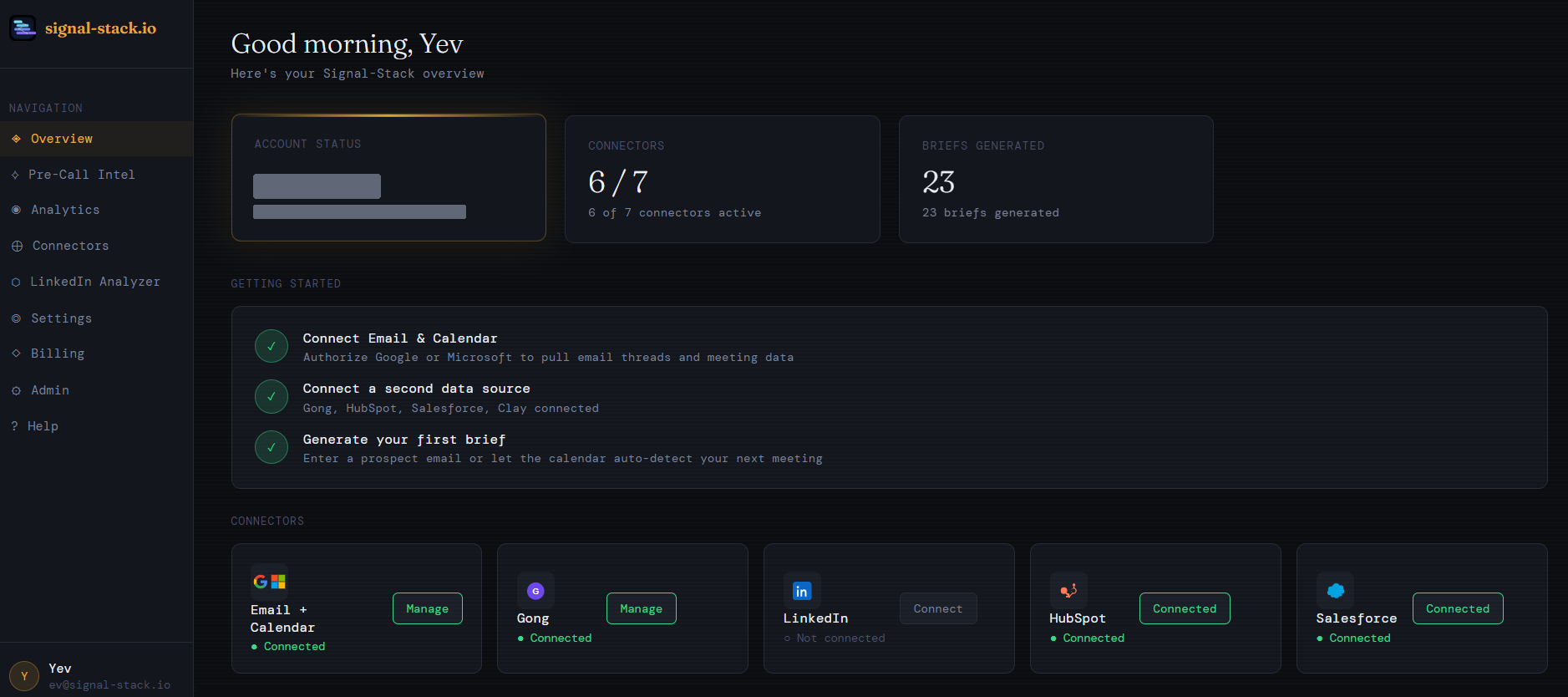
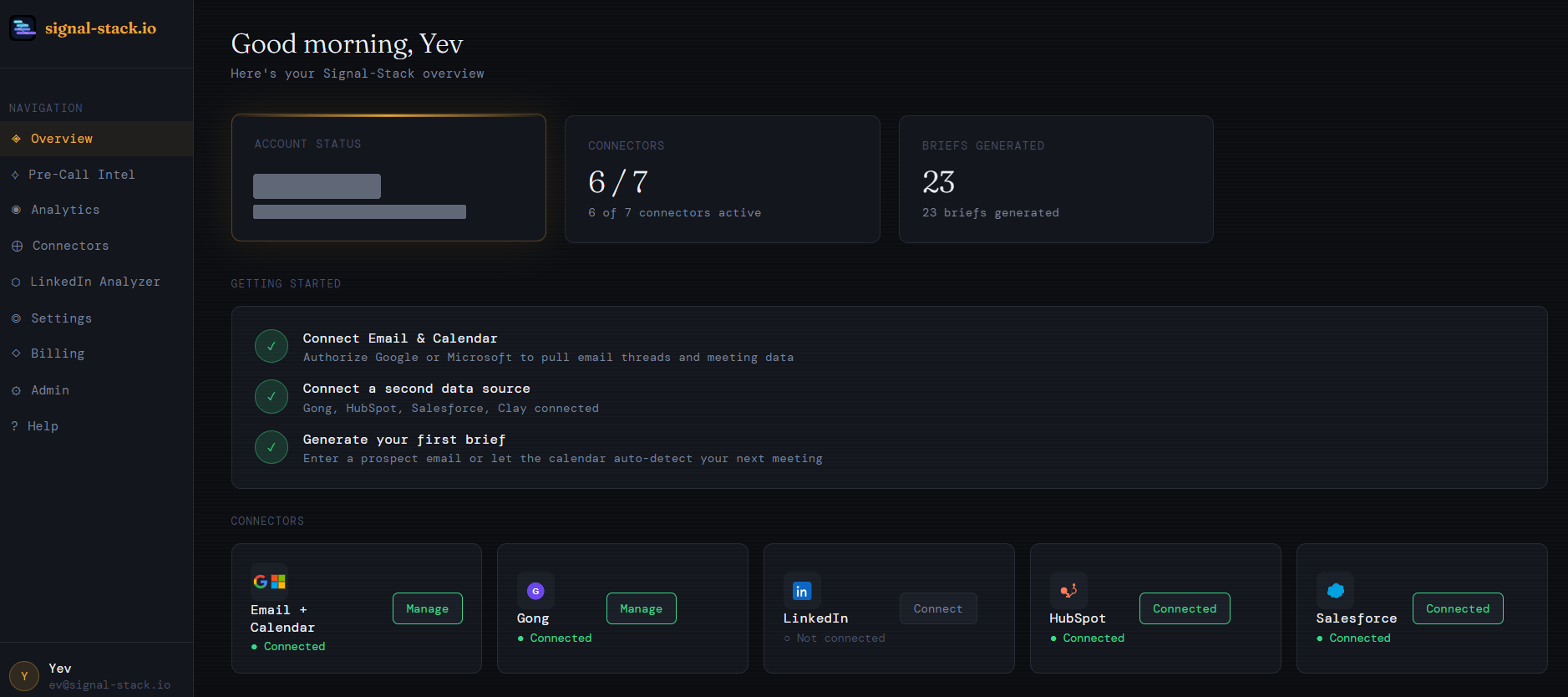
It does this by reading the last 90 days of calls, the last 60 days of email, and any signals available in Salesforce, HubSpot, LinkedIn, and Clay. The synthesis runs through Claude using an org-customizable prompt template, and the resulting brief lands as email or in Slack the morning of every meeting on the calendar.

A brief that reflects the relationship.
Not a CRM summary.

Product thesis

02 Two product lines

Pre-call intelligence.
And a network analyzer.

  • 01

    Pre-call Intelligence

    Calendar → Connectors → Signals → Claude → Brief

    • Cron-driven morning briefs
    • Gong call history (90d)
    • Gmail / Outlook threads (60d)
    • LinkedIn profile signals
    • Salesforce / HubSpot context
    • Meeting-type classification (full / cold / personal)
    • Deal health · stakeholder map · competitive context
    • Predicted next steps
    • Delivered via email or Slack
  • 02

    LinkedIn Network Analyzer

    Exports → Overlaps → ICP match → Shortest warm path

    • Collaborative team workspaces
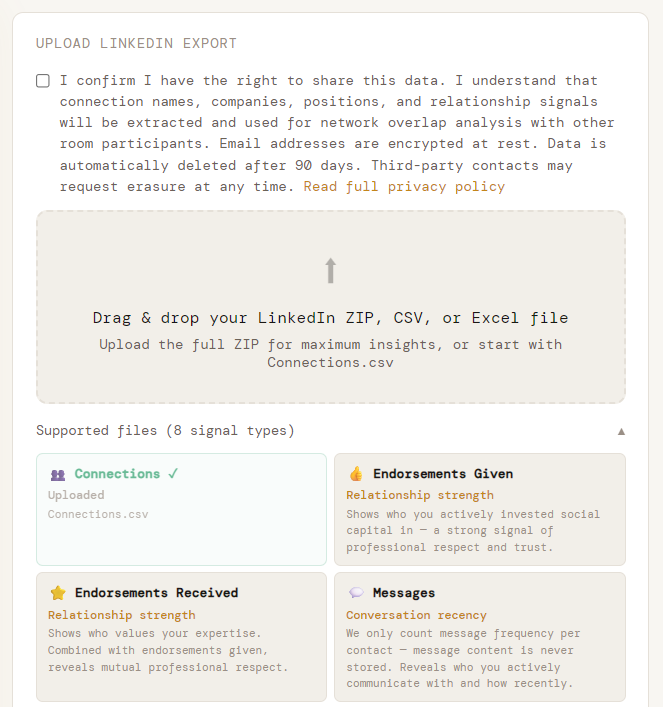
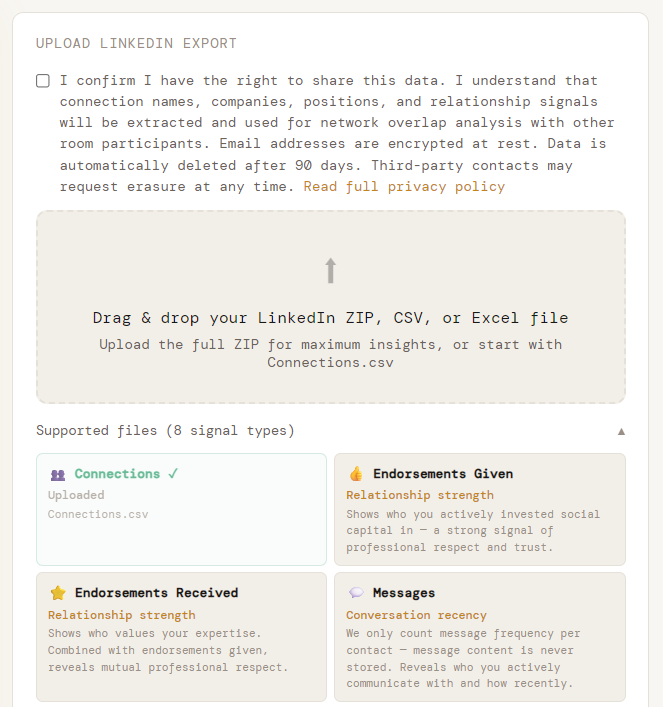
    • LinkedIn connection exports per member
    • Mutual-connection overlap computation
    • ICP-matching contact discovery
    • Shortest-path warm intros to target prospects
    • Account coverage analysis
    • Outreach console with auto-fill templates
    • Saved searches + intro-request flow
Architecture

Four sources.
One pre-call brief.

Four connectors fan in (Gong, Gmail/Outlook, LinkedIn, CRM), get hydrated in parallel, and feed a signal-computation layer that scores deal health, relationship velocity, champion stability, and deal-velocity trend. Claude synthesizes those signals into a structured brief at the org's prompt template.

Signal-Stack — relationship signals to meeting intelligence Morning calendar triggers connector hydration (Gong, Gmail/Outlook, LinkedIn, Salesforce/HubSpot, Clay), which flows into signal computation (deal health, relationship velocity, champion stability, deal velocity trend), then Claude synthesis with org-customizable prompts, then delivery as a pre-call brief to email or Slack. RELATIONSHIP SIGNALS → MEETING INTELLIGENCE CRON · 15m Calendar meetings today HYDRATION Gong calls · 90d Gmail / Outlook threads · 60d LinkedIn profile signals CRM SF · HubSpot Clay enrichment parallel · rate-limited SIGNALS Deal healthRelationship velocityChampion stabilityVelocity trend SYNTHESIS Claude. org template + structured output DELIVERY Email · Slack · brief Morning of every meeting. Edge-native. Org-customizable. Brief that reflects the actual relationship.
03 Stack

Edge-native.
End to end.

Worker Cloudflare Workers · JavaScript · 43 modules
Frontend Next.js static export · Cloudflare Pages
Database D1 (SQLite) · 60 migrations · ~30 tables
Cache KV namespace · 12 h brief TTL
AI Claude API · org-customizable templates
Integrations Gong · Gmail · LinkedIn · Salesforce · HubSpot · Outlook · Clay · Slack
Auth ECDSA-signed session cookies · CSRF · IP-rate-limited
Billing Stripe · three product lines · grace-period recovery
CI / CD GitHub Actions · auto-migrate · smoke-tested
04 Engineering notes

Five decisions
worth flagging.

  1. Edge-first. The entire stack runs on Cloudflare — Workers, Pages, D1, KV. No origin servers, no Docker, no Kubernetes. Cold start measured in single-digit ms.
  2. Encryption at rest. Every connector credential (Gong API key, Salesforce OAuth token, etc.) is AES-GCM encrypted before storing in D1. Decryption is fail-closed.
  3. CASA Tier 2 readiness. Independent peer review by OpenAI, all P0/P1 findings closed, security headers + CSRF + rate limiting throughout.
  4. Brief synthesis pipeline. Six-stage flow — contact classification → Gong hydration → Gmail analysis → parallel enrichment → signal computation → Claude synthesis. Each stage independently testable.
  5. Privacy-by-design. Gmail scope minimized to brief generation only. Restricted-contact list. Erasure log. CCPA + GDPR data-subject request flow.
Why this belongs on No Fluff Advisory

The operator side
of the advisory.

Signal-Stack is where the theses on agentic workflows, edge-native AI products, signal computation, and revenue-team context get tested against real users and real workflow pressure.

  1. 01

    Strategy tested in code.

    The advisory work argues for orchestration, signal computation, and edge-native architecture. Signal-Stack proves those theses against paying customers, not slide decks.

  2. 02

    AI built around workflow.

    Most AI in sales generates more emails. Signal-Stack does the opposite — it classifies, summarizes, scores, and routes inside the workflow the rep already lives in. The brief shows up where the meeting lives.

  3. 03

    Product judgment sharpened by shipping.

    Building exposes the real trade-offs behind the strategy — connector quality, prompt brittleness, latency, error budgets, billing edge cases. Each one sharpens the advisory.

05 Industry context

The operator side
of the advisory.

Signal-Stack is the operator counterpart to the advisory work — the place where the theses on agentic measurement, vector-based audience matching, and edge-native B2B software get tested against paying customers and real data.

It's also the home of the adcp.signal-stack.io subdomain — the production demo of the AdCP Signals Adaptor, a separate open-source reference implementation contributed back to the working group.

Talk shop

Curious about the architecture?
Want a demo?
Building something similar?

Get in touch →