From Meridian to NNN: How Transformers Are Redefining Marketing Mix Modeling
Google's NNN replaces Meridian's fixed Adstock and Hill curves with Transformer self-attention, learning temporal lags, cross-channel synergies, and creative nuance straight from aggregated data rather than assuming them. Early benchmarks show roughly 22% better predictive accuracy on about 5x less data. For advertisers in a post-cookie world, it turns MMM from a backward-looking ROI estimate into a privacy-safe simulator for budget and scenario planning.
In English, please
Companies that spend on TV, digital, and social ads want to know how much sales each channel actually produced -- using aggregate totals like weekly spend and weekly sales, not individual tracking. This is called Marketing Mix Modeling. Google released a tool for it, Meridian, in 2024, then a more advanced successor, NNN, in April 2025, built on the same broad AI techniques that power today's chatbots.
Meridian fed weekly spend numbers into fixed formulas: one assumed an ad's effect always fades at the same steady rate, another assumed a fixed point past which extra spend pays off less. That worked reasonably well, but it treated every campaign as decaying identically and missed cases where one channel's ads boosted another's results.
NNN drops those fixed formulas and lets the model find the real patterns itself. It can weigh any past week individually, rather than assuming everything fades on the same schedule -- so it can notice, for example, that a TV campaign from three months ago is still quietly driving sales today.
It can also track several such patterns side by side -- a digital ad's effect showing up immediately, a TV ad's effect showing up later as people search for the brand -- catching channels that reinforce each other. It also turns descriptive details like an ad's tone into data it can use, telling an emotional ad apart from a comedic one. Early benchmarks found NNN about 22% more accurate at predicting outcomes than the older approach.
A model this flexible would normally need huge amounts of data, but NNN automatically drops input variables that aren't pulling their weight, reportedly needing about five times less data than older models -- useful since these models typically have only a few years of weekly numbers to learn from. It can also be queried: showing which past campaigns still drive today's results, letting a marketer swap in a different ad creative to see which performs better, and running what-if scenarios like doubling digital spend while cutting TV. This aggregate, non-tracking approach also fits where advertising is headed as cookies disappear and privacy rules tighten.
On this page
In the fast-evolving world of digital advertising, understanding the true impact of marketing efforts has never been more critical — or more challenging. Marketing Mix Modeling (MMM) has long been a cornerstone for advertisers seeking to quantify how channels like TV, digital, and social drive sales. In 2024, Google’s Meridian MMM brought Bayesian rigor to traditional regression-based models, offering robust ROI estimates. Now, in April 2025, Google’s NNN (Next-Generation Neural Networks) takes MMM into a new era — leveraging Transformer-based neural networks to deliver unprecedented attribution accuracy and actionable insights. For advertising professionals, NNN signals a transformative shift in how we measure and optimize media in a privacy-first, post-cookie world.
The evolution from Meridian to NNN
Meridian MMM, launched in 2024, was a leap forward for traditional MMM. It used scalar inputs like weekly spend or impressions, applying parametric functions — Adstock for lagged effects and Hill for saturation — to model channel impact. Bayesian Markov Chain Monte Carlo (MCMC) provided confidence intervals, making Meridian a reliable tool for estimating ROI. However, its limitations were clear: it struggled with granular creative nuances, cross-channel synergies, and long-term effects, often assuming uniform decay patterns across campaigns.
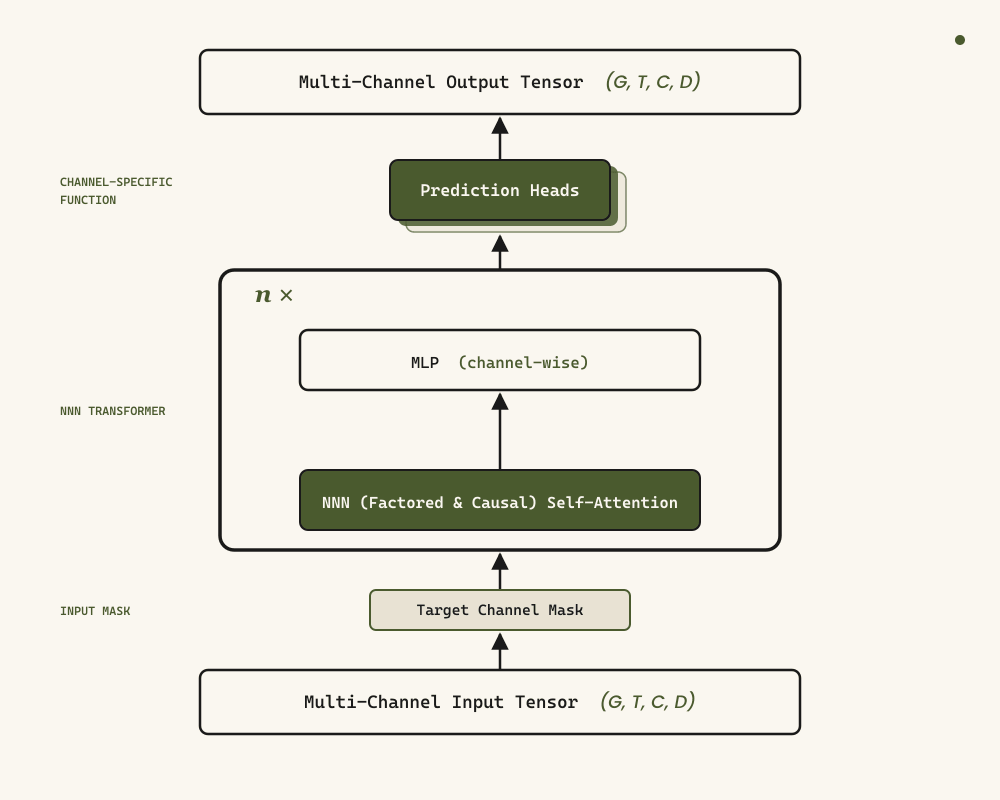
Enter NNN — Google’s Transformer-based MMM model introduced in 2025. Unlike Meridian, NNN uses high-dimensional embeddings to represent marketing activities, blending quantitative data (spend, impressions) with qualitative factors like ad-creative attributes or search-query types. Its Transformer architecture, powered by self-attention and multi-head attention, dynamically learns temporal dependencies and channel interactions, offering a richer, more accurate picture of marketing impact.
Early benchmarks show NNN outperforming traditional MMM by ~22% in predictive accuracy — a game-changer for advertisers seeking precision.
Meridian vs NNN at a glance
| Aspect | Meridian MMM | NNN Neural MMM |
|---|---|---|
| Inputs | Scalar spend / impressions | Embedded qualitative and quantitative inputs |
| Temporal dynamics | Parametric (Adstock) | Learned via self-attention |
| Attribution | Regression coefficients | Non-linear attribution via causal Transformer |
| Handling interactions | Limited (manual terms) | Dynamic via multi-head attention |
| Creative sensitivity | None | Embedded creative impact |
Why Transformers matter for MMM
The power of NNN lies in its Transformer mechanisms, which address longstanding MMM challenges:
- Self-attention for temporal dynamics. Traditional MMM relies on fixed decay curves to model carryover effects. NNN’s self-attention allows it to “attend” to any past time period, learning complex lag patterns — like a TV campaign from three months ago driving today’s sales — without rigid assumptions. This flexibility captures both short-term bursts and long-term brand effects, critical for holistic measurement.
- Multi-head attention for interactions. NNN’s multi-head attention processes multiple influence patterns simultaneously. One head might focus on immediate digital ad impacts, another on TV-driven search uplifts. This enables NNN to quantify synergies — such as social media amplifying display-ad performance — which Meridian often missed.
- Rich embeddings for creative nuance. NNN encodes qualitative factors like ad-creative tone or keyword intent into embeddings. This allows the model to differentiate, say, an emotional video ad from a comedic one, or branded search queries from generic ones. For advertisers, this means granular insights into what drives performance within a channel.
These mechanisms make NNN a dynamic, data-driven tool that captures the complexity of modern marketing ecosystems — from cross-channel customer journeys to creative effectiveness.
Taming complexity with regularization
Deep-learning models like NNN thrive on large datasets, but MMM often works with limited aggregate data — think a few years of weekly sales and media metrics. To prevent overfitting, NNN employs L1 regularization, which prunes less-impactful features, creating a sparser, more generalizable model.
This not only ensures NNN performs well with smaller datasets (reportedly requiring ~5× less data than traditional MMM) but also enhances interpretability by highlighting key drivers. For advertisers, this means reliable insights even for new campaigns or niche markets, without needing years of historical data.
Actionable insights and scenario planning
NNN isn’t just a measurement tool — it’s a marketing simulator that empowers strategic decision-making. Its interpretability features make complex outputs accessible:
- Attention visualization. By analyzing attention weights, marketers can see which past campaigns or channels drive current performance. High attention on last quarter’s TV spend might reveal strong carryover effects, guiding budget allocation.
- Creative-effectiveness analysis. NNN lets you swap creative embeddings while holding spend constant — simulating how different ads impact sales. This helps identify high-performing creatives or keywords without costly A/B tests.
- Scenario simulation. NNN supports “what-if” planning, like projecting sales if digital spend doubles and TV is cut. A “marketing pause” scenario — setting all media to zero — reveals baseline sales and decay rates, showing how long past investments sustain performance. These simulations enable bold, data-driven strategies.
Navigating a privacy-first future
NNN arrives at a pivotal moment. With cookies phasing out and privacy regulations like GDPR and CCPA tightening, user-level tracking is fading. MMM, with its aggregated approach, is regaining prominence as a privacy-safe solution.
NNN enhances this by incorporating first-party data (e.g., CRM segments) via embeddings, blending it with media metrics to deliver granular insights without personal identifiers. This aligns perfectly with the industry’s shift toward holistic, privacy-compliant measurement. Retail media is converging on the same discipline — incrementality as the IAB/MRC retail media guidelines define it is the causal bar MMM outputs increasingly get held to.
Moreover, NNN’s potential for continuous learning — updating with weekly data — could blur the line between periodic MMM projects and real-time optimization. This agility is crucial as marketing cycles accelerate and walled gardens limit cross-channel visibility.
What this means for advertisers
For advertising professionals, NNN is a call to evolve. It offers:
- Holistic optimization. By modeling cross-channel synergies and creative impacts, NNN enables true budget optimization across online and offline media, even in fragmented ecosystems.
- Confidence in experimentation. With accurate attribution, marketers can test new creatives or channel mixes — knowing NNN will capture the effects reliably.
- Collaborative analytics. NNN’s complexity demands teamwork. Data scientists tune the model, while strategists translate outputs into campaigns. This collaboration will define next-gen analytics teams.
The future of marketing measurement
NNN marks a new chapter where AI and marketing science converge. It builds on Meridian’s econometric roots — preserving MMM’s practicality while unlocking deep learning’s flexibility. By capturing long-term effects, creative nuances, and channel interactions within one framework, NNN offers advertisers a clearer, more actionable view of their media mix.
As we navigate a privacy-first landscape, NNN’s ability to deliver precise, interpretable insights from aggregated data positions it as a cornerstone for future measurement. The journey from Meridian to NNN shows that innovation can honor tradition while pushing boundaries — ensuring advertisers can optimize with confidence, no matter how the digital ecosystem evolves.
References
- Google. “NNN: Next-Generation Neural Networks for Marketing Mix Modeling.” April 2025.
- Google. “Meridian: Open Source Marketing Mix Modeling.” 2024.
- Vaswani et al. “Attention Is All You Need.” 2017.
- Digital Advertising Industry Reports. “The Role of MMM in the Post-Cookie World.” 2024.
- Evgeny Popov. “Understanding Regression-Based Attribution (RBA) and Meridian MMM.” Medium, 2024.
- Evgeny Popov. “Revolutionizing AI: How the Transformer Model is Redefining Data Processing.” Medium, 2024.