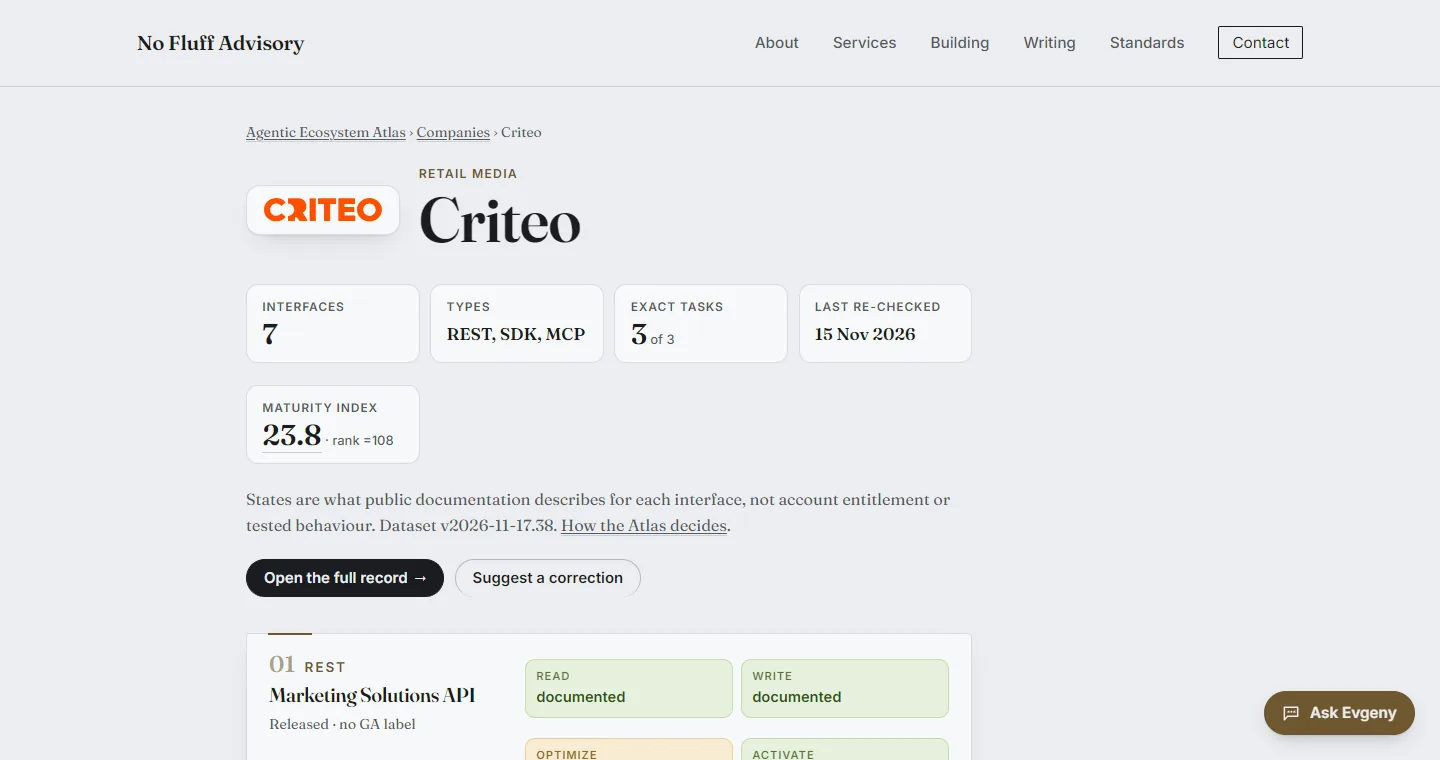
Part 2 of the Agentic Ecosystem Atlas turns the map into an index: every company with an agent interface scored 0 to 100 on what those interfaces document an AI agent can do, rebuilt every week.
Full gist
Almost the whole market is now connected to agents, but most of it still cannot let an agent change a campaign, a budget or an audience, no company documents all three buying tasks through an agent interface, and the companies moving fastest are the ones shipping an agent with write authority attached.
- published
- reading
- 13 min read
- topics
On this page
Part 1 gave ad tech a map: who lets AI agents in, and through which exact interface. Part 2 asks the question every board deck now asks. Who is actually getting there, and how fast? So I turned the Atlas into an index. The answer is uncomfortable for most of the market. Nearly everyone is connected. Very few let an agent do anything that matters.
The short version
The Agentic Maturity Index scores every company in the Atlas that has an agent interface from 0 to 100, on what those interfaces document an AI agent can do. As of 17 November 2026 (dataset v2026-11-17.38, method 1.2.1) the index stands at 35.2 across 160 scored companies, and half of them score 30 or less.
- 160 of the 179 companies in the Atlas have an operational agent interface: an MCP server or an AdCP, AAMP or A2A agent.
- 117 of those 160, 73%, have no task authority through an agent interface. Their agents cannot change a campaign, change a bid or budget, or put an audience live.
- Not one company documents all three of those tasks through an agent interface.
- Seven companies score 80 or more. 112 score below 40.
- Of the 88 agent interfaces with a vendor-dated launch, 73 shipped from April 2026 onward.
Connection was the easy part. Authority is where the market actually stands, and it is thin.
The index in six screens
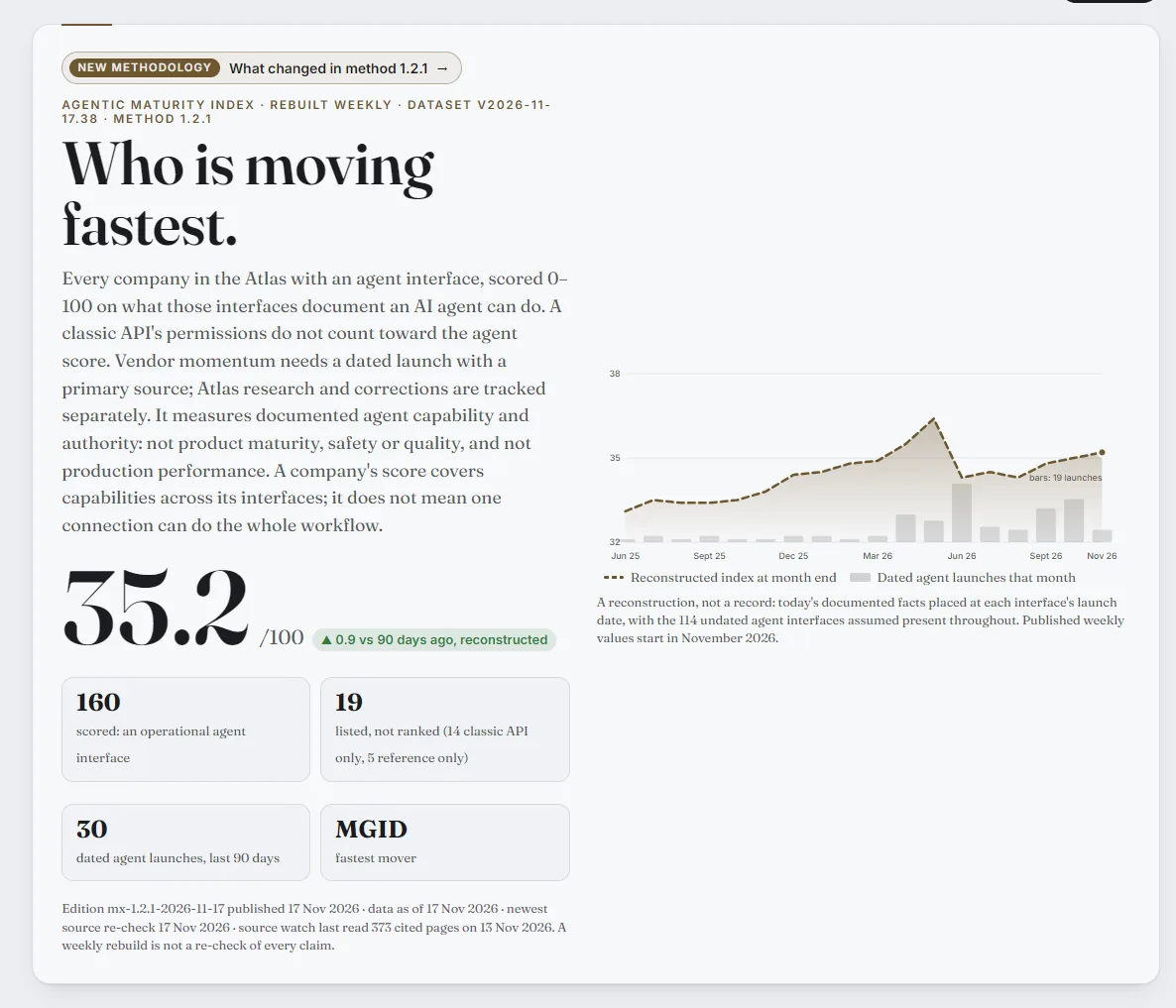
The index. One number for the market, a labelled reconstruction since mid-2025, and the month-by-month launches behind it.
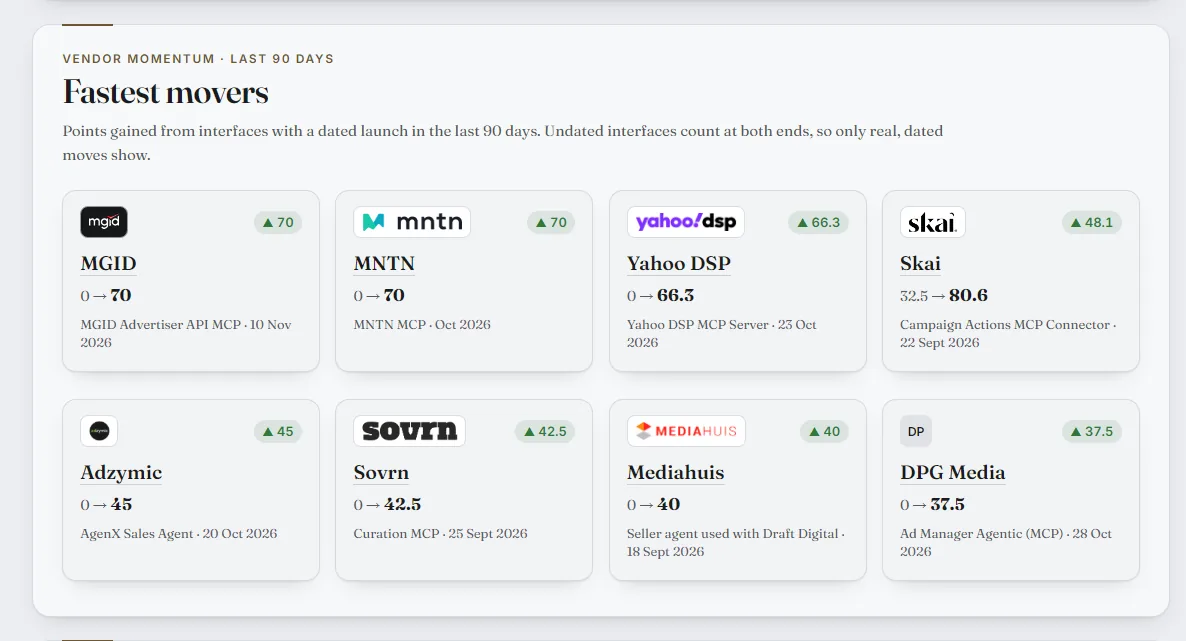
Fastest movers. Points gained from dated launches in the last 90 days, with the launch that caused each move.
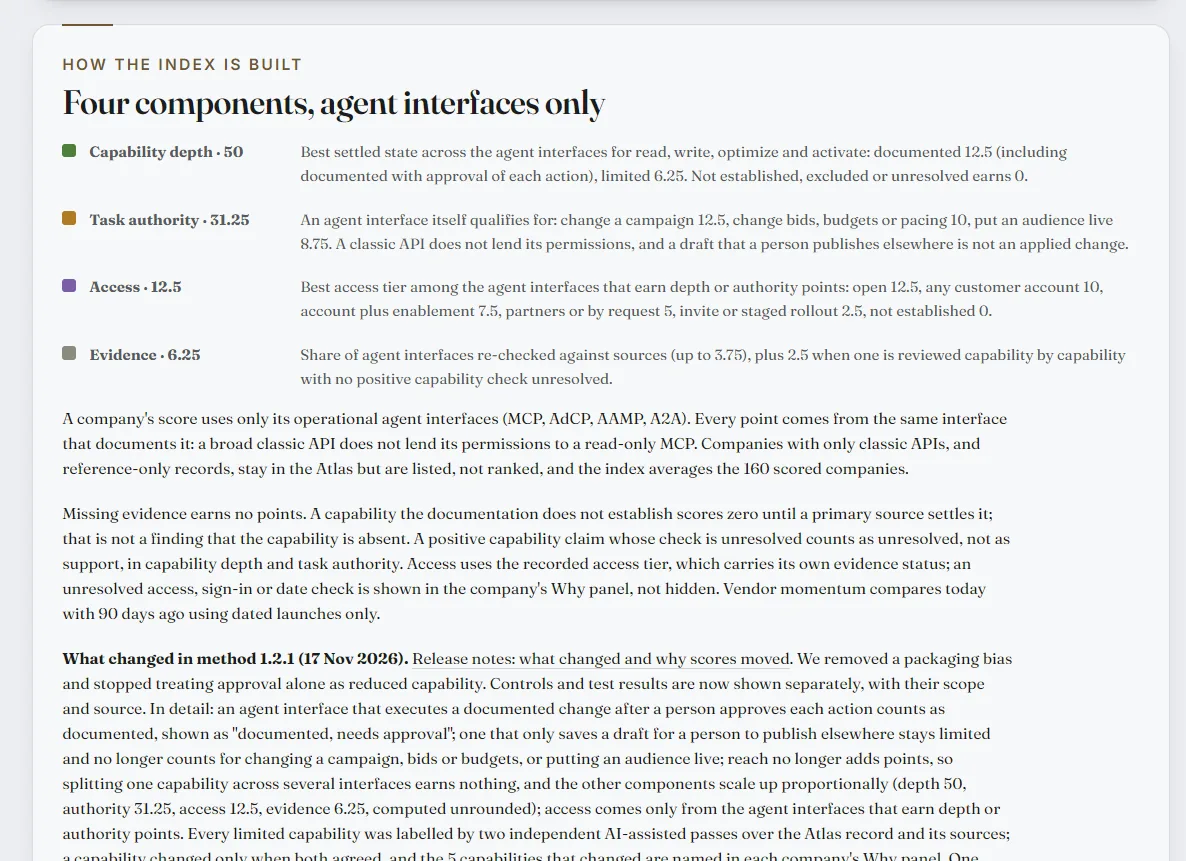
The method. Four scored components, agent interfaces only, published weights and method version.
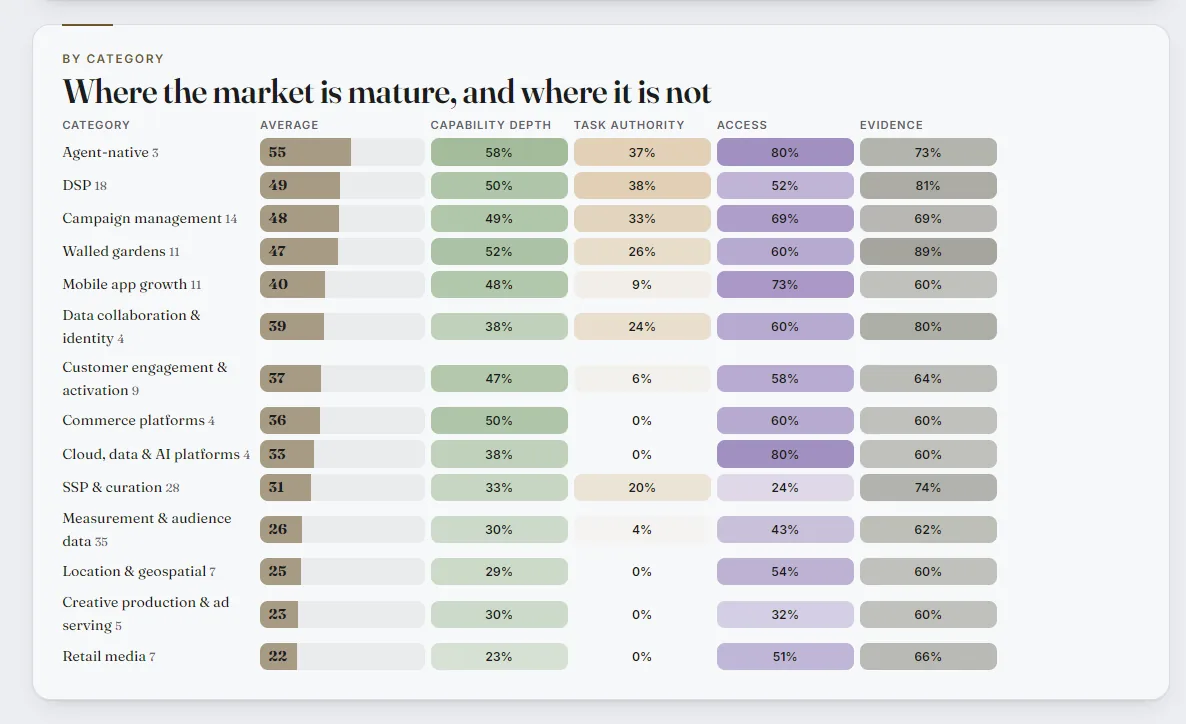
By category. Where maturity is concentrated, and where task authority is almost absent.
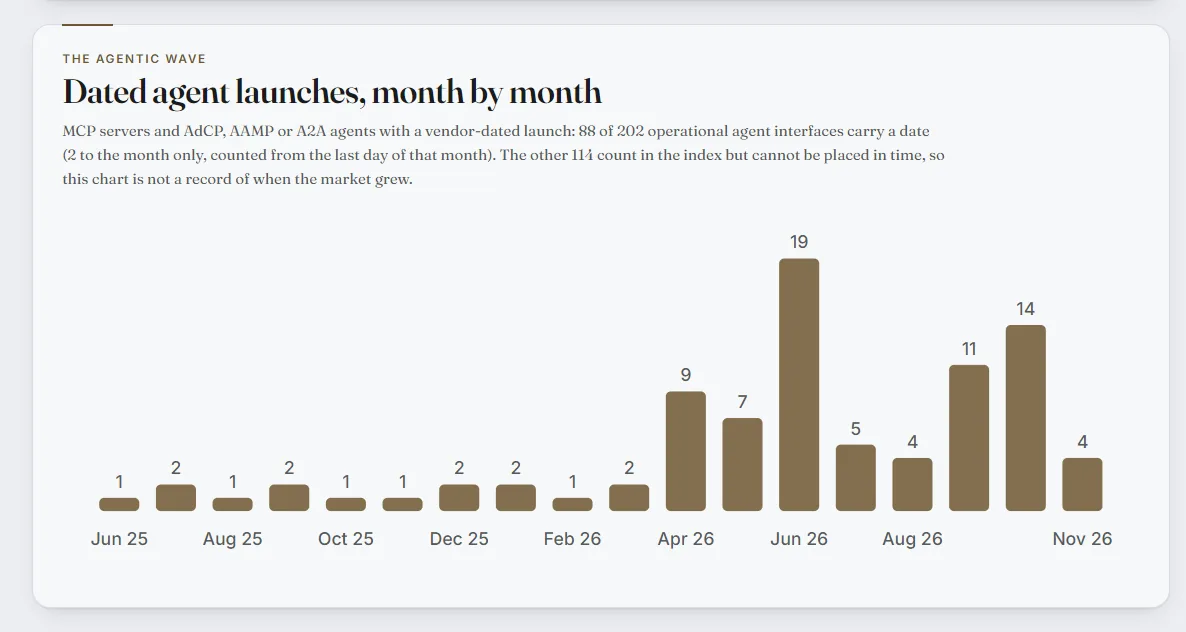
The agentic wave. Dated agent launches by month: a trickle, then April 2026.
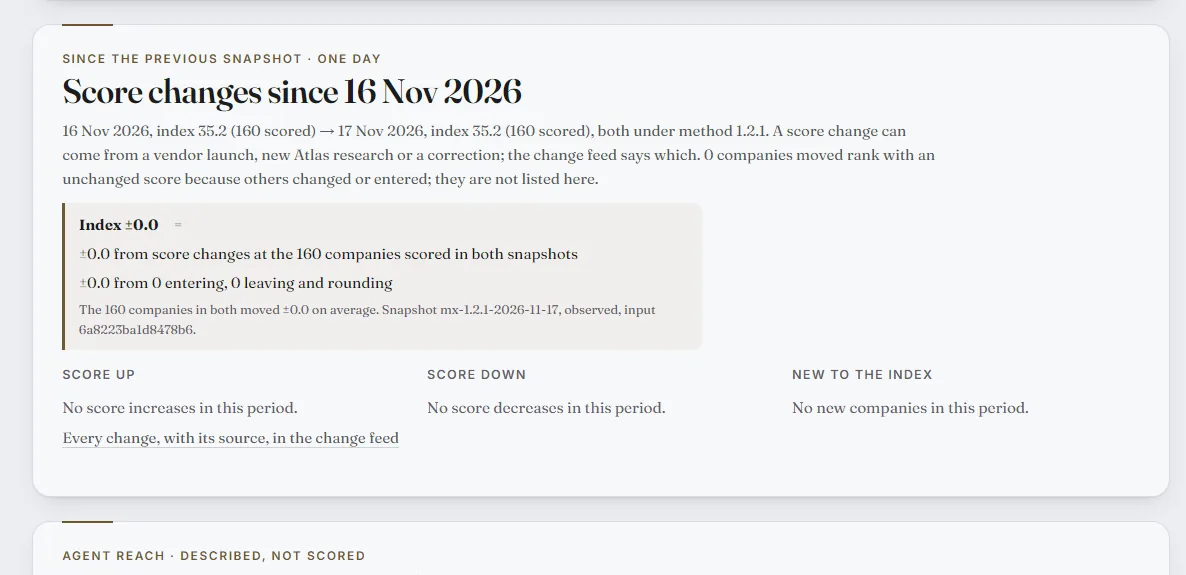
Since the last snapshot. Score changes, kept apart from rank-only moves and from vendor momentum.
Why an index, and why only from documents
Everyone in ad tech now claims to be agentic. Most of those claims are true in the narrowest sense: there is a server an agent can talk to. The interesting question is what the agent can do once it is connected, and that answer lives in vendor documentation, not in launch posts.
So the index scores only what the Atlas already records about each company’s agent interfaces: the documented state of each capability, the tasks those exact interfaces qualify for, who can get access, and how much of the record has been re-checked against sources. No surveys, no analyst opinion, no self-reported maturity. If a vendor’s own pages do not establish it, it earns no points, and the score goes up the day they publish it. Earning no points is not a finding that the capability is absent.
How the score works
Each company gets up to 100 points from four components, all from its operational agent interfaces: MCP servers and AdCP, AAMP or A2A agents.
- Capability depth, 50. The best settled state across those agent interfaces for read, write, optimize and activate. Documented is worth 12.5, limited 6.25. An interface that makes the change once a person approves each action counts as documented: approval is a control, not a missing capability. Not established, excluded or unresolved earns nothing.
- Task authority, 31.25. Whether an agent interface itself qualifies for the three tasks that matter in a buy: changing a campaign (12.5), changing bids, budgets or pacing (10), putting an audience live (8.75). An interface that only saves a draft for a person to publish somewhere else does not qualify. A draft is not an applied change.
- Access, 12.5. The most open access tier among the agent interfaces that earn depth or authority points, from open to “not established”. An open documentation server does not make a gated buying agent look easy to get.
- Evidence, 6.25. How much of the agent record has been re-checked against sources, plus a bonus when one interface was reviewed claim by claim with nothing left unresolved.
Reach, how many agent interfaces a company runs, is described on the page but not scored. Splitting one job across three servers should not earn more than doing it through one. The weights are no longer whole numbers, so scores carry one decimal.
A classic API’s permissions do not count. A company with a broad REST API and a read-only MCP server gets the MCP server’s score, because that is what an agent connecting over MCP can do. Companies with only classic APIs, and records that are documentation or listings only, stay in the Atlas but are listed below the table, not ranked. The index is the plain average of the scored companies.
Method 1.1 was the second edition, published on 15 November. The first edition, published the same morning, let a company’s classic API lend authority to its agent interfaces and counted claims whose sources could not be read. An outside review caught both within hours. I rebuilt the index the same day, restated the earlier snapshots under the new method, and kept the first-edition values in the public history archive. The new method moved the index from 48.6 to 41.2.
Method 1.2.1, from 17 November. Two days later the method changed again. After the index launched, vendors and practitioners pointed at two problems, and both held up against the data. Method 1.1 halved a capability’s points whenever a person had to approve the action, so it punished the vendors with guardrails. And reach paid up to 20 points for running three or more agent interfaces, so a company that split one job across three servers outscored one that did the same job through one. Method 1.2.1 fixes both and tightens two rules. Approval of each action counts as documented. Reach leaves the score, and the other four components scale up by 1.25. A draft that a person has to publish somewhere else no longer counts for the buying tasks. Access comes from the interface that earns the points. The release notes set out each change, why it is more accurate, and which companies moved.
Every figure in this essay is method 1.2.1. The level is lower because a whole component left the score: reach gave every scored company at least 12 points. The same 15 November data that read 41.2 under method 1.1 reads 35.1 under 1.2.1. That is a change of units, not a decline. The weekly series was restated under the new method, and the method 1.1 editions stay unchanged in the history archive.
Movement comes in two kinds, kept apart on purpose. Vendor momentum counts only interfaces with a dated vendor launch inside the last 90 days. Revisions compare published snapshots scored with the same method, and those can also move when the Atlas learns something or corrects itself. The page labels each kind, and every move links back to a record and its sources.
Finding one: connected is not capable
160 of the 179 companies in the Atlas now have an agent interface. That is the headline everybody expected. The one nobody is talking about: 117 of them, 73%, have no task authority through that interface. Their agents can read reports, explain settings and answer questions. They cannot change a campaign, a bid, a budget or an audience. And not a single company documents all three tasks through an agent interface. The best manage two.
Criteo shows the gap in one page. Across its seven interfaces it qualifies for all three tasks. But the authority lives in its Retail Media API, which writes line-item bids, budgets and pacing. Its Commerce Max MCP server is read-only by its own tool reference. So Criteo scores 23.8 on the index. The first edition, which let the classic API lend its authority, had it at 89. An agent that only speaks MCP gets the reading, not the doing. Google Ads and The Trade Desk tell the same story, at 36.3 and 23.8. Reach and authority are different things, and buyers who confuse them will overestimate what they can automate.
Finding two: maturity is concentrated
Agent-native companies average 55, and DSPs, campaign management and walled gardens sit between 47 and 49. DSPs and agent-native companies carry the most agent task authority, a little over a third of the maximum. Then it falls away. Retail media averages 22, creative production 23, location 25, and measurement and audience data 26. Retail media, commerce, cloud, location and creative score no agent task authority at all.
That is not a verdict on those companies. Many of them were never built to change a campaign. It is a map of where an agent can act end to end today, and where a human still has to carry the decision across the gap.
Finding three: the wave started in April 2026
Only 88 of the 202 operational agent interfaces carry a vendor-dated launch, so the timeline is a lower bound. Even so, the shape is clear. From June 2025 through March 2026 the Atlas records 15 dated agent launches. From April 2026 onward it records 73.
The index itself barely moves. Rebuilt from today’s facts at each launch date, it goes from 33.1 in June 2025 to 35.2 today. That is not a market standing still. Every new entrant joins the average, and most first agent interfaces are thin, so newcomers pull the mean down as fast as leaders push it up. That is why the page shows vendor momentum company by company, not just the headline number, and labels the long line as a reconstruction rather than a record.
Who is moving fastest
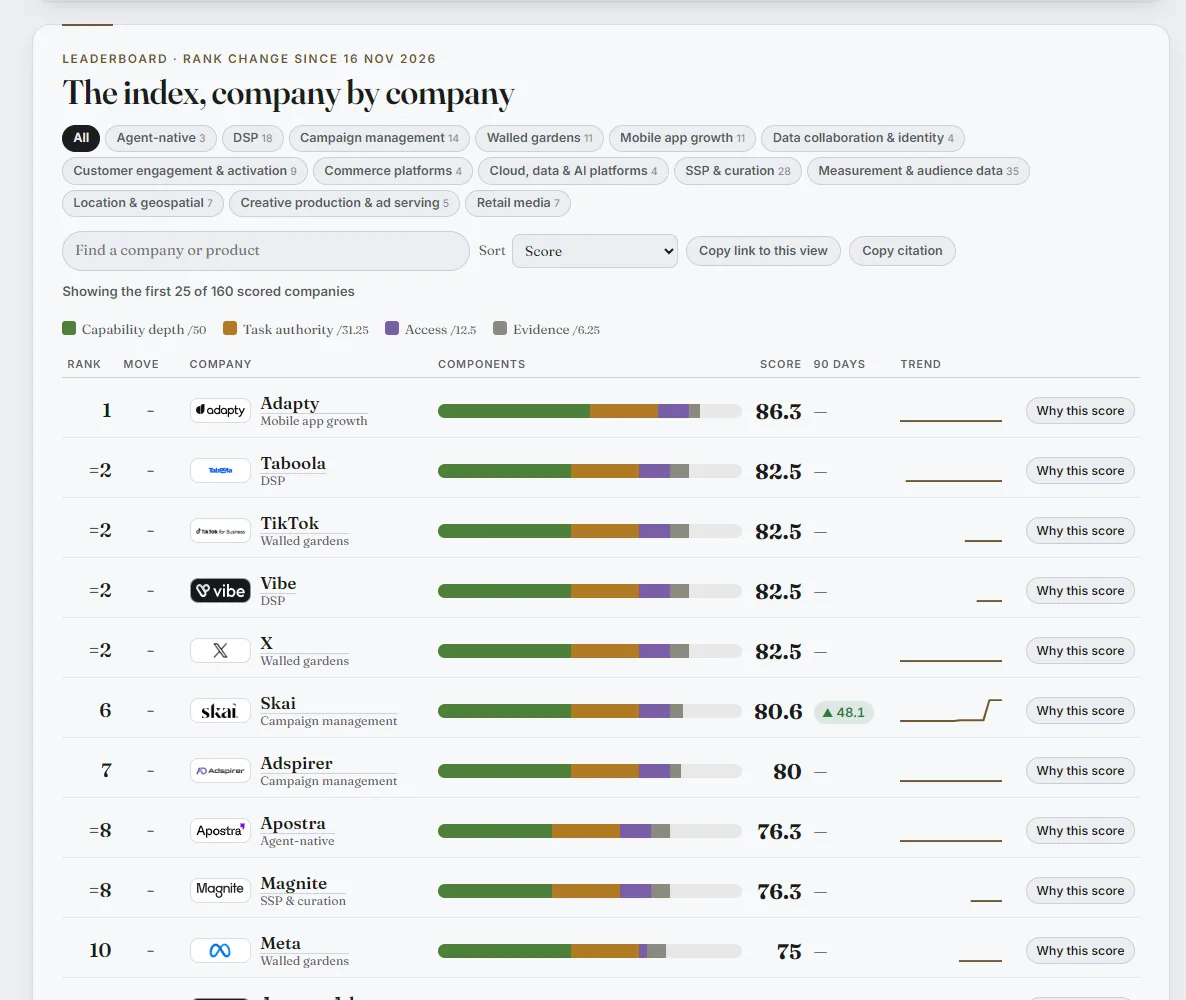
Over the last 90 days, 24 companies gained points from dated launches. The fastest went from no agent interface to the upper half of the table in one release. MGID and MNTN both entered at 70, with MGID’s Advertiser API MCP on 10 November and MNTN’s MCP server in October. Yahoo DSP’s MCP server took it to 66.3. Adzymic entered at 45 with its AgenX sales agent, Sovrn at 42.5 with its Curation MCP, and Mediahuis at 40 with the seller agent it ran with Draft Digital’s buying agent in September. Skai, already in the index, climbed from 32.5 to 80.6, to sixth place, with its Campaign Actions MCP connector.
The pattern is worth noticing. The biggest jumps did not come from incumbents adding a twelfth API. They came from companies shipping an agent interface with write authority attached.
What the index is not
It is a measure of what is documented, not a certification of what works in production. A score of 80 means the public documentation describes broad agent authority. It does not mean the integration is stable, cheap or approved for your account.
It also undercounts movement. Interfaces without a vendor date are counted in every period, so they never show up as momentum. And a weekly revision can come from the Atlas, not the vendor: Madhive’s score rose from 41.3 to 66.3 between the 14 and 15 November snapshots, as restated under method 1.2.1, because its published tools were read claim by claim, not because Madhive shipped anything. The page says which kind of move you are looking at.
How to use it
Open the index before a vendor call and you know where a platform stands against its category. Press Present and the page becomes a slide deck you can run full screen in a meeting, one section per slide. Every company page now shows its score and rank, a sample of the data is open under CC BY 4.0, and the full dataset, with every score, component, 90-day move and weekly snapshot, is shared on request.
The index is rebuilt every Monday, and any change of formula gets a new method version and a restatement, never a silent rewrite, so the trend gets more useful every week. If you think a score is wrong, the fix is the same as in Part 1: show me the primary source, and the record changes, in public, with a date.